AlsyVox Michelangelo Full-Range Ribbon Loudspeaker Review: Ultimate Sound Experience



AlsyVox Michelangelo Full-Range Ribbon Loudspeaker Review: Ultimate Sound Experience
Experience music like never before with the AlsyVox Michelangelo full-range ribbon loudspeaker’s unparalleled realism and dynamic power.
A New Benchmark in Full-Range Ribbon Speakers
When I first fell for the AlsyVox Caravaggio XX full-range ribbon loudspeaker back in the summer of 2024, it was a revelation. This speaker brought music to life with such immediacy and transparency, it felt like the sound was no longer coming from a device but floating freely in the room. It wasn’t just about clarity; it was about coherence, speed, and an expansive soundstage that simply vanished into thin air. While other full-range ribbons had flirted with these qualities before, they often came handicapped by practical challenges, like being hard to drive or lacking in bass depth.
Daniele Coen, the visionary behind AlsyVox, didn’t settle for incremental improvements. He reimagined what a full-range ribbon loudspeaker could be, pushing the technology into a realm previously thought impossible. Take the Caravaggio XX’s jaw-dropping 94 dB sensitivity and bass that reached as low as 22 Hz (later upgraded to 20 Hz). Beyond specs, though, it was the way it captured the soul of music that astonished me. The speaker’s tonal and dynamic coherence created a sense of music existing entirely independent of any mechanical device. No wonder it earned the title of Overall Product of the Year in early 2025.
Introducing the Michelangelo: A Monumental Leap
But AlsyVox didn’t stop at the Caravaggio. Enter the Michelangelo, a true statement piece and a musical powerhouse. Towering at 80 inches tall and 50 inches wide, and tipping the scales at nearly 800 pounds per side (plus external crossovers), this beast demands respect—and space. It’s an investment in every sense, with a price tag over half a million dollars and room requirements that are anything but modest. Yet, when paired with the right environment and top-tier electronics, it delivers a musical experience that’s nothing short of transformative.
Design and Engineering Marvel
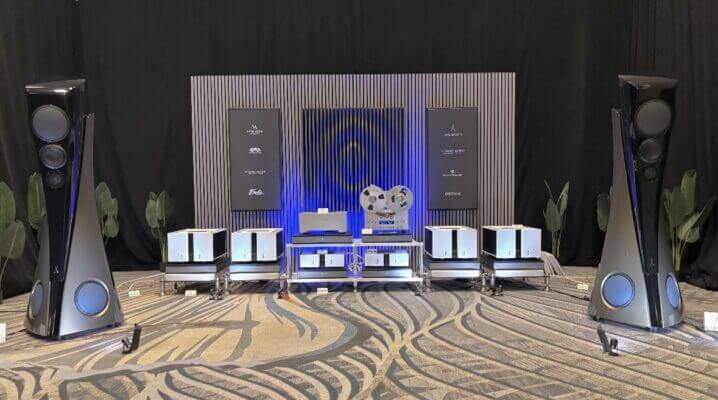
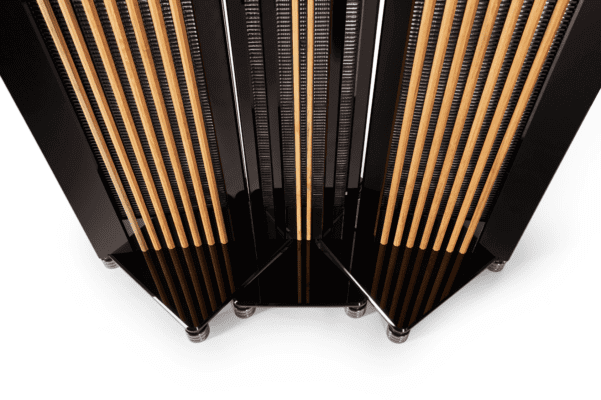
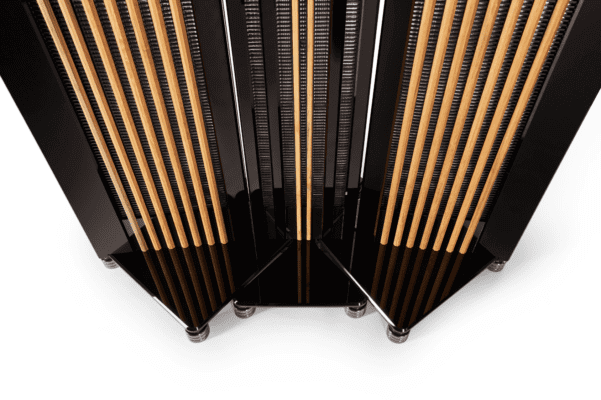
Unlike the Caravaggio’s single-panel design, the Michelangelo is a majestic three-panel four-way dipole loudspeaker. Two massive panels house the planar woofers, while a central third panel nestles the dual-ribbon midrange, dual-ribbon tweeter, and ribbon super-tweeter in perfect symmetrical harmony. Each panel rests on a square base with custom multi-part vibration-absorbing feet, specially crafted by AlsyVox to tame any unwanted vibrations.
Spreading the woofers across two panels doubles the diaphragm surface area, boosting sensitivity to a stunning 97 dB. This translates into not just louder sound but bass that dives deep and hits hard—down to 18 Hz, which is incredible for planar speakers. Each speaker's woofer boasts 26 square feet of diaphragm surface, with the midrange and tweeter drivers adding another 2.7 square feet. The physical design helps cut distortion since each woofer moves half the distance compared to a single one, creating clearer, punchier bass.
The midrange driver is a highlight: two 45mm-wide ribbon transducers wider than those on the Caravaggio. They feature an innovative magnetic setup, with magnets in front, back, and sides, ensuring that the ribbon stays in a uniform magnetic field even during intense movement. This design lowers distortion at high volumes and lets the midrange ribbon play deeper into the lower frequencies—down to 250 Hz, a remarkable feat for ribbons. This improvement means the crossover point between the woofer and midrange has been lowered from 700 Hz on the Caravaggio to 250 Hz on the Michelangelo, broadening the midrange’s territory and resulting in a more cohesive sound.
Moving up the frequency ladder, the tweeter is a dual-diaphragm ribbon, each 25mm wide, covering the range from 1250 Hz to 4800 Hz. Above that is a single 9mm super-tweeter (upgraded from 5mm on the Caravaggio) that handles the highest frequencies with finesse. All crossover slopes are first order (6dB per octave), promoting smooth transitions between drivers.
Visually, the Michelangelo is a showstopper: a massive steel frame clad in sleek black acrylic with tasteful teakwood accents, giving it an elegant yet commanding presence.
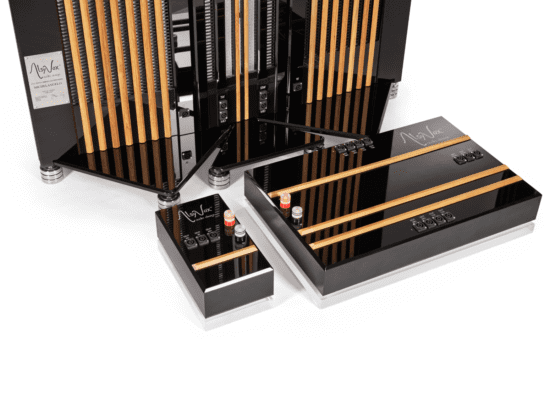
The crossover network is housed externally in two black acrylic boxes. This separation allows large inductors in the low-pass section to be isolated from the rest of the crossover, minimizing magnetic interference. Notably, each driver has three output options—neutral, +1dB, and -1dB—allowing fine-tuning during setup for the perfect tonal balance. The crossover is fully symmetrical, doubling the number of components for superior audio purity, and is built with top-tier parts like Duelund’s Cast Sn/Cu capacitors.
Listening Experience: Redefining Reality in Sound
Setting up the Michelangelo was a significant event. Daniele Coen himself came along, backed by a team of movers, to position these giants in my 18-foot-wide room. Although daunting in size, Daniele was confident the room would accommodate the speakers, and he was right. The speakers were placed just inches from the sidewalls with a strong toe-in aimed directly at the listening position, maximizing image stability. Dipole radiation patterns—shaped like figure-eights—mean that precise positioning is key for the best experience. The speakers stood nearly 11 feet from the rear wall, allowing their sound to breathe fully.
The Michelangelo was first driven by a pair of CH Precision M10 monoblocks power amplifiers but later paired with a Berning/Hi-Fi One Reference SET amplifier—a 20-watt single-ended triode amp that had worked wonders with the Caravaggio. Thanks to the Michelangelo’s even greater sensitivity, this modest wattage produced a sound that was bold and vibrant.
Unlike typical reviews that fit within known sonic criteria like tonal balance or soundstage size, the Michelangelo dismantles the usual framework. It doesn’t just perform better; it changes the very way we listen. The bass is especially mind-blowing, rich and textured with weight and clarity that contradicts the dipole ribbon stereotype. The bass never feels disconnected but blends seamlessly with mids and highs, creating a unified musical narrative.
Rhythmically, the Michelangelo is a marvel. Its precision and energy breathe life into every beat, whether it’s a jazz combo or a rock anthem. The bass articulation reveals the bassist’s every subtle move, deepening the musical conversation.
Thanks to its sheer radiating surface and lightning-fast ribbons, the Michelangelo’s bass possesses an unmatched physicality, making the music feel palpably real. Vocals are rendered with stunning dimensionality and presence, while every instrument shines with tone color and freedom from artificial box coloration. The result? A soundscape that says “music” first, and “hi-fi” nowhere.
Transient coherence is another area where the Michelangelo excels, maintaining uniform speed and precision across all frequencies. Its soundstage envelopes you in a wide, immersive environment, with natural acoustics that make the room itself fade away.
Compared to the Caravaggio XX, the Michelangelo ups the ante with more powerful bass, denser tonal quality, and higher sensitivity—especially advantageous for pairing with low-powered amplifiers.
Conclusion: A Monumental Tribute to Music
The AlsyVox Michelangelo full-range ribbon loudspeaker is not just a speaker; it’s a journey into the heart of music itself. It’s large, demanding, and undeniably expensive—but for those who can embrace these challenges, it promises a musical experience that is simply unmatched. For anyone serious about hearing music at its most lifelike and engaging, the Michelangelo is a dream realized.
Specifications & Pricing
- Type: Full-range four-way ribbon loudspeaker
- Panels: Three per speaker
- Frequency Response: 18 Hz – 40 kHz
- Sensitivity: 96–98 dB (depending on crossover settings)
- Impedance: 4 ohms
- Woofer Size: 320 mm x2
- Midrange Ribbon: 45 mm x2
- Tweeter Ribbon: 25 mm x2
- Super Tweeter Ribbon: 9 mm
- Crossover Frequencies: 250, 1250, 4800 Hz (first-order)
- Dimensions: 50" W x 80" H x 0.213" D
- Weight: 638 lbs each + 154 lbs crossover (net)
- Price: $555,805
Associated Equipment
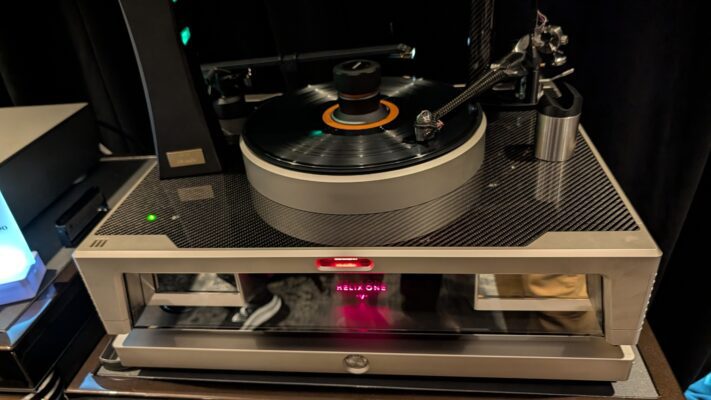
- Analog Source: Basis Audio A.J. Conti Transcendence turntable with SuperArm 12.5 tonearm; Air Tight Opus cartridge; Moon 810LP phonostage; DS Audio ST-50 stylus cleaner, DS Audio ES-001 Eccentricity Detection Stabilizer, Levin record brush, Degritter ultrasonic LP cleaner
- Digital Source: Wadax Reference DAC with Reference DC cables, Reference Server with Reference PSU and Reference DC cables, Wadax Akasa digital interface
- Amplification: Berning/Hi-Fi One Reference SET amplifier; CH Precision L10 Dual Monaural linestage; CH Precision M10 Dual Monaural power amplifiers
- AC Power: Shunyata Everest 8000-X and Shunyata Typhon 2 conditioners, Shunyata Omega-X QR and Sigma-X QR power cords, Shunyata AC outlets, five dedicated 20A lines wired with identical length 10AWG
- Support: Critical Mass Systems Olympus equipment racks and Olympus amplifier stands; Harmonic Resolution VXR equipment rack, Ayra Audio RevOpods isolation
- Cables: AudioQuest Dragon interconnects, AudioQuest Dragon Zero loudspeaker cables
- Grounding: Shunyata Altaira-X grounding system
- Accessories: The Chord Company GroundArray noise reduction
- Acoustics: Acoustic Geometry Pro Room Pack 12, ASC 16″ Round Tube Traps
- Room: Purpose-built; Acoustic Sciences Corporation Iso-Wall System
“The Michelangelo doesn’t just perform better; it changes the very way we listen.” — Reviewer
FAQ
- What makes the Michelangelo different from other full-range ribbon speakers? Its three-panel design with dual woofers, innovative ribbon midrange with added magnets, and ultra-low crossover points deliver unmatched tonal coherence and bass depth.
- How big is the Michelangelo and what room does it require? It stands 80 inches tall and 50 inches wide, weighing about 800 pounds per side. It needs a large room with at least 11 feet of space behind, and careful placement near sidewalls.
- Can it be driven by low-powered amplifiers? Yes! Its remarkable 97 dB sensitivity means it pairs well with even low-wattage single-ended triode amps, making it versatile despite its size.
- What’s special about the crossover design? The fully symmetrical crossover uses premium components and allows precise tonal tuning with neutral, +1dB, and -1dB outputs for each driver.
- Why is the bass so impressive on the Michelangelo? Dual woofers move less distance for the same output, reducing distortion and enhancing dynamic headroom, resulting in bass that is rich, textured, and physically engaging.
If this journey through audio excellence has you inspired, why not bring a piece of that magic home? Shop your favorite album cover poster at our store for a stylish tribute to sound and music. Explore the collection here.
 | DISCOUNTGET 30% OFF*Use code on your next order:
|
* This post may contain affiliate links, meaning we earn a commission if you make a purchase through these links, at no additional cost to you.