Aurender T1000 Network Player Review: Versatile Streaming DAC With Audiophile Roots



Aurender T1000 Network Player Review: Versatile Streaming DAC With Audiophile Roots
Explore the Aurender T1000's high-resolution streaming prowess and versatile DAC features in this detailed review of a standout network player.
A Legacy of Audio Excellence
When Harry Lee launched Aurender T1000 network player in 2010, the mission was clear: to craft top-tier digital audio solutions that marry the precision of traditional audiophile design with modern streaming technology. Aurender, derived from “Audio Renderer,” has since built its reputation on a lineup ranging from ultra-premium models hitting $30,000 down to more approachable yet high-quality components like the $3,850 A1000 network player, which is the star of our story.
Designed and manufactured in South Korea, with some design and marketing efforts based out of California, Aurender’s products cover a spectrum of roles: servers, streamers, DACs, CD rippers, and master clocks. The A1000 stands out as a multi-functional network player/DAC/server in one sleek package. Just plug in an Ethernet cable, connect its analog outputs to your preamp or power amp, and you're ready to dive into rich digital audio. Plus, with both fixed and variable outputs, you can even drive a power amp directly.
Aurender, true to its digital audio streaming specialization, prides itself on delivering an "utterly transparent audio presentation" by blending classic audiophile component principles with cutting-edge digital tech. While Aurender’s ecosystem is optimized for its own hardware and software, I found the A1000 quite at ease navigating the open waters of internet streaming, effortlessly handling 16/44 and high-res files from Qobuz and Tidal using Aurender’s Conductor app. If you’re a Roon fan, the A1000 plays beautifully there too.
Technical Heart and Elegant Design
At its core, the A1000 boasts the AKM 4490REQ Dual-Mono DAC chip, paired with a quad-core 2.0GHz ARM Cortex-A55 CPU handling DSP duties — each powered by separate low-noise linear power supplies to minimize interference. Storage-wise, it offers a 2.5" SSD drive bay ready for you to add your own hard drive (up to 8TB), while a built-in 120GB NVMe SSD serves as a cache for smooth playback but not as primary music storage.
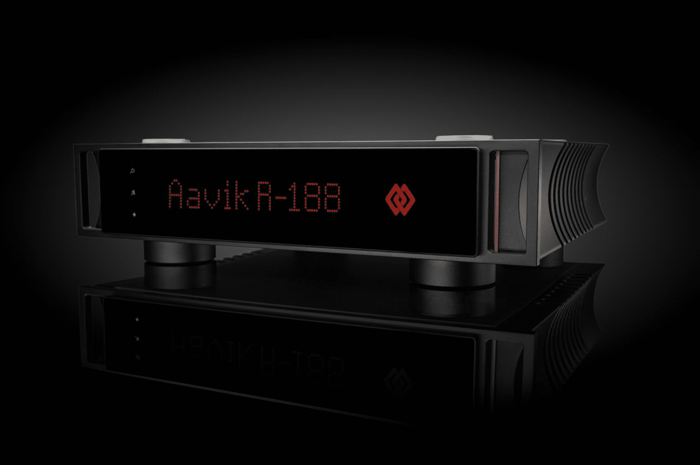
The chassis is elegantly compact — roughly a 14-inch square footprint by 15 inches deep — crafted from matte silver milled aluminum with contrasting black sides. Its 6.9-inch display is large and mostly legible from your listening position, and a remote control comes included, rounding out the package perfectly.
Connectivity and Streaming Options
Once you dive into streaming, the A1000 doesn't disappoint. It supports a wide array of options:
- Roon
- Tidal Connect
- Qobuz Connect
- Spotify Connect
- AirPlay
- Google Cast
- Bluetooth aptX HD
- Aurender’s proprietary Conductor app
While I hit a snag trying to run the Conductor app on a Fire OS tablet (compatibility is limited to Apple and Android devices), switching to my Samsung Android phone worked flawlessly — though the smaller screen wasn't quite as enjoyable as a tablet’s. Both Tidal and Qobuz streamed smoothly.
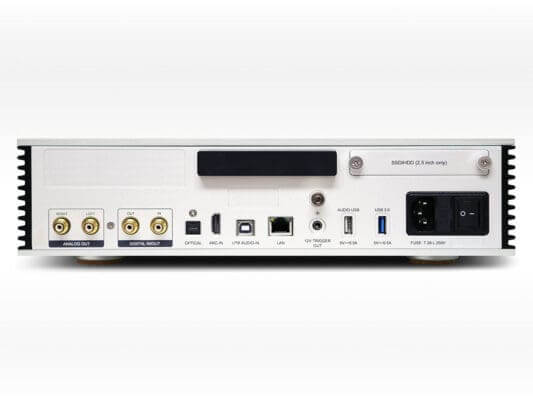
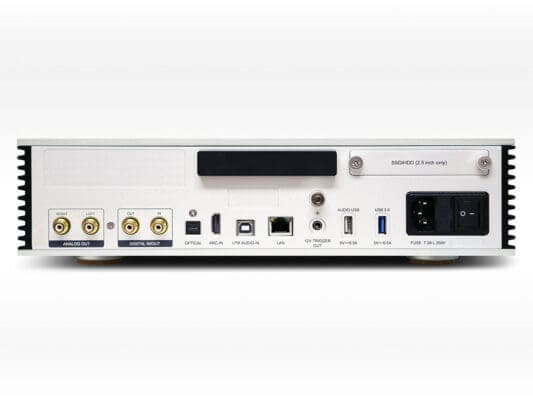
Back panel of the Aurender T1000 showcasing connectivity ports
Inputs mirror what you'd expect from a modern network player: Ethernet, USB media and audio inputs, coaxial and TosLink digital, HDMI ARC, and Bluetooth. Outputs include a 12V trigger, coaxial digital, and single-ended RCA analog jacks. The HDMI ARC port is a nice touch, letting you route TV audio through the A1000’s DAC and out your hi-fi system. Compared to a popular peer like the Cambridge EXN100, the Aurender adds an extra USB audio output and that crucial 2.5" drive bay for expanding local storage.
Getting Into the Groove: Usage and Listening Experience
Setting up the Aurender took a bit more elbow grease than the Cambridge EXN100, but not unreasonably so — after all, the A1000 doubles as a music server or interfaces with one. Your experience depends on how deep you dive into the Conductor app’s rich feature set, perfect for playlist curators. I tend more toward spontaneous listening — picking tracks by mood or letting entire albums spin — and found that approach worked fine too.
Aurender’s North America phone support deserves a shout-out: prompt, knowledgeable, and downright friendly. After struggling with Bluetooth remote connectivity, their online support remotely accessed my unit and fixed the issue quickly. For premium gear, this kind of service comfort is invaluable.
Tinkering with the digital filter settings revealed an audible difference. Switching from short delay/fast roll-off to short delay/slow roll-off yielded a more organic, natural sound—welcome relief from the A1000’s otherwise analytical edge.
Unveiling Audio Nuance
As a long-time fan of Goth and Industrial Dance music — yes, dancing to dark beats is a longtime guilty pleasure — the Aurender’s ability to reveal fine gradations in recording quality stood out. Take “Horses in the Abattoir” by Traitrs (Qobuz 16/44) and the 2022 album “Sympathy Garden” by Forever Grey (Qobuz 16/44). The A1000 laid bare subtle differences in recording clarity, detail, and production that many players gloss over. This isn’t just about good or bad quality; it’s a spectrum of sonic fidelity.
I found my best soundstage came with a fiber-optic connection running from my router to the A1000. Coupled with premium Ethernet cables and an optical module near the player, this setup enhanced clarity and transparency, even though the A1000 caches files internally before playback. DIY enthusiasts can build similar fiber-optic setups affordably, following guidelines like those in “How To Optimize Digital Streaming With Optical Fiber” from previous audiophile references.
Head-to-Head: Aurender vs. Cambridge
Putting the Aurender A1000 against the Cambridge Audio EXN100 was a revealing exercise. While the EXN100 is half the price, its sound quality runs impressively close. On The Police’s classic “Tea in the Sahara” from Synchronicity (Qobuz 16/44), the Aurender exposed more sibilance on vocals, which might annoy some ears, while the Cambridge showed a bit more top octave sparkle. However, Aurender’s bass response was deeper and stronger, and its 3D soundstage had more palpable depth. The A1000 also edged out with a tiny bit more detail, possibly thanks to its more incisive presentation.
On Peter Gabriel’s Passion (Qobuz 24/96), tracks like “Of These, Hope” and “A Different Drum” presented airier reverbs on the Cambridge, but Aurender’s images were more concrete and solid. The A1000 delivered richer midbass, though Cambridge dug deeper in low bass. Instruments seemed to float more realistically in space with Aurender, with better layering and timbre richness, especially in mid-treble, which some might find a tad hot but could easily tame with cable tweaks.
Overall, Aurender’s sound was just a shade better, but the EXN100’s value proposition remains strong for many audiophiles.
Specs & Pricing
- Type: Network player / streaming DAC
- Inputs: Ethernet LAN, Wi-Fi, Bluetooth, SPDIF coax, SPDIF TosLink, TV ARC, Google Cast, Tidal Connect, Spotify Connect, USB 3.0 data
- Outputs: Unbalanced RCA analog, SPDIF coax digital, USB audio
- Onboard library storage: 2.5" SSD drive bay up to 8TB (not included)
- Dimensions: 13.8" x 3.8" x 14"
- Weight: 18.3 lbs
- Price: $3,850
Final Thoughts
The Aurender T1000/A1000 network player is a sophisticated, versatile, and well-designed streaming DAC and server combo that rewards patient setup and exploration. Its transparent sound, robust build, and flexible software ecosystem make it a worthy contender in the audiophile streaming landscape. Whether you’re craving detailed dance beats or immersive spatial soundscapes, this network player offers a compelling blend of performance and polish.
FAQ
- What makes the Aurender A1000 different from other network players?
It combines high-resolution streaming, a top-tier AKM DAC, and storage expandability in one elegant unit, offering both fixed and variable analog outputs. - Can I use the Aurender A1000 with popular streaming services?
Absolutely. It supports Qobuz, Tidal, Spotify Connect, and many others via its Conductor app or directly through Roon. - Does the A1000 include built-in storage?
It has a cache SSD of 120GB and a 2.5" drive bay for adding your own storage up to 8TB. - Is the Conductor app compatible with all devices?
It works on Apple and Android devices; however, it is not compatible with Amazon Fire tablets. - How does the A1000 compare to the Cambridge EXN100?
Aurender offers a slightly more detailed and spacious sound but at roughly twice the price; Cambridge holds strong as a great value alternative.
Elevate your listening space with a stunning album cover poster from our store—perfect to complement your Aurender setup and celebrate the art of music.
 | DISCOUNTGET 30% OFF*Use code on your next order:
|
* This post may contain affiliate links, meaning we earn a commission if you make a purchase through these links, at no additional cost to you.