Milestones: All Eyez On Me — Tupac’s Groundbreaking Album That Changed Hip-Hop


 See more Architeg Prints stories on Google.
Milestones: All Eyez On Me — Tupac’s Groundbreaking Album That Changed Hip-Hop
The album All Eyez On Me redefined hip-hop with its bold creativity, vivid storytelling, and powerful production, sealing 2Pac’s place as a legendary artist.
The Unforgettable Rivalry and 2Pac’s Artistic Depth
When you think of Tupac and Biggie, the iconic East Coast-West Coast rivalry immediately pops into your mind, often described with all kinds of adjectives — foolish, megalomaniacal, and excessive, just to name a few. But that’s just scratching the surface. Behind the media hype and sensationalism lies Tupac Shakur: a complex artist who drew inspiration from the Black Panthers, Shakespeare, religion, and cinema. Too often, these deeper layers were overlooked or misunderstood by journalists who preferred simpler stories. But for those who truly listened, Tupac wasn’t just a rapper; he was a visionary.
And his album All Eyez On Me reflects that vision—ambitious, intense, excessive, and packed with hits. It’s an album that blends party anthems with introspective storytelling, pushing hip-hop into new realms.
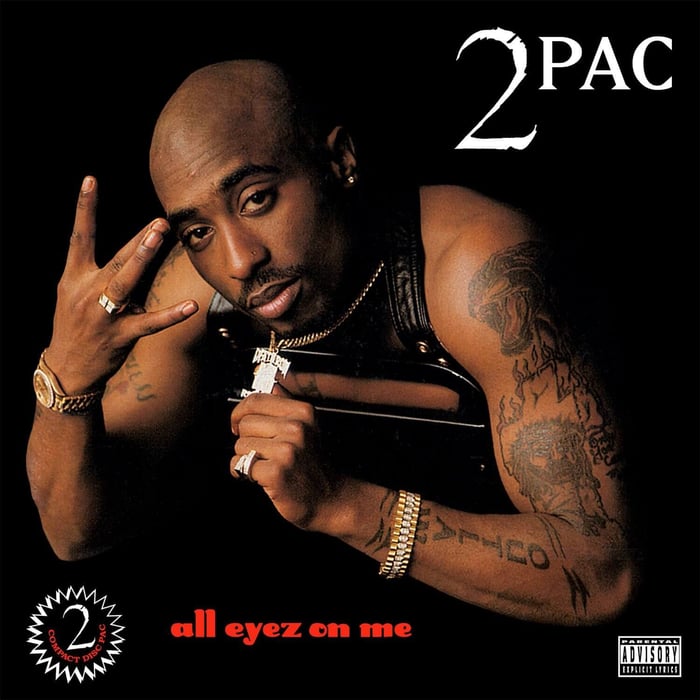
Courtesy of Death Row Records.
2Pac’s Tireless Promotion and Vision
The promotion for All Eyez On Me was nothing short of relentless. Tupac hit the road for concerts in cities like Las Vegas, Cleveland, Hollywood, and New Orleans. He postponed the album’s holiday season release to shoot seven music videos — yes, seven! On top of that, he performed on Saturday Night Live with Ice-T and gave countless interviews, always brimming with energy and his unique philosophy.
In one interview with Angie Martinez, he emphasized the importance of money in hip-hop — not just for personal gain, but as a tool to uplift communities. “Rap should be more focused on money, on crazier music too, but above all on money, because with it we could really do something for our communities, where the artists come from... Let’s start newspapers, build buildings, community centers—but you can’t have any of that without money.”
This mindset shaped the album as much as its tracks.
A Double Album That Broke the Mold
All Eyez On Me wasn’t just another release; it was a watershed moment for hip-hop. This double album spread Tupac’s creativity wide — 27 tracks that oscillated between wild party vibes and raw introspection, told through novelistic storytelling and gritty truths. It shattered conventions, mixing fantastic grooves, hard-hitting production, vibrant choruses, and poetic violence. It was unapologetically loud, brash, and honest.
The era welcomed mainstream rap albums that combined political edge, musical inventiveness, and youthful rebellion. Alongside records like The Score by the Fugees, Reasonable Doubt by JAY-Z, and ATLiens by Outkast, Tupac’s double album pushed hip-hop beyond a simple music genre — it was a full sensory, emotional experience.
Collaborators came from every coast — New Jersey’s Outlawz, New York’s Method Man and Redman, Bay Area’s E-40 and Richie Rich, and West Coast legends like Dr. Dre, Kurupt, Snoop Dogg, and Nate Dogg, proving the album’s ambitious and inclusive vision.
The Creative Freedom at Can-Am Studios
With Death Row's Suge Knight’s backing, Tupac had full creative control and all the studio time he wanted. Can-Am Studios in Tarzana, California, became his creative playground. For the first time, recording costs weren’t a worry, allowing Tupac to pour his entire life and contradictions into this masterpiece.
Yet no matter how expansive the album grew, Tupac’s roots were never far away. Street slang and raw realities kept the album grounded, reflecting the authenticity that made him relevant and thrilling to hip-hop fans everywhere. Every track held its own, and the record didn’t have a single filler song. It was Tupac at the height of his powers, fearless and candid.
The Evolution of Tupac’s Persona
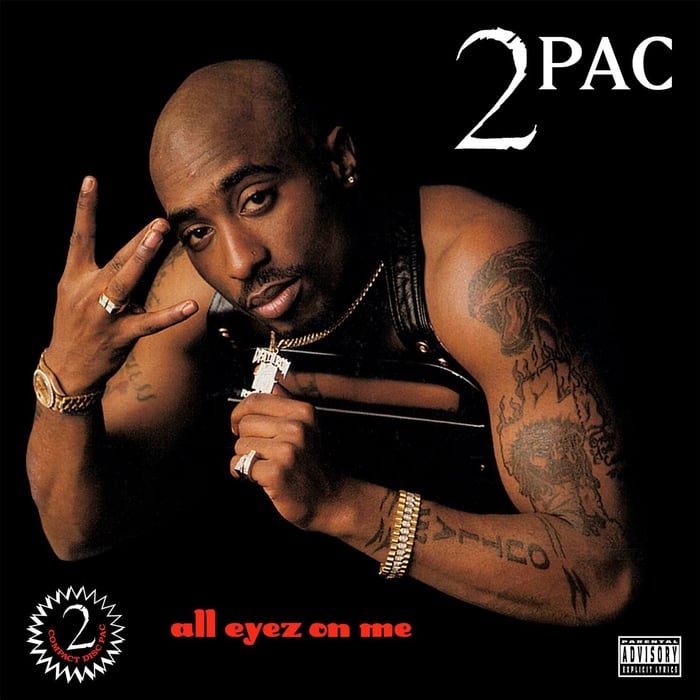
Gone was the somber image from Me Against the World. The All Eyez On Me cover captures Tupac’s transformation: a bold, flashy figure sporting Death Row’s medallion, Rolex, rings, and a black leather vest by Jean-Paul Gaultier showing off his tattoos. His eyes were bloodshot — perhaps from marijuana — and he flashed the “W” sign, marking his allegiance to the West Coast.
This wasn’t just an album cover; it was Tupac’s declaration of dominance and rebirth.
Collaboration and Chemistry: The Magic with Johnny J
One of the unsung heroes behind the album was producer Johnny J. After Tupac’s prison stint, their partnership ignited swiftly. Johnny J’s melodies and Tupac’s lyrics clicked like lightning. The creative process was spontaneous — no re-recordings, no overthinking, just raw emotion captured in one take.
Johnny J recalled, “When the lyrics landed on my compositions, I felt like I was in heaven... Finally, an artist who understands what I’m trying to do with my beats.” Their first collaboration was the title track “All Eyez On Me,” recorded just days after Tupac’s release from prison.
Their synergy was unique — Johnny J could guide Tupac without getting shut down, something few producers managed. This dynamic helped shape the album’s unique sound and rapid pace of production.
An Intense Work Ethic Fueled by Urgency
Tupac’s energy in the studio was electric and urgent. Captured in the documentary Tupac: Resurrection, we glimpse his relentless drive to record quickly — sometimes three tracks a day — and his impatience with studio delays. “We can’t afford to linger on a single track,” he said, emphasizing efficiency.
Between his release and his tragic death in September 1996, Tupac recorded nearly 200 tracks, spending almost all his waking hours in the studio or shooting videos. Friends like Big Syke recalled their daily grind: mornings at the villa, then studio work until late at night, followed by clubbing. It was intense, nonstop, and fueled by the knowledge that time was precious.
Iconic Tracks and Videos That Defined an Era
- “California Love” — Tupac’s first post-prison single, produced with Dr. Dre and featuring Roger Troutman. The track’s infectious groove and catchy hook became an anthem, bolstered by a high-budget, Mad Max-inspired video directed by Hype Williams. It was a cultural juggernaut.
- “2 of Amerikaz Most Wanted” — A raw, defiant duet with Snoop Dogg, referencing their legal troubles and standing as “the two most wanted Americans.” The video’s recreation of a Scarface-inspired showdown remains iconic.
- “How Do U Want It” — Notorious for its explicit video featuring adult film stars, this track combined seductive party vibes with Tupac’s melodic talents. Originally, Tupac sang the hook himself before K-Ci & JoJo’s vocals were added.
- “What’z Ya Phone #” — Featuring Danny Boy, this track captures the hedonistic side of studio life, inspired by real phone calls from admirers. It offers a glimpse into the chaotic, often wild atmosphere of Death Row’s sessions.
Ghost Contributors and the Studio Atmosphere
While the album credits some big names like Dr. Dre, DJ Pooh, and Daz Dillinger, others worked in the shadows. DJ Quik, for example, played a significant role in remixing and shaping several tracks, yet received little formal credit due to Death Row’s messy business dealings.
Quik noted how meticulous Tupac was about his lyrics and how their collaboration on “Heartz of Men” blended fierce beats with rapid-fire flow, creating one of the album’s more experimental tracks.
A Mirror to Society and Tupac’s Activism
Beneath the bravado and party anthems, All Eyez On Me holds a mirror to the harsh realities of urban America in the 1990s: poverty, violence, broken families, and systemic oppression. Tupac never shied away from these themes, balancing street credibility with deep social commentary.
Tracks like “Life Goes On” reveal Tupac’s vulnerability and his nuanced perspective on life, loss, and resilience. Suge Knight himself favored this song, with its poignant lyrics serving as a daily reminder of Tupac’s complex personality.
“Bury me smilin’ with G’s in my pocket / Have a party at my funeral, let every rapper rock it...” — Tupac Shakur, Life Goes On
The Spiritual and Emotional Depth
Tupac’s introspective side shines in songs such as “Only God Can Judge Me,” a spiritual manifesto blending hope, despair, and defiance. This track explores paranoia, betrayal, and the fragility of life, underscored by his own experiences with violence and mistrust.
The album also showcases Tupac’s ability to convey raw emotion without pretension, resonating with listeners who sensed his psychological struggles and humanity beneath the gangsta image.
Lasting Legacy and Timeless Relevance
Upon release, All Eyez On Me exploded commercially and culturally. It debuted at number one and swiftly went platinum, forever changing the landscape of hip-hop. Critics hailed it as an epic, comparing it to Pink Floyd’s The Wall or The Beatles’ White Album in scope and ambition.
More than three decades later, this album remains a towering achievement — eclectic, bold, and unapologetically Tupac. It captures the spirit of 1996 Black music, joining legendary company alongside N.W.A., Marvin Gaye, and Miles Davis.
FAQ
- What made All Eyez On Me unique compared to other rap albums?
Its double-album format allowed Tupac to explore a wide range of themes and styles, blending party tracks with deep introspection, all with a raw emotional edge. - Who were some key collaborators on the album?
Notable collaborators included Dr. Dre, Johnny J, DJ Pooh, Daz Dillinger, Snoop Dogg, Method Man, Redman, and K-Ci & JoJo, among others. - How many tracks did Tupac record for the album?
He recorded nearly 150 tracks during the sessions, with 27 making the final cut on the double album. - What is the significance of the album cover?
The cover marks Tupac’s transformation into a confident, dominant figure, adorned with jewelry and tattoos, signaling his new era at Death Row and West Coast allegiance. - Why was the music video for "How Do U Want It" controversial?
It featured explicit content and adult film actresses, pushing boundaries in hip-hop visuals and reflecting the song’s overt sexual themes.
If All Eyez On Me has you reminiscing or discovering Tupac’s genius anew, why not bring a piece of that legacy home? Shop your favorite album cover posters and celebrate hip-hop history with us here.
 | DISCOUNTGET 30% OFF*Use code on your next order:
|
* This post may contain affiliate links, meaning we earn a commission if you make a purchase through these links, at no additional cost to you.