Theoretica Applied Physics BACCH Stratosonic Surround Renderer: Revolutionizing Immersive Audio with Two Speakers


 See more Architeg Prints stories on Google.
Theoretica Applied Physics BACCH Stratosonic Surround Renderer: Revolutionizing Immersive Audio with Two Speakers
Immerse yourself in spatial audio like never before—BACCH Stratosonic Surround Renderer transforms multichannel sound into a stunning two-speaker experience.
Surround sound has always promised a richer, more enveloping listening experience, yet it’s struggled to break through mainstream adoption. From the early fade of quadraphonic systems to the modest impact of SACD, the dream of immersive audio has been elusive. Even today, formats like Dolby Atmos gain traction but still face challenges with content availability and system complexity. What if you could enjoy natural, high-resolution surround sound with just a pair of stereo speakers? Sounds like a fantasy, right? Enter the BACCH Stratosonic Surround Renderer by Theoretica Applied Physics, a true game-changer in immersive audio technology.
Why Surround Sound Has Struggled and What BACCH Brings to the Table
Surround sound has long been the underdog of audio formats. Quadraphonic sound fizzled out within a decade, and SACD never ignited a mass following. The main hurdles? Expense, aesthetics, and practicality. Setting up two speakers is challenging enough; multiplying that by six or more can feel like a logistical nightmare for everyday living rooms.
Many audiophiles even dismiss multichannel sound as gimmicky, often without truly experiencing its potential. But Theoretica Applied Physics, founded by Princeton professor Edgar Choueiri in 2014, is tackling these obstacles head-on with a clever twist on stereo sound.
The secret sauce is their BACCH (Band-Assembled Crosstalk Cancellation Hierarchy) crosstalk cancellation filter. You see, when listening to stereo speakers, sound from the left speaker reaches the right ear and vice versa—this “crosstalk” blurs the stereo image and reduces spatial clarity. Earlier attempts at crosstalk cancellation date back to the 1960s, but Choueiri’s BACCH filter is a breakthrough by shifting this cancellation from volume-based amplitude control to a more subtle phase-based psychoacoustic method.
This technology dramatically improves spatial effects like proximity and depth, enhancing the perception of sound occupying a three-dimensional space even through just two speakers.
From Stereo to Surround: The Challenge and the Breakthrough
Back in 2022, the BACCH-SP processor was put to the test trying to replicate the immersive surround sound of a favorite SACD—the Poulenc Organ Concerto by Gillian Weir, recorded in a large church. Despite best efforts, the spatial presentation was muddled and confusing.
Fast forward three years later and Theoretica is back with the BACCH Stratosonic Surround Renderer, affectionately called Stratos. But before we dive deeper, let’s clear up what Stratos isn’t: it’s not some cheesy reverb button that slaps a generic “cathedral” or “concert hall” effect onto your music. Those gimmicks applied artificial spatial cues that often annoyed audiophiles and felt inauthentic.
Stratos, on the other hand, uses sophisticated audio processing to take a true multichannel or Atmos mix and emulate it perfectly through just two speakers. Skeptical? You’re not alone. Even longtime fans of BACCH had their doubts until experiencing the tech firsthand, thanks to Choueiri’s insistence on proof over hype.
How Stratos Works Its Magic
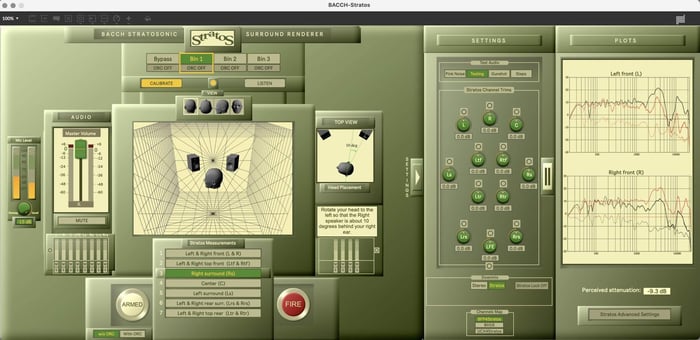
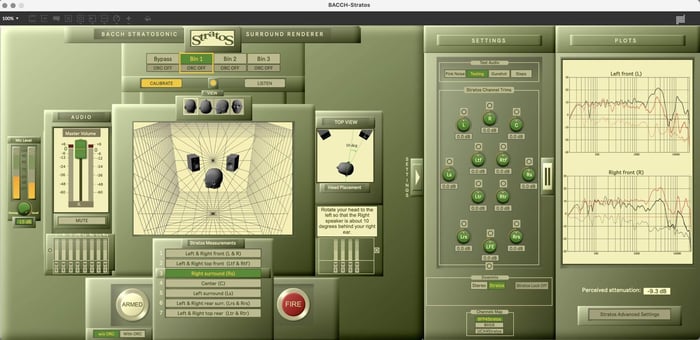
The magic starts with a quick calibration—usually under seven minutes—using Theoretica’s BACCH-BM in-ear microphones. This captures the ‘binaural fingerprint’ of your stereo speakers as heard from your listening spot, creating a Main Speaker Binaural Signature (MSBS). This step tells Stratos exactly how your speakers sound in your specific room and seat.
Then comes the clever part: instead of physically moving speakers, you make small guided head movements to simulate the angles of the standard 12 Atmos speaker layout (front, surround, height channels, etc.). These measurements, called Target Speaker Binaural Signatures (TSBS), act as acoustic blueprints for each surround speaker position.
Stratos then mathematically transforms your two stereo speakers into perfect stand-ins for all those missing speakers by subtracting out the coloration of your main speakers and convoluting the signal to create a virtual surround soundscape.
The result? When playing an Atmos soundtrack, your ears receive the exact same spatial cues as if a full 12-speaker system surrounded you.
Compatibility and Practical Setup
Stratos supports 5.0/5.1 multichannel files from SACDs or online sources, as well as immersive formats like Atmos and Auro3D, playable from Blu-ray rips or downloads in full-resolution MKV formats from services like Immersive Audio Album or labels such as 2L and TRPTK.
It even works with compressed Dolby Digital Plus streams from Apple Music, Tidal, or Amazon, making it versatile for both audiophiles and casual listeners.
Stratos is available as an add-on module to the BACCH4Mac software, costing $3,000 on top of the $4,980 base price for the audiophile version, or $5,980 if you want headphone compatibility as well. Owners of the BACCH-SP hardware will have to wait until 2026 for a Stratos port.
Getting Started: Calibration and User Experience
Installing Stratos involves some initial learning. The user interface is packed with controls, virtual speaker arrays, level meters, and measurement plots. There are two main modes: Calibrate and Listen. The calibration requires you to make seven measurements from your sweet spot, turning your head as guided by on-screen cartoon heads to capture all speaker positions.
It’s best to have a buddy handle the computer while you focus on precise head movements and microphone positioning. Your customized filter is then stored for playback, and even your friends can save theirs in separate slots—like a fine whisky locker for audiophiles.
Listening Impressions: From Roxy Music to Classical Masterpieces
In my own setup—a 15’ x 15’ room with Silent Pound Blooms speakers and an RME BabyFace Pro interface—I tested Stratos against a reference 10-speaker system featuring Magico drivers and high-end amplification.
Two iterations of Stratos revealed clear improvements. For instance, Roxy Music’s 1982 Avalon album, revered for its atmospheric sonics, showed how Stratos v0.9 could envelope vocals and instruments beyond the front plane of speakers, even if it wasn’t a perfect emulation of physical speaker placement.
Classical works like Morten Lindberg’s 2L label recordings showcased how Stratos could recreate circular musician arrangements from a virtual perspective just outside the ensemble—something both musically valid and sonically unique.
After software refinements and using BACCH’s head-tracking feature, the spatial envelopment improved dramatically. James Taylor’s Hourglass demonstrated uncanny room size illusions and precise vocal placement, while the tricky Poulenc Organ Concerto finally achieved believable spatial separation between organ and orchestra.
Does Stratos Change the Game?
While I hesitate to call it a paradigm shift outright, Stratos is undeniably a leap forward. Its ability to deliver immersive audio through just two speakers is groundbreaking, especially as streaming platforms start offering more Atmos content.
Watching Apple TV shows and movies with Stratos active produced audio nearly as effective as typical home theater setups, far surpassing soundbars or tiny speaker arrays. Imagine the possibilities when full-resolution Atmos streams become widespread.
Stratos isn’t perfect yet—it doesn’t fully replicate a physical Atmos speaker array—but it’s tantalizingly close. And knowing Dr. Choueiri’s commitment to ongoing development, this tech will only get better.
“The marvel is not that the bear dances well, but that the bear dances at all.”
—Russian proverb
After 25 years of chasing surround sound perfection, I can say this: BACCH Stratosonic Surround Renderer is one of the most exciting strides I’ve seen. Audiophiles ready to dive into immersive audio with a simpler setup are in for a thrilling ride. The bear is dancing—and pretty well, too.
Specs & Pricing
- BACCH Stratosonic Surround Renderer (software for Mac OS, requires BACCH4Mac)
- $3,000 for Stratos module plus $4,980 base BACCH4Mac package (audiophile version) or $5,980 with headphone support
- Includes remote setup and personalized support
FAQ
- How does BACCH Stratosonic create surround sound from two speakers? It uses crosstalk cancellation combined with binaural measurements and head movement simulations to emulate 12-speaker Atmos setups virtually.
- What formats does Stratos support? It supports 5.0/5.1 multichannel files from SACD or online sources, full-resolution immersive formats like Atmos and Auro3D, plus compressed Dolby Digital Plus streams from services like Apple Music and Tidal.
- Is the setup process complicated? The calibration involves seven guided measurements with in-ear microphones and some user coordination, but Theoretica offers remote help and detailed guidance to streamline it.
- Can Stratos replace a physical Atmos speaker system? Not entirely yet. While it gets very close in spatial performance, it doesn’t fully replicate the physical speaker placement but offers a highly convincing alternative.
- Is Stratos compatible with headphones? Yes, the Audiophile+ version of BACCH4Mac with Stratos supports headphone playback for immersive sound.
For those who appreciate the artistry of album covers as much as the sound, shop your favorite immersive album cover posters at our store and bring the magic of music into your home visually and sonically. Explore our collection here.
 | DISCOUNTGET 30% OFF*Use code on your next order:
|
* This post may contain affiliate links, meaning we earn a commission if you make a purchase through these links, at no additional cost to you.