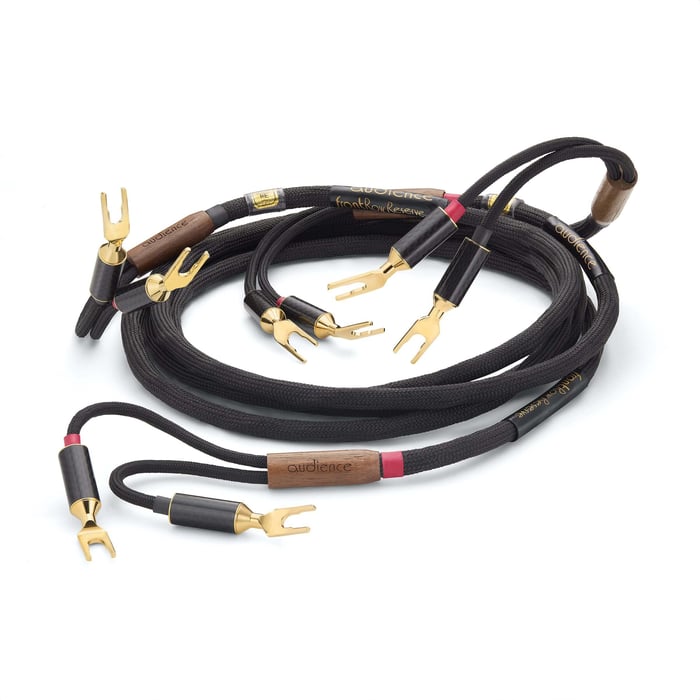
Audience frontRow Reserve Loudspeaker Cable Review: Elevated Sound with Precision and Warmth



Audience frontRow Reserve Loudspeaker Cable Review: Elevated Sound with Precision and Warmth
Experience the detailed and warm soundstage of Audience frontRow Reserve loudspeaker cable, elevating your system with refined imaging and rich tonal balance.
A Longtime Fan’s Love for Audience Cables
If you’ve been around the hi-fi corner like I have, you know the name Audience carries weight in the world of high-end audio cabling. I’ve had the pleasure of dissecting their power cords, entry-level and top-tier cables over the years. Each time, they deliver a consistent, musical, and truthful sound that never fails to impress. My reference system has happily relied on Audience components for some time, so when the frontRow Reserve landed on my doorstep, I was ready to dive in.

Introducing the frontRow Reserve: A Step Above
Audience didn’t just release a new cable; they elevated the frontRow legacy with the Reserve edition. This cable builds upon the original frontRow’s foundation but introduces multiple shielded and isolated silver conductors alongside its 6N OCC copper wire. That’s right—silver meets top-tier copper in this sonic cocktail. On top of that, a fresh compound of natural crystalline minerals joins the mix, designed to dampen pesky electromagnetic and radio frequency interference (EMI/RFI). And lest we forget, a new EMI/RFI damping sleeve completes the package.
Design and Craftsmanship: More Muscle and Mettle
These upgrades mean the frontRow Reserve is physically more substantial—it’s thicker and heavier than its predecessor—yet it remains surprisingly flexible enough to snake through tight system setups. The cable also exudes premium quality not just in sound but in feel; it’s a tactile reminder you’re dealing with something special.
Like the original, the Reserve undergoes Audience’s Extreme High-Voltage Process (EHVP), a method claimed to align the crystalline structure of the conductors for smoother signal flow. Throw in a double-cryogenic treatment and a mandatory three-day burn-in, and you have a cable that’s been meticulously crafted for performance.
The Testing Grounds: My System Setup
To evaluate this cable, I hooked it up to a mix of the new and trusted: Dynaudio Evoke 30 loudspeakers—a bold 2.5-way design that I recently reviewed—and my reliable compact ATC SCM20 speakers. Both were powered by the 150W per channel Aesthetix Mimas integrated amplifier. For sources, I turned to the Lumin S1 media player and dCS Puccini SACD player, with analog duties handled by a SOTA Total Eclipse turntable paired with SME V tonearm, Clearaudio Charisma V2 MM cartridge, and EBI Khumar MC cartridge. This rig provided a robust playground to let the frontRow Reserve strut its stuff.
Listening Impressions: Familiar Warmth with Added Nuance
Having the original frontRow cable by my side during these sessions made comparisons a breeze. As expected, the Reserve retained much of the welcoming, warm tonality that makes Audience’s cables so approachable. This isn’t a cable that pumps up the bass to boomy extremes or pushes treble into harsh territory. Instead, it stays focused on the midrange with a smooth, weighty bass that never feels overblown.
Where the Reserve truly shines is in the realm of low-level detail. This isn’t about clinical or dry detail overload but a subtle unveiling of textures that invites you closer. Take Malcolm Arnold’s “Beckus the Dandiprat,” for example—the delicate and feather-light snare drum roll upstage was recreated with every nuance intact: the stick’s strike, the skin’s response, the rattle of the snares. Similarly, the piano passages revealed the complexity of hammered transients, sustain, and decay with a richness that filled out the notes’ body and timbre beautifully.
Imaging and Percussion: A Percussive Punch with Precision
The Reserve’s prowess in imaging was immediately evident when listening to Harold Faberman’s All Star Percussion Ensemble. Tracks like Pachelbel’s “Canon in D” and Berlioz’s “March to the Scaffold” from Symphony Fantastique burst forth with spirited energy. You could almost feel the pulse from the ten premier orchestral percussionists and their 60 instruments, each strike placed with delightful clarity and exciting transient snap that made the music come alive.
Rock On: Dynamics and Impact That Don’t Hold Back
When it came time to crank up the volume and unleash some rock energy, the frontRow Reserve kept pace. The Police’s “Murder By Numbers” exploded with Stewart Copeland’s crackling snare and lightning-fast rhythmic shifts. The dynamic energy was palpable, the sound crisp and uncompressed. Even the brass in the Manhattan Jazz Quintet’s numbers had a sharper, more driven edge, with Lew Soloff’s trumpet delivering piquant, finely etched transient attacks.
Vocal Nuance: Emotive and Intimate
One of my favorite aspects of this cable is its handling of vocals. Rickie Lee Jones’ fragile, halting delivery in her cover of “I’ll Be Seeing You” was more exposed and touching than ever before. Dianne Reeves’ “One For My Baby” from the Good Night and Good Luck soundtrack painted a vivid picture of a late-night jazz club, complete with a sensuous acoustic bass vamp and Reeves’ velvety, intimate voice.
Backup singers and choral arrangements also gained new depth and positioning, whether it was the layered harmonies in Rutter’s Requiem or Leonard Cohen’s backup vocals in “Going Home” and “Darkness.” Norah Jones’ “Jersey Girl” similarly benefited from this enhanced focus, making previously background voices step forward with surprising physical presence.
I often pondered whether these gains came from the silver conductors or the improved shielding that lowers the noise floor. Whatever the cause, the end result was unmistakably a more refined and tactile sound.
Soundstage and Orchestral Depth: A Hall-Filling Experience
The frontRow Reserve creates a soundstage that isn’t just wide but layered and dimensional. Listening to the finale of Bruch’s Violin Concerto No.1 with Itzhak Perlman, I felt transported into the concert hall itself. The orchestra unfolded in a hemispherical shape, with the music rising gently upstage. The experience was less about sitting front row and more like enjoying the concert from rows F or G—close enough to feel enveloped by the music but with enough distance to appreciate the full scope and flow of the event. It’s a more natural and immersive perspective that’s rare to experience through cables.
Should You Upgrade to frontRow Reserve?
Here’s the thing: the frontRow was already the pinnacle of what Audience offered. Stepping beyond that with Reserve wasn’t a simple task, but Audience pulled it off. This cable is a more finely tuned, sophisticated iteration that justifies its premium price.
Would I rush to swap my current frontRow for Reserve? Not without considering my full system’s needs first. Sometimes the biggest sonic leaps come from other components rather than cables. But if you’re chasing the last ounce of refinement in your setup, the frontRow Reserve deserves a listen. It’s a state-of-the-art cable that brings a new level of musicality and precision.
“Audience frontRow was the best wire the company has ever produced. Moving the needle forward was not an easy task. But that’s exactly what Audience has done with Reserve.” — Reviewer
Specs & Pricing
Audience
120 N. Pacific St., K-9
San Marcos, CA 92069
(800) 565-4390
Price: $7,000 for 2.0 meters
FAQ
- What materials are used in the frontRow Reserve cable?
The cable combines 6N OCC copper wire with multiple shielded and isolated silver conductors, plus a natural crystalline mineral compound for EMI/RFI damping. - How does the frontRow Reserve compare to the original frontRow?
While retaining the warmth and midrange focus of the original, the Reserve offers improved low-level detail, imaging clarity, and a more refined overall soundstage. - Is the frontRow Reserve flexible enough for tight setups?
Despite being thicker and heavier than its predecessor, it remains pliable and easy to manage in cramped spaces. - What system components pair well with this cable?
It excels with high-resolution speakers and amplifiers, as demonstrated with Dynaudio Evoke 30, ATC SCM20, and Aesthetix Mimas integrated amp in testing. - Does the cable improve vocal and orchestral presentations?
Absolutely. It enhances vocal intimacy and separation, while delivering a vivid, dimensional orchestral soundstage.
If you want to celebrate your love for great sound, why not shop our favorite album cover posters at Architeg Prints? It's a perfect way to bring your passion for music into your living space with stylish flair.
 | DISCOUNTGET 30% OFF*Use code on your next order:
|
* This post may contain affiliate links, meaning we earn a commission if you make a purchase through these links, at no additional cost to you.