Goldmund Mimesis Statement Sets a New Standard for Analog Preamps



Goldmund Mimesis Statement Sets a New Standard for Analog Preamps
The Mimesis Statement is Goldmund’s flagship analog preamplifier, pairing three-chassis isolation, ultra-low distortion, and a $240,000 price tag.
A Flagship Built Around Precision
Some hi-fi components quietly join a system. Others arrive like they’ve booked the whole concert hall. Goldmund’s flagship Mimesis Statement belongs firmly in the second category: an analog preamplifier designed around signal purity, physical separation, and engineering pushed to an extraordinary extreme.
The company has launched the Mimesis Statement as a complete rethink of its preamplifier architecture. Rather than simply refining the layout used in earlier generations, Goldmund has rebuilt the design with precision and signal integrity at the center. The goal is straightforward, even if the technology behind it is anything but: preserve the character of a recording while allowing its dynamics, detail, and subtle textures to pass through with as little alteration as possible.
That philosophy will sound familiar to anyone who has spent time chasing the last five percent of a high-end audio system. A small improvement in noise, separation, or control can change the way familiar music feels. Suddenly, a bass line seems more settled, a vocal sounds more naturally placed, and the space around instruments becomes easier to follow. The Mimesis Statement is engineered for that kind of pursuit.
Three Chassis, One Carefully Divided System
The most obvious change begins with the physical layout. The Mimesis Statement uses three separate chassis rather than housing the entire preamplifier in one enclosure.
The central chassis contains the preamplifier electronics. Flanking it are two external power supply units, with one dedicated to the left channel and the other assigned to the right. It’s a deliberately divided approach, separating the delicate audio circuitry from the power supply hardware and isolating the two stereo channels from one another.
That separation matters because a preamplifier must handle small, sensitive audio signals. Any unwanted electrical interaction, vibration, or noise around those signals can potentially affect the final result. By giving each channel its own power supply and keeping the main audio electronics apart from those supplies, Goldmund is creating a more controlled environment for the signal path.
The three-unit arrangement also gives the Mimesis Statement a distinct visual presence. This isn’t a discreet little box destined to disappear on a crowded equipment rack. It’s a component that makes its architecture visible, with the separation of functions becoming part of the design language.
Symmetry Designed to Protect the Stereo Image
Physical separation is only one part of the strategy. Inside the Mimesis Statement, Goldmund uses a fully symmetrical architecture to keep the left and right channels isolated from each other.
In practical terms, the left and right channels are treated as matching, independent paths. This helps prevent one channel from influencing the other and gives the audio circuitry stable, low-noise conditions in which to operate. For listeners, the intended benefit is improved signal integrity and a cleaner presentation of the stereo image.
Stereo separation can be one of those specifications that feels abstract until it becomes audible. When the channels are well controlled, instruments can occupy their own positions more convincingly, while quieter details remain easier to follow. It’s the difference between looking at a sharply focused photograph and one that has just a hint of blur around the edges.
Goldmund’s design places that kind of control at the heart of the Mimesis Statement. The preamplifier isn’t only trying to increase volume or switch between sources. It’s intended to manage the signal with extraordinary care from input to output.
A New Generation of Power Supply Electronics
The power supply design receives its own major overhaul. Goldmund says the Mimesis Statement uses a new generation of power supply electronics based on the company’s discrete regulation principle.
The new arrangement adds further voltage-regulation stages to the design. These additional stages are credited with delivering exceptional noise rejection, helping the preamplifier maintain a cleaner electrical environment while it operates.
This is the sort of behind-the-scenes engineering that rarely makes a casual listening session feel dramatic at first. There’s no flashy feature to tap on a touchscreen, no dramatic lighting effect, and no theatrical startup sequence required. Instead, the power supply is intended to support everything else the Mimesis Statement does by providing stable, carefully regulated power.
That foundation is especially important in a component built around transparency. If the aim is to preserve the original character of a recording, the circuitry needs to avoid adding unwanted noise or instability of its own. Goldmund’s approach is to address that challenge at the power stage, with more regulation and physical separation working together.
A Fresh Audio Board and Refined Volume Control
The rethink continues beyond the power supply. Goldmund has developed a new audio board for the Mimesis Statement, bringing a new internal architecture and a revised approach to volume-control management.
Volume control may seem simple from the outside. Turn a dial, press a button, and the music gets louder or softer. Inside a high-end preamplifier, however, the process is much more demanding. The circuit needs to adjust level while preserving balance, detail, and channel separation across its operating range.
Goldmund’s new volume-control management is intended to refine the way the preamplifier handles that signal. Combined with the redesigned audio board, it gives the Mimesis Statement a fresh internal platform rather than a minor update to an existing layout.
That distinction is important. The company hasn’t presented this model as a cosmetic refresh with a handful of revised components. The Mimesis Statement is built around a new architecture, from its chassis arrangement to its audio board and control systems.
Internal Wiring and Heat Management
Even the details that remain hidden from view have received attention. Goldmund uses proprietary internal wiring throughout the preamplifier, while optimized heat dissipation helps maintain suitable operating conditions for the electronics.
Internal wiring can influence how a component manages interference and how consistently its circuits perform. In a design that places such emphasis on low noise, the connections between sections are naturally part of the larger picture. Goldmund’s proprietary wiring is intended to minimize unwanted interference as signals move through the unit.
Heat management plays a similarly practical role. Electronics perform best when they can operate within stable conditions, and the Mimesis Statement’s thermal design is meant to support that stability. The goal isn’t simply to make the hardware run; it’s to help preserve the carefully controlled environment established by the chassis separation and power supply design.
Taken together, these changes show a familiar high-end audio mindset: every part of the component is treated as part of the signal path, even the parts most listeners will never see.
Published Measurements Tell the Story
The engineering choices are reflected in the published measurements for the Mimesis Statement. Goldmund lists a frequency response of 0.2Hz to 1.5MHz, with a tolerance of ±3dB.
The preamplifier’s total harmonic distortion plus noise is listed at 0.0002% from an unbalanced input to an unbalanced output. Intermodulation distortion plus noise is also given as 0.0006% across the same unbalanced input-to-output path.
Those figures describe a component designed to add as little unwanted material to the signal as possible. Harmonic distortion and intermodulation distortion measure different forms of alteration, but both are relevant when a manufacturer is aiming for transparency and accuracy.
Goldmund also lists a signal-to-noise ratio above 130dB on the line input. With A-weighting applied, that figure rises above 138dB. In plain English, the specifications point toward a very low noise floor, giving the music room to emerge without a prominent electronic hush competing with quieter passages.
These results help explain why Goldmund presents the Mimesis Statement as its most advanced analog preamplifier to date. The published performance supports the broader design brief: preserve dynamics, nuances, and the personality of a recording with minimal interference from the electronics.
Connectivity Adds System Control
The Mimesis Statement isn’t only focused on the internal signal path. Goldmund has also added two Trigger Out connections, each switching between 0V and 12V.
These outputs allow the preamplifier to control the operating state of two compatible power amplifiers at the same time. It’s a practical feature for a system built around separate amplification, allowing compatible equipment to respond as part of a coordinated setup.
In a large, carefully assembled audio system, that kind of control can make daily use feel more seamless. The Mimesis Statement may be an uncompromising piece of hardware, but its connectivity acknowledges that it still needs to work as part of a complete listening system.
A New Look for a Monumental Component
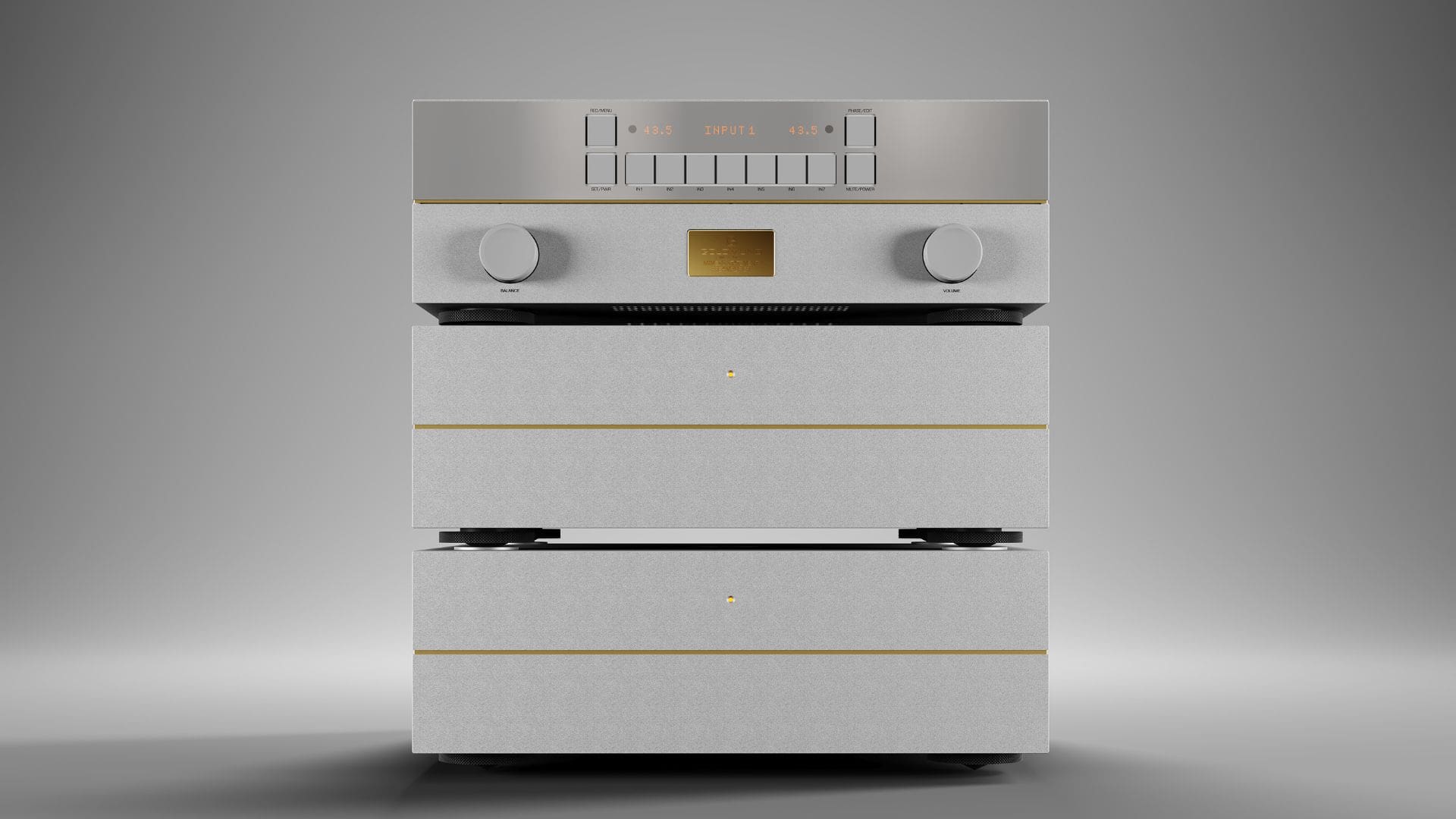
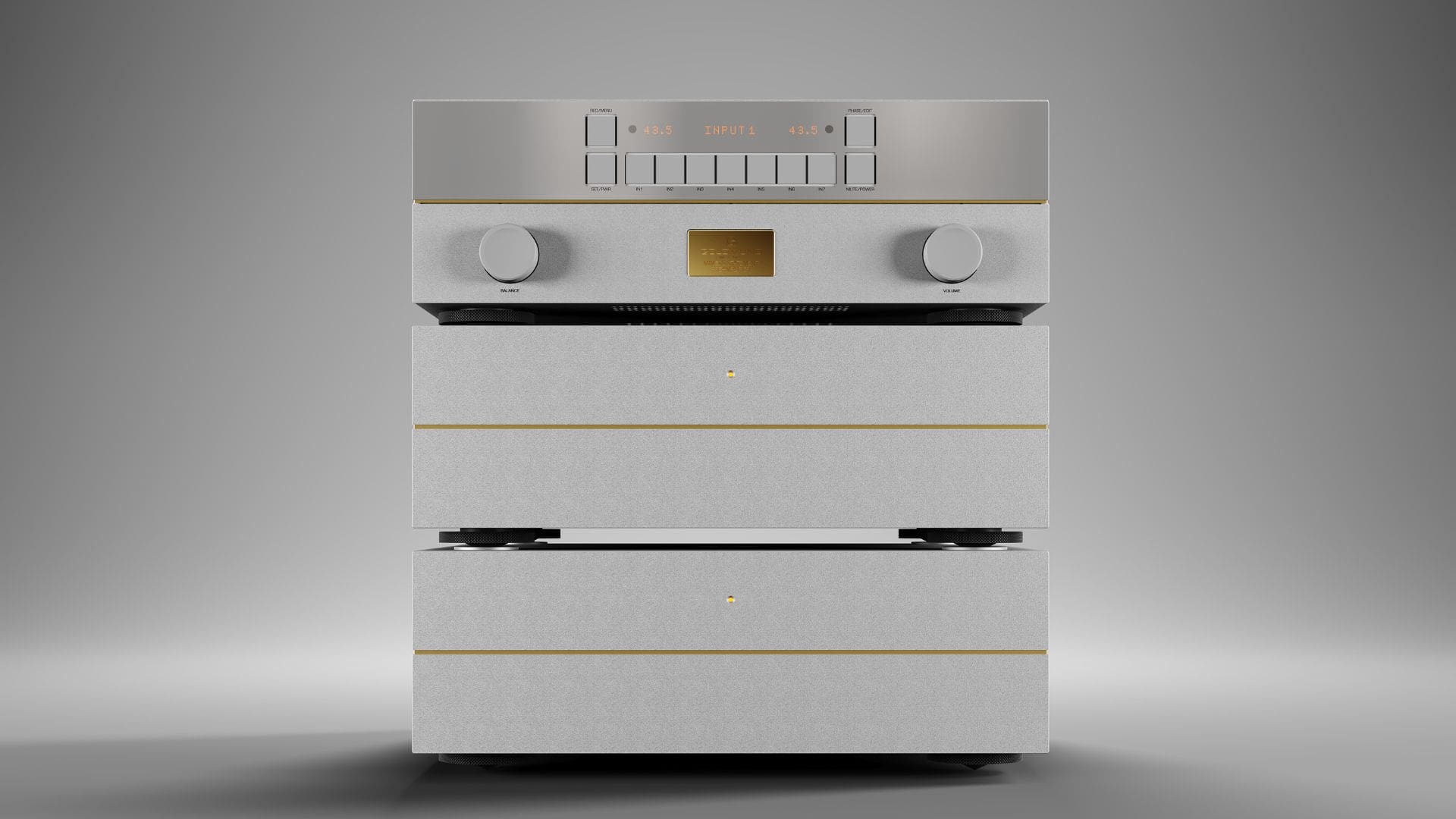
Goldmund has refreshed the exterior design with a new cover-glass display and metal-coated controls on the front panel. These details give the Mimesis Statement a more contemporary face while keeping the presentation focused and purposeful.
A fine recessed gold line runs across all three chassis, visually linking the units despite their separate functions. It’s a small but effective design gesture. The chassis are divided because the engineering requires it, yet the gold line reminds you that they remain one unified preamplifier system.
That balance between separation and cohesion is central to the Mimesis Statement’s identity. The three boxes don’t look like unrelated pieces stacked together. They read as parts of a single machine—one that simply happens to reveal its internal logic from the outside.
A Price for the Extreme End of Hi-Fi
The Mimesis Statement sits at the very top of the high-end audio market, and its price makes that clear. Goldmund lists the preamplifier at $240,000 / £182,000.
That is, without question, a stratospheric figure. For most music lovers, it places the Mimesis Statement firmly in the realm of aspirational hi-fi rather than an everyday upgrade. Still, flagship components often function as statements of engineering ambition as much as practical products, and Goldmund has named this one accordingly.
The Mimesis Statement is built around a very specific idea: that a preamplifier should interfere as little as possible with the music passing through it. Its three-chassis design, symmetrical layout, advanced regulation, redesigned audio board, refined volume control, and extremely low published distortion figures all support that pursuit.
The Goldmund Mimesis Statement takes the humble preamplifier and treats it like the control room of a concert hall—isolated, meticulously regulated, and engineered down to the smallest connection. Would a component this extreme change the way you hear your favorite records, or is the real magic still in the music itself?
FAQ
- What is the Goldmund Mimesis Statement?
The Mimesis Statement is Goldmund’s flagship analog preamplifier, designed to prioritize signal integrity, low noise, channel separation, and transparent musical reproduction. - Why does the Mimesis Statement use three chassis?
One chassis houses the preamplifier electronics, while two external power supply units serve the left and right channels separately. This layout is intended to reduce interference and provide stable operating conditions. - What are the Mimesis Statement’s published distortion figures?
Goldmund lists THD+N at 0.0002% and IMD+N at 0.0006% for an unbalanced input-to-unbalanced output connection. - What connectivity feature has Goldmund added?
The preamplifier includes two Trigger Out connections that switch between 0V and 12V, allowing it to control two compatible power amplifiers. - How much does the Goldmund Mimesis Statement cost?
The listed price is $240,000 / £182,000, placing it at the extreme flagship end of the analog hi-fi market.
If the Mimesis Statement’s sculptural design and love of classic audio engineering speak to you, take a look at the favorite album cover posters available at Architeg Prints. They’re a warm, visual way to bring music’s character into your space.
 | DISCOUNTGET 30% OFF*Use code on your next order:
|
* This post may contain affiliate links, meaning we earn a commission if you make a purchase through these links, at no additional cost to you.