Porcelain Pioneer DJ Setup Blends Korean Art With Club Culture



Porcelain Pioneer DJ Setup Blends Korean Art With Club Culture
Porcelain Pioneer DJ setup turns familiar club hardware into a museum-worthy vision inspired by Korean folk art, royal symbolism, and luxury design.
A DJ Booth With Museum-Level Drama
Some DJ equipment is built to disappear into the booth. This porcelain Pioneer DJ setup does the exact opposite. It demands a spotlight, a velvet rope, and perhaps a polite museum guard reminding visitors not to touch the jog wheels.
David Guetta recently claimed DJ Mag’s Top 100 DJs poll for a record sixth time, and that immediately raises an amusing question: what kind of trophy-shelf object suits a superstar who spends his time headlining major clubs and Ibiza residencies? The answer, apparently, is a complete DJ rig transformed into Korean blue-and-white porcelain.
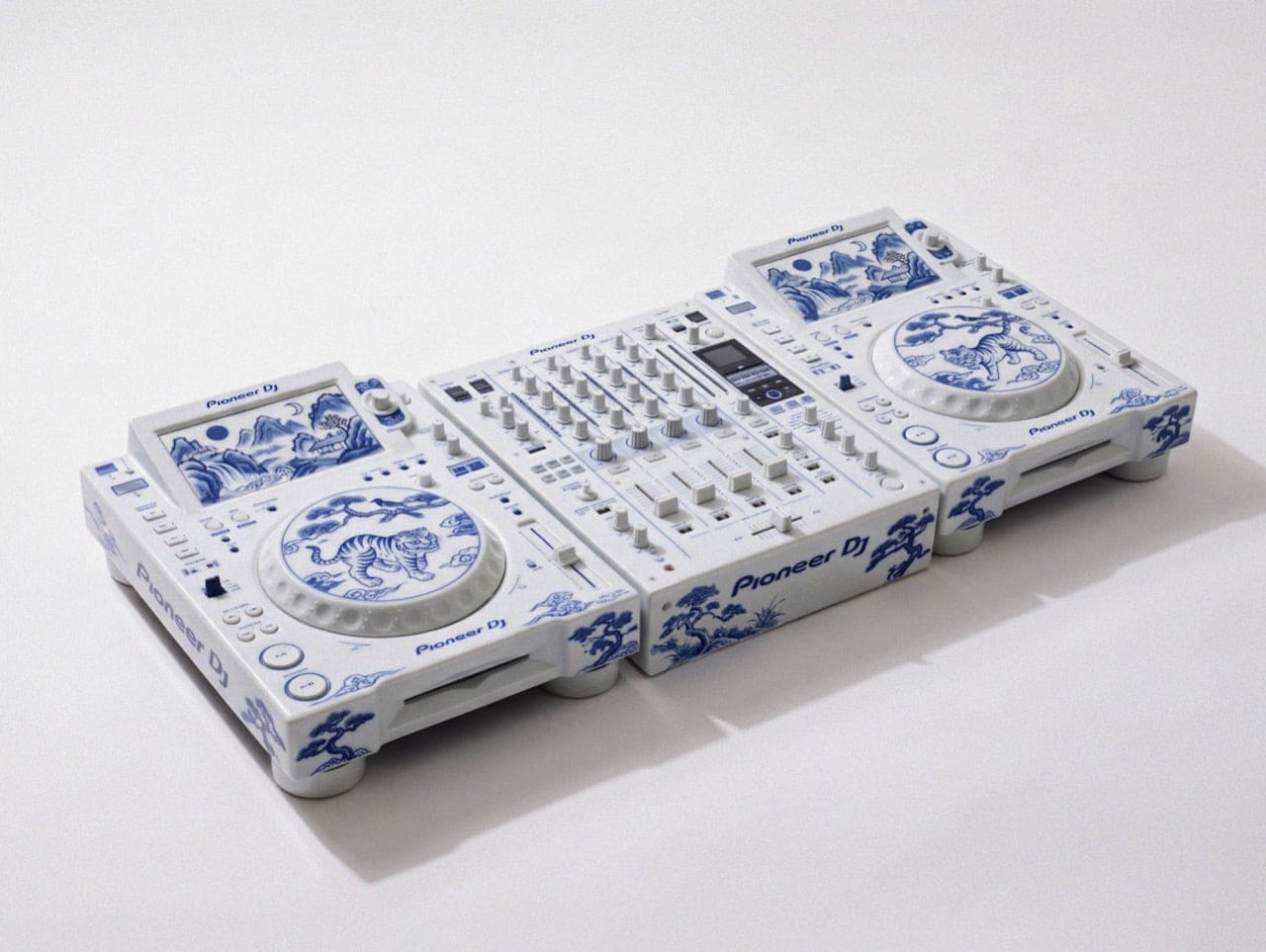
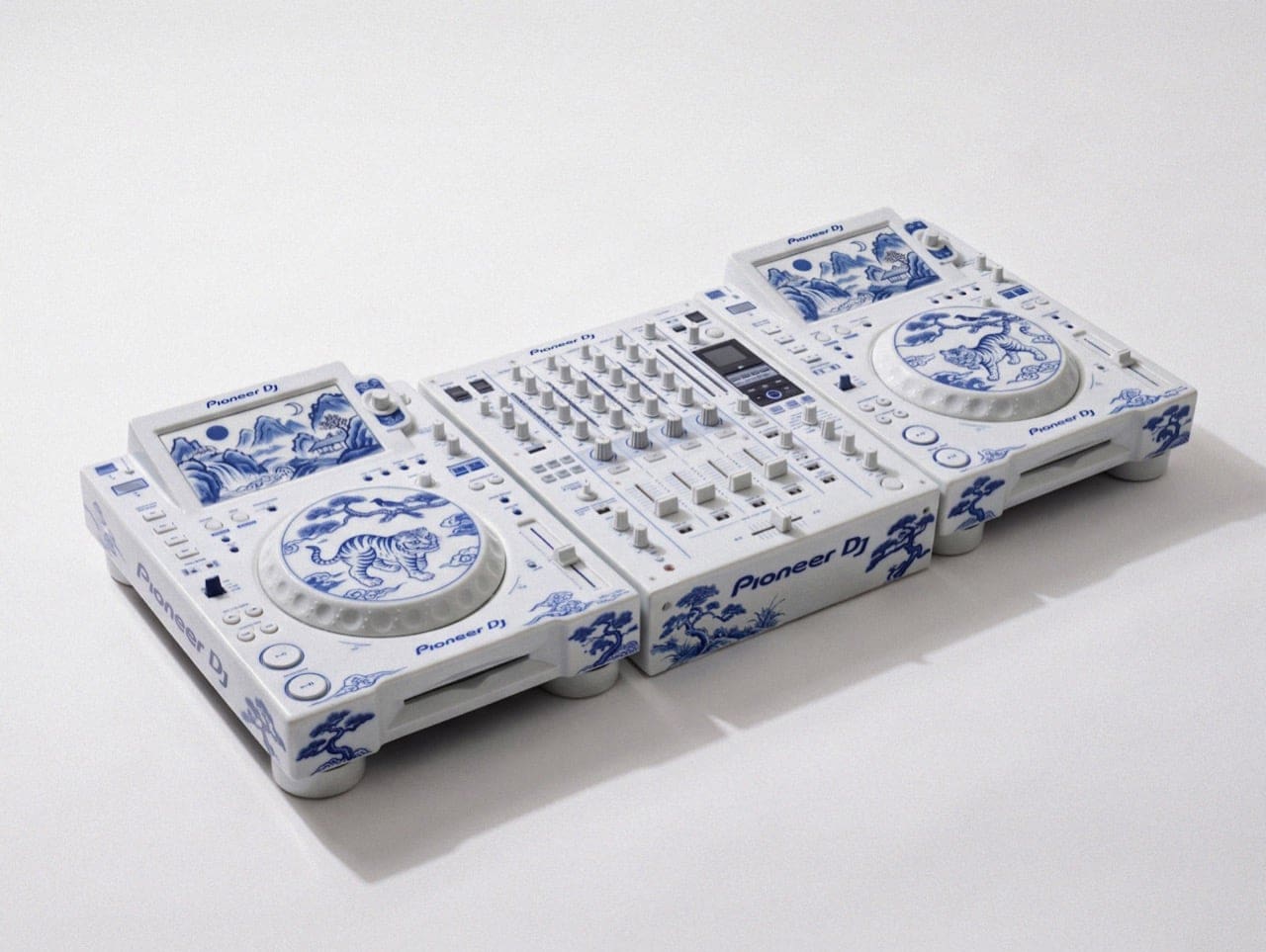
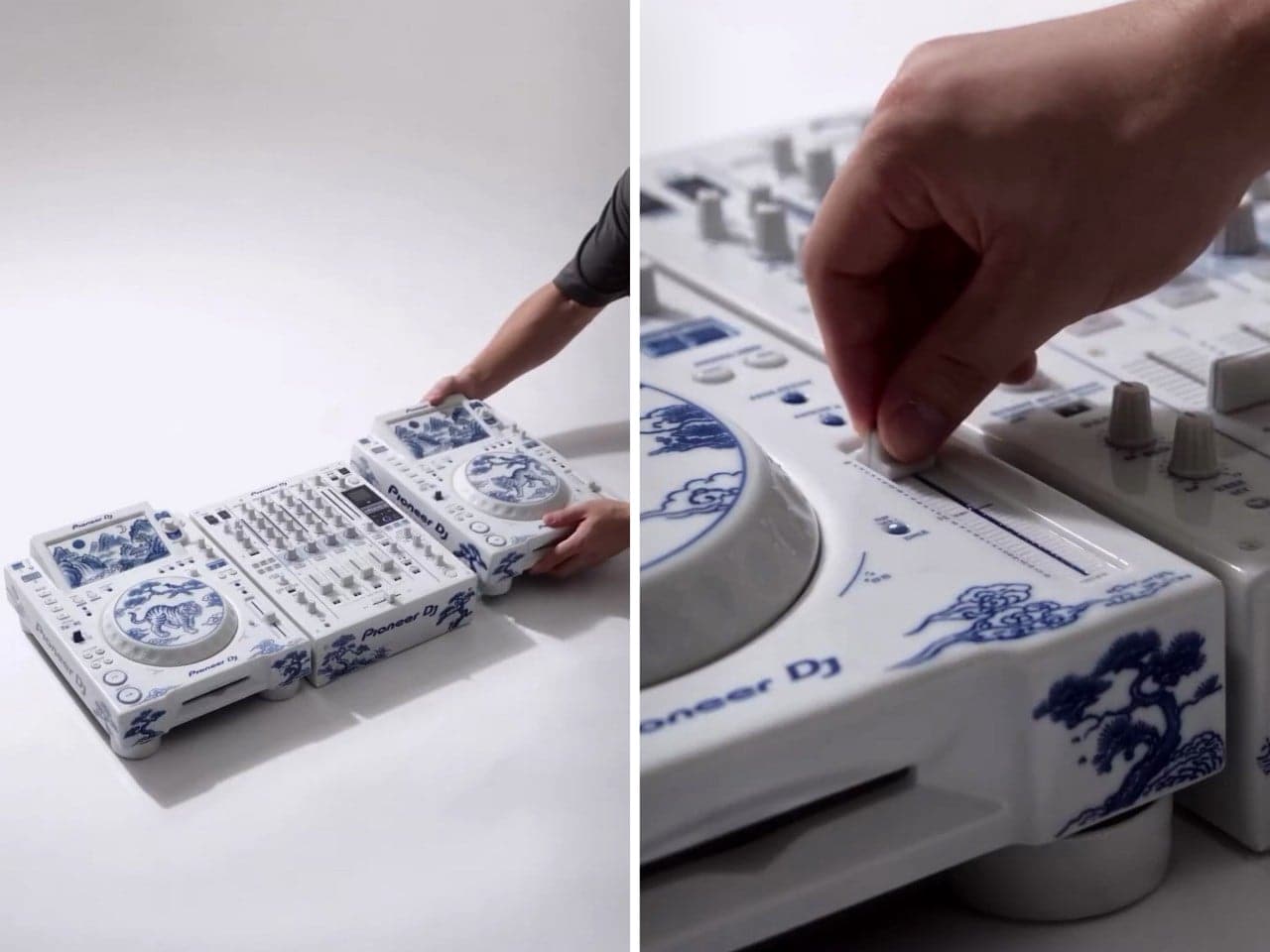
The imagined setup features two decks and a four-channel mixer, all rendered in glazed bone white with rich cobalt-blue details. Instead of looking like ordinary booth hardware, it resembles an elaborate ceramic artifact—something that could sit behind glass in a grand collection before anyone even realizes it’s designed for mixing dance tracks.
There’s a certain delicious mismatch at work here. Club equipment usually suggests black plastic, glowing buttons, cables, and the faint panic of a track ending too soon. This version brings in delicate porcelain, folk imagery, and royal symbolism. It’s less “late-night festival set” and more “the palace has a guest DJ.”
From AI Concept to Luxury Statement
The concept was created by patchkims and takitani.lab under the name:
Joseon Baekja Prototype
The presentation even includes the phrase “1 of 1, no restock,” giving the imagined object the language of an exclusive sneaker release.
That playful caption is important because this isn’t a production model waiting to arrive at a retailer. It’s an AI render—a visual experiment rather than a product announcement. Nobody is shipping this exact setup to a celebrity’s villa, at least not based on the information available here. Still, the idea works because it takes something familiar and pushes it into an entirely different cultural and visual world.
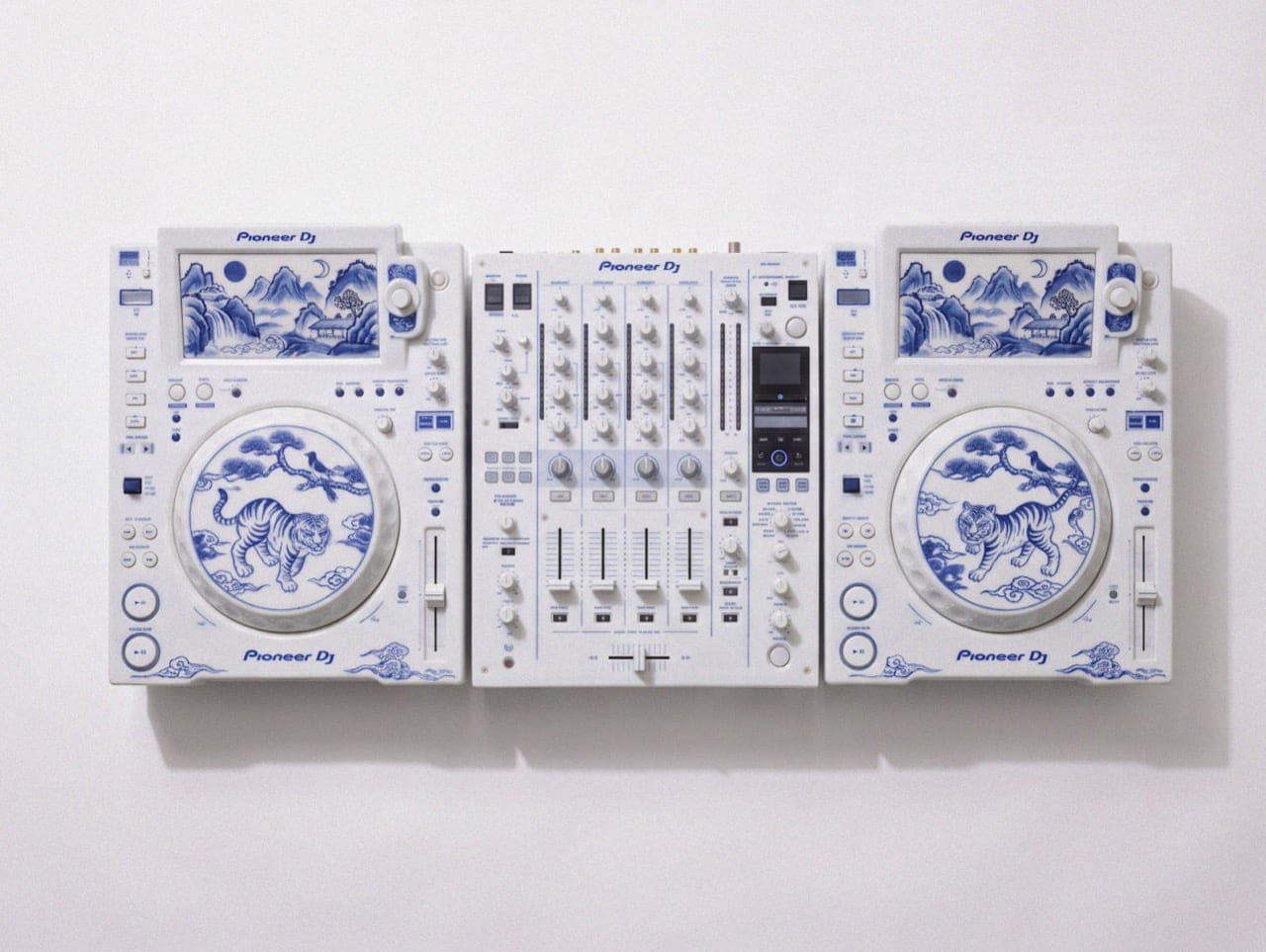
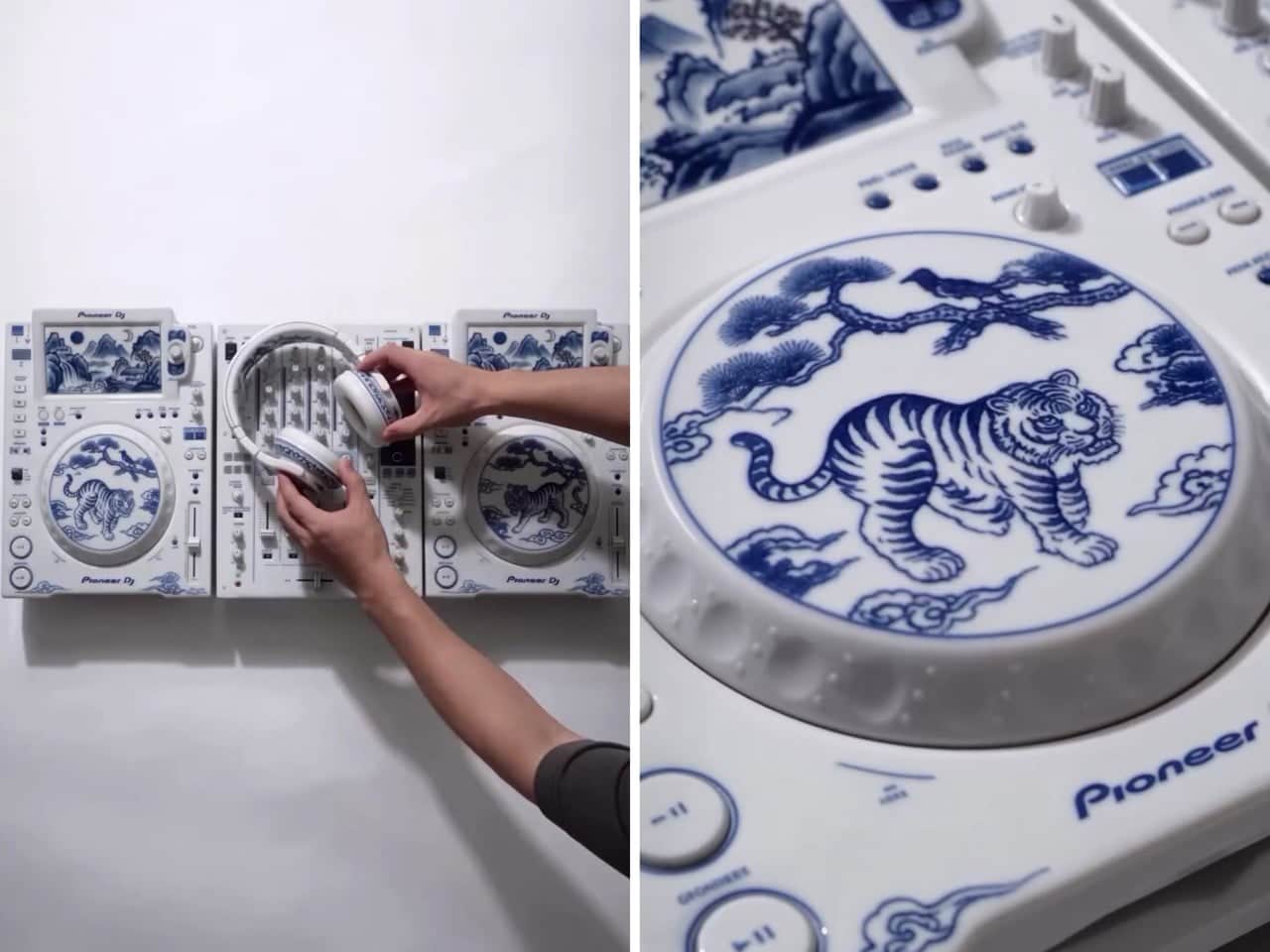
The design coats the decks in a bone-white ceramic look, then uses cobalt-blue illustrations to give every surface a story. Tigers and magpies appear beneath pine trees, while the display screens replace standard waveforms with misty landscapes, waterfalls, and distant peaks.
That shift changes the role of the equipment. A conventional DJ setup belongs in a booth. This one feels built for a living room, gallery, or private collection—somewhere it can be admired even when nobody is cueing the next track. It turns technical gear into a conversation piece, which is quite a flex for anyone with enough space and money to make their music room feel like a design exhibition.
The Tigers and Magpie Tell a Joke
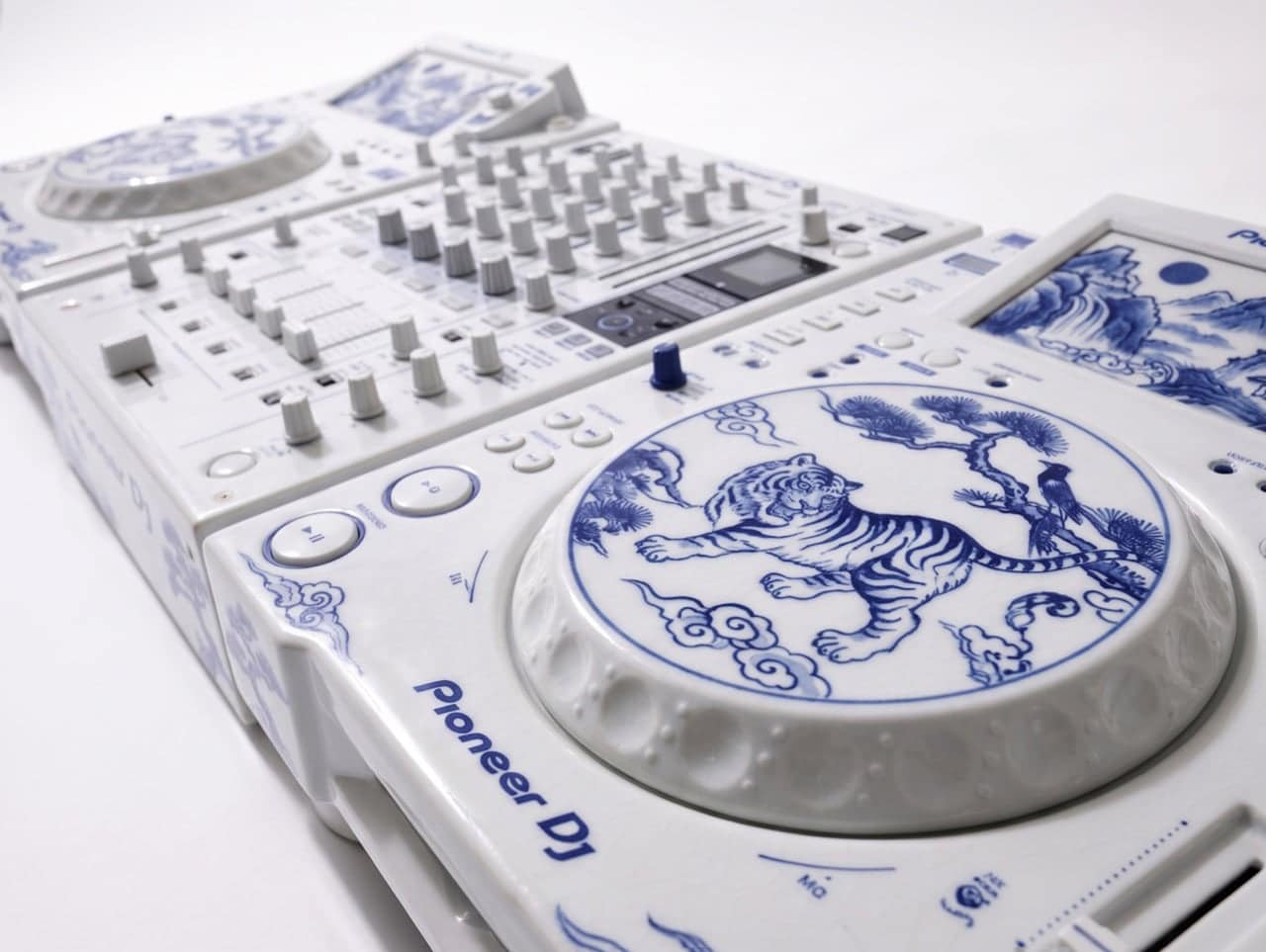
The strongest visual reference comes from kkachi horangi, a Korean folk-painting tradition centered on a deliberately foolish-looking tiger and a self-assured magpie perched in a pine tree.
The tiger, sometimes nicknamed the “idiot tiger,” represents the aristocratic yangban in a humorous, slightly ridiculous form. The magpie, by contrast, speaks for ordinary people. Together, they create a satirical scene: the supposedly powerful figure appears clumsy, while the smaller bird looks perfectly aware of what’s going on.
Both jog wheels borrow this exact visual language. A tiger prowls below while a magpie watches from above, apparently unimpressed by the whole performance. The two decks use different tiger poses, giving the platters a subtle sense of dialogue. One side answers the other, almost like a visual call and response between two performers.
That’s a clever choice for DJ equipment. Decks are already designed to work as a pair, with one track answering or challenging the next. Here, the traditional imagery gives the relationship an extra layer. The decks aren’t identical twins; they’re two halves of a little painted conversation.
There’s also some delightful irony in placing imagery that once poked fun at the ruling class beneath the hands of a modern dance-floor headliner. Joseon painters used the tiger and magpie scene to tease power and status. Now the same visual language appears on equipment designed for the person commanding a crowd from a raised booth.
Is that a contradiction? Maybe. Is it fun? Absolutely.
When Waveforms Become a Royal Backdrop
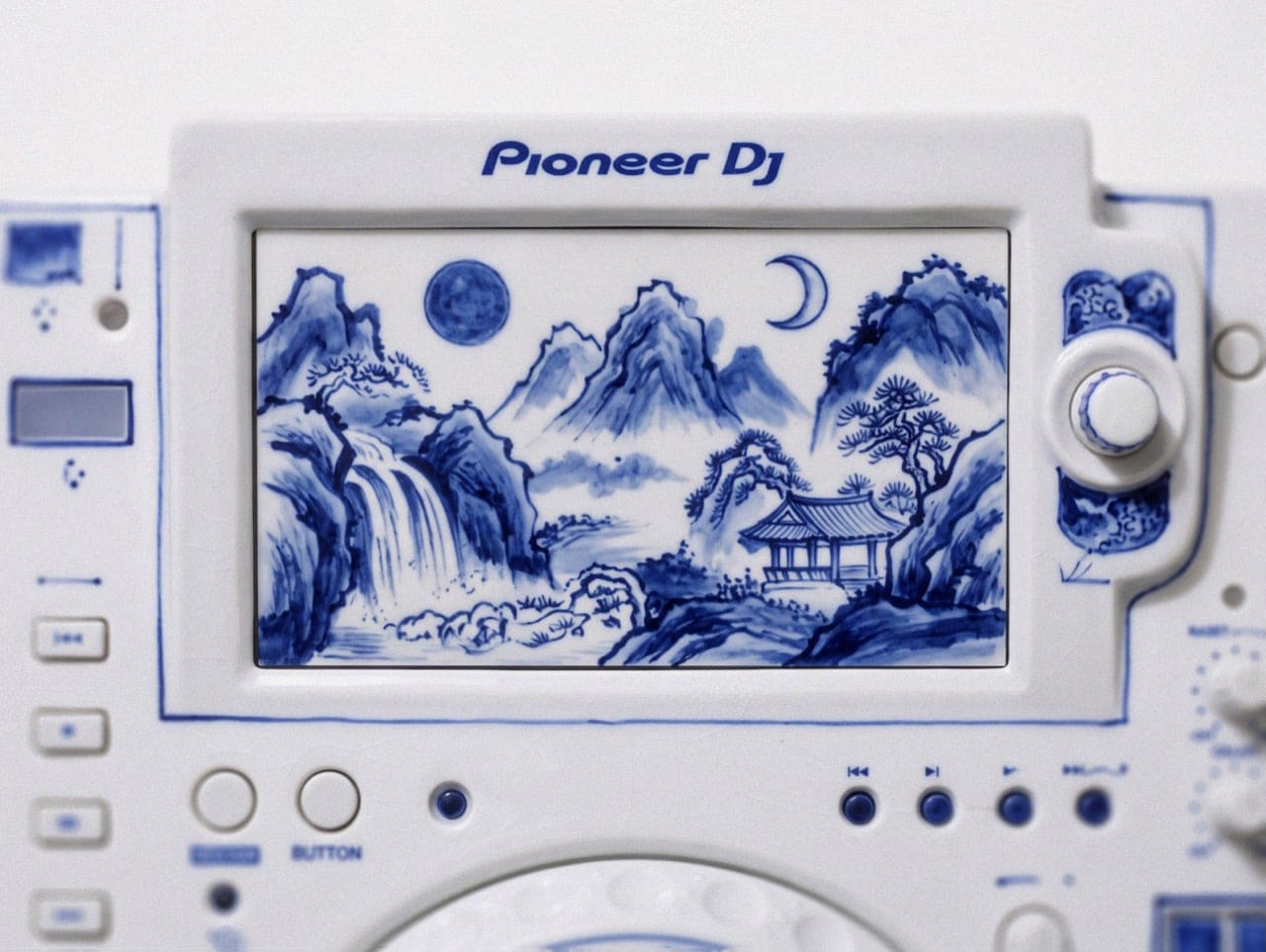
The screens are just as important as the jog wheels. Instead of showing the familiar visual language of DJ software—waveforms, track information, and timing cues—the displays show mist-covered mountains, a waterfall, a pavilion, and two moons.
Those images echo Irworobongdo, the sun, moon, and five peaks painting traditionally placed behind the king’s throne in Joseon palaces. The sun and moon represented the king and queen, turning the artwork into more than decoration. It was a formal backdrop for royal authority.
That reference makes the DJ booth feel like a throne room. A headliner standing above thousands of people already occupies a position that is part performance space and part ceremonial stage. The crowd watches, waits, and reacts to every build-up. Put a royal landscape behind the decks, and suddenly the comparison doesn’t seem quite so exaggerated.
The original royal image featured a red sun. In this porcelain reinterpretation, the color palette turns toward cobalt blue, making the sun feel more like a second moon. That adjustment suits the nocturnal energy of club culture, where the day fades away and the real spectacle begins after midnight.
Of course, calling a DJ booth a throne room is a bit theatrical. But watch an arena audience hold its breath during a major drop, and the symbolism starts to feel surprisingly natural. Music performance has always borrowed the language of ceremony, drama, and power. This design simply makes that connection impossible to miss.
Why White and Cobalt Matter
The porcelain idea also connects to the history of Korean ceramics. Joseon Korea became known for its white porcelain after the earlier green celadon tradition of Goryeo. Blue-and-white porcelain, painted with cobalt, occupied an especially elevated position.
Cobalt pigment was rare and imported from China. When supplies became difficult to obtain, court kilns had to improvise with iron-brown decoration. Some banquet pieces even featured painted imitations of blue-and-white porcelain known as gahwa, a term that translates to “fake painting.”
That history creates an amusing parallel with this AI-designed Pioneer rig. It is, in a sense, a 2026 gahwa: a convincing visual stand-in for an object that has never actually been fired in a kiln. The render borrows the appearance and status of porcelain without becoming a physical ceramic artifact.
Rather than weakening the concept, that connection makes it more interesting. The Joseon court already understood the appeal of reproducing a prized look when the original materials were scarce. This design does something similar with digital tools, imagining a luxury object before anyone has solved the practical problems of manufacturing it.
And the stakes for authentic historic porcelain are high. Christie’s has estimated that a genuine 15th-century cobalt jar could be worth roughly $2 million to $3 million. Compared with that, an imaginary porcelain DJ setup is an affordable fantasy—at least until somebody decides to make one by hand.
A Very Expensive Set of Decks
The real-world hardware behind the fantasy is already serious equipment. Two AlphaTheta CDJ-3000X DJ decks cost $2,999 each, while a Pioneer DJ DJM-A9 mixer is priced at $2,899. Together, that places the modern setup at roughly $8,900 in the United States before adding anything else a working DJ might need.
The render itself appears closer to the older Pioneer DJ CDJ-2000NXS2 generation, complete with disc slots and the broad, familiar shape associated with that era of club hardware. That detail gives the concept a slightly nostalgic edge. It recalls a period when the standard booth setup was instantly recognizable from across a crowded dance floor.
The brand has experimented with special finishes before, too. A limited white CDJ-2000NXS2-W run appeared in 2017, so an unusual colorway isn’t entirely outside the realm of possibility. Still, covering an entire rig in a hand-painted porcelain aesthetic would be a much larger leap than simply changing the casing.
If someone turned this concept into a physical luxury object, the price could easily climb into the hundreds of thousands. The cost wouldn’t come only from the electronics. It would also involve custom fabrication, painting, glazing, finishing, and the challenge of preserving the controls that working DJs rely on.
That’s the strange charm of the idea. It looks too precious to touch, yet it’s based on equipment meant to be spun, pressed, adjusted, and used under pressure. A DJ would have to decide whether the artwork comes first—or whether the tiger can survive a particularly enthusiastic mix.
Who Could Actually Own One?
The fantasy practically writes its own guest list. David Guetta would be an obvious candidate, given his global profile and the connection to the DJ poll. Swedish House Mafia could make sense, too, especially for a dramatic studio or performance space. Even Shaquille O’Neal—another larger-than-life personality with a serious appreciation for spectacle—could be imagined making room for it.
The object feels designed for people who don’t just want equipment; they want an entire atmosphere. It belongs to the kind of room where the furniture is chosen as carefully as the music, where a record collection doubles as interior design, and where visitors may need permission before touching anything.
At the same time, the design is more than celebrity decoration. Its strongest quality is the way it brings together unrelated worlds: Korean folk painting, royal iconography, historic porcelain, modern club equipment, and the culture of luxury customization.
That combination is what makes the render memorable. It doesn’t simply make a DJ setup prettier. It changes the story the hardware tells. The decks become paired characters, the screens become a royal landscape, and the mixer becomes the center of a ceremonial object that happens to be capable of controlling a dance floor.
The “Joseon Baekja Prototype” may exist only as a digital concept, but it proves how far a familiar piece of music equipment can travel when designers stop treating it as mere technology. Would you put this porcelain Pioneer DJ setup in a museum, a private studio, or right in the middle of an Ibiza nightclub?
FAQ
- What is the porcelain Pioneer DJ setup?
It is an AI-rendered concept featuring two Pioneer-style decks and a four-channel mixer redesigned with white porcelain surfaces, cobalt-blue decoration, Korean folk imagery, and royal landscape references. - Who created the Joseon Baekja Prototype?
The concept was created by patchkims and takitani.lab. - What does the tiger and magpie imagery represent?
The imagery references kkachi horangi, a Korean folk-painting tradition in which a foolish-looking tiger represents the aristocracy while a confident magpie speaks for ordinary people. - What is shown on the DJ screens?
The screens replace traditional waveforms with misty mountains, waterfalls, a pavilion, and moon imagery inspired by Irworobongdo, the royal sun, moon, and five peaks painting. - How much would the real-world DJ equipment cost?
Two AlphaTheta CDJ-3000X players and a Pioneer DJ DJM-A9 mixer total approximately $8,900 in the United States, before any custom porcelain-style construction or finishing.
If this blend of music history, visual culture, and bold design speaks to you, take a look at the album cover posters available at Architeg Prints. They’re a warm way to bring that same record-room energy home.
 | DISCOUNTGET 30% OFF*Use code on your next order:
|
* This post may contain affiliate links, meaning we earn a commission if you make a purchase through these links, at no additional cost to you.