MAD-5 Music Player Puts Its Edge Screen Where Your Eyes Are


 See more Architeg Prints stories on Google.
MAD-5 Music Player Puts Its Edge Screen Where Your Eyes Are
The MAD-5 music player blends MiniDisc nostalgia, iPod Shuffle practicality, and a clever edge-mounted display for modern listening.
A Tiny Display With a Big Idea
Some music players make you squint. Others make you reach into your pocket, wake a screen, and interrupt the song just to check what’s playing. The MAD-5 music player takes a wonderfully old-school approach: it puts the information right where your eyes naturally land.
The concept comes from designer Florent Porta, who revisited an unusual detail from Sony’s MZ-RH1 MiniDisc recorder. Sony ended the MiniDisc era with that recorder in 2006, and it was such a capable machine that working examples still attract steep prices from collectors. Its most intriguing feature wasn’t just the recording hardware, though. It was the OLED display mounted along the front edge of the body rather than across the top.
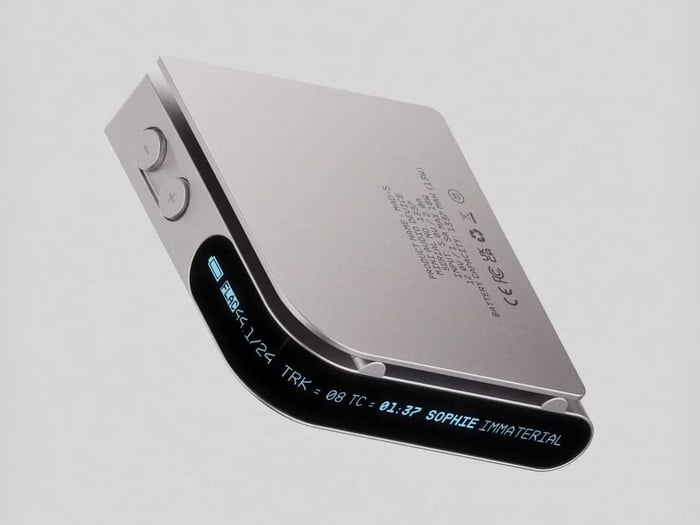
That small design decision made the screen readable from an angle. It was a modest change, almost easy to miss, but it solved a very practical problem. When a compact device is clipped to clothing or a bag, its broad face often points away from you. Its edge, however, remains visible.
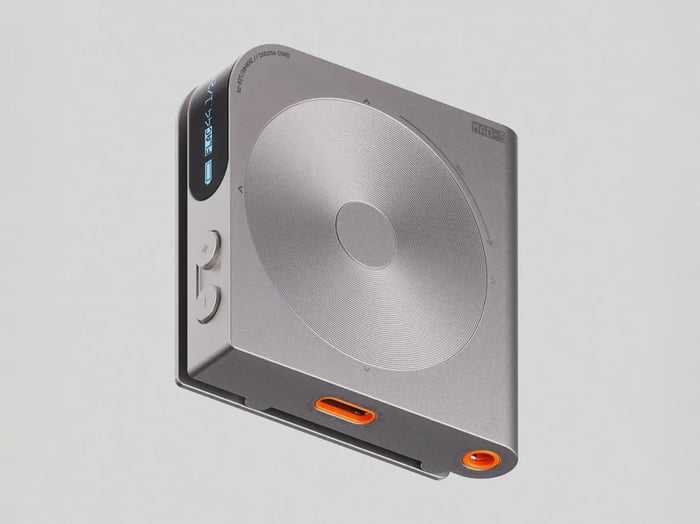
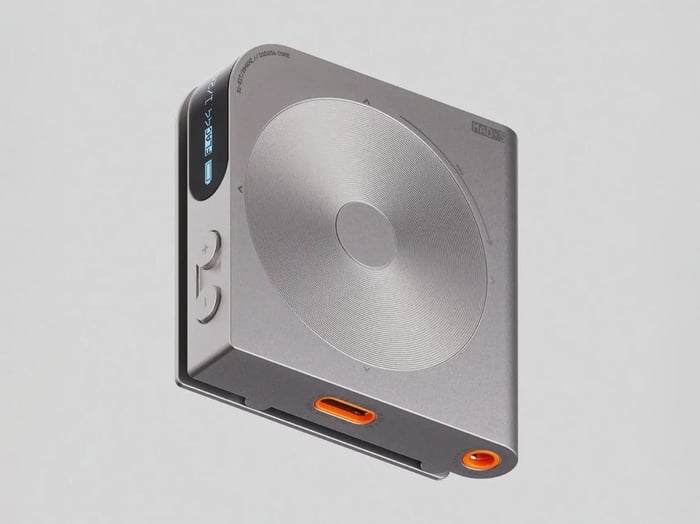
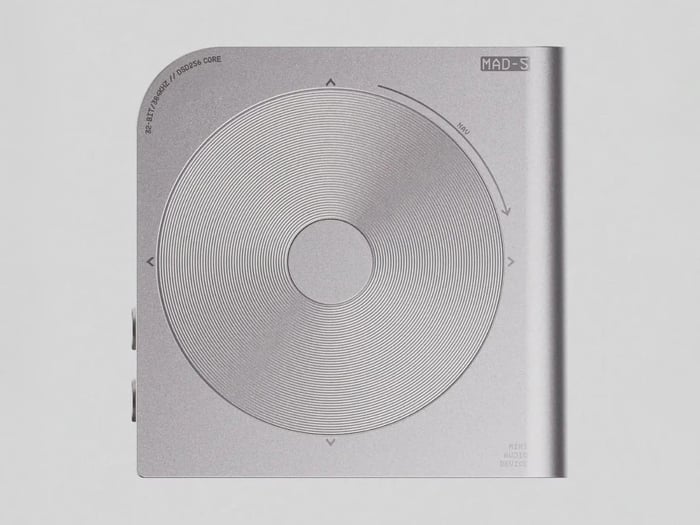
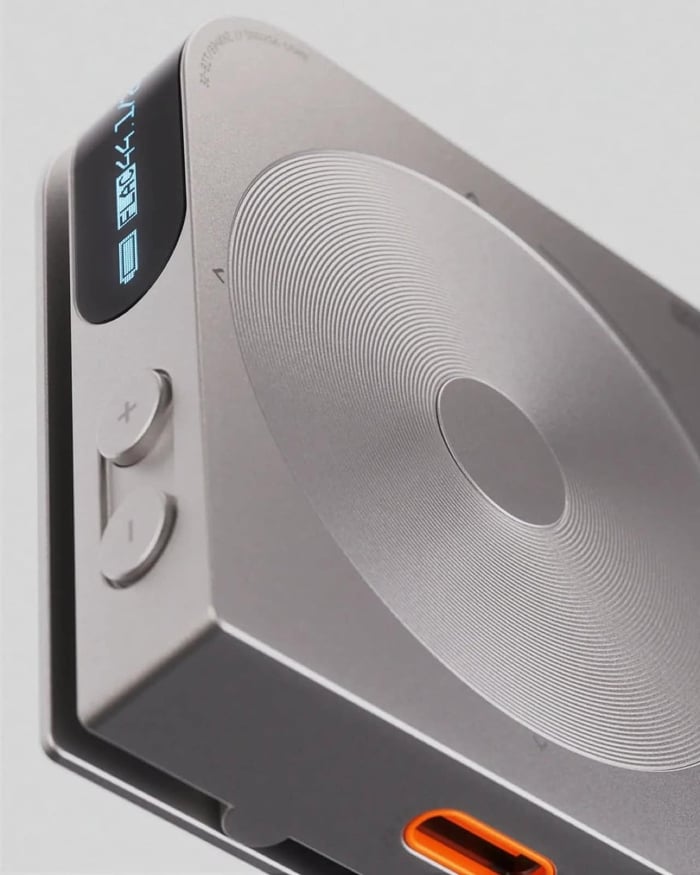
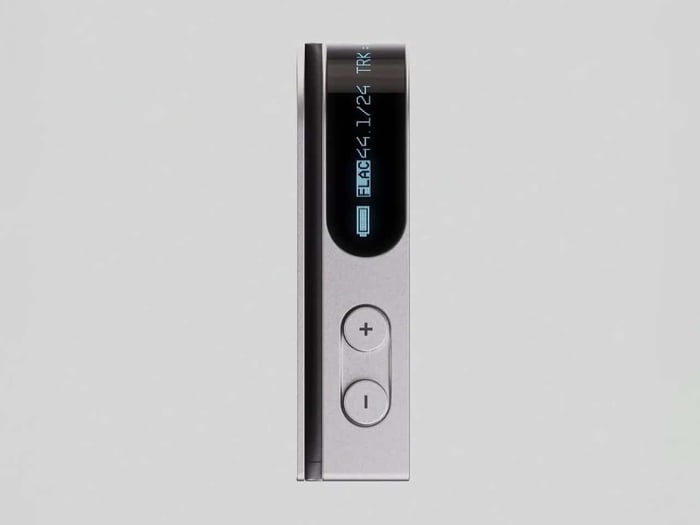
Porta says he has been thinking about that screen for years. The MAD-5 is the result: a square aluminum player with a narrow blue ticker running across its front lip. The display is designed to show useful playback information, including the audio format, sample rate, track number, timecode, and song title.
It’s the kind of feature that makes you pause and think, “Why didn’t more players do this?”
A Square Shape With MiniDisc DNA
The proportions make the connection even clearer. Sony’s MZ-RH1 measured 83.8 by 84.4 millimeters, giving it an almost perfectly square silhouette. The MAD-5 follows a remarkably similar shape.
Whether that’s a direct visual reference or simply an excellent coincidence, the result feels familiar in the best possible way. It recalls the era when portable audio products had strong physical identities instead of looking like featureless black rectangles.
Porta adds another important ingredient: a clip inspired by later iPod Shuffle portable music players. That clip changes the way the device is viewed. A clipped-on music player doesn’t present its face to the wearer; it presents its side. Once you accept that, placing the display along the edge becomes less of a design flourish and more of a logical correction.
The MAD-5’s basic formula is therefore refreshingly simple:
- A compact, square aluminum body
- A built-in clip for attaching it to clothing or a bag
- An edge-mounted ticker display
- A face-mounted jog disc
- Two physical buttons for direct control
The designer behind the concept is Florent Porta, whose work here feels less like a nostalgia exercise and more like an attempt to finish an idea that portable audio left behind.
The Clip Solves What the Shuffle Couldn’t
The iPod Shuffle connection is especially interesting because Apple once ran into the same physical-control problem from the opposite direction.
The third-generation Shuffle, released in 2009, removed nearly every control from the player itself. Only a power switch remained on the body, while volume and track changes moved to a three-button remote built into proprietary earbuds.
It was a bold attempt to make the player almost invisible. It was also famously inconvenient. Without the matching remote earbuds, basic controls became difficult or impossible to access, and the design received plenty of criticism. Apple soon changed direction, bringing back a button ring on the fourth-generation model, which also adopted a smaller, nearly square body.
The MAD-5 borrows the useful part of that later Shuffle: the clip. It leaves behind the earlier model’s control-free experiment and approaches the problem from a smarter angle. Rather than forcing information through a wired remote or a spoken software menu, it makes the device readable from the position where it naturally hangs.
That’s the charm of the concept. The display doesn’t demand a new behavior from the user. It simply works with the way the player is already being worn.
A Familiar Disc With a Different Job
The front-mounted jog disc brings another piece of modern audio design into the mix. It visually echoes the circular reel on Teenage Engineering’s TP-7 field recorder, a device known for its motorized tape-reel effect and tactile recording controls.
The MAD-5’s disc isn’t motorized. There’s no spinning reel hidden beneath the aluminum, no moving mechanism creating a little piece of theater while music plays. Instead, the disc uses concentric engraved rings and directional arrows to suggest navigation.
That makes the reference visual rather than mechanical. The TP-7’s reel earns its appeal through motion, while the MAD-5 borrows the visual language of that motion and turns it into a static control surface. For a concept product, that’s a reasonable trade-off. The disc still gives the player a strong tactile identity, even if it doesn’t perform a miniature mechanical dance.
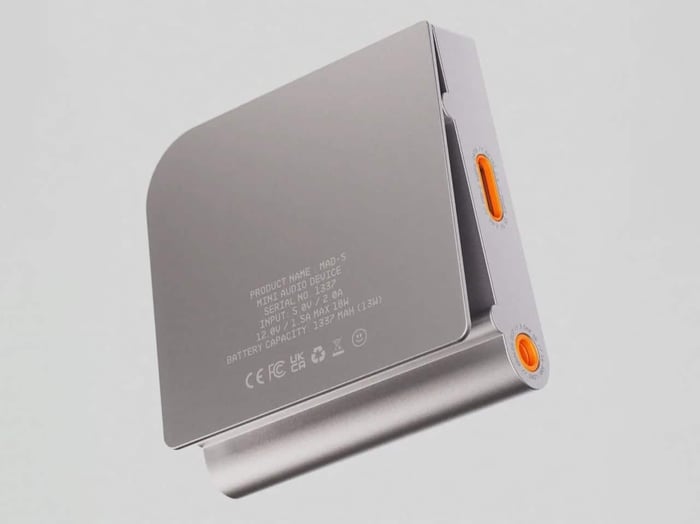
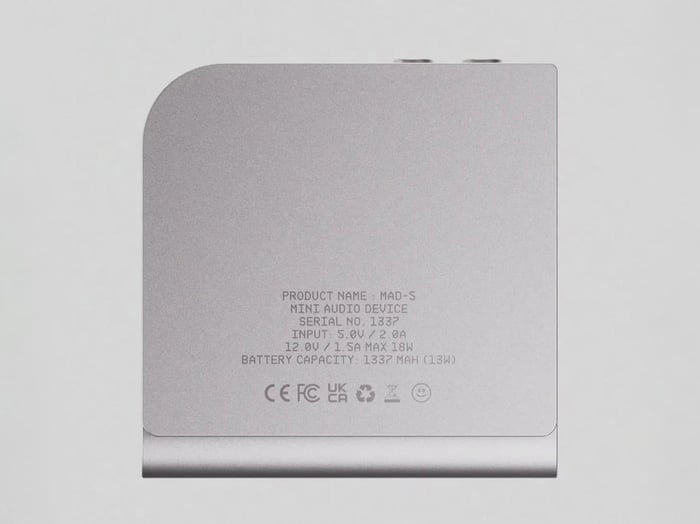
An engraved specification plate adds to the high-end audio mood. It lists a 1,337 mAh battery, a number Porta has apparently used before in another product concept. The detail is slightly playful and slightly mysterious, like an easter egg tucked into a piece of industrial design.
The Missing Features Tell Their Own Story
The MAD-5 looks polished, but its omissions are just as revealing as its visible hardware.
There’s no Bluetooth marking on the body. There’s no balanced output for listeners who prefer more specialized headphone setups. Expandable storage isn’t listed either, despite those features being common among current high-end digital audio players from established portable-audio brands.
That doesn’t necessarily weaken the concept, but it does place the MAD-5 in an unusual position. It looks like a premium player, yet its feature set appears deliberately focused rather than comprehensive. This isn’t trying to be a pocket-sized command center packed with every possible connection.
In fact, the strongest idea may not be the ticker display at all. It could be the USB DAC mode.
When connected to a laptop, the MAD-5 can function as an audio interface. That matters because anyone carrying a computer already owns the main source that makes a dongle DAC useful. Instead of carrying one device for music playback and another for improved computer audio, the player could serve both purposes.
That’s a practical solution rather than a decorative one. The edge display is clever; the USB DAC mode could be genuinely useful in everyday life. It turns the player from a single-purpose music box into something that earns its place in a bag.
A Dock Could Expand the Concept
Porta has also described a desktop dock intended to provide additional input and output options when the MAD-5 is used at home.
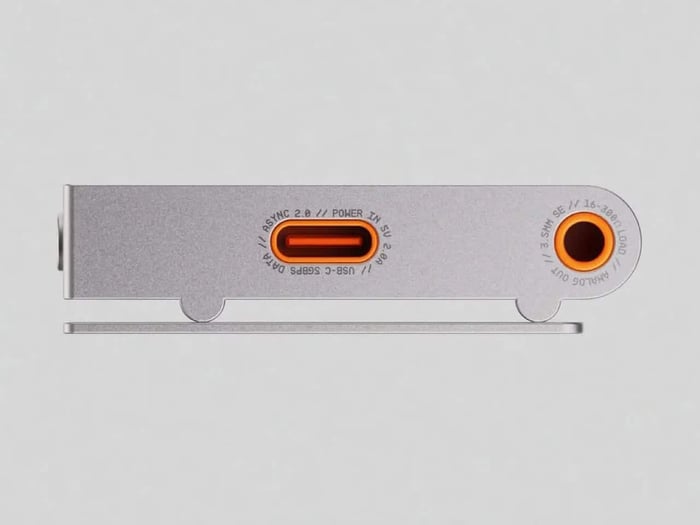
That dock quietly acknowledges that the portable version keeps its connections limited. Rather than pretending the small body can do everything, the concept divides the experience between portable listening and desktop use.
It’s a fairly self-aware approach. The player stays clean and compact on the move, while the dock could provide more flexibility at home. In theory, that could make the MAD-5 feel less like a stripped-down audiophile device and more like a two-part system.
Of course, the dock remains an idea rather than a product with a confirmed release schedule. The MAD-5 itself is also still a concept, so its specifications and functions exist in the world of design proposals rather than finished hardware.
A Sharper Turn From the DAP-1
The MAD-5 also contrasts sharply with Porta’s earlier DAP-1 digital audio player, another portable audio concept built around high-resolution FLAC files.
That earlier design took a maximalist route, combining an OLED touchscreen with a built-in speaker. It was the sort of player that wanted to show and do everything. The MAD-5 moves in the opposite direction, reducing the experience to a disc, two buttons, and one slim strip of information.
The difference is striking, especially since both concepts come from the same designer. One treats the music player as a small computer. The other treats it as a focused object for selecting an album, pressing play, and getting on with your day.
Neither design has become hardware yet, and the dock has no confirmed timeline either. Still, the MAD-5’s edge display feels worth remembering even if this exact player never reaches production.
For years, clip-on devices have made users look at the wrong surface. Sony found a possible answer in 2006 with an edge-mounted screen. Apple explored the clip but didn’t carry that display idea forward. Porta brings both elements together in one compact object.
And sometimes that’s how good design happens: not through a giant technological breakthrough, but by noticing the small inconvenience everyone else has accepted.
The MAD-5 music player is compelling because it doesn’t try to reinvent portable audio from scratch. Instead, it combines a MiniDisc-era display idea, iPod Shuffle-style portability, tactile modern controls, and a potentially useful USB DAC mode. Would you carry a player with a screen designed for the angle at which you actually wear it?
FAQ
- What is the MAD-5 music player?
The MAD-5 is a concept portable audio player designed by Florent Porta. It features a square aluminum body, a clothing clip, a narrow edge-mounted display, a circular navigation disc, and two physical buttons. - Why is the screen mounted on the edge?
A clipped player usually faces sideways or away from the wearer. The edge-mounted screen keeps playback information visible while the device is attached to clothing or a bag. - Which older music players inspired the MAD-5?
The design draws from Sony’s MZ-RH1 MiniDisc recorder, particularly its edge-mounted OLED display, and later iPod Shuffle models, especially their compact clip-based form. - Does the MAD-5 have Bluetooth or expandable storage?
Bluetooth, balanced output, and expandable storage are not listed on the concept’s visible specifications. - What is the USB DAC mode for?
The USB DAC mode would allow the MAD-5 to work as an audio interface when connected to a laptop, giving the device a second role beyond portable music playback.
If the MAD-5’s blend of tactile controls and pocket-sized nostalgia speaks to you, browse your favorite album cover poster designs at Architeg Prints. It’s a warm way to bring that same love of music hardware and album artwork into your space.
 | DISCOUNTGET 30% OFF*Use code on your next order:
|
* This post may contain affiliate links, meaning we earn a commission if you make a purchase through these links, at no additional cost to you.