Some Books (And Philosophers) Truly Threaten the State—and That’s a Good Thing


 See more Architeg Prints stories on Google.
Some Books (And Philosophers) Truly Threaten the State—and That’s a Good Thing
When ideas challenge power, they become a real threat to the state—and that’s the spark of true freedom.
Ideas vs. Force: A Clash as Old as Time
Whenever I hear about libraries pulling controversial or subversive books off their shelves, my mind drifts to two vivid memories. The first is from my senior year of high school when my friends and I kept borrowing Aldous Huxley’s The Doors of Perception so often that the librarian caught on. Unlike his dystopian Brave New World or the more subdued Eyeless in Gaza, this particular book dove deep into Huxley’s experience with mescaline and the mystical “sacramental vision” that came with it. Our Jesuit school—strict and wary—clearly thought such psychedelic, mind-expanding content was far too spicy for a group of impressionable Catholic teens.
But the second memory is weightier and stretches far beyond classroom curiosity: it takes me to Iran in 2009, during one of the tensest moments of modern political upheaval.
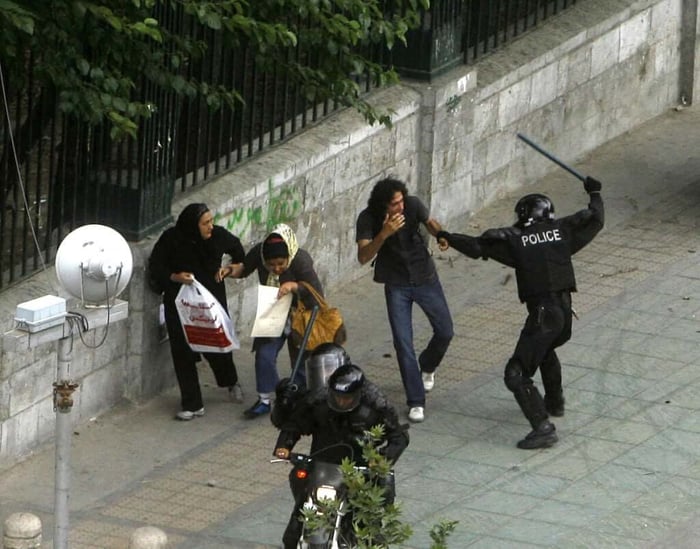
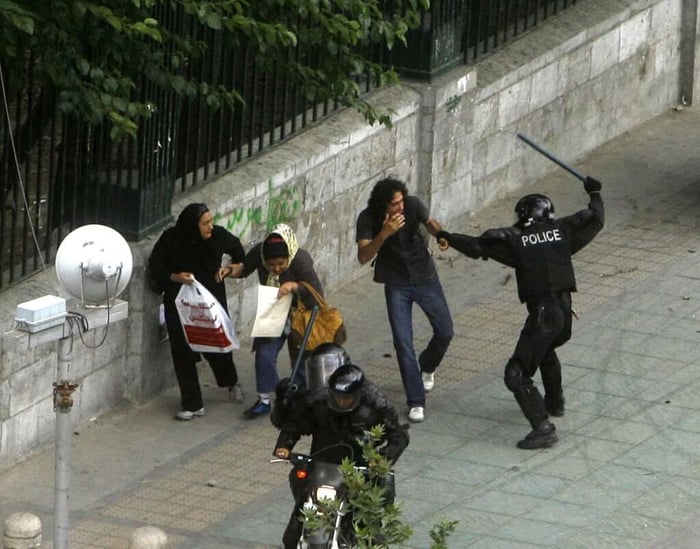
Ideas versus force: an Iranian riot cop wields the stick near Tehran University in 2009. (Photo by STR/AFP via Getty Images)
Tehran 2009: Witnessing a Rift Between Reality and Propaganda
In 2009, Iran was in turmoil after a presidential election that many believed was rigged. The regime cracked down brutally on dissent, revoking visas of foreign journalists to silence outside witnesses. I entered on a tourist visa, claiming I was a college sports tutor fascinated by traditional Persian wrestling. A flimsy cover, but one that let me step into the eye of the storm.
One cold, smog-choked afternoon, I found myself amid a chaotic protest near Tehran University. What began as an intense observation quickly turned into a full-on sprint as riot police on motorcycles barreled into the crowd, their passengers swinging batons wildly. It was raw, violent, and terrifying.
Later at my hotel, the state’s midnight news told a very different story: no protest had happened. Instead, “patriotic” students had gathered in droves, waving pictures of the Islamic Republic’s leaders, chanting support for the regime, and warning academics against “plots hatched by enemies.” Oh, and the skies? Bright blue on TV, while outside, a grim gray smog clung to the winter air—held close by the Alborz Mountains.
“The true color does not matter to them; they are big liars,” my Iranian contact told me the next day. “The government can say the sky is blue; it can say Tehranis love them; it can say everything is America’s fault. But nobody here believes them.”
From Believer to Doubter: One Man’s Journey Through Censorship
Among those who once believed the regime was defending Iran from Western corruption was Arman, a former member of the Basij—the feared volunteer militia that enforced the regime’s iron grip. He swallowed the government’s narrative of a “soft war,” where Western cultural products like books, films, and music were tools to undermine Iran’s identity and sovereignty. For years, Arman supported fierce censorship and the brutal suppression of dissent.
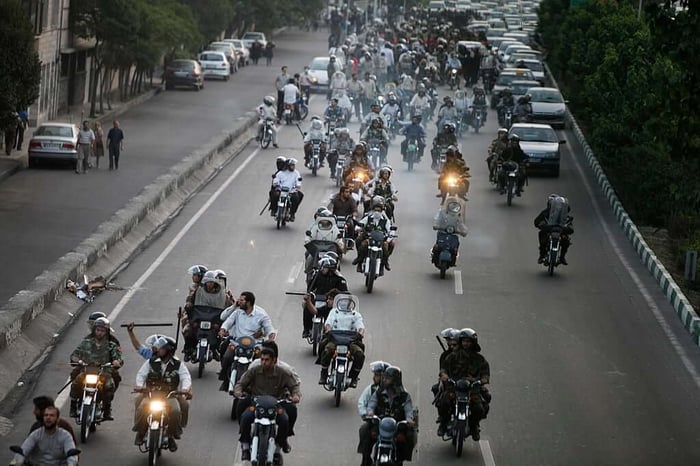
Basij militiamen on motorcycles in Tehran, 2009. (Photo by Getty Images)
But then, a glimmer of hope: in 1997, reformist Mohammad Khatami became president and loosened censorship. Suddenly, books previously banned flooded in—works on Buddhism, Taoism, and even Western philosophers like Bertrand Russell. For Arman, this influx of ideas was transformative.
“I read many books—Buddhism, Taoism, Bertrand Russell—and Islam and the situation in Iran started to seem stupid to me. I realized I was an atheist and didn’t want to be part of the repression,” he confessed.
Bertrand Russell: A Philosopher Who Shook the Foundations of Authority
Russell, the English philosopher, mathematician, and Nobel laureate, has long been a champion of free thought and inquiry. His 1922 essay, Free Thought and Official Propaganda, directly contrasts the open, evolving nature of scientific knowledge with the rigid dogmatism of authoritarian regimes.
“In religion and politics, though there is as yet nothing approaching scientific knowledge, everybody considers it de rigueur to have a dogmatic opinion, to be backed up by inflicting starvation, prison, and war, and to be carefully guarded from argumentative competition with any different opinion,” Russell wrote.
Imagine the seismic impact these words had inside a theocratic dictatorship, where curiosity and questioning are viewed as threats.

Subversive English mathematician and philosopher Bertrand Russell (1872-1970). (Photo by Sylvia Salmi/Bettmann via Getty Images)
For Arman, Russell’s arguments were a revelation that flipped his world upside down, leading him to resign from the Basij. “It was books. They are dangerous,” he said simply.
The Tightening Grip: When Reform Is Stifled
The regime didn’t take kindly to this wave of intellectual awakening. Khatami’s reforms were eventually stifled by more powerful hardliner factions. By 2005, Mahmoud Ahmadinejad’s rise to power marked a return to brutal repression, culminating in the violent suppression of the 2009 protests I witnessed firsthand.
The cycle of censorship and propaganda continues, with the state fearing the very ideas that could spark meaningful change.
Why Dangerous Ideas Are the Heartbeat of Freedom
In times when governments tighten control, ideas become the most potent form of rebellion. Books, philosophy, and free inquiry challenge dogma and open minds. And as history shows—from Huxley’s controversial writings in a Jesuit school library to banned books smuggled in Tehran—ideas have an unstoppable power that regimes fear.
So when books are deemed dangerous or philosophers are branded threats, it’s often a sign that their ideas are exactly what society needs.
FAQ
- How did censorship affect everyday life in Iran during the crackdown?
Censorship extended across books, internet, music, and film, severely limiting access to foreign cultural products and suppressing dissenting voices to maintain regime control. - Who are the Basij, and what role do they play in Iran?
The Basij are a volunteer militia enforcing regime policies, often involved in suppressing protests and cracking down on dissent, known for their plainclothes operations and violent tactics. - What is the “soft war” the Iranian government talks about?
It’s the regime’s term for Western cultural influence seen as a deliberate effort to weaken Iran’s societal fabric through media, literature, and music. - Why was Bertrand Russell’s philosophy so threatening to authoritarian states?
His emphasis on free thought, inquiry, and rejection of dogma challenged the fixed narratives that authoritarian regimes rely on to maintain power. - What happened after reformist president Mohammad Khatami relaxed censorship?
There was a brief period of intellectual openness with banned books becoming available, but this was eventually reversed as hardliners regained control, reinstating harsh censorship.
If you’re inspired by the power of ideas and want to celebrate iconic cultural moments, why not shop your favorite album cover poster at our store? Dive into the spirit of rebellion and thoughtfulness through art that speaks volumes. Browse our collection here.
 | DISCOUNTGET 30% OFF*Use code on your next order:
|
* This post may contain affiliate links, meaning we earn a commission if you make a purchase through these links, at no additional cost to you.