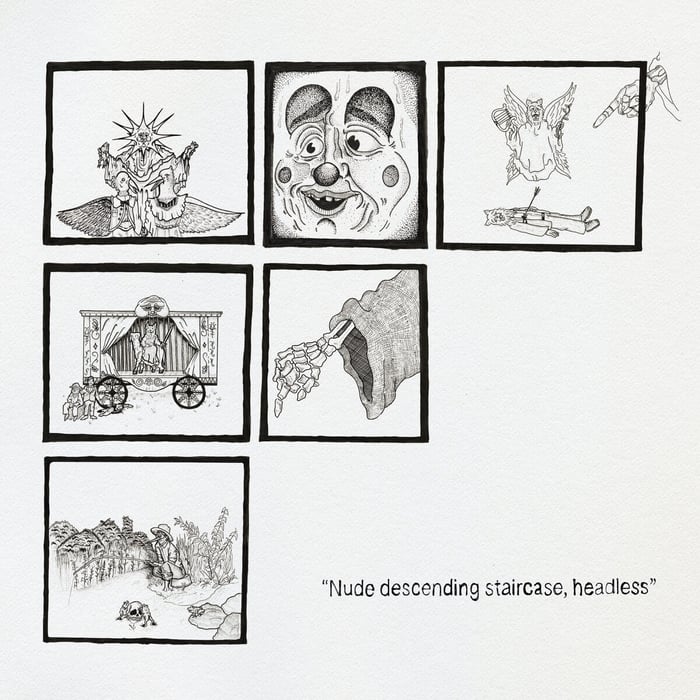
Teen Suicide Album Review: “Nude Descending…” Is Chaos With Manners


 See more Architeg Prints stories on Google.
Teen Suicide Album Review: “Nude Descending…” Is Chaos With Manners
Teen Suicide sharpens their lo-fi mess into a studio-sized punch—still unpredictable, still emotional, and occasionally trying a little too hard.
Let’s get this out of the way: this album doesn’t want your comfort
If you press play expecting a neat “new era,” Teen Suicide basically laughs and changes the subject mid-sentence. This record wants motion, not resolution—and it gets there by yanking the floor out from under its own songs.
Who they are here: a cult band suddenly given real lighting
Teen Suicide have always carried that scrappy, emotionally-overloaded punk DNA—loud rock, lo-fi grime, and the kind of sincerity that usually shows up right before someone storms out of the room. The big shift this time is the sound of the room itself.
This is their first proper studio release, recorded and produced by Mike Sapone (yes, that Mike Sapone—the one tied to bands like Taking Back Sunday and Oso Oso). You can hear what that changes immediately: the guitars don’t just smear across the speakers anymore—they land. The mix is wider, heavier, and more “epic” in a way Teen Suicide normally avoids like it’s embarrassing to admit you care.
And here’s the contradiction that makes the album interesting: the band keeps their identity as a jittery, left-turn machine, but now they’ve got production that makes every left turn feel like it’s happening in slow motion on a massive screen.
Thirteen tracks, zero patience: the album’s real gimmick is whiplash
The “fun” part—if you’re the kind of person who enjoys being pushed around a little—is how the album refuses to sit still across its thirteen tracks. The band clearly made a decision to treat consistency like a trap. No song stays in one style for long, and no two tracks share the same emotional temperature for more than a minute.
That could’ve been a cheap trick. Here, it mostly works because the changes don’t feel random; they feel like someone flipping through mental states in real time. Not “playlist-core” genre hopping—more like mood volatility turned into arrangement.
I’ll admit, on first listen I thought, “Okay, this is going to be exhausting.” But on second pass, the constant shifting started to feel less like chaos and more like a very specific kind of control: the band knows exactly when to deny you the payoff.
“Anhedonia” opens like a threat—and then follows through
The opener, “Anhedonia,” starts with moody, slow guitar and vocals that match that same drained stare. There are distorted strings hanging behind everything like fog on a streetlamp. It’s the kind of intro that screams,
something bad is coming,and for once that feeling isn’t lying.
Then it kicks into loud alternative rock without dropping the melancholy. That’s the move: it gets bigger, but it doesn’t get brighter. The distortion stays, the atmosphere stays, and the ending drags out into a long close of feedback—less “big finale,” more “let’s sit in the noise until you stop asking questions.”
If you wanted an inviting first track, you’re in the wrong house.
The video moment: “Idiot” shows the band’s real trick
The track “Idiot” is where the band’s split-personality approach becomes the point, not just a habit. It begins in loud alternative/garage-rock mode—sharp, physical, immediate. And then it starts shape-shifting.
Here’s the embedded video exactly as it appeared in the source:
At some point, the song slides into a slower tempo and suddenly turns mournful—like it’s trying to drag the listener through something ceremonial. I kept wanting to call it a funeral march, but I’m not totally sure that’s the exact reference. It’s more like the feeling of one: heavy steps, forward motion, no celebration allowed.
Then, just when the sadness starts to feel settled, the song shifts again into something a little funkier before snapping back to that loud alternative garage rock energy. That return shouldn’t work—too many costume changes—but the tighter guitar sound makes it feel deliberate instead of messy.
And yeah: the guitar tone across this record is kind of insane. Not flashy in a “look what I can do” way—more like every chord is sharpened until it can cut.
Sam leads the vocals… but Kitty is the album’s secret weapon
Most of the lead vocal load sits with Sam, and that choice matters: his presence keeps the songs feeling like diary pages thrown into an amp. It’s not “pretty,” it’s specific. The emotion doesn’t get polished; it gets framed.
But the record gets a jolt when Kitty Ray steps forward. She’s used like a weapon on the heavier moments, and it’s smart because the album’s loud sections could’ve started blending together without a different kind of voice to change the weight of the room.
When Kitty comes in, it doesn’t feel like a “feature.” It feels like the band turning on a second engine.
“Spiders” is a slow-burn fuse that actually explodes
“Spiders” starts slow, which almost feels like bait. Then it blows open into a punk-meets-garage-rock shove, with aggressive vocals that match the instrumental mood. The track’s whole point seems to be contrast: restraint as setup, chaos as payoff.
A reasonable person could argue the hard switch is too on-the-nose. I’d argue that’s exactly why it works—Teen Suicide aren’t aiming for subtle, they’re aiming for impact.
“Candy / Squeeze” goes all-in on distortion—maybe too far
“Candy / Squeeze” leans heavily on distorted noise and guitar, and it feels like the band testing how abrasive they can get while still sounding like themselves. The texture is the hook. The mess is the hook.
This is also where I’ll push back a little: the commitment to noise is admirable, but the song flirts with becoming more surface than song. I don’t need everything to be tidy—but I do need the chaos to feel like it’s pointing somewhere. Here, it almost dares you to call it indulgent.
Still, that dare is part of the album’s personality. Teen Suicide keep asking,
Are you still here?and they don’t ask nicely.
“Keeping Her Keys” does the slow-to-loud thing—because it’s effective
“Keeping Her Keys” starts in a slow zone again, with ethereal sounds drifting around the edges. Then it crashes back into that loud punk/garage blend with vocals that hit just as hard.
Normally I roll my eyes at the quiet-loud formula because it’s become a rock cliché. But Teen Suicide use it less like a trick and more like a mood swing. It doesn’t feel engineered for a crowd pop; it feels like a pressure change—something internal finally snapping outward.
If anything, the album’s studio clarity makes this move even more brutal. You hear the air in the “slow” section, so when the loud part hits, it feels like the room gets smaller.
The duo vocal moment on “Idiot” is the album’s emotional center
When Sam and Kitty sing together on “Idiot,” the song stops feeling like a collection of cool sections and starts feeling like a scene. Their voices together turn the melancholy shift into something communal—like the track stops spiraling alone and becomes a shared spiral.
And that’s the sneaky emotional thesis of the album: for all its fragmentation, it keeps returning to connection. Loud connection, messy connection, sometimes uncomfortable connection.
Why the constant genre-switching isn’t just “genius”—it’s the point
It’d be easy to map every song’s stylistic turns like a tour guide. But that kind of play-by-play misses what the album is actually doing to you in the moment.
The constant shifts in style, tempo, and texture aren’t there to show range. They’re there to prevent you from settling into a stable interpretation. The band doesn’t want you to “understand” a track and move on; they want you to keep adjusting your posture as you listen.
That’s also why the record feels more “epic” now: not because it’s suddenly heroic, but because the production gives these emotional pivots real scale. Even the small moments sound like they’re happening under stadium lights—whether or not they should.
And yes, sometimes I’m unsure whether the album is brilliantly unpredictable or just addicted to surprise. But the fact I can’t decide is part of its grip.
So where do I land on it? Somewhere around an 8/10, honestly
If I had to slap a number on it, I’d land at 8/10—not because it’s flawless, but because it’s doing something specific and mostly pulling it off: taking a cult-band lo-fi instability and letting it hit with studio-force without sanding off the weird edges.
The record is out now via Run For Cover.
Conclusion: the album isn’t trying to be liked—it’s trying to be felt
Teen Suicide could’ve used a studio debut to “clean up.” Instead, they used it to make their volatility louder, clearer, and harder to ignore. The best moments don’t just switch styles—they switch gravity, and you feel your stomach react before your brain catches up.
Our verdict: People who like Teen Suicide when they’re emotionally reckless—but secretly precise—will love this. If you need songs to pick a lane and stay there (or you think distortion is a seasoning, not a main course), you’ll tap out fast and complain about it like it’s a personality trait.
FAQ
- Is Teen Suicide’s “Nude Descending Staircase, Headless” a lo-fi record?
It still thinks like a lo-fi band, but the studio production makes everything bigger, clearer, and more forceful. - What’s the core vibe across the album?
Unpredictability with intent—songs pivot from slow, moody tension into loud alt/garage eruptions without warning. - Which track best represents the album’s shifts?
“Idiot”—it jumps from loud garage-rock to a slower, mournful section, detours into something funkier, then returns to volume. - How are the vocals split between the members?
Sam handles most lead vocals, but Kitty Ray shows up on heavier moments and adds serious power when she takes the front. - Does the album ever overdo the distortion?
At least once—“Candy / Squeeze” risks turning texture into the whole point, depending on your tolerance for noise-forward writing.
If this record lodged in your brain, you might as well let it live on your wall too—grab a favorite album cover poster over at our store as a neat, quiet way to commemorate all that not-quiet music.
 | DISCOUNTGET 30% OFF*Use code on your next order:
|
* This post may contain affiliate links, meaning we earn a commission if you make a purchase through these links, at no additional cost to you.