Harrowing Album Review: Lindsay Schoolcraft Turns Pain into Stadium Smoke

 See more Architeg Prints stories on Google.
Harrowing Album Review: Lindsay Schoolcraft Turns Pain into Stadium Smoke
Harrowing album turns harp-born elegance into modern metal bite—sometimes too familiar, sometimes weirdly perfect, and always trying to outgrow its own bruises.
A record that wants you to flinch first
Some albums want you to “enjoy the journey.” Harrowing album mostly wants you to survive it—then stand up at the end like you meant to get hit.
What hooked me isn’t just the heaviness. It’s the way Lindsay Schoolcraft keeps yanking the lighting between holy and hostile, like she’s daring you to pick one version of her and stay there.
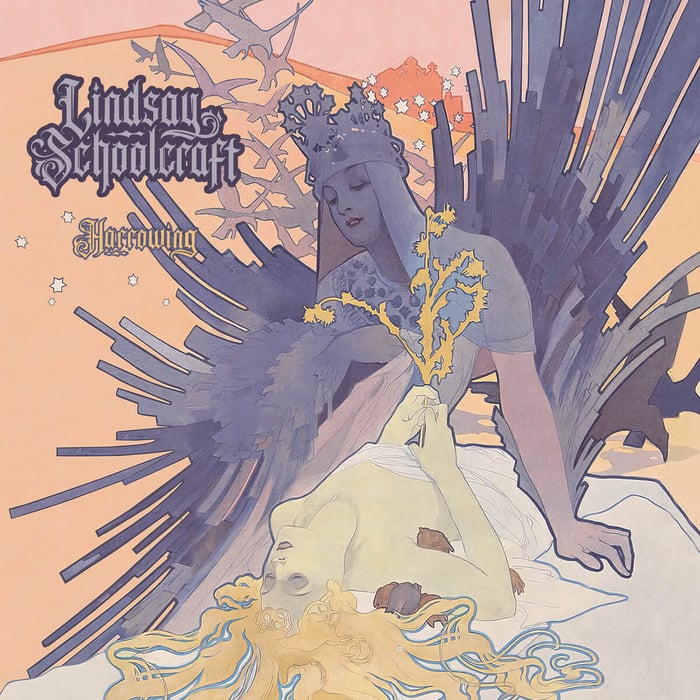
The cover art tells on the album before the first note
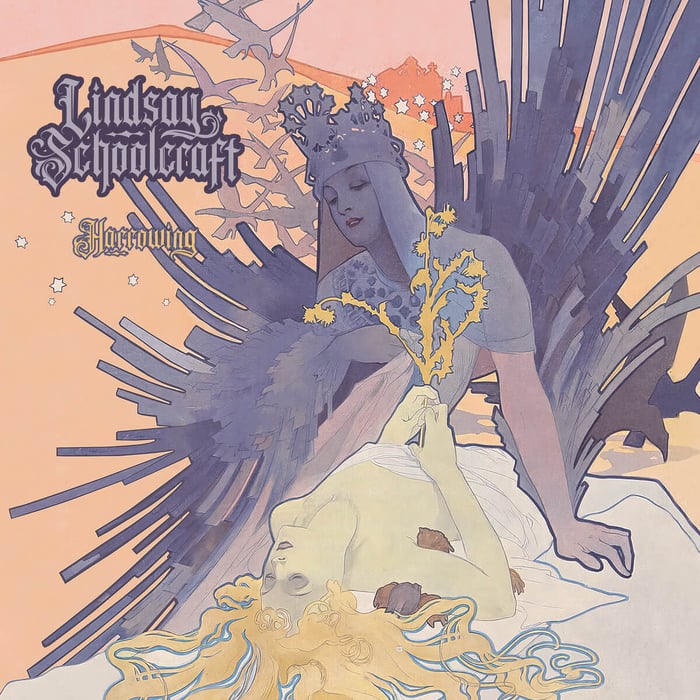
Before I heard a single track, the artwork already gave the game away. It borrows Alphonse Mucha’s L’Illustration—a pale woman dying, a dark figure folding her into a shroud. The image isn’t subtle, but it’s not empty theater either. Look closer and it quietly hints at the next cycle: the “new year” idea, rebirth sneaking in through tragedy’s back door.
That’s basically the album’s emotional blueprint. I’m not saying the music literally paints the canvas, but it absolutely behaves like it: death pose up front, bargaining in the middle, and something like a stiff-legged peace at the end. If you came here for a victory lap, you’re early.
It opens in torment, then starts plotting
Once the record actually starts moving, it’s clear Schoolcraft isn’t just writing heavy songs—she’s staging a sequence. The whole thing feels like it begins in a locked room, spends a while sharpening something, and finally walks out into air again.
The closer “Chase The Dark” is the tell, because it lands on a line that feels like the thesis statement she’s been circling:
“Where you end is where I start.” — Lindsay Schoolcraft
That’s not a cute bumper-sticker lyric. It’s a boundary being drawn with a dull knife. And it reframes everything before it: the suffering isn’t the point, it’s the fuel.
I’ll admit, I wasn’t totally sure on first listen whether the album’s “arc” was intentional or just me imposing meaning because the cover art primed me. But by the time the last tracks exhale, it’s hard not to hear a deliberate push from panic → revenge → release.
The production goes for “modern metal” clarity—sometimes at a cost
Here’s the practical pivot: Schoolcraft leans harder into metallic muscle this time, and she brings in Justin deBlieck (known for work with Motionless In White) to give the record weight. And yeah—he does. The album comes off cleaner, louder, more “finished.”
The easiest way to say it: Harrowing feels like the high-definition version of what she’s been working toward. Bigger frame, sharper edges, less haze. It also positions her more squarely in today’s modern metal lane—the one built on tight low-end, punchy drums, and choruses engineered to hit like a door slam.
That shift mostly works. She sounds more fully locked into “metal artist” mode here than before. But the trade-off is real: the more she nails the current template, the more she risks sounding like she’s renting it.
When it plays it safe, you can hear the walls closing in
This is where the album gets a little frustrating—not because it’s bad, but because it’s capable.
“Vague” has the skeleton of a standout: solid drive, chorus with actual kick. And yet, the more I replayed it, the more I kept waiting for the moment that screams only Lindsay Schoolcraft would do this. That moment doesn’t quite show up. The song is playlist-friendly in the most literal way: competent, smooth, and a little too interchangeable.
Same story with the djent-adjacent chug and judder on tracks like “Crucified” and “So Alive.” The riffs hit, the rhythm locks, the machine runs. But modern metal is full of bands who can chug in perfect time; that’s the baseline now, not the flex. These songs feel like they’re asking for one flourish—a strange harmony choice, a left-turn vocal phrasing, anything—to stamp her fingerprint on the steel.
That’s my mild gripe: chunks of Harrowing album sound like they’re trying so hard to be “current” that they forget to be personal in the actual music, not just the lyrics.
Then the album gets weird for a second—and suddenly it’s alive
Just when the record starts flirting with sameness, it throws in something oddly memorable: on “I Wait For You To Fall,” there’s a moment that sounds like a DJ scratching cutting across the layered percussion.
Is it “tasteful”? I don’t even know. It kind of sounds out of place—like an old-school nu metal ghost wandering into a modern session. But it works because it’s awkward. It’s the sonic equivalent of making eye contact at the exact wrong time: you remember it.
More importantly, the track gets danceable in a way the more straight-ahead crushers don’t. It invites movement instead of just head-down endurance. And Schoolcraft rides that groove with melodies that feel judged precisely—she doesn’t over-sing it, doesn’t smear it with drama. She lets the funkier pocket do some of the talking.
Here’s where my first impression shifted: I initially clocked Harrowing as a “bigger, cleaner” record—and assumed that meant it would be more rigid. But the second that scratchy, percussive weirdness hit, I realized the album’s best moments come when it stops trying to be seamless.
“Cut Your Teeth” slows down just enough to feel threatening
Next bridge in the album’s logic: after the punch-and-polish tracks, “Cut Your Teeth” shows up with a different palette—more sinister, more apocalyptic, less “look how tight the band is” and more “listen to the space between hits.”
The arrangement leans into those gaps between hammered chords. It’s not empty; it’s accusatory. Every pause feels like the room going quiet so someone can finally say the ugly part out loud.
And she does:
“We all know you’ll never change.”
“Your dirty hands cannot conceal what you’ve done.”
They’re blunt lines, almost aggressively unsubtle. But that’s the point. This song isn’t here to be poetic; it’s here to be a reckoning. The directness hits harder because she refuses to decorate it.
A reasonable listener could argue it’s too on-the-nose. I get that. Still, I’d rather hear a songwriter commit to a clear throat-grab than hide behind pretty fog when the emotions are obviously not pretty.
The closer doesn’t “heal”—it reclaims
By the time “Chase The Dark” rolls in, the album isn’t trying to win a fight so much as end one. It lands with lines that feel like reclamation rather than revenge—especially:
“As I carve you out of my soul, the pain brings back a glow.”
That’s the album’s final move: not forgiveness, not amnesia—extraction. The pain becomes proof of life, a glow you get back after you stop letting someone live in you rent-free.
And this is where Schoolcraft’s biggest advantage becomes obvious: her writing. She accuses, threatens, and lets go without hiding behind metaphorical curtains. It reads like diary-sincere confession, which makes it easy to project yourself into—listeners will grab whatever line matches their own story and walk away with it.
Her voice—both as singer and as lyricist—is the engine here. If she brings that same personality deeper into the metal choices (not just the words), she won’t just “fit” the modern landscape; she’ll start bending it.
Release detail (because yes, timing matters)
Harrowing is set for release on June 19 via Cyber Proxy Records.
If you want to keep up with her directly, she’s on Facebook here: Facebook.
Conclusion
Harrowing album feels like Lindsay Schoolcraft stepping into a larger room—cleaner production, heavier posture, and a clearer aim: turn private damage into something that can fill a venue. It doesn’t always escape the gravitational pull of modern metal sameness, but when it gets strange (or spacious, or brutally direct), it stops sounding like a “good record” and starts sounding like a person.
Our verdict: People who like modern metal with crisp production and emotionally blunt lyrics will eat this up, especially if they enjoy a little nu-metal-adjacent oddness sneaking in. If you need every riff to sound unmistakably unique—or you roll your eyes at diary-direct lines like “you’ll never change”—this one might feel like a well-built house with a few rooms you’ve already toured.
FAQ
- Is Harrowing album more metal than Lindsay Schoolcraft’s earlier work?
Yes—heavier production, more modern metal framing, and a stronger emphasis on big, stomping structure. - What’s the most memorable left-field moment on the album?
“I Wait For You To Fall” pulling in a DJ-scratch-like sound over layered percussion. It’s weird enough to stick. - Does the album tell a clear emotional story?
It plays like a sequence: torment up front, revenge in the middle, and a hard-earned calm by the end—especially with “Chase The Dark.” - Where does the album feel a bit too familiar?
Tracks like “Vague,” plus the djent-style riffing on “Crucified” and “So Alive,” can blend into the broader modern metal crowd. - What’s Schoolcraft’s strongest asset on this record?
Her writing—direct, accusatory, and easy for listeners to map onto their own experiences.
If this album put a specific image in your head—shrouds, stained light, that end-of-year collapse—you might want it on your wall. We keep album-cover poster prints over at https://www.architeg-prints.com, and this one practically begs for a frame.
 | DISCOUNTGET 30% OFF*Use code on your next order:
|
* This post may contain affiliate links, meaning we earn a commission if you make a purchase through these links, at no additional cost to you.