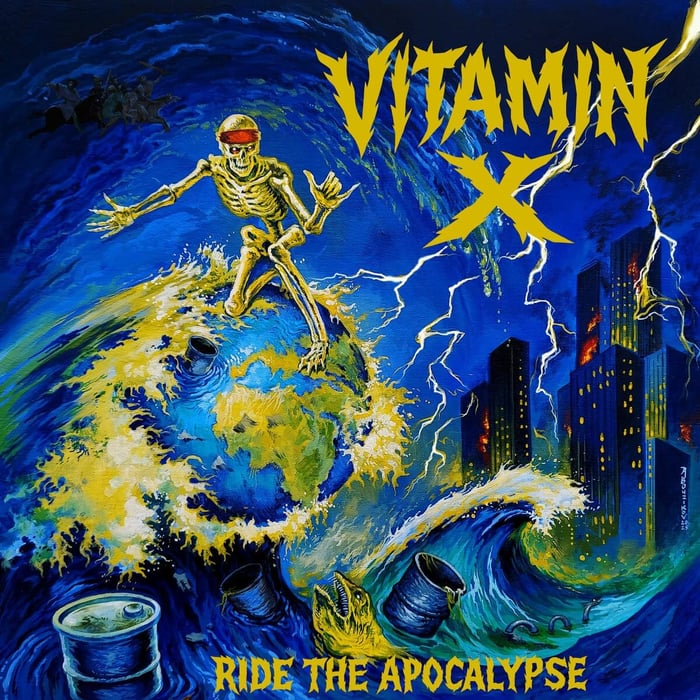
Ride The Apocalypse Review: Vitamin X Sound Like They Packed a Go-Bag


 See more Architeg Prints stories on Google.
Ride The Apocalypse Review: Vitamin X Sound Like They Packed a Go-Bag
Vitamin X turn Ride The Apocalypse into a fast, nasty pep talk—hardcore that laughs in your face while the world wobbles.
Let’s be honest: this album doesn’t “arrive,” it detonates
There are records that ask for your attention, and then there are records that kick the door off its hinges and stand there grinning. Ride The Apocalypse is the second kind. I hit play expecting “another solid hardcore album,” and within minutes I had to admit that was the wrong frame. This thing is built like a panic response—fast, sharp, and annoyingly catchy for something that clearly wants to sound like it’s sprinting away from the end of everything.
Vitamin X have been doing this long enough to know exactly what they’re poking at: that specific modern buzz where it feels like the world is constantly one headline away from an actual catastrophe. And instead of writing a long, dramatic speech about it, they compress that feeling into short blasts that make you move whether you agree or not.
They’re not predicting doom—they’re weaponizing the vibe
Here’s the part people might argue with: I don’t think Ride The Apocalypse is “about” an apocalypse in the literal, plot-heavy way metal bands sometimes do it. It’s closer to a response—like the band looked around, saw the chaos, and decided the only sane reaction was to play even faster and sound even more alive.
Hardcore and crossover worked in the ’80s because the paranoia felt physical. That era was soaked in nuclear-war dread, and the music mirrored it with speed, riffs, and a kind of gallows humor. Listening here, I kept thinking Vitamin X are deliberately keeping that lineage going—not by copying it, but by rebuilding the same nervous system in 2026. The riffs don’t “reference” old classics; they behave like them. The message isn’t subtle, but the delivery is the trick: they make urgency feel fun, which is a slightly insane creative decision… and it mostly works.
“Chop Chop Chop” is the mission statement, and it’s kind of rude
The opener, “Chop Chop Chop,” doesn’t ease you in—it shoves you in. The hook is the first surprise: it’s insanely catchy for something that’s basically a controlled riot. My first impression was that it was just chaos-for-chaos’s-sake, like a blender with sneakers on. But on second listen, it clicked: the catchiness is the point. They want you humming the apocalypse like it’s a slogan.
The track hits with that crossover snap—the sort of momentum that makes you think of bands who treated punk like a contact sport. It even carries a Suicidal Tendencies-style sense of “yeah, this is serious, but we’re still having fun.” And honestly, that fun is doing a lot of heavy lifting: without it, the album could’ve come off like pure stress. Instead, it feels like stress turned into motion.
Arguable take: the band’s “fun” isn’t decoration—it’s the engine. Without that grin in the riffs, the whole thing would collapse into generic aggression.
Speed isn’t the only trick—they keep changing how the speed feels
After that opening punch, the album keeps firing off short, rapid tracks that refuse to settle. The energy stays high, but it doesn’t stay identical. That matters, because 17 short tracks can blur together if you’re not careful—and Vitamin X mostly avoid that trap by shifting the shape of the attack.
A few highlights where the pacing choices actually say something:
- “Unleash The Wolves” comes off Motörhead-esque in spirit—less about complexity, more about a hard-driving push that feels like it’s rolling over you.
- “Ride The Apocalypse” (the title track) feels like the album locking its theme into place: not subtle, not poetic, just direct impact.
- “Sociopath” keeps the velocity up, but there’s a nasty precision to it—like they’re aiming the chaos instead of just spraying it.
Arguable take: these songs aren’t trying to be “memorable” individually as much as they’re trying to keep you in a single sustained adrenaline tunnel. If you want big standalone anthems, you might call that a weakness. If you want a record that behaves like a single event, you’ll call it smart.
The slight pace shifts are where the album shows its brains
Here’s where I hesitated for a second: I kept waiting for a real breather—something that lets your ears reset. It never fully arrives. What you get instead are small tempo and groove pivots that function like a quick inhale, not a rest.
“Genetic Mutation” and “W.A.R.” are the obvious examples. They don’t turn the album into mid-tempo rock or anything polite; they just twist the pressure valve a little. And “W.A.R.” has that chant that lodges in your skull:
“war inside my head” — Vitamin X
That line matters because it gives away what the album is really doing. The apocalypse here isn’t just “out there.” It’s internal, mental, constant. And the way they deliver it—like a barked group-chant—makes it feel less like introspection and more like a diagnosis you’re not allowed to ignore.
Arguable take: “W.A.R.” is more revealing than the title track, because it admits the chaos is psychological, not cinematic.
Riffs and grooves: not a feature, the whole lifestyle
Sonically, this album runs on massive riffs and stomping grooves—not in a show-off way, but in a “this is how we breathe” way. The guitars don’t shimmer or experiment; they bite. The grooves aren’t there to make you nod politely; they’re there to make you feel like you’re being herded through the songs at speed.
And it’s consistent. That’s both a strength and—here’s my mild criticism—a limitation. By the middle stretch, I did briefly wonder if they were so committed to the constant punch that they left some dynamics on the table. Not dynamics as in “ballads,” obviously, but dynamics as in surprise. The album’s best trick is that it’s relentless; the tradeoff is that relentlessness can become predictable if you’re hoping for a left turn.
Arguable take: the record’s consistency is almost confrontational—Vitamin X are basically saying, “No, you don’t get a break, because the world doesn’t either.”
The closing run doesn’t wind down—it keeps swinging
When the album hits the final stretch with “Fear, It Never Ends” and “Over The Line,” the impressive part is that it still sounds energized, not drained. A lot of albums like this start to feel like they’re just finishing the checklist. These tracks don’t. They keep that same punchy urgency, like the band’s trying to prove the “apocalypse ride” doesn’t end when you want it to.
It also makes the full 17-track sprint feel like a deliberate design choice: short, sharp shocks that build an arc by accumulation. I’m not totally certain everyone will experience it that way—some listeners will hear “a lot of fast songs” and bounce off. But if you let the sequence hit you as a full run, the ending feels less like closure and more like a final shove forward.
Arguable take: the closer isn’t trying to resolve anything; it’s trying to keep you tense enough to do something about your own chaos.
So what’s the album actually saying? Hope—delivered like a headbutt
The weird magic of Ride The Apocalypse is that it carries hope without sounding soft for even a second. It’s not “everything will be okay.” It’s more like: everything is on fire, so move. The band’s confidence—nearly three decades of being a band, and it shows—turns that message into something physical.
And yeah, part of me wants to roll my eyes at the idea of “hope” in a thrashing hardcore barrage. But the record earns it by never slipping into theatrical despair. It’s angry, sure. It’s fast. It’s chaotic. But it’s also weirdly uplifting in the way a well-timed shove can be uplifting: not comforting, just clarifying.
Release note
Ride The Apocalypse is out now via Svart Records.
Conclusion
Vitamin X didn’t make a “timely” record. They made a record that treats modern chaos like fuel and then lights it anyway. Ride The Apocalypse is what happens when a band refuses to slow down—not because they can’t, but because slowing down would feel like lying.
Our verdict: People who like hardcore and crossover that’s catchy enough to be dangerous will love this—especially if you enjoy records that feel like one continuous, sweaty shove. If you need dynamics, big singalong choruses, or any kind of gentle invitation, you’ll hate it and probably call it exhausting (you won’t be wrong, you’ll just be missing the point).
FAQ
- Is “Ride The Apocalypse” more hardcore or thrash?
It plays in that hardcore/crossover lane where thrash energy shows up as riff weight and speed, but the attitude stays punk-first. - What track best represents the album’s vibe?
“Chop Chop Chop” says it plainly: maximum momentum, nasty hook, no warm-up. - Does the album ever slow down?
Not really. It shifts pace in spots (“Genetic Mutation,” “W.A.R.”), but it never gives you a true breather. - What’s the standout lyrical moment?
The “war inside my head” chant in “W.A.R.” is the tell—it frames the apocalypse as internal as much as external. - Who is this album not for?
Anyone who wants subtle mood-building, long songs, or spacious production will feel like they’re trapped in a fast room with no exit.
If you want a physical reminder of that “beautiful panic” feeling, it makes a lot of sense to hang an album cover poster where you’ll actually see it. You can shop your favorite album cover poster at our store: https://www.architeg-prints.com
 | DISCOUNTGET 30% OFF*Use code on your next order:
|
* This post may contain affiliate links, meaning we earn a commission if you make a purchase through these links, at no additional cost to you.