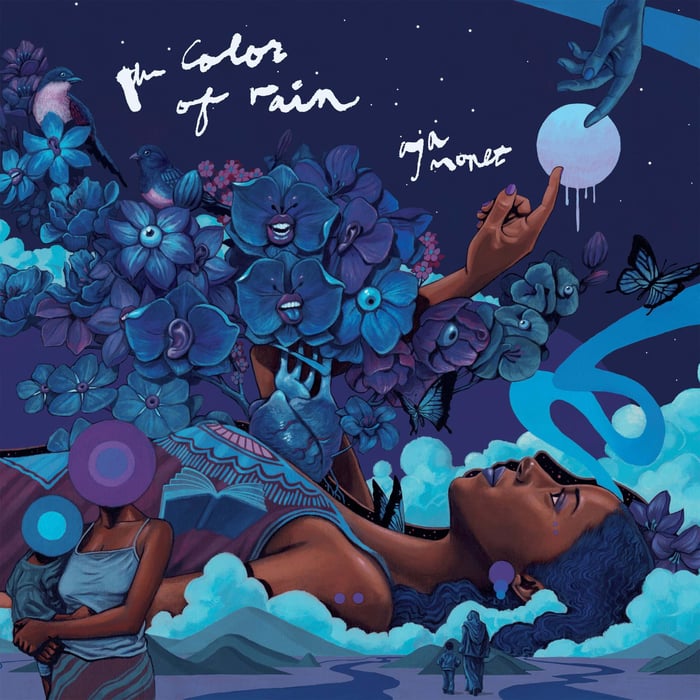
Aja Monet’s Color of Rain Review: Poetry as a City Map (Fight Me)


 See more Architeg Prints stories on Google.
Aja Monet’s Color of Rain Review: Poetry as a City Map (Fight Me)
aja monet’s color of rain turns doom-scroll panic into bass, harp, and blunt self-interrogation—pretty, angry, and occasionally a beat too long.
This album doesn’t “set a mood.” It sets a location.
Three minutes into color of rain, I wasn’t admiring the poetry—I was trying to keep up with it. The record moves like someone narrating a city while sprinting, except the point isn’t to impress you with endurance. The point is to make you feel how exhausting it is to be awake right now.
And yes, it’s gorgeous in places. But it’s not “pretty” in the decorative sense. It’s pretty the way a lightning storm is pretty: the air gets charged, your hair stands up, and you realize you might be standing in the wrong place.
“hollyweird” opens like a broadcast from the grave
The opener, “hollyweird,” is where the album makes its mission statement without politely calling it that. The setting is Altadena—close enough to a fire scar to smell like aftermath—and it drags Octavia Butler’s headstone into the frame like a television anchor desk. The whole track plays like a newscast beamed up from the ground.
Musically, it’s all motion. A marching band energy reduced down to four players—still trying to strut, but leaner, stranger, almost damaged. The bass is the real agitator: it refuses to settle on a single picture, like it’s flipping channels inside your chest. The images come fast and kind of mean:
- Runyon Canyon turned into an arsonist’s fantasy
- Koreatown under a neon cotton-candy cloud at midnight
- a mayor in Ghana during Detty December
- a trans woman in burgundy and yellow sunglasses sipping iced tea while a protest slides by
That last detail is the tell. This record isn’t interested in “the movement” as an abstract poster. It’s interested in the sidewalk. The body. The random human still doing human stuff while the world performs its collapse in the background.
And Monet doesn’t pretend any of this is clean. She even says it straight:
“It is not rain.”That line lands like someone stopping mid-metaphor to admit the metaphor isn’t comforting anymore.
A reasonable listener could call this cluttered. I’d argue the clutter is the point—because that’s what a doom-scroll feels like when it leaks into real streets.
“withness” teaches the band how to breathe
After that opening sprint, “withness” does something sneaky: it slows your heartbeat without fully calming you down. The bass plays a repetitive figure that feels like a stretched inhale—four notes, elongated, held in the air long enough for you to notice your own lungs.
Justin Brown’s drumming here isn’t “light” as in gentle; it’s light as in testing gravity. He taps at the edges of time, like he’s trying to find the thinnest spot in the wall and push through. The room sort of decolorizes. Reality fades back. Monet’s interior takes over.
At first, I thought the minimalism meant the track was going to drift into background music. On second listen, I caught what it’s actually doing: it’s building a private chamber inside the record where the later anger can echo.
That’s a deliberate choice, and it’s a risky one. Some people want their protest art to be loud at all times. color of rain keeps insisting that quiet is part of the argument.
“elsewhere” turns the band toward the club—without pretending it’s escapism
“elsewhere” pivots the focus into something like a club pulse. Not “party track,” not “dance floor relief.” More like: the body still needs rhythm even while the brain is full of headlines.
The syncopation feels like a nod to Sly Stone—tight but slippery, the groove as a mirror you can’t stare into without seeing yourself distort. Georgia Anne Muldrow’s voice shows up on that electric line, like she’s singing through a filament. It’s a smart placement: her presence makes the track feel less like a feature and more like a haunt.
This is where I started realizing the album is longer and more relaxed than Monet’s last one, and it’s not an accident. The previous approach had a tense band feel—wired, sharp. Here, the looseness is a tactic. She’s not defusing the anger; she’s giving it room to turn into something that can last longer than a slogan.
“indigo” makes the harp a pressure system, not a decoration
Brandee Younger’s harp on “indigo” doesn’t float in like some angelic garnish. It washes through in glissandi that act like a buffer—almost a vocal mechanism between words and rhythm. There’s a physicality to it, like a throat clearing, like sound turning into skin.
I kept thinking about how often harp gets used as shorthand for “pretty.” Here it’s used as shorthand for continuity—for the thing that keeps moving even when the speaker is stuck.
If you don’t like spoken-word records, this is the stretch that might convert you. Or annoy you more. Either way, it’s not passive.
“for the Congo” attacks you in under two bars
Then “for the Congo” shows up and stops being patient. The hand-drum pattern locks in with a relentlessness that feels hostile almost immediately—less “welcome” and more “you’re going to listen now.”
Lyrically, Monet fires directly at big machinery: the World Bank, the IMF, Paul Kagame, Rwanda, foreign extraction companies, military regimes. It’s naming names, and the percussion makes the naming feel like an accusation you can’t dodge.
But the part that actually sticks isn’t just the geopolitical roll call—it’s when she turns the blade inward:
“This is the war my favorite poet warned me about / The one between me and me.”
That flip matters. A lot of political art wants the enemy to stay conveniently external. This track admits the uglier truth: the outside war gets inside, and then you’re fighting yourself with the same tools.
When she says
“the death machines in our palms,”the song isn’t being poetic. It’s being literal enough to make you look down at your hand. This track is basically grabbing your phone and asking, Are you sure you’re not holding the problem right now?
If that feels unfair, good. It’s meant to.
“to sister” pulls the record back into the body (before it collapses into grievances)
After all that, the album could’ve easily become a pileup of specifics—Edison power lines, smart meters, the Rafah border—so many details that the cumulative weight turns into one long grievance note.
But “to sister” stops that from happening. It drags the focus back to flesh and care. Monet sings:
- “un-punish yourself”
- “un-self yourself”
- “you deserve to be well-kept, held close to the chest”
And the imagery is intimate without being sentimental: stretch marks holding the frame, a head wrap, a thigh thinking of cocoa beans. It’s not “self-love” in the motivational-poster sense. It’s survival talk. The kind you say when you’re tired of watching people weaponize purity against themselves.
Here’s my arguable claim: this might be the album’s most political moment, because it refuses to treat the body as an afterthought to ideology.
“skinfolk” is the tender center—and it sneaks its politics in through rhythm
Side A’s real heart is “skinfolk.” It turns a catalog of bodies into a hymn without turning it into a lecture. Monet sings skin into prayer hands, hard work, sacrifice—then drops “dreadlocked Jesus” into the frame like she’s daring you to argue with the image.
The hook that keeps looping in my mind is
“Skin double dutching the darkness.”And yeah, that’s a wild phrase. But it works because it’s not just clever—there’s a jump-rope rhythm implied in the words. Two ropes turning. Feet hitting concrete. That motion carries more political weight than a lot of neatly typed protest poetry, because it’s bodily. It’s lived.
Mereba’s voice floats in with:
“I was dancing… with the sound of light… Good grief… We escaped a world of black and white.”
Younger’s harp cascades through the verses, the bass holds a deep funk groove, and Monet closes with a line that feels like an oath: she’s loved this skin “longer than loving.”
I’ll risk another arguable statement: “skinfolk” makes the case that tenderness can be more defiant than rage—because tenderness refuses to be shaped by the enemy’s expectations.
“melting clocks” is the feature track that almost trips over its own urgency
“melting clocks” brings in Mick Jenkins and Vic Mensa, and it’s the album’s most uneven moment for me. Not a disaster—just a little lopsided, like everyone showed up with a different assignment.
Mensa’s verse goes full velocity with historical reversals—“If I could turn back the hands of time…”—and it name-checks so fast that the references blur into each other. I’m not saying the bars are empty. I’m saying the speed doesn’t let anything land, which is a weird problem to have on an album that otherwise understands pacing so well.
Mick Jenkins does the opposite: he turns inward.
“The moment you start keeping is the moment you lost me.”
That line actually breathes.
And Monet? She’s slower than both of them, almost stubbornly patient, talking about how wristwatches sell us the pipe dream of owning time. The rappers sound urgent against her calm, which is an interesting tension… but it also makes the song feel like it’s pulling in two directions without choosing one.
I might be wrong, and maybe that friction is intentional. Still, this is the one track where I felt the seams.
“every media minute” starts razor-sharp, then thins out
When “every media minute” shows up, it returns to the opener’s panoramic speed—news-cycle intensity, images flipping by at the pace of scrolling. The opening is sharp enough to cut.
Then it drifts into a long passage about wanting a God no American can worship—a God who smuggles souls past patrol officers, returns prayers to sender. The idea is strong. The wish is vivid.
But the list goes on just a beat too long. The section thins, and a climactic line—
“There’s a whole lot of religion and not enough God”—hits like a finisher from a slam set. And look, I like a good finisher. I just don’t think this album needs that kind of button. It’s already doing something more unsettling than crowd-pleasing closure.
That’s my mild criticism: color of rain is at its best when it refuses to resolve. When it tries to stick the landing too neatly, it briefly shrinks its own world.
“working class musicians” keeps its hands dirty—and that’s why it wins
By contrast, “working class musicians” stays gritty and specific: trumpet trigger fingers grappling brass valves, hauling a kit on the subway in the snow, rent stress turned into chant. It’s the kind of writing that doesn’t romanticize the grind but also doesn’t perform misery like it’s a credential.
And the hook—“The rent’s too damn high”—shouldn’t work as well as it does. It’s almost too obvious. But the groove underneath is so tight you can’t argue with it. It makes you laugh before you realize you’re laughing at your own situation.
This track also clarifies something about the record’s evolution: where Monet’s debut leaned hard on a trumpet voice, here Justin Brown’s drums take over that role—marking time, breaking it open, pushing the air around the words. Brandee Younger’s harp answers where the horn used to lift. And the bass in “withness” holds the floor in a way that feels like the new foundation.
This isn’t “growth” as in polishing. It’s growth as in redistributing weight.
Where I land on it (and what I’m still not sure about)
I land on color of rain as a four-out-of-five kind of listen—messy in places, intentionally overwhelming in others, and still strangely replayable for an album that keeps staring straight at catastrophe.
What I’m still not totally sure about is whether the record wants you to feel relief at any point. Sometimes the tenderness feels like a rope thrown to the listener. Sometimes it feels like another demand: Be softer, but don’t you dare look away.
That contradiction might be the real design. Or I might just be reacting to how personal the record gets when it could’ve stayed safely political.
Either way, these are the tracks I kept circling back to because they actually move—not just sonically, but ethically:
- “hollyweird”
- “for the Congo”
- “skinfolk”
Conclusion
color of rain doesn’t try to convince you the world is ending. It assumes you already know—and then it asks what you’re going to do with your body, your time, your attention, and the little death machine glowing in your palm.
Our verdict: People who like their poetry musical, their grooves lived-in, and their politics personal will actually love this album. People who want tidy hooks, quick resolutions, or “keep it positive” vibes will bounce off it and call it exhausting—correctly, but also kind of missing the point.
FAQ
- Is color of rain more jazz, poetry, or soul?
It plays all three lanes at once, but it uses rhythm like infrastructure—bass and drums do as much storytelling as the words. - What’s the best entry point track if I’m new to aja monet?
“skinfolk” is the most welcoming without watering anything down. - Does the album ever get too dense?
Yes—“every media minute” flirts with overstaying its own idea, even though the opening is razor-sharp. - Which track hits hardest politically?
“for the Congo,” because the percussion feels like accusation and the lyrics refuse to keep the war “over there.” - Are the features essential?
They’re interesting rather than essential. “melting clocks” is the most uneven moment, but it’s uneven in a revealing way.
If you’re the type who remembers albums by their artwork as much as their sound, you can shop a favorite album cover poster at our store—tastefully, not loudly—over at https://www.architeg-prints.com/.
 | DISCOUNTGET 30% OFF*Use code on your next order:
|
* This post may contain affiliate links, meaning we earn a commission if you make a purchase through these links, at no additional cost to you.