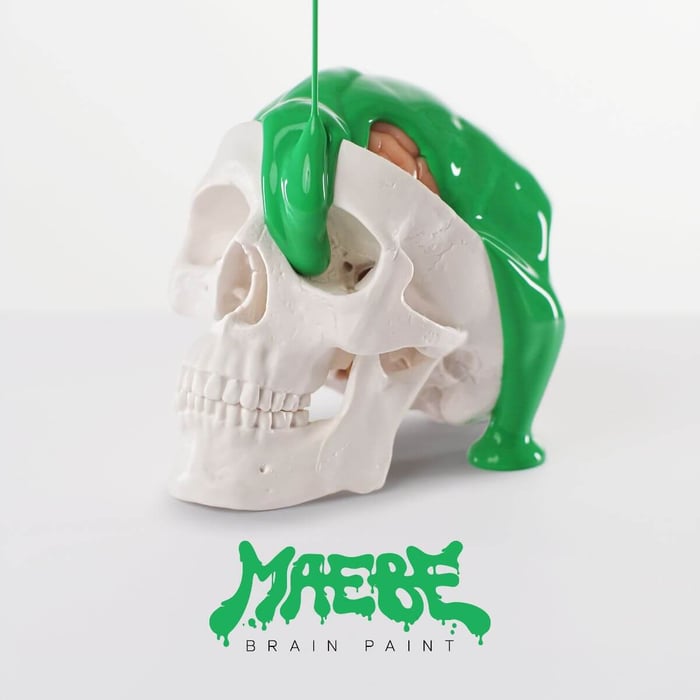
Brain Paint Review: Maebe’s Guitar Maximalism, For Better or Worse


 See more Architeg Prints stories on Google.
Brain Paint Review: Maebe’s Guitar Maximalism, For Better or Worse
Brain Paint is Maebe going full five-piece and turning ADHD-like whiplash into a songwriting strategy—hooky, loud, and occasionally too samey.
A record that dares you not to grin
Some albums want to change your life. Brain Paint mostly wants to light up the “plug in the guitar and do something dumb and glorious” part of your brain—and it’s surprisingly good at it.
The funny thing is, I went in expecting another sterile instrumental shred-fest. On first impression, the opening minutes had me bracing for endless technique worship. But the longer I sat with it, the clearer it got: this isn’t a flex record. It’s a “move your neck, remember riffs exist” record. That’s a more interesting ambition than it sounds.
From bedroom project to five-piece: the real upgrade
Here’s the context you can hear without reading a press release: Maebe used to feel like one person stacking guitar ideas in a room, and now it sounds like a band that has to look each other in the eye and commit.
This project started as a solo instrumental guitar thing built in spare hours, led by Michael Astley-Brown—someone who clearly knows the particular thrill of picking up an electric guitar for the first time and immediately trying to become a riff machine. That origin still shows. Even now, when the arrangements get busy, the music keeps circling back to that beginner’s-fire feeling: what if I learned one more lick and it unlocked a new personality?
A lot changed over the last six years: Maebe expanded into a full five-piece, put out a second album in 2023, and piled up enough gigs to sit comfortably in the UK’s prog/post-rock/math-rock ecosystem. But Brain Paint keeps the same stubborn through-line as earlier work: it’s unapologetically guitar-forward, not in a “guitar is the only valid instrument” way, but in a “this is the toy we chose, so we’re using every button” way. You could argue that’s limiting. I’d argue it’s honest.
The title track “Brain Paint” sets the terms: chaos with a grin
The opener and title track, “Brain Paint,” doesn’t ease you in. It sprints. Three guitars hit like they’re trying to out-run each other, and the drums don’t politely “support”—they shove.
The title can point at an ADHD treatment (among other meanings), and whether or not you care about that association, the sound sells the idea: the song flips from calm to full-throttle so fast it feels like someone yanked the steering wheel mid-sentence. That dynamic snap is basically the album’s thesis. And it’s an arguable move: some listeners will hear it as exciting; others will hear it as the band refusing to sit still long enough to be memorable. I landed on the exciting side… most of the time.
Three guitarists, one mix: the production choice that saves it
Next hook line, because it matters: this album could’ve been a mud fight, but it isn’t.
Astley-Brown is now joined by Duncan Stagg and Will Thomas on six-string duties, and Maebe rarely settle for a single guitar line when two (or three) will do. The tricky part isn’t playing a lot—it’s keeping it intelligible.
That’s where producer Tom Peters earns his keep. The record carries some of the same kind of punchy, kinetic production energy you’d want for this style, but the bigger win is separation: the guitars stay distinct instead of collapsing into one overcooked wall. Honestly, I expected at least a few moments where everything turns to sludge. It mostly doesn’t. You can follow the lines. You can tell who’s doing what. That’s not a small deal on a record built around maximalism.
If you want a hot take: this mix is basically the album’s fourth guitarist. Without it, Brain Paint would just be “a lot,” and not the good kind.
Drums and bass finally feel like humans, not a grid
Here’s the bridge from “wall of guitars” to “band identity”: the rhythm section gives the music a spine that a programmed approach just can’t fake.
With full-time bass and drums, the songs feel less like parts assembled and more like people reacting. Nicholas Appelgren’s drumming gets real highlights—the 16-beat cymbal textures on “Dripping Colour” are the sort of detail that changes how you hear an entire section. It’s not flashy; it’s atmosphere with muscle.
That said, I’m not going to pretend this is a drums-forward record. Compared to modern instrumental monsters where the drummer feels like a co-lead voice, Maebe keep the kit a little more “useful” than “show-stopping.” Some listeners will prefer that. If you came for virtuosic drum heroics, you might end up staring at the guitars like, “Okay, fine, I get it, you’re the main character.”
Not Satriani, not Polyphia: Maebe choose hooks over stunt work
This is where Brain Paint quietly separates itself from a lot of instrumental guitar music. It doesn’t chase the old-school “virtuoso hero” tradition, and it doesn’t feel engineered for modern clip-ready “look at my hands” flexing either. The playing is clearly skilled, but it doesn’t constantly go for that how is that physically possible effect.
Instead, Maebe keep aiming at something less braggy and more practical: hooks. Energy. Parts that would actually make sense in a room full of people rather than a comment section full of guitarists arguing about pickups.
- “lower case song title” is a clean example of their approach: math-rock jitter and post-rock lift-off, but structured so the crescendo feels like the point, not just an accident of layering.
- “God Wit” does a similar trick, just bigger—guitars running across each other until it locks into a hook that’s honestly catchier than this genre sometimes allows itself to be.
I kept waiting for the band to drop into pure self-indulgence. They flirt with it, sure, but the writing usually wins the argument. That’s a deliberate choice, and I respect it—even when I’m not fully convinced by the results.
The cost of maximalism: when “more” starts sounding like “same”
Now the part where the album shows its seams.
Writing for live performance without backing tracks gives the material a certain honest punch—like the band is building songs they can actually reproduce, not just render. But packing the record with similar guitar tones and similar types of forward motion can create a weird staleness. Not boredom, exactly. More like palate fatigue.
There are moments where I genuinely wasn’t sure whether my attention was drifting because the songs were too long, or because the album keeps returning to the same few gears. It’s probably both.
The most obvious “we can do another color” hint shows up right at the start of “Do Not Take Risks,” where a light bitcrush effect briefly suggests the record might pivot into something more textural or left-field. It’s a tease. The album mostly goes back to being, well, an album about guitars being guitars.
And yeah—mild criticism time—a tighter edit would’ve helped. When most tracks stretch out, the sameness has more time to settle in. Trimming some runtimes could’ve made the big moments hit harder instead of simply arriving on schedule.
The exceptions that prove they can break the formula
Here’s the link forward: the best moments are the ones where Maebe slightly betray their own template.
“Sadstorm” is the standout in this category. It folds prog and post-rock together, leans into a 5/4 pulse, and lets wah and tremolo color the edges. It also taps into a kind of madcap, spacey energy that reminds me of the guitar-odyssey spirit you get in The Artful Escape—not because it sounds the same, but because it shares that giddy belief that instrumental guitar music can still be an adventure rather than a résumé.
Then there’s the closer, “Who Do You Think You Aren’t,” which finally releases the handbrake and goes harder—chunky breakdowns, a more hardcore gear, less “sparkly math sprint,” more “okay, let’s hit something.” If someone told you Maebe can’t do heavy, this track argues back.
My arguable claim here: those two tracks feel like the band accidentally admitting they’re capable of a wider emotional range than the rest of the album lets on. I wanted more of that risk.
So what is Brain Paint actually doing?
It’s not trying to be profound. It’s not pretending to carry a grand message. Brain Paint is built to produce a specific reaction: a big dumb smile, the kind you get when a riff lands and your brain goes, “Right. That’s why people buy guitars.”
If that sounds like I’m underselling it, I’m not. This is Maebe’s business: guitar maximalism taken at face value, played with verve, arranged for a real band, and mixed so you can actually hear the moving parts. And while I can’t swear every long track earns its runtime, I can say the album commits to its own idea with zero embarrassment—which is rarer than it should be.
Brain Paint is set for release on May 22nd, 2026 via Ripcord Records.
Conclusion
Brain Paint isn’t a philosophical statement; it’s a practical one: guitars are fun, a five-piece can sound huge without turning to sludge, and hooks still matter in instrumental music—even when the riffs are sprinting.
Our verdict: Guitar players (new or jaded) who miss that first-riff dopamine hit will actually like this album, because it’s basically engineered to restart your “I should practice” impulse. People who need big stylistic left turns, vocal narratives, or radically different textures from track to track will not—this thing loves its own palette and doesn’t apologize for it.
FAQ
- What is the core vibe of Brain Paint?
It’s high-energy instrumental guitar music that prioritizes hooks and momentum over showy impossibility. - Does Maebe focus on virtuoso shredding?
The playing is clearly skilled, but the album avoids constant stunt-work; it aims for memorable parts more than jaw-drop technique. - Is this album more “band” than “solo project”?
Yes. You can hear the shift into a full five-piece—more interaction, more layered guitar lines, and less of a programmed feel. - Which tracks break the album’s usual formula the most?
“Sadstorm” (with its 5/4, wah, and tremolo colors) and “Who Do You Think You Aren’t” (hardcore-leaning breakdown energy). - Any downsides worth knowing?
The guitar-maximal approach can start to feel sonically uniform across longer runtimes; a little trimming would’ve sharpened the impact.
If this album got you thinking about the visual side of guitar obsession too, you can shop a favorite album cover poster over at https://www.architeg-prints.com — an easy way to keep that riff-brain mood on the wall.
 | DISCOUNTGET 30% OFF*Use code on your next order:
|
* This post may contain affiliate links, meaning we earn a commission if you make a purchase through these links, at no additional cost to you.