Armour of Angels Review: Guilt Trip’s Holy Violence (Too Catchy?)


 See more Architeg Prints stories on Google.
Armour of Angels Review: Guilt Trip’s Holy Violence (Too Catchy?)
Armour of Angels turns Guilt Trip’s metalcore into pit-fuel with biblical flair—hooks, hate, and breakdowns that feel like a dare.
Welcome to the part where your sneakers betray you
This is the kind of album that makes you understand why people tie their shoes like they’re prepping for combat. Armour of Angels doesn’t invite movement—it demands it, and it does it with the blunt confidence of a band that knows the pit is basically their natural habitat.
I’ve watched the slow creep happen at shows: more and more Guilt Trip shirts clustered near the front like a migrating species. This record feels like the moment they stop being “that heavy band people mention” and start being the band other bands quietly worry about running into on a lineup.
“One By One” opens the door—then kicks it off the hinges
The first real swing is “One By One,” and it shows its hand immediately: menace first, manners never. The intro lands with that sharp, classic-thrash tension—honestly, it flashed Metallica’s “Battery” in my head before the main riff even finished its first lap. And once those slashing guitars start, the album basically says: you’re here now, good luck leaving.
Jay Valentine doesn’t sound like he’s trying to “perform” anger. He sounds like he already made the decision and the mic is just paperwork. The solos and squealing harmonics come in like they’re meant to cut through bone, not decorate the song. If there’s a mission statement across this album, it’s that there’s no room for wasted notes—everything that’s here is here to hit.
That said, I’ll admit something: on my first pass, I thought the opening was almost too eager to prove it’s hard. On second listen, it stopped feeling like showing off and started feeling like a band refusing to dilute anything for comfort.
The album’s “biblical apocalypse” thing isn’t subtle—and that’s the point
The titles alone push a very specific mood: “Cut from God,” “Resurrected,” and of course Armour of Angels as the banner over the whole thing. It’s not delicate symbolism. It’s end-times language used like a weapon—big words for big riffs, and the album commits to that aesthetic so hard it becomes weirdly coherent.
The closer “The Banner of Heaven” is where that imagery turns physical. The breakdowns don’t feel like a standard heavy-music “drop”—they feel like the floor splitting open. It plays like Heaven and Hell collide and decide they’d rather become the same thing than negotiate.
And that’s the album’s real trick: it rarely gives you a breather. Track-to-track, the riffs keep coming like the band’s allergic to “let’s bring it down for dynamics.” I kept waiting for the record to blink. It mostly doesn’t.
“Burn” wins the intro war, and the guitars deserve the credit
If we’re talking about pure opening-impact, “Burn” is the one that tries to crack the earth in half right from the start. There’s an immediate, earth-shaking quality to it—the kind of intro that makes you do that instinctive stank-face check, like: okay, so this is what we’re doing today.
A lot of that comes down to the guitar work. Jak Maden and Sam Baker don’t just write riffs; they build pressure systems. The album’s riffs feel “stacked”—as if each section is designed to shove the next one into the wall harder. It’s not just heavy. It’s engineered to keep you moving.
They sneak melody in like it’s contraband
Here’s the part some people will argue with me about: the album’s best flex isn’t the brutality—it’s the restraint in the melodic moments.
The fast, brutal catharsis is obviously the main protein here, but Guilt Trip layer it with choruses that actually sing without turning soft. “Dirt” is the clean example: the chorus comes in composed, almost poised, like the band briefly steps back and lets atmosphere do the intimidation. It’s not pretty in a shiny way; it’s “sinister elegance,” like a knife polished just enough to reflect your face.
I’m not claiming they’re reinventing melody. But the way they place it—right where you’d expect another punch—adds depth without deflating the heaviness. That’s harder than it sounds, and plenty of bands mess it up by making the chorus feel like an apology. This one doesn’t.
Yes, it has that “touch me and it’s over” energy
Most of this album carries a distinct tough-guy hardcore tinge—the kind that feels adjacent to Hatebreed or Kublai Khan TX in attitude. Not a copy, more like the same emotional temperature: “I will solve this problem with my hands.”
And honestly… that’s what a lot of people came for. The record leans into confrontation like it’s a hook, and in this genre, that’s basically a love language.
If I have one mild gripe, it’s that the constant intensity can blur the edges between tracks if you’re not paying attention. The upside is obvious: the album never drags. The downside is that it sometimes feels like it’s trying to win every moment, even the moments that would hit harder if they waited half a second.
Jay Valentine’s lyrics aren’t subtle; they’re a lit match
The lyrical highlights aren’t about cleverness. They’re about impact—and Valentine knows exactly how much violence a single line can carry when the band behind him is already throwing cinder blocks.
“I know god forgives but I fucking don’t” — Jay Valentine
On “Angel Eyes,” he drops a line that sounds like a personal rule carved into stone.
“Forge my fist into a bullet before I send it through your fucking teeth” — Jay Valentine
And “No Love Lost” goes for the throat with that line. Those lines don’t work because they’re poetic. They work because they match the firepower in the instruments—anything softer would’ve felt dishonest. Valentine’s delivery has that unhinged, unforgiving edge that makes the heart rate climb a little, like you’re listening to someone pace in a room with no windows.
Do I fully know if the record is playing a character or if it’s just pure emotional discharge? I’m not 100% sure. But I do know it’s convincing enough that the question barely matters while it’s blasting.
This thing moves like it wants a fight—and it could soundtrack one
By the end, Armour of Angels feels like it’s galloping on pure adrenaline—like demonic blood cells tearing through a steroid-inflated bicep. Overstated? Sure. But the album earns that kind of ridiculous metaphor because it’s ridiculous in the way it refuses to calm down.
It’s also strangely easy to imagine these songs as walkout music—big arena drama, big stomping tempo, riffs designed to make humans act like they’re made of springs. If someone in sports-entertainment-land is asleep at the wheel, they’re missing a pile of ready-made entrances.
Where do I land overall? Somewhere around an 8/10 in effect: it does what it’s trying to do with very little wasted motion, and when it adds melody, it does it without turning the lights on.
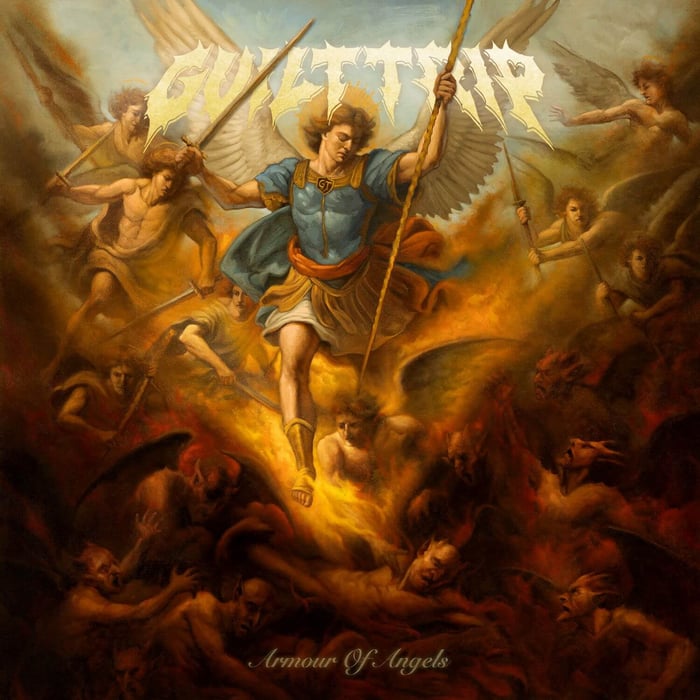
Album art (and the promise it makes)
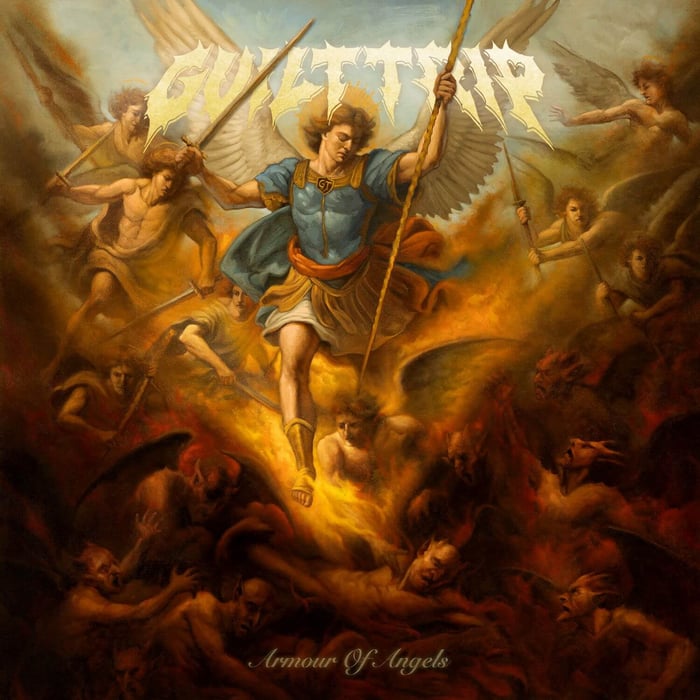
The cover fits the record: dramatic, ominous, and not remotely interested in subtlety. Like the music, it looks like it wants to be taken seriously and punched at the same time.
Release note (keeping it simple)
Armour of Angels is out now via Roadrunner Records. If you’re the type who keeps tabs on bands through social media, Guilt Trip are on Facebook.
Conclusion
Armour of Angels is Guilt Trip choosing escalation as a lifestyle: riffs stacked like bricks, vocals like a threat letter, and just enough melody to make the heaviness feel sharper instead of safer.
Our verdict: People who like metalcore that acts like it could start a riot will love this album—especially if you enjoy choruses that don’t apologize for being catchy. If you need nuance, softness, or even a single moment of calm to reset your brain, this record will treat you like you brought a library voice to a demolition site.
FAQ
- What is the core sound of Armour of Angels?
Fast, brutal metalcore with hardcore bite—packed with riffs, breakdowns, and an aggressive vocal approach that rarely lets up. - Does Armour of Angels have any melodic moments?
Yes. Tracks like “Dirt” use melodic choruses to add atmosphere without deflating the heaviness. - Which track hits hardest right away?
“Burn” stands out for an especially earth-shaking intro that sets a “no mercy” tone instantly. - What’s the lyrical vibe on the album?
Apocalyptic and biblical imagery mixed with blunt violence and personal grievance—delivered like it’s meant to sting, not impress. - Is this album approachable for new listeners?
If you already like heavy music that stays confrontational, yes. If you want gradual build-ups or wide dynamic range, it may feel relentless.
If the album’s aesthetic stuck with you, a sharp album-cover poster can be a nice way to keep that energy on the wall instead of in your knees. You can browse options at our store: https://www.architeg-prints.com/
 | DISCOUNTGET 30% OFF*Use code on your next order:
|
* This post may contain affiliate links, meaning we earn a commission if you make a purchase through these links, at no additional cost to you.