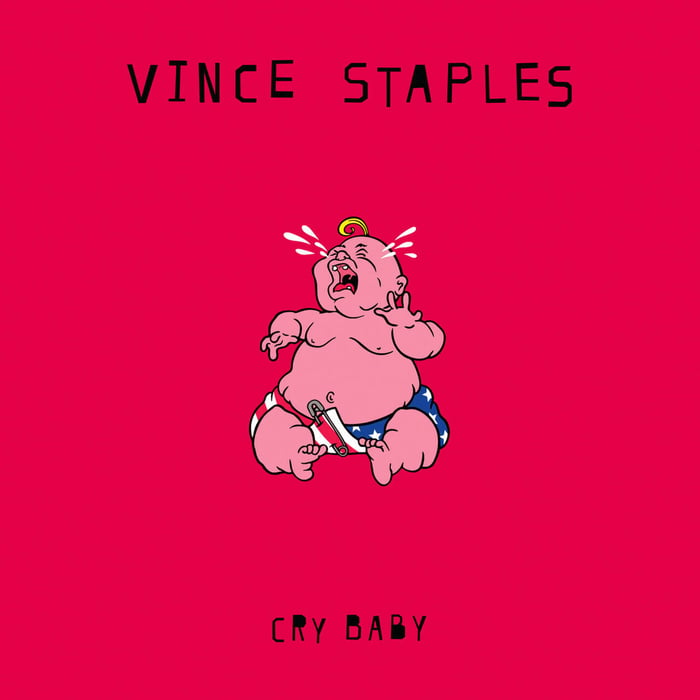
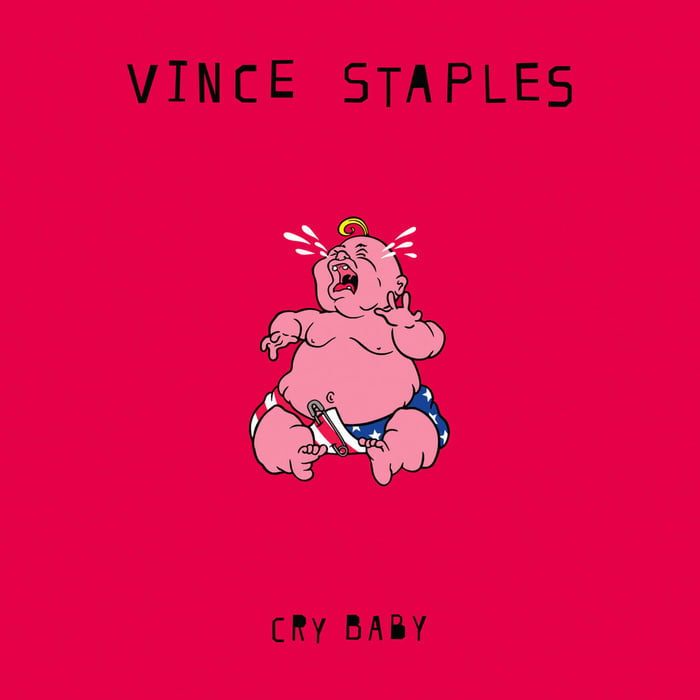
Vince Staples’ Cry Baby Review: Patriotism, But Make It a Threat


 See more Architeg Prints stories on Google.
Vince Staples’ Cry Baby Review: Patriotism, But Make It a Threat
Cry Baby turns Vince Staples’ gaze outward—guitars, no comfort, and a brutal read on America that dares you to keep watching.
The first shock: he flips the camera, but it’s still aimed at his chest
Vince Staples has spent the last stretch of his catalog filming close-ups: Ramona Park, the original block, the letdowns, the grind, the emotional toll that comes from being watched for a decade straight. Those projects felt small on purpose—tight frames, no wasted air, a guy taking his own measurements and not asking anyone to clap.
Cry Baby does something sneakier. It turns the camera around, supposedly toward the country that made him. The sound follows: songs performed like they’re being played live, guitars up front, and the kind of momentum you get when drums aren’t trapped in a grid. But here’s the catch: even when he looks outward, he keeps the lens stuck on his own body. The subjects are “America,” sure—but the bruises are still his.
That’s the intent I hear: not “here’s my story,” but “here’s what your story does to my nervous system.”
“Blackberry Marmalade” opens sweet—and then yanks the spoon away
The album’s tone-shift trick shows up early on “Blackberry Marmalade.” A single guitar figure basically is the song’s spine, and Vince stacks it with tiny comforts—domestic joy rendered in pantry items and warm-weather habits: blackberry marmalade, sweet tea, the whole small-life fantasy.
At first, I thought he was relaxing. Like maybe he’d finally let himself be tender without immediately turning it into a crime scene.
Then the hook comes back around and he cuts it with two words: “They lying.” The sweetness turns into bait. The chorus isn’t comfort—it’s a setup for the post-chorus gut-check aimed at whoever’s listening: “Promise me you won’t gun me down.” That line doesn’t ask for empathy. It asks for a basic suspension of violence, like he’s negotiating with the room.
And the song’s most jolting moment is the third verse: a rapid-fire chain of labels—“ghetto, bougie, conscious, pompous, Obama, and Kamala, who the fuck you calling nigga?” It’s not just wordplay. It’s him dragging an entire lifetime of how a Black man gets addressed—every “acceptable” version and every degrading one—into a single breath. You can disagree with how blunt it is, but you can’t claim it’s unclear.
Arguable take: the guitar’s warmth isn’t there to soften the message—it’s there to make the betrayal sting harder.
“Go! Go! Gorilla” turns a traffic stop into the album’s central thesis
The dread gets more literal on “Go! Go! Gorilla.” Vince plays a suspect in real time, trying to parse what’s happening: Is this harassment or arrest? It’s the kind of question you ask when you already know the answer but need the ritual to follow the script.
He asks the cop to speak with him. He hands over his safety like it’s a receipt. And then he drops the line that feels like the album’s thesis statement: “Why do I live in fear of a gun and a badge?”
That’s not poetic. That’s a practical question from someone who has done the math and still can’t solve for “alive.” In one stroke, he compresses a whole national history—breadlines to prisons—then snaps back to a memory of being twelve and getting shoved to the ground by a grown man for refusing arrest. The gun and badge aren’t a plot device. They’re an antagonism that doesn’t get outsmarted.
If there’s a mild issue here, it’s that the track’s intensity arrives so fast it almost leaves the music behind. It’s gripping, but it doesn’t “build.” It just grabs you by the collar—and depending on your taste, that might be the point or it might feel like he skipped a step.
Arguable take: the lack of gradual ramp-up is a deliberate refusal to “entertain” you into caring.
“The Big Bad Wolf” borrows a familiar story frame—and makes it feel like a rerun you can’t turn off
On “The Big Bad Wolf,” Vince borrows the storybook structure associated with Slick Rick’s “Children’s Story,” and he even threads in an interpolation that lands like a broken emergency alert: “Cops shot the kid.” That choice matters. He’s using a classic narrative template—the kind we associate with moral lessons—and showing how the same tragedy keeps getting retold like a children’s fable no one learns from.
He raps with a kind of practiced echo, like he’s heard this tale so many times he can recite it while staring at the wall. The line “Every time a nigga in the news, he in the noose” isn’t subtle, and it isn’t trying to be. It’s the album daring you to call it exaggerated when the whole point is that the exaggeration is just compression.
And by the end—on the closer—there’s an admission of the facts and then the dead-end verdict: twenty-five to life. Not as a twist. As a predictable ending.
Arguable take: using a “classic” rap storytelling scaffold isn’t nostalgia—it’s Vince saying the country loves repetition more than justice.
He drags out America’s most abused furniture: flags, slogans, and TV glow
Here’s where Cry Baby gets almost cynical in its symbolism—on purpose.
“Only In America” turns patriotic phrases into self-parody
“Only In America” stacks the familiar soft-focus lines—“God bless the U.S.A.” against “You can live by the gun, die by the gun”—and keeps piling on apple pie and July 4th imagery until it collapses under its own weight. The verses don’t politely critique. They puncture.
When the phrase “Home of the brave” shows up, he answers with what got dragged across the ocean to build it—bodies, labor, theft, the stuff slogans never mention. And then he reduces the whole exchange to a four-word shrug that somehow feels like the sharpest knife on the album: “Thank you, I guess.”
Arguable take: the shrug is the most honest “patriotism” on the record—because it admits how forced the gratitude is.
“TV Guide” uses the screen as both sedative and execution feed
On “TV Guide,” he pulls the same trick through a different object: the television. The TV becomes a drug that drags him through morning and night, a numbness machine that can casually slot a live execution between episodes.
Then the third verse floods the room with identities forced onto a Black man—Brando, Pacino, Richard Pryor, Jim Crow, the Scarecrow—until the labels stop feeling like references and start feeling like suffocation. It’s overload as a method. And he ends by snapping straight at the listener: “What the fuck are you lookin’ at?”
I’m not totally sure if that line is meant as accusation, shame, or self-defense—maybe all three. But it works because it breaks the “listener safety” bubble. You’re not observing anymore. You’re involved.
Arguable take: “TV Guide” isn’t about media—it’s about how easily spectatorship turns into participation.
Under the symbols, he keeps retreating into one exhausted person
The album keeps dipping below the surface—beneath flags and police lights—into a solitary, worn-down voice. These tracks don’t feel like “vulnerable confessionals.” They feel like a man running out of places to put the fear.
“White Flag” is surrender without peace
On “White Flag,” the refrain “White flag, I don’t wanna fight no more” plays like a white-knuckle confession. He loops surrender not as relief, but as depletion.
The verse pulls police back in again: a kid stopped in his car, feeling like an alien inside his own vehicle. Then the song slides sideways into a broken marriage comparison that lands because it’s so bluntly human: “Love’s a losin’ game, like Amy sang.” That’s not him being clever—it’s him trying to borrow language for something he can’t fix.
Arguable take: the “white flag” isn’t aimed at enemies—it’s aimed at himself, because constant vigilance is its own addiction.
“The Running Man” crams the world in—then empties the room
“The Running Man” is denser and more panicked. He shoves in grim reaper imagery, revolution talk, even Grand Central Station—like the verse is a crowd scene and he’s trying to sprint through it without getting grabbed.
Then the bridge clears the space. Suddenly it’s just him admitting he hasn’t seen a therapist, hasn’t leaned on Jesus much. And what’s left isn’t enlightenment. It’s pain—plain, unvarnished, not prettified for a chorus.
On first listen, I thought the track was almost too packed—like he didn’t trust a single image to carry the weight. On second listen, that clutter started to feel intentional: anxiety doesn’t organize itself into neat stanzas.
Arguable take: the song’s density is the point—the mess is the message.
“Do You Know the Devil” names the bargain, then admits the only tool he has
“Do You Know the Devil” is the bargain track. A sinner asking if we know the devil, admitting he might’ve sold his soul—then turning and confronting God with the only instrument he can actually hold onto: “What am I supposed to do without nothing but a vocal booth?”
That line basically hands the album its title. The crybaby isn’t a cartoon. It’s a man alone in a vocal booth—no therapist, no choir—just a microphone and the burden of having to turn survival into sound.
Arguable take: the “devil” here isn’t a character—it’s the economy of attention that forces pain to perform.
“Cotton” is the one moment he lets music outrun language
Then comes “Cotton,” and it’s the closest thing this record has to oxygen.
This is the one place where the music gets to lead and the words loosen their grip. The hook says it straight: “Music makes me feel just like cotton.” Soft, cushioning, maybe even insulating. The verses are lighter—more hook than narrative—like he’s finally letting sound carry him instead of forcing language to do all the heavy lifting.
If you wanted a whole album in this lane, you’re not getting it. And honestly, I’m glad—because making Cry Baby “comfortable” would’ve been a lie. Still, I can’t pretend I didn’t want another thirty seconds of this kind of breath.
Arguable take: “Cotton” isn’t a detour—it’s proof that relief exists, but it’s rare and temporary.
“7 in the Morning” ends like a march—and asks the ugliest question
“7 in the Morning” closes the album with a cadence that feels like boots on pavement: left, left, left, right, left. A war starting at first light. No romance, no heroic lens—just routine.
And then the final verse pulls back to the widest question he asks anywhere on the record: “Why is death our entertainment?” He underpins it with an accusation—that we slaughter our brothers in the name of Uncle Sam—and he doesn’t dress it up like a think piece. It lands as a disgusted, tired observation.
Arguable take: ending on that march isn’t about closure—it’s about showing there is no “after,” only repetition.
Independence is the real jump-scare: no label guardrails, no radio wink
Here’s what makes all of this hit harder: Cry Baby sounds like an artist who didn’t have anybody in the room to dilute the message.
This is Vince away from Def Jam and making moves without a solo label safety net for the first time. You can hear the absence of a committee. Nobody talked him out of:
- opening with a first-person shooter video that starts on a massacre of Black people
- parking a hooded Klansman dummy behind a white flag
- keeping the album short, hostile, and apparently uninterested in radio redemption arcs
That freedom reads as gutsy. And more than that, it reads as dangerous—like the writing is so exposed it feels physical. The emotion here can hit like a hand flattened on a car window during a traffic stop: not “dramatic,” just terrifyingly ordinary.
I kept waiting for the album to offer an obvious reach for mass appeal—a feature, a big glossy hook, a smoothing-over. It basically refuses. Whether you think that’s brave or stubborn depends on what you want music to do. I’m leaning brave… though I’ll admit there’s a thin line between “no compromises” and “no relief,” and this record tap-dances on it.
Arguable take: the album’s biggest flex isn’t the guitar switch—it’s how little it cares if you enjoy yourself.
Where it hits hardest (and what I keep replaying)
Some tracks feel like the record’s pressure points—the ones that hold the whole argument together:
- “Blackberry Marmalade” — sweetness weaponized, then a blunt plea for basic safety
- “Go! Go! Gorilla” — the gun-and-badge fear stated without metaphor
- “The Running Man” — panic as a crowded room, then a stark confession
- “Only In America” — patriotic furniture dragged into the yard and snapped in half
Arguable take: these songs work because they don’t ask for sympathy—they demand that you stop pretending the setup is normal.
Conclusion: Cry Baby isn’t crying—it’s reporting from inside the booth
Cry Baby plays like Vince Staples locking the door, turning on the mic, and refusing to translate his fear into something “uplifting.” The guitars and live-feel choices don’t warm the record up; they make it feel closer, like you’re standing near the amps while he points at the country and still somehow ends up pointing at the bruise on his own ribs. The moments of sweetness aren’t comfort—they’re contrast, used to prove how quickly American life can turn a small joy into a threat.
Our verdict: People who like their rap with teeth—who don’t need a pop hook to keep them awake—will actually love Cry Baby. If you want “vibes,” easy escapism, or anything that pretends the world is fine as long as the drums slap, this album will feel like being assigned homework by a man holding a guitar and a grudge.
FAQ
- Is Cry Baby a “guitar album,” or just rap with guitars on top?
It’s rap performed with a live-band posture—guitars matter because they change the emotional temperature, not because Vince suddenly wants to be in an indie band. - What’s the main idea Cry Baby keeps returning to?
The fear of the gun and the badge, and how American slogans and screens can normalize that fear until you start calling it daily life. - Which track best captures the album’s bait-and-switch sweetness?
“Blackberry Marmalade.” It offers domestic calm, then flips it into suspicion and a plea not to be murdered. - Does the album offer any real relief or softness?
“Cotton” comes closest—music first, words second. It’s brief, which feels intentional, like relief is rationed. - Who should start with the “best entry point” songs?
Try “Only In America” for the thesis, then “Go! Go! Gorilla” for the gut, and “The Running Man” for the interior aftermath.
If you’re the kind of listener who wants the image to match the impact, it’s worth putting an album-cover poster into your space—same energy, quieter volume. You can browse prints at https://www.architeg-prints.com.
 | DISCOUNTGET 30% OFF*Use code on your next order:
|
* This post may contain affiliate links, meaning we earn a commission if you make a purchase through these links, at no additional cost to you.