BLACK ASS KUNG-FU: Mick Jenkins & greenSLLIME Album Listening Notes


 See more Architeg Prints stories on Google.
BLACK ASS KUNG-FU: Mick Jenkins & greenSLLIME Album Listening Notes
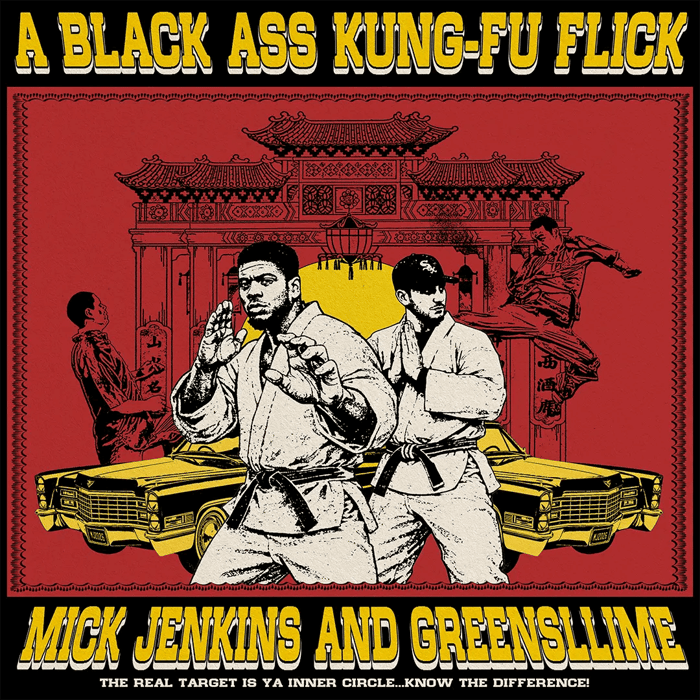
BLACK ASS KUNG-FU frames Mick Jenkins and greenSLLIME in blunt, block-specific Chicago rap, with spare production built to hold dense writing and routine pressure.

Courtesy of EVEN.
A Chicago collaboration presented without small talk
This album places Mick Jenkins and greenSLLIME in the same working space and lets them operate at their preferred speeds. The title, BLACK ASS KUNG-FU, leans on blaxploitation and martial-arts language, while the actual behavior of the record stays grounded in specific streets, specific names, and the unglamorous accounting that comes with staying present in a city.
The pairing also runs on contrast. greenSLLIME arrives with street-level detail delivered with minimal ornament, rapping and producing in a way that treats polish as optional. Jenkins shows up with the opposite impulse: tightly packed lines that stack meanings and then move on, assuming the listener can keep up without a handbook. The album doesn’t force them into a midpoint. It documents them talking from different ends of the same neighborhood and somehow sharing the same track without needing to merge personalities.
How the two voices split the same block into different languages
The division is clear early, and it stays consistent. On “White Belts in the Way,” greenSLLIME steps in first and keeps his posture steady: addicts heating spoons at night, shots aimed at squad cars, and a funeral scene where the pastor doesn’t perform grief because recklessness has been a long-standing habit. He drops a Hyde Park reference with the casual specificity of someone giving directions, and he tosses threats that land like routine statements of capability.
Jenkins follows with a line that turns writing into fencing, stationery into weaponry, and a “fenced off” phrase into both a sport and a property boundary. The effect is practical: greenSLLIME supplies the address and the incident log; Jenkins supplies compressed logic that snaps into place after a half-second delay. They sound like they’re describing the same environment through two incompatible interfaces. The album treats that incompatibility as normal.
Early tracks treat memory and survival as everyday inventory
“Tai Chi” opens with greenSLLIME moving through a domestic memory set that includes fried okra, a lake breeze, kids yelling on a grandmother’s block, and a pistol stored in a specific drawer. Historical and personal references arrive without ceremony: Jean-Baptiste Point du Sable gets invoked; a claimed Native American name appears as a deliberately crude punchline; childhood deprivation is described through an image of seeing snow through a hole in a roof and turning the situation into a reason to wear gold in a tooth. Nothing gets framed as inspirational. It’s presented as how the mind files material.
Jenkins answers “Tai Chi” from a different shelf of the same library: Slytherin references, a 1967 car treated like a piece of art, Belgian Malinois, and intellectual property traveling in the carpool lane. The overlap isn’t vocabulary; it’s function. Both are circling legacy, Chicago identity, and the administrative work of staying alive long enough to hand anything down. They just refuse to speak the same dialect while doing it.
“Vincennes” pushes the album deeper into mapped terrain. greenSLLIME pins the corner—115th and Vincennes—and describes the local economy with blunt clarity, including pumping rock and naming the dead. Mikey gets an R.I.P. with a remembered jump shot. The killer is locked up, and retaliation spreads outward until even a grandmother becomes a target, with a home burned down. Another death is described in front of children. The details keep moving: Kool-Aid coolers, stolen chocolate milk, jumping out of school windows, and an older figure’s dice-roll philosophy.
greenSLLIME’s response to that philosophy is direct and managerial: he’s controlling the heist, and death is treated as a problem that can be revisited later for follow-up action. Jenkins enters on the same track with a sentence that rejects the idea that this is movie talk and insists the words function like documentary material. He adds a quick calibration about borrowed personas—speaking like Spock without having the actual energy for it—then moves on. The two perspectives don’t argue. They simply occupy the same space.
“Creamed Corn” uses a sample and then gets back to work
The “Creamed Corn” opener uses a Black Dynamite sample that states the premise with unhelpful honesty: “We’re Black Dynamite! I sell drugs in the community.” The album treats this as atmosphere rather than thesis-writing. The line plays, the track continues, and nobody pauses to moralize.
Jenkins moves through wordplay—bread puns and Pret A Manger—then angles toward institutions that don’t function properly, like schools lacking accreditation. Christiania appears as an image for chosen affiliation, the idea of blood replaced with a selected network. Then the verse slows into a small sequence that lays out household order as a kind of behavioral timeline:
- hugging the block before loving a father
- washing hands before hugging a mother
- buying new pots and pans before doing the dishes
The lines land because they’re procedural. Affection comes after territory. Cleanliness becomes a checkpoint before family contact. Tools get purchased before the existing mess gets handled. The images sit near talk of cutting trees and building bridges, and the gap between those tasks reads like the cost of learning life through corners and consequences.
greenSLLIME takes the second verse and drops the listener back into trench-level logistics: grape Swishers, a missing judge, and kids young enough to be alarming who already clock counterfeit jewelry on sight. Jenkins’s compressed loss and greenSLLIME’s flat cataloging don’t combine into dialogue; they sit back-to-back like two camera angles pointed at the same damaged street.
Martial-arts framing shows up as stance, not storyline
The kung-fu and blaxploitation framing reaches its most obvious point on “Basically,” where greenSLLIME states he could beat Jackie Chan and Jet Li, then pivots immediately to meat cleavers, deep freezers, and “four ounces” attached to a Bieber meeting. The references behave like posture checks. They’re not building plot; they’re establishing a way of standing in the room.
Jenkins matches the track’s pace with a clenched-cadence list—wrist, chick, check, neck—then keeps the momentum with “no face, no case” logic and refusal to negotiate ransoms. The song doesn’t pretend this is subtle. It also doesn’t insist it’s grand. It simply runs the sequence and exits.
“Iron Lungs” turns politics and street memory into the same breath
“Iron Lungs” keeps the stance but takes it into stranger territory. greenSLLIME describes himself as a neighborhood hero fighting gentrification, then defines the superpower as home invasion, which is an efficient way to remove any confusion about methods. He name-checks Steve Biko, renames himself “Guwop Mandela,” and then admits exhaustion: kids dying, mothers crying, and the repetition of it all.
A story arrives underneath the bravado: the first time he robbed someone, the getaway car wouldn’t start. The solution was to run into the dark and toss the partner the gun. The memory sits there like a lodged fragment—less dramatic than it should be, more explanatory than a slogan.
Jenkins follows with Tony Stark comparisons and Phil Harden stepbacks, moving lighter while still landing heavy lines. Across the album, this is the basic balance: greenSLLIME supplies weight and incident; Jenkins supplies angles and compression. The record doesn’t let either approach “win.” It just keeps them in rotation.
Production stays spare so the writing can crowd the room
Conductor Williams drops his tag on “Iron Lungs,” and the beat underneath behaves like a clean floor with no clutter: clipped soul loop, drums that crack without taking up every inch of space. Elsewhere, much of the production handled by greenSLLIME stays mid-tempo and lean, built less for sonic density than for holding a high word count without collapsing.
On “Jungle,” Jenkins talks tithes, Godiva butter toffee, and submarine pressure. The beat opens gaps between kick and sample chop and lets those images occupy the air. greenSLLIME also delivers one of the album’s bluntest promises on the same track, addressed to a fourteen-year-old with a life sentence: he says the person isn’t coming home, but also won’t die alone, and he describes smuggling truth until it overflows and breaks down walls. The statement is direct, almost administrative in tone, as if loyalty is a job with unpleasant overtime.
Wordplay and domestic detail share the same shelf on “Not Guilty”
“Not Guilty” shows Jenkins at his most playful and precise, flipping CBD into CPD within the space of a bar. One abbreviation points to wellness retail; the other points to Chicago police. He stitches them into the same couplet without pausing to explain the mechanics, letting the joke land at full speed.
greenSLLIME opens the track with a different kind of groundedness: planting seeds, growing trees, keeping the imagery domestic and agricultural. Then the neighbor story arrives—neighbors rob his mother, and he shoots back. The shift is not dramatized. It’s treated like a factual addendum to the gardening notes.
The closing stretch treats silence as a practical instruction
The album ends with “STFU,” and Jenkins’s hook functions as the final instruction, delivered without softness: “And all you had to do was shut the fuck up.” greenSLLIME’s verse runs through RICO as “real kryptonite,” then stacks geopolitical and surveillance-era references—Gaddafi rockets, COINTEL—alongside relapse economics and rooftop snipers. The language moves quickly, with the implication that consequences also move quickly.
Jenkins closes the album talking about walking his talk, buying his own product with cash, carrying “Dame Dash energy,” and growing up doing “stains” on shopping window panes. The command to be quiet doesn’t limit itself to anti-snitch messaging. It reads as a broader operating procedure: move without announcements, work without advertisement, keep discipline plain. The kung-fu framing promised restraint; the closer treats restraint as basic hygiene.
The opening track makes the target audience clear
The first track, “Kaiju,” settles the question of who this is for. greenSLLIME calls out Gordon Parks, Larry Hoover, David Barksdale, and Chief Malik, then addresses the chief of police with a blunt directive to “read and weep.” Jenkins follows with morning-work imagery—cracking dawn, catching worms, whipping biscuits, emulsifying—then places the writing itself on the table as a long-term record.
“Read everything I ever wrote, you’d never quote a line,” — Mick Jenkins
It lands as both dare and routine fact: the material is available, the compression is high, and quotation requires effort.
The album’s central dynamic stays consistent from that first track to the last: push and pull without reconciliation. The beats leave room. The bars fill it. The Chicago specificity stays present down to block names, and the genre framing behaves like a label on the file folder rather than a script.
Tracks specifically foregrounded by the listening
A few moments keep returning during playback because they concentrate the album’s working methods rather than because they demand celebration:
- “Creamed Corn” — sample-as-signal, then dense writing with domestic sequencing that explains more than it announces
- “Vincennes” — pinned geography, named losses, and philosophy reduced to action items
- “STFU” — closing instruction that treats quiet as a long-term survival setting
Conclusion
BLACK ASS KUNG-FU proceeds as a functional two-voice document: one rapper reports from street-level with blunt inventory, the other compresses ideas until they travel like sharp objects. The production stays spare enough to keep language in the foreground, and the martial-arts framing mainly describes posture—discipline, readiness, and an assumption that noise is rarely necessary when work is being done.
Our verdict: controlled, densely written, and committed to moving forward without explaining itself twice.
FAQ
- What is the core sound of BLACK ASS KUNG-FU?
It runs on spare, mid-tempo rap production designed to hold heavy lyric density without turning the mix into a traffic jam. - How do Mick Jenkins and greenSLLIME differ on the album?
greenSLLIME favors direct street reporting and blunt images; Jenkins stacks wordplay and compressed logic, often folding multiple meanings into single lines. - Does the kung-fu theme create a storyline across the tracks?
Not as plot. The martial-arts references function more like stance and atmosphere—an attitude of discipline and readiness—than narrative architecture. - Is the album focused on specific Chicago places?
Yes. It repeatedly uses block names and localized detail, treating geography as practical information rather than scenery. - What kind of production role does greenSLLIME take here?
Much of the production is handled in-house by greenSLLIME, with a notable Conductor Williams appearance adding a clipped soul loop and sharply cracking drums.
If you want a physical reminder of this album’s no-frills presentation, you can shop a favorite album cover poster at our store: https://www.architeg-prints.com. It fits the theme of keeping the statement on the wall and the commentary to a minimum.
 | DISCOUNTGET 30% OFF*Use code on your next order:
|
* This post may contain affiliate links, meaning we earn a commission if you make a purchase through these links, at no additional cost to you.