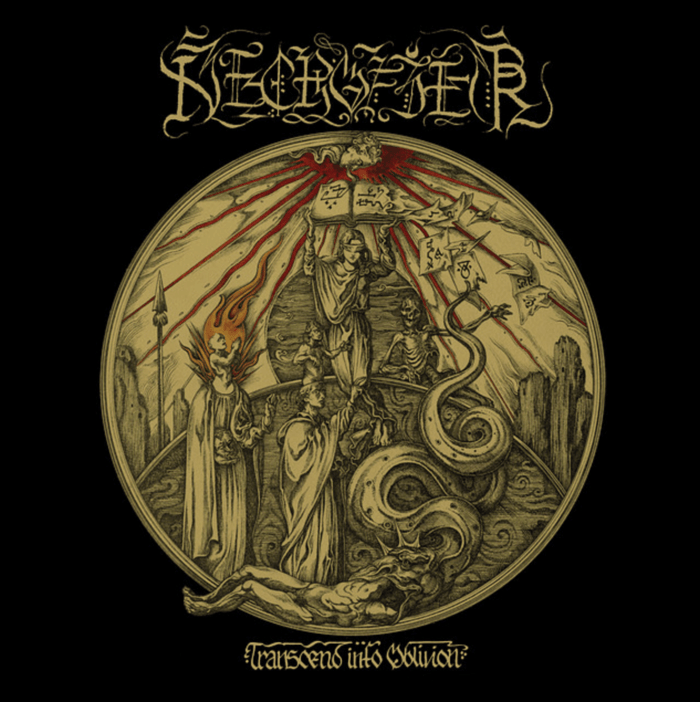
Transcend Into Oblivion review: Necrofier’s three-act black metal suite


 See more Architeg Prints stories on Google.
Transcend Into Oblivion review: Necrofier’s three-act black metal suite
Transcend Into Oblivion presents Necrofier’s three-act melodic black metal structure, using interludes and recurring titles to mark a staged transformation.
Album context and release details
Necrofier’s Transcend Into Oblivion arrives as the band’s third full-length in five years, continuing their melodic black metal approach while tightening its narrative framing. The album is set for release on February 27 via Metal Blade Records.
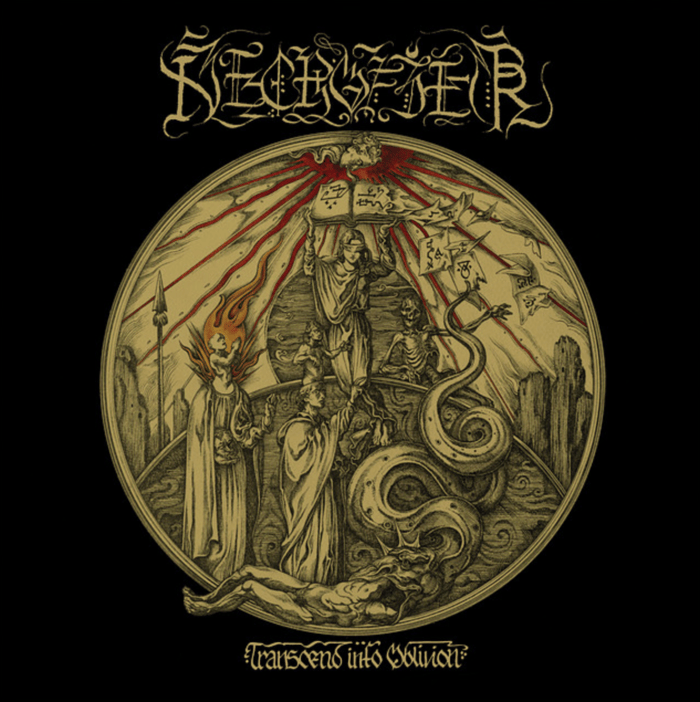
Concept framing: transformation treated as a practical problem
The record organizes its lyrical attention around personal collapse and reassembly—crisis of faith, ego-death, spiritual desolation—presented as a “dark night of the soul.” In practice, that premise functions less like a riddle to solve and more like a work order: something breaks, the album documents the process, and the system comes back online in a different configuration.
The listening experience reflects that same idea in plain physical terms. The material behaves as if it is periodically shedding one skin and putting on another—sometimes subtly, sometimes with the volume turned up enough to make the change hard to ignore.
Structure: three acts, with instrumentals as scene changes
The album is split into three acts, separated by cinematic instrumentals that operate like scene-setters. They don’t behave like “bonus tracks.” They behave like lighting cues—brief, deliberate, and there to inform the listener that the next section is meant to be taken as a new phase rather than a continuation of the previous one.
Across the tracklist, the three suites are framed as follows:
- Fires of the Apocalypse, Light My Path I–III — the awakening, where the “dark night” begins
- Servants of Darkness, Guide My Way I–III — the struggle and ego-death portion, where the transformation is treated as an ongoing inconvenience
- Horns of Destruction, Lift My Blade I–III — the rebirth section, where the album insists the process has reached a functional conclusion
That three-part naming scheme also has a practical side effect: it encourages listening in larger blocks. Each act behaves like a self-contained room, and the interludes serve as the hallway.
Video: “Servants of Darkness, Guide My Way I”
The album’s middle act is represented with an official video for Part I, which aligns neatly with how the record positions this section as the hinge point—less introduction, more full operational strain.
Act I: “Fires of the Apocalypse, Light My Path I–III” as controlled setup
Act I, Fires of the Apocalypse, Light My Path, functions as the album’s most cautious sequence. It lands like a soundcheck that happens to be well-rehearsed: the band runs through established behaviors, confirms the machinery still works, and keeps the risks minimal.
The production has a swampy thickness that lets the vocals push through like weather rather than narration. Vocalist Bakka delivers high, cutting howls that stay persistent and unembarrassed about their volume. Drummer Dobber Beverly supports this with blastbeats and rapid patterning that keep the momentum busy enough to feel continuous, while tremolo-picked dissonance fills the upper range and maintains the album’s tense atmosphere.
This opening trio also carries a recognizable set of ingredients:
- a melodic black metal chassis kept intact from the prior album’s blueprint
- power-chord movement rooted in NWOBHM habits
- percussion that frequently ignores speed limits
- shrieks that are treated as standard equipment rather than a special feature
- a general sense that the rawness has been cleaned up without being removed
The act is presented as the “awakening,” but sonically it behaves more like orientation: here are the tools, here is the room tone, here is the level of intensity that will be considered normal from this point forward.
Act II: “Servants of Darkness, Guide My Way I–III” adds weight and friction
Act II, Servants of Darkness, Guide My Way, is where the album starts adding actual pressure. The performances become less decorative and more insistent, as if the band has stopped explaining the setting and started documenting the ordeal.
Bakka’s vocal approach shifts into a more hybrid delivery—still capable of shrieking, but now leaning into a harsher, more venomous low register that sits closer to death growls. The effect is not subtle. It sounds like the same voice choosing a more abrasive tool for the job.
The suite begins with a surge of speed metal fury—fast, forceful movement that feels like momentum being used as a coping strategy. Then Track II interrupts itself with a pivotal Spanish guitar interlude. The interlude reads as solemn chamber-like breathing room, a brief stretch of controlled quiet that allows the listener to register the cost of what’s happening without the music pretending the cost is poetic. If the act is meant to soundtrack torment and ego-death, this is where it pauses long enough to ask, practically, whether the transformation is worth the damage required to complete it.
Track III changes the method again. Instead of detonating, it simmers. The tempo and intensity remain present, but the energy behaves like it’s being held in the body rather than thrown outward. Beverly’s drumming turns monolithic—less “keeping time” and more “causing events,” with hits that land heavy enough to register as physical disturbance.
Underneath, Mat Valentine’s bass mirrors guitarist Semir Özerkan’s dissonant tones closely, creating a doubled shadow effect: the guitar outlines the unease, and the bass makes sure it has weight. The suite closes with organ-like notes that suggest something brighter is approaching, though the album treats that brightness the way a workplace treats a deadline—inevitable, not necessarily comforting.
Act III: “Horns of Destruction, Lift My Blade I–III” as completion and release
After Act II does the real labor, Act III, Horns of Destruction, Lift My Blade, arrives to finalize the transformation. The shift isn’t presented as a sudden genre change; it’s more like a subtle recalibration of the band’s melodic black metal habits, now delivered with less hesitation.
Beverly’s drumming takes on a tribal, ritualistic character—repetition with purpose, intensity that feels organized rather than chaotic. It’s chest-level impact music, delivered as if that’s simply what the section requires.
NWOBHM-styled solos appear as propulsion rather than decoration, lifting the tracks upward and keeping the momentum assertive. Over that, Bakka’s shrieks wage war against shamanic chanting, with the vocal layers sounding consistently bloodthirsty and direct. The record treats this conflict as procedural: one voice attacks, another answers, the arrangement keeps moving.
This act also leans hardest into the album’s “cinematic” framing. The songs are arranged to feel like scenes with transitions rather than isolated tracks lined up in a row. The six-minute closer is built as a climax, using yo-yoing distorted riffs and symphonic strings to mark the completion of the transformation. Nothing here arrives as a surprise; it arrives as a planned concluding step, executed at high volume.
How the album’s ambition shows up in the sequencing
By the end, Transcend Into Oblivion presents a clear internal hierarchy. Act I is comparatively undercooked next to what follows, and the record doesn’t fully hide that. It functions as stable groundwork—useful, coherent, and less demanding than the later material.
Act II is the album’s densest stretch, where the band’s writing and performance feel most invested in escalation and contrast: speed metal urgency, a sober classical-leaning interlude, then a slow-burn closing track that trades explosion for endurance.
Act III consolidates the changes and frames them as rebirth, using ritual drumming, melodic leads, and layered vocals to make the ending feel conclusive in an orderly way.
A numeric tag also appears alongside the album in the form of a 7/10 rating, which sits there like a stamp on paperwork—present, readable, and ultimately less interesting than the sound of the record putting its three-act plan into action.
Availability and band presence
Transcend Into Oblivion is scheduled for release on February 27 via Metal Blade Records. Necrofier also maintains an official presence on Facebook.
Conclusion
Transcend Into Oblivion proceeds as a three-act melodic black metal album with interludes that function as scene changes and suites that behave like chapters. It starts with controlled setup, moves into heavier internal friction, and closes by treating intensity as a completion ritual rather than a temporary condition.
“Transcend Into Oblivion is structured, persistent, and unusually committed to making its transformation feel like a scheduled process with proper transitions.”
Our verdict: structured, persistent, and unusually committed to making its transformation feel like a scheduled process with proper transitions.
FAQ
- What is the core structure of Transcend Into Oblivion?
It’s split into three acts, each presented as a three-part suite, with cinematic instrumentals separating the acts like scene-setters. - Which act contains the Spanish guitar interlude?
The interlude appears in Servants of Darkness, Guide My Way II, where it provides a brief, solemn pause inside the album’s most strained section. - Who are the credited band members mentioned on the album?
The album highlights vocalist Bakka, drummer Dobber Beverly, bassist Mat Valentine, and guitarist Semir Özerkan in descriptions of the performances. - When is Transcend Into Oblivion being released, and on what label?
It is set for release on February 27 via Metal Blade Records. - Is there an official video tied to the album’s track suites?
Yes. The provided video is for “Servants of Darkness, Guide My Way I.”
If you want a physical reminder of albums that treat sequencing like architecture, you can shop a favorite album cover poster at our store: https://www.architeg-prints.com/.
 | DISCOUNTGET 30% OFF*Use code on your next order:
|
* This post may contain affiliate links, meaning we earn a commission if you make a purchase through these links, at no additional cost to you.