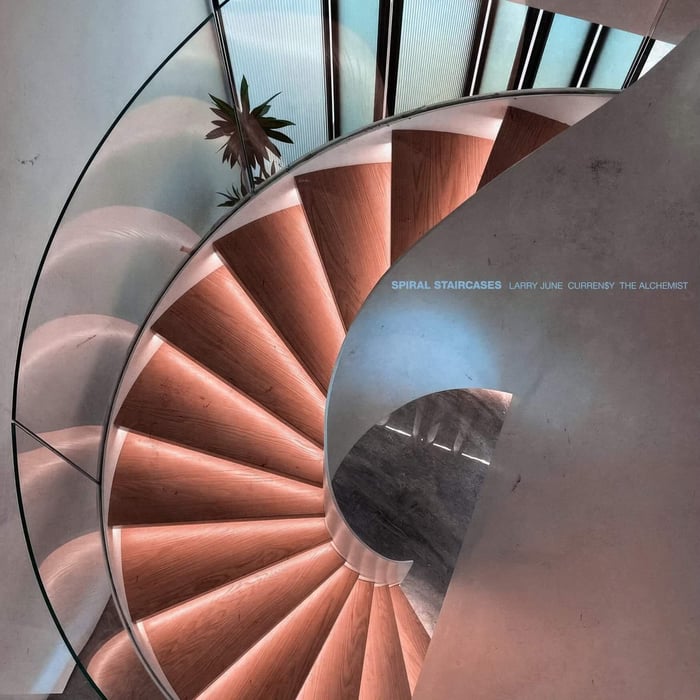
Spiral Staircases Album Review: Larry June, Curren$y, and The Alchemist


 See more Architeg Prints stories on Google.
Spiral Staircases Album Review: Larry June, Curren$y, and The Alchemist
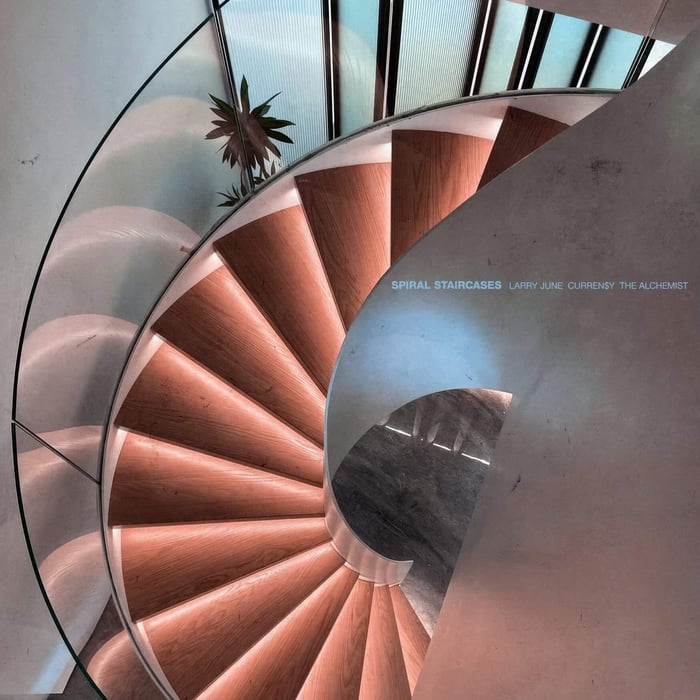
Spiral Staircases pairs Larry June and Curren$y over The Alchemist’s steady, lived-in production, keeping the tone controlled while the details stack up.
Release context and setup
Spiral Staircases arrives as a three-way collaboration between Larry June, Curren$y, and The Alchemist, released with credits pointing to The Freeminded Records / Jet Life Recordings / ALC / EMPIRE. It plays like a meeting that’s been on the calendar for a while, with everyone showing up on time and already knowing where the chairs are.
How the collaboration behaves in practice
The album presents itself as an efficient overlap of habits. Larry June and The Alchemist already operate comfortably in a shared space; Curren$y and The Alchemist have a longer-running familiarity; June and Curren$y move like two people who’ve been passing through the same rooms for years and finally decide to stand in the same one at the same time. That built-in alignment matters here because the record doesn’t spend time arguing with itself.
The result is a project that feels “complete” in the straightforward sense: the components fit. It also means the album tends to run on a single setting—pleasantly controlled, rarely rushed, and not interested in dramatic changes unless one happens accidentally. The main achievement is the lack of friction. The main limitation is that friction, when absent, cannot be used.
The Alchemist’s production: patient rooms with the lights left low
The Alchemist’s beats on Spiral Staircases behave like they’re designed to let things settle. Samples linger a touch longer than expected, as if nobody is in a hurry to clear the air. Percussion arrives with a light tap where another producer might insist on a sharper impact, and the album largely trusts that this will be enough. It generally is.
A few production choices stand out because the overall palette stays so even:
- “Stars on the Roof” carries a muted organ line that circles under Larry June’s verse with a kind of parked-car patience—engine off, time available, no visible agenda.
- “Drive Alone” uses a piano figure treated with enough reverb that individual notes blur into each other. The drums sit back and behave like they’re only there to confirm the passage of time.
- Across the tracklist, the beats provide lateral space, letting both rappers stretch a thought over a few bars without needing to fight the instrumental for attention.
Because the album holds one emotional temperature for most of its runtime, small shifts register more than they normally would. When “Palo Santo” brings in a heavier kick and a slightly sharper snare partway through, it lands like a meaningful event—mostly because the surrounding environment stays so level that any change becomes noticeable workplace drama.
Larry June’s writing: accounting as a lifestyle
Larry June’s approach to money is procedural rather than theatrical. Listening to him here feels like hearing someone read out loud from a well-organized ledger, only with better timing and fewer spreadsheets in view.
On “Everything Allocated,” he talks through costs, purchases, and returns like someone who expects the math to make sense because the math is what he’s been doing. The flexes don’t inflate into fantasy; they stay connected to the steps that supposedly produced them. He mentions consistent turnover and minimal clientele, and the language remains grounded in process. When he says he calculates in his sleep, the delivery doesn’t change enough to suggest exaggeration. The statement just sits there like an additional line item.
The title track continues that approach but widens the scene. He describes spending $1.2 million renovating land, flying someone in from the East Coast for sushi, grilling filet mignon on the deck, and counting hundreds in latex gloves in the kitchen. These images don’t arrive as “big moments.” They’re presented as scheduled tasks, handled in sequence, filed under normal.
Domestic life and illicit routine share the same calendar
The album keeps placing ordinary domestic settings next to street-coded behavior without treating the combination as unusual. A kitchen becomes a place for counting money with gloves. A deck becomes a place for grilling while wealth quietly continues being itself. The point isn’t shock; it’s workflow.
When Larry lands on “I’m on the money like ‘In God We Trust,’” it comes across less like a punchline and more like a daily affirmation—something said because it’s useful to say. Prayer language and asset language run in the same stream.
On “Palo Santo,” Larry allows a brief moment where uncertainty shows up without being invited. He wonders whether the life is meant for him, recalls a one-way Greyhound trip out of Arizona, and notes a tear on his face. Then the track moves forward. He pivots back into routine: an SF90 with “chinky eyes,” Palo Santo burning, dollars counted in the morning. The doubt doesn’t get “resolved” so much as it gets re-absorbed into the schedule, where it becomes another thing that happened and then ended.
Curren$y as the album’s main source of tension
If Spiral Staircases carries tension, most of it comes from Curren$y, largely because he describes dangerous circumstances with the calm of someone giving a weather update that won’t interrupt the day. His voice stays steady even when the information turns grim, which makes the content feel more practical than performative.
On “Drive Alone,” he walks through the mechanics of envy inside familiar circles—jealousy presented as assistance, betrayal arriving through people who already know where things are kept. He drops the phrase “Genocide from your own side” without pausing to frame it as a headline. It’s tucked into the flow of a verse that also includes Spyders, hate, and solitary commutes, delivered at a consistent temperature.
Compressed street grammar, then a kaleidoscope
On “2.P.I.G.,” Curren$y warns about treacherous company through a chess comparison, then tells a story involving Wes trying to knock Ace because Ace said he “wasn’t eating.” The shorthand is specific and delivered as if no further explanation is required, which the album treats as a reasonable expectation.
What’s notable is how easily that language sits beside a line like “kaleidoscope on the coffee table, look at things from all angles.” The record doesn’t stop to reconcile them; it simply places them next to each other and keeps moving. In the Spiral Staircases world, a coffee table can hold both perspective tools and whatever else was set down earlier.
On “Stars on the Roof,” Curren$y’s verse runs through joy and pain, then passes through million-dollar headstone graves and carbon-fiber steering wheels. The contrast is presented as normal proximity rather than dramatic juxtaposition—two categories filed in the same folder.
“Empty Pages”: The Alchemist steps in front of the glass
“Empty Pages” introduces The Alchemist on the mic, and his presence shifts the album’s angle because the producer suddenly occupies the foreground. The record briefly becomes about procedure in a different way: risk management and supply control delivered in plain terms.
He describes:
- leaving a plate with a piece of steak out so the wolves stay fed,
- a briefcase that is expected to be full of bread,
- buying merchandise only after it has been opened and inspected.
It’s a verse built around checking systems, maintaining boundaries, and ensuring that even the “simple” transactions include verification. The album doesn’t treat this as paranoia. It treats it as standard operations.
The title track as a mission statement without the theatrics
The title track’s chorus gives the cleanest summary of the album’s self-image: spiral staircases, no prints, actual paintings, actually made it, actually players. It’s a portrait of access and proof—less “look at me” than “this is the infrastructure.”
The surrounding details reinforce that controlled approach to wealth:
- a mansion with a security gate,
- a stash spot forty miles from the main property,
- a balcony where Larry sits writing “all type of shit” and feeling like a novelist.
The language keeps returning to gates, distance, and inspection. Access is managed. Money is present but intentionally quiet. Even the status symbols—cars, watches, weapons—are spoken about in the same measured cadence as prayer, children’s futures, and careful speech.
Larry’s warning that “words too loose could quickly form into a noose” lands as a practical note about consequences rather than a moment of moralizing. Curren$y, in turn, finishes a sentence about Ferraris by insisting they’re real and that he’s being sincere—an unusual thing to clarify, which is exactly why the album includes it without fanfare.
Where the album coasts—and why it matters more at seven tracks
The record maintains its lane so reliably that it occasionally drifts into autopilot. Nothing collapses, but some passages pass by without leaving much behind. On longer projects, that kind of coasting is easy to ignore; the extra runtime creates buffer space where momentum can return later. Here, the album is seven songs, so a forgettable stretch takes up a larger percentage of the total experience. There’s less margin for idle cruising.
That said, the same consistency is also the reason the album feels coherent. The sound is steady, the performances are controlled, and the atmosphere remains intact even when individual moments don’t insist on being remembered.
Favorite tracks
The album highlights itself most clearly in a few places where the writing tightens and the production’s patience becomes a feature rather than a background condition:
- “Drive Alone”
- “Palo Santo”
- “Empty Pages”
Spiral Staircases functions like a well-lit routine: The Alchemist supplies calm rooms with soft edges, Larry June itemizes a lifestyle with accountant-level steadiness, and Curren$y reports risk with the relaxed cadence of someone who already did the math. The album stays level, occasionally to its own disadvantage, but it also avoids confusion and clutter by simply refusing to escalate.
Our verdict: consistent, carefully gated, and built to keep everything moving at the same reliable speed—even when a sharper snare briefly counts as a major event.
FAQ
- What is Spiral Staircases?
It’s a collaborative album by Larry June and Curren$y produced by The Alchemist, presented as a short, tightly controlled set of tracks. - How does The Alchemist’s production come across on this album?
The beats leave space, let samples hang, and keep percussion understated, which creates a steady atmosphere with only a few noticeable shifts. - What stands out about Larry June’s lyrics here?
He describes money and lifestyle as process—overhead, purchases, routines—more like bookkeeping than spectacle. - Where does Curren$y bring tension into the record?
He describes envy, betrayal, and danger in a calm tone, making the content feel practical rather than dramatized. - Which tracks best represent the album’s approach?
“Drive Alone,” “Palo Santo,” and “Empty Pages” show the record’s balance of restrained production, detail-heavy verses, and controlled pacing.
If you want the visuals to match the music’s quietly managed luxury, you can shop a favorite album cover poster at our store: https://www.architeg-prints.com.
 | DISCOUNTGET 30% OFF*Use code on your next order:
|
* This post may contain affiliate links, meaning we earn a commission if you make a purchase through these links, at no additional cost to you.