Chris Brown’s BROWN Album Review: 27 Tracks of Bedroom Deja Vu


 See more Architeg Prints stories on Google.
Chris Brown’s BROWN Album Review: 27 Tracks of Bedroom Deja Vu
The BROWN album opens like a midnight trap confession, then sprints back to autopilot seduction—until the back half finally admits something real.
A Scrollable Tracklist That Tells on Itself
Twenty-seven tracks on a phone screen is its own little genre of intimidation. You don’t press play so much as you commit. And the first stretch of BROWN album makes that commitment feel like signing up for the same scene over and over: bassline drops, a verse that treats getting someone undressed like it’s a plot twist, a chorus split between demanding and vaguely tender… then the next song reloads the same fantasy with slightly tweaked drums.
By the time you hit the middle, the bedroom isn’t even a setting anymore—it’s just wallpaper. It’s like being in a room with a strong smell until your brain decides it’s normal and stops reporting it. Somewhere after the sixteenth track, Chris Brown lands on a ’90s-flavored hip-hop beat and admits he doesn’t know what love is. Then track eighteen starts and—of course—the bedroom shows up again, like it pays rent.
The Numbers Don’t Lie—They Just Keep Getting Bigger
Here’s the career math you can hear even before you do the research-in-your-head thing. Brown debuted in 2005, and his first single hit the Hot 100 at number one—he was sixteen, and it made him the first male solo artist to do that since Montell Jordan a decade earlier. Fast-forward: twelve studio albums later, and the track counts have only learned one direction.
- F.A.M.E. (2011): 18 songs
- Heartbreak on a Full Moon (2017): 45 songs
- Indigo (2019): 32 songs
- 11:11 (2023): 22 songs, then 35 with a deluxe edition that went on to win Best R&B Album at the 2025 Grammys
On top of that, the Breezy Bowl XX Stadium Tour pulled in nearly $300 million across 52 dates. The point is: this isn’t an artist struggling to get heard. This is an artist testing how much “more” the audience will accept as “value.”
And here’s the part where I paused, because I thought we were past the era of bragging about bloat. Brown even promised, before 11:11, that the swollen-album era was done. BROWN still lands at 27 tracks. So either the promise was a mood, not a plan… or the plan is that the album is supposed to feel endless on purpose.
The Album’s Best Trick: Hiding the Good Stuff in the Back
The handful of songs I actually want to return to are the ones where Brown stops acting like confidence is his only personality setting. That’s where the record finally coughs up something human.
- On “Hate Me,” he basically offers himself up as a punching bag—and he sells it hard enough that the self-destruction feels intentional, not decorative. A reasonable listener could say it’s melodrama, but it lands because it sounds like he means it.
- “Won’t Let Me Leave” hangs onto a fog-driving metaphor for a whole verse without turning it into a cheap moral. That restraint is rare here, which is exactly why it works.
- “Colours” doesn’t posture. It asks for safety, plain and almost unadorned.
But the record doesn’t lead with those. It stashes them past track 16, behind a wall of bedroom propositions like they’re bonus content you earn by staying awake. That’s a choice. And I can’t decide if it’s cynical—“you’ll stream the first half anyway”—or if he genuinely thinks the disposable stuff is the main course. Either way, surviving the front-loaded filler takes faith I’m not sure the album earns.
That Metro Boomin Opener Is a Tease (And Not the Fun Kind)
The album opens with Metro Boomin on “Leave Me Alone,” and the vibe is immediately… different. Heavy 808s. A somber synth line. The mix feels like a locked room at 2 a.m.—tight, claustrophobic, more like trap that wants to brood than R&B that wants to charm. It hints that Brown might spend the next hour somewhere darker, messier, maybe even complicated.
He doesn’t. Not even close.
And I’ll admit, my first impression was wrong here: I thought the opening meant the album would keep that tension. On second listen, it’s obvious the opener is more like a movie trailer for a film you’re not about to see.
What you mostly get in the middle is Hitmaka’s competent club-pop: bright drums, dramatic piano snaps, the kind of engineering that practically begs for playlist placement. None of it is offensively bad—arguably that’s the problem. It slides by without demanding an opinion. It’s hard to hate and easy to forget, which is the exact texture of modern musical “content.”
Then, way down at track 26, the album finally lets a song breathe.
“Holy Blindfold” Is Where the Record Accidentally Learns Patience
“Holy Blindfold” is the exception that proves the album needed more risk. Jon Bellion plus The Monsters & Strangerz stack dream-pop textures over gospel-tinged harmonies, and the track opens into these extended wordless post-choruses where the arrangement actually stretches out instead of sprinting to the next hook.
This is the closest BROWN gets to patience—or at least the shape of it. The song gives you room to feel something without immediately interrupting you with another proposition. A reasonable listener could argue it’s too glossy, too “pretty,” but I’d take pretty with intention over competent with amnesia any day.
And it made me think: the rest of the tracklist could’ve used one producer willing to wait, to let a groove sit long enough to get interesting.
The Sex-Song Assembly Line (And the One That Wastes Its Own Premise)
Sex is the default setting here, and most of the midsection sounds like it was written on autopilot—like the booth light turned on and the lyrics arrived preloaded.
“Honey Pack” and “#BODYGOALS” circle the same proposition from different angles: Hennessy and stamina in one lane, Tank and a minimal bassline in another. And Brown drops lines like:
“Penetratin’ slowly / Lovin’ your performance / So put that shit up on me”
That’s not even scandalous. It’s just… weirdly generic. Like it could’ve been pulled off a comment card someone filled out while half-watching a reality show. And I kept asking myself, who is this for? Not in a moral way—more in a craft way. Who hears that and thinks: yes, that’s the sentence that completes the song.
The sharpest case—because it almost becomes something—is “Cry for Me.” It starts with a legitimately biting emotional premise: asking a partner to cry real tears as proof the relationship mattered. That’s nasty and vulnerable at the same time, the idea that pain is the only evidence of love you can trust.
Then it collapses by the second verse into:
“You fuck me like a demon / One minute you moanin’ / Next minute you screamin’”
And whatever the song was reaching for in its first thirty seconds is gone. It’s frustrating because Brown can write sex songs—he proved that years ago. But ten of them on one album, and the tenth ends up indistinguishable from the first. That’s not liberation; it’s repetition with better lighting.
The Cover Wants “Legend” While the Lyrics Admit “Mess”
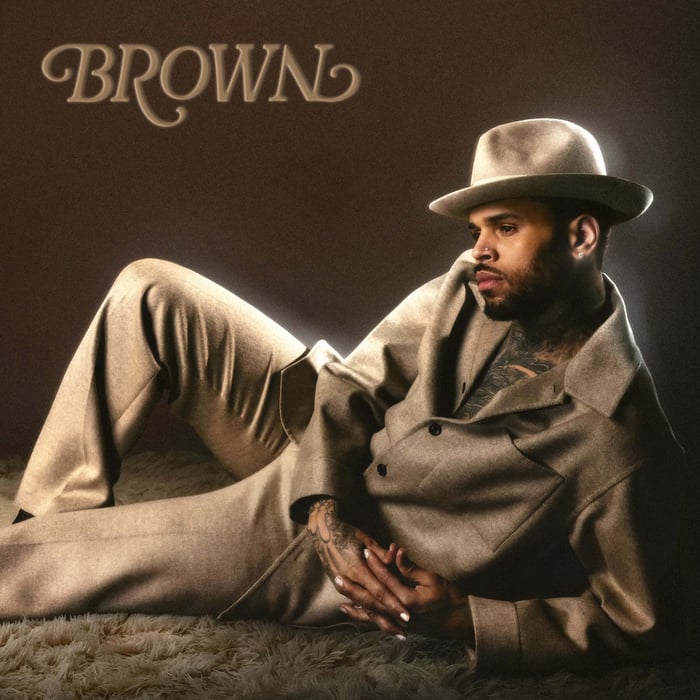
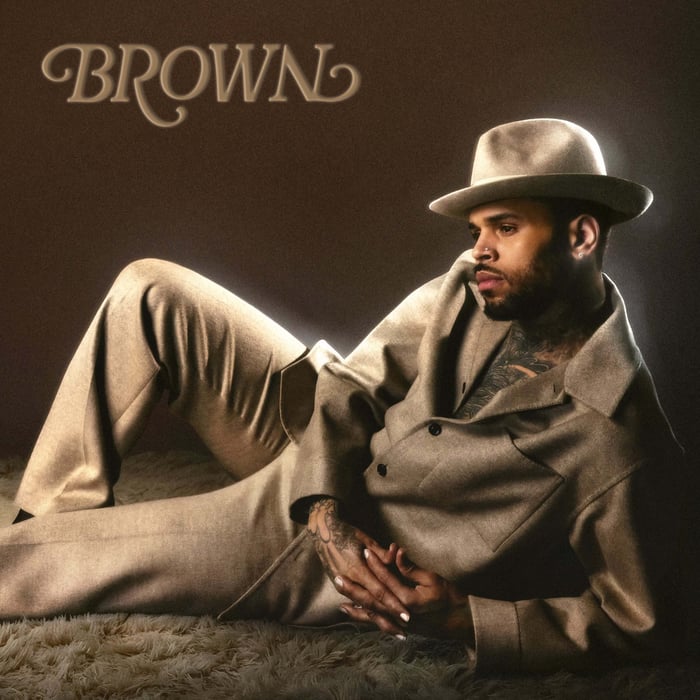
Brown is thirty-seven years old, and this is the cover he chose: reclining in a tan suit and fedora, a pose that mirrors Michael Jackson on Thriller and nods to the classic R&B portraiture of Teddy Pendergrass and Luther Vandross—guys who wore the suit like they didn’t need to convince you.
The cover says: legacy.
Inside the album, the back half tells a different truth. Brown calls himself a mess on one song, admits fear about what he feels on another, asks for safety on a third, and compares his devotion to a poison he can’t quit on a fourth. At sixteen, he was on top of the Hot 100. Now he’s dressing like a legend while track 17 asks if he even knows what love is.
That contradiction might be the most honest thing on the record, even if it’s accidental. A reasonable listener could say the cover is just aesthetics, not a manifesto—but on an album this long, visuals become part of the argument whether you like it or not.
After Track 16, The Album Finally Stops Lying (For a While)
Past track 16, the mood shifts. Beats slow down. The lyrics stop yelling at the bedroom door, and Brown starts saying things that sound like they cost him something to admit.
For four or five songs in a row, the record plays like someone finally edited the tracklist in half and kept the right pieces. It’s not that every line is brilliant—it’s that the songs feel like they have an emotional budget instead of just a sonic one.
Then track 23 snaps back to club mode, and the closing stretch scatters between gratitude and resentment without committing to either. It’s like watching someone start to apologize, then remember they’re supposed to be cool.
And here’s my mild criticism, because it matters: the sequencing feels like a dare. The album hides the emotional core behind stamina-testing length, like vulnerability is a reward for obedience.
The Stranger Problem Under the “Too Many Songs” Complaint
Yes, there are too many songs. Everyone is going to say that about BROWN album, and they’ll be right.
But the stranger problem isn’t just quantity—it’s the narrative the album accidentally creates. It opens with “Leave Me Alone,” a demand, almost a warning. Then over the next 26 songs, it turns into an album made almost entirely of invitations to stay the night. And the one genuine confession—track 17 asking if he knows what love is—gets wedged between a honey pack and a drowning metaphor like it’s embarrassed to be there.
By the time “What’s Love” arrives, the answer has already been given a dozen ways: lust as default, seduction as routine, confidence as costume. Brown sings like he doesn’t know what love is, but he buries those songs under twenty others that pretend he does.
That’s the real tell. The album isn’t confused; it’s split. It wants maturity and muscle memory at the same time, and it keeps choosing muscle memory.
Conclusion
BROWN feels like two albums fighting over the same runtime: one is an efficient machine for bedroom club-R&B, the other is a quieter, back-loaded admission that the machine isn’t solving anything.
Our verdict: People who like long, playlist-friendly runs of polished seduction songs will happily live in this thing—especially if they don’t need the lyrics to evolve. People who want the emotional songs up front (or, radical concept, edited into a coherent arc) are going to feel like they paid for the director’s cut just to find the actual movie hiding in the last act.
FAQ
- Is the BROWN album worth playing front-to-back?
If you’re patient and don’t mind repetition, yes—but the most rewarding stretch is after track 16, which is a wild ask. - What’s the biggest bait-and-switch moment on the album?
The opener “Leave Me Alone” sets up a darker, more complicated record than the one you mostly get. - Which songs feel like Brown drops the confidence act?
“Hate Me,” “Won’t Let Me Leave,” and “Colours” hit hardest because they sound like admissions, not performances. - What’s the most frustrating track conceptually?
“Cry for Me,” because it starts with a sharp emotional premise and then abandons it for generic bedroom talk. - What should I listen for near the end?
“Holy Blindfold” (track 26) opens up the sound and finally lets the arrangement breathe.
If this album got you thinking about how much the cover tries to say “classic,” you might enjoy grabbing a favorite album cover poster and putting that argument on your wall. We keep clean, frame-ready prints over at our store.
 | DISCOUNTGET 30% OFF*Use code on your next order:
|
* This post may contain affiliate links, meaning we earn a commission if you make a purchase through these links, at no additional cost to you.