Crayola Circles Review: Fatboi Sharif Turns Rap Into a Broken Radio


 See more Architeg Prints stories on Google.
Crayola Circles Review: Fatboi Sharif Turns Rap Into a Broken Radio
Crayola Circles is Fatboi Sharif at peak compression—short tracks, warped samples, and lyrics that hit like flashbulbs instead of stories.
Come in close: this album doesn’t “tell” you anything
Crayola Circles isn’t trying to walk you through a narrative. It’s trying to scramble your mental signal until the only thing left is Sharif’s voice—booming, calm, and weirdly patient—hovering over production that behaves like a radio you can’t quite tune.
And yes, that’s a compliment. Mostly.
The first thing it announces: Sharif has been building a ridiculous output
Here’s the reality you feel immediately: Fatboi Sharif moves like someone who doesn’t believe in “album cycles.” The sheer pace comes through in how Crayola Circles is structured—quick scenes, abrupt cuts, no time wasted on traditional “songwriting” manners.
Even before this record, that habit is obvious from the shape of his world: Age of Extinction, Ape Twin, Gandhi Loves Children, Cyber City Society, Preaching In Havana, Decay, Insomniac Missile Launcher, Something About Shirley, Brain Candy, Psychedelics Wrote the Bible, Goth Girl On the Enterprise… it reads less like a tidy discography and more like a stack of sketchbooks. The point isn’t consistency. The point is volume-as-vision.
And Crayola Circles matters because it’s the first time I’m hearing him lock into a full collaboration with Child Actor handling the production. It plays like Sharif walked into somebody else’s lab and decided not to wipe his shoes.
Child Actor’s beats aren’t “beats”—they’re environments with loose floorboards
The connection here is basically chemistry-by-constraint. Child Actor is affiliated with the same orbit as Backwoodz Studioz, and you can hear that shared taste for off-center rap architecture: the kind that makes space feel more important than momentum.
Child Actor’s résumé circles artists like Navy Blue, Earl Sweatshirt, ELUCID, Cavalier, Open Mike Eagle, and Ghais Guevara—people who tend to treat rap like inner monologue more than performance. That background shows up here as a very specific decision: almost every track is under three minutes, and none of them stretch out to “develop.” They show up, do the job, leave.
That’s also where my first mild gripe lands: sometimes the constant shortness feels less like discipline and more like the music refusing to breathe. I kept waiting for one track to actually stay long enough for my ears to settle. It rarely does.
“Six Figurines” sets the rules: blink and you’ll miss the whole room
This album opens with “Six Figurines,” a tiny instrumental built from what sounds like a 21-second sample fragment. It’s basically a mission statement: Crayola Circles runs on samples and interference, like somebody stitched together late-night college radio while walking through a tunnel.
The production keeps doing this trick where drumming arrives as an afterthought—or doesn’t arrive at all. Sometimes percussion is the final ingredient tossed into the pot. Sometimes the pot is just air, dust, and Sharif’s voice.
Arguably, that’s the whole flex: the record acts like rhythm is optional, because the real pulse is Sharif’s delivery.
Percussion here isn’t “groove,” it’s a moving object in the next room
The transition from track to track starts to feel like wandering inside a building where you can hear people upstairs dragging furniture. On “Assassination Tapes,” the percussion and electronic drum bits don’t land like drums; they land like impact noises—as if the track is scoring a scene rather than backing a verse.
“Chemo Crystal Ball” takes vocal snippets and smears them through effects until they’re barely human, mostly reduced to a low-end thump. It’s not catchy in a normal way. It’s catchy in the way a persistent headache is catchy: it returns whether you invited it or not.
Then there’s “Recognition,” which goes even further—no real rhythm, just Sharif’s voice hanging in open air, with the faint suggestion of a heartbeat. It’s a gutsy move, and a slightly arrogant one too. A reasonable listener could call it hypnotic; another could call it unfinished. I bounced between both depending on how loud I played it.
And that’s where the album draws a line in the sand: if you enjoy a man calmly saying something like “Live grenade incoming” over a dusty soul loop, you’ll hear generosity in the space. If you don’t, it’ll feel brutal—like the track is daring you to flinch.
Sharif’s writing isn’t storytelling—it’s a rapid slideshow of proper nouns
The lyrics on Crayola Circles don’t behave like arguments, confessions, or plot. They behave like visual flashes fired in sequence, with just enough grammar to be legally considered “sentences.”
On “How to Disinfect a Live Grenade,” lines come stuffed with proper nouns and verbs, but the relationships between them feel dream-logic—like you woke up and tried to explain one specific image before it evaporated. Things happen “near” each other without actually connecting. A hotdog truck gets postponed. A syringe falls. Same neighborhood, no handshake, no narrative bridge.
“Diagnosis” does this even harder. It feels like Sharif tries to pack the meaning of a whole song into a single verse. Not “dense” like technical rap density—dense like a drawer you can’t close because it’s jammed with sharp objects.
Here’s the trick: individual words are clear. The whole isn’t paraphrasable. You either let the lyrics hit you like an electric current (not the “energy” kind—the involuntary kind), or you stand there trying to diagram it and miss the point.
Name-drops, but not the flattering kind
Sharif uses proper names constantly, but not like traditional allusions (where you’re supposed to follow the reference) and not like braggy name-drops (where you’re supposed to be impressed).
They land more like shards—mid-line, sometimes grammatically disconnected from what they’re attached to. JFK, Mizell, Betty Shabazz, Baldwin, Lynch, Dr. Octagon, Basquiat, Michael Myers, Ironheart—these aren’t trophies. They’re debris.
“Assassination Tapes” is a good example of how ridiculous this gets, in a way that somehow still feels controlled: the chorus can jump from Ancient Jack mixing cocaine with sour, to an informant yelling “Black power” in Times Square, to Tupac working at McDonald’s for twelve bucks an hour—like it’s nothing. And later, a line like “I shot Regan/Injected relief” sits in the same moral space as fast food wages. No hierarchy. No “this is sacred, this is casual.” Everything is just… there.
On “Cold Day in Hell,” Sharif says:
“Betty Shabazz and James Baldwin won a fortune at the DJ School Memorial as purple rain was falling.” — Fatboi Sharif
It’s the kind of line that’s so overloaded with American mythology that if you tug one thread, the whole thing snags. That’s the point. The album wants the references to collapse into each other, because the world it’s describing collapses categories in real time.
The “simple” moments hit hardest because they’re surrounded by chaos
I didn’t expect the most direct lyric on the album to be the one that sticks, but it did. On “Chemo Crystal Ball,” Sharif gives you something close to a chorus—plain language, repeated structure, one clean twist at the end.
It stands out because almost everything else is jagged and compressed. The track draws a straight line between the forces that label you, manage you, and punish you: family, systems, religion. Same grammatical slot. Same verdict. Then it flips outward onto “you,” and suddenly the accusation isn’t personal anymore—it’s communal.
This is where Crayola Circles quietly shows its worldview: police, hospitals, churches, cartels, family—different uniforms, similar harm. The album doesn’t sort them into neat boxes. It lets them leak into each other the way they do in real neighborhoods, where the same person might fear the clinic, the cop, and the pew.
Family keeps showing up—because paranoia doesn’t stay private
Even with all the surrealism, the family lines recur like a grim refrain.
You’ll hear a line like “My parents asked if suicide is the solution” show up in “How to Disinfect a Live Grenade,” dropped almost casually, wedged between images like a ghost ship and a fast track to heaven. The placement feels arbitrary, but the emotional effect isn’t. It’s like Sharif’s saying: this is how the mind actually works when it’s overloaded—grief doesn’t arrive politely.
Then “The Destitute Stashspot” closes with “My father who carved out my heart at arm's length from a distance,” and the simplicity almost makes it worse. It’s so straightforward it can sound bureaucratic, like the trauma has been processed into paperwork.
There are also lines about watching the family tree break down branches—tantrums, emotional rollercoasters, time running short. The record keeps returning to this idea that even if Sharif’s imagery is surreal, the consequences are domestic. The dread comes home.
That voice: a concrete-stairwell sermon, delivered with zero “acting”
Sharif’s baritone is thick and echoing, and the vocal processing makes it feel like you’re hearing him through a wall—like you’re standing in a concrete stairwell while somebody speaks from the floor above.
What’s striking (and arguable) is how little he changes his delivery. He’ll rap about paranoia affecting family, then pivot to something that sounds like a monster film—werewolves, soul-eating body horror—and the pitch barely shifts. Even “Seen it all from the bleeding knife/Loud screams when I dream at night” lands with the same calm temperature as everything else.
At first, I thought the flatness might be a limitation—like he was stuck in one mode. On second listen, I started hearing it as a choice: he’s refusing to “perform” pain differently than menace, because in his head they’re part of the same weather. Still, I’m not 100% sure. There were moments I wanted a crack in the voice, a human wobble, something that admits fear instead of reporting it.
No builds, no big finales—just starts, stops, and hard cuts
This album doesn’t do crescendos. Tracks begin, they do their thing, they discontinue, they cease. No runway, no landing speech.
“ANGER” even opens with a sample warning about content unsuitable for people with heart conditions—then Sharif comes in with “Financially forged, forgotten family entertained” in the exact same tone he uses everywhere else. The warning is almost funny in context, because the delivery refuses to panic. The alarm is in the text, not the voice.
And “Leon Ichaso” is basically a single spoken line—“Enter a world of perpetual dreams”—named after the Cuban-American director behind Piñero and El Cantante. It functions like a hinge more than a song.
One of the slickest production decisions is how the album keeps a shared center by sliding bass lines between tracks—like Child Actor is connecting rooms by quietly moving the furniture while you’re still looking at the wall.
By the time I hit the end, my revised first impression was simple: I initially wanted longer songs, but the shortness is part of the menace. The album doesn’t “let you in” because the whole theme is that nothing stays stable long enough to trust.
Conclusion: this is what Crayola Circles is actually doing
Crayola Circles isn’t a collection of songs so much as a controlled malfunction: tiny sample-loops, half-there percussion, and lyrics packed like shrapnel. Child Actor builds a world that feels out of tune on purpose, and Sharif walks through it delivering nightmare headlines in the same steady baritone—because panic would be too easy.
If you want hooks and arcs, you’ll call it abrupt. If you want your rap to feel like a fevered surveillance feed, you’ll call it honest.
Our verdict: This album will actually land for listeners who like rap as atmosphere—people who enjoy surreal detail, compressed tracks, and the feeling of being mildly haunted by a bassline. If you need clean choruses, emotional “growth,” or even the courtesy of a normal drum pattern, you’re going to bounce off this and blame the speakers.
FAQ
- What’s the core vibe of Crayola Circles?
It feels like scanning radio stations at night—samples, static, and Sharif’s voice acting as the main structure. - Are there any long tracks or big buildups?
No. The tracks stay short and don’t really “build.” They start, cut, and move on. - Does the album focus more on beats or lyrics?
Lyrics take the front seat because the beats leave a lot of open space—sometimes barely any drums at all. - What makes Sharif’s writing style stand out here?
He stacks proper nouns and sharp images like a dream you can’t summarize—clear words, unclear “plot,” on purpose. - Where should I start if I’m unsure about the whole album?
Try “Chemo Crystal Ball,” then “Cold Day in Hell,” then “The Destitute Stashspot” to get the range of directness, mythology, and family dread.
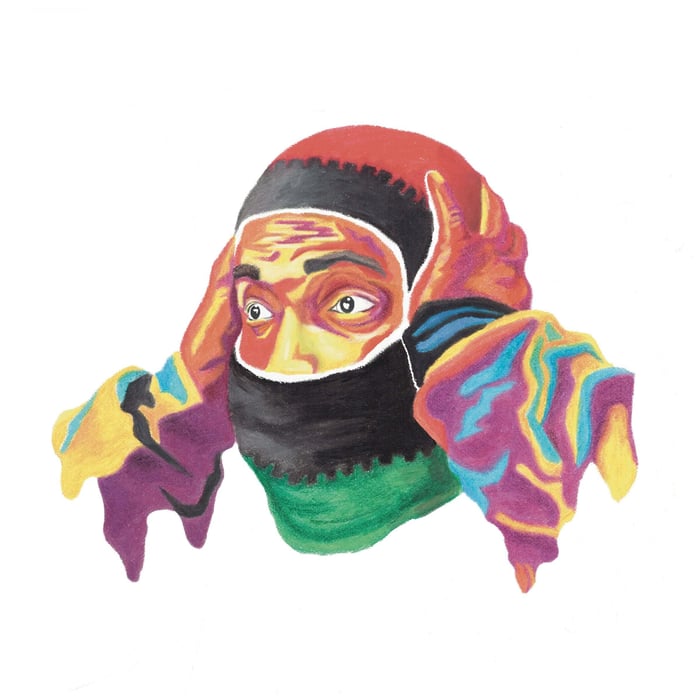
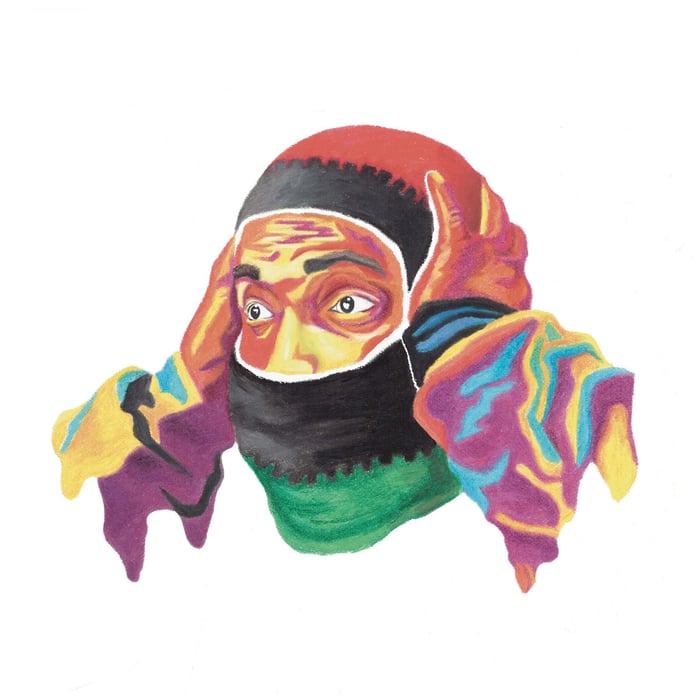
If the cover art (and the whole cracked-crayon mood) stuck with you, you can grab a favorite album-cover poster for your wall at our store — no hard sell, just a nice way to live with the aesthetic a little longer.
 | DISCOUNTGET 30% OFF*Use code on your next order:
|
* This post may contain affiliate links, meaning we earn a commission if you make a purchase through these links, at no additional cost to you.