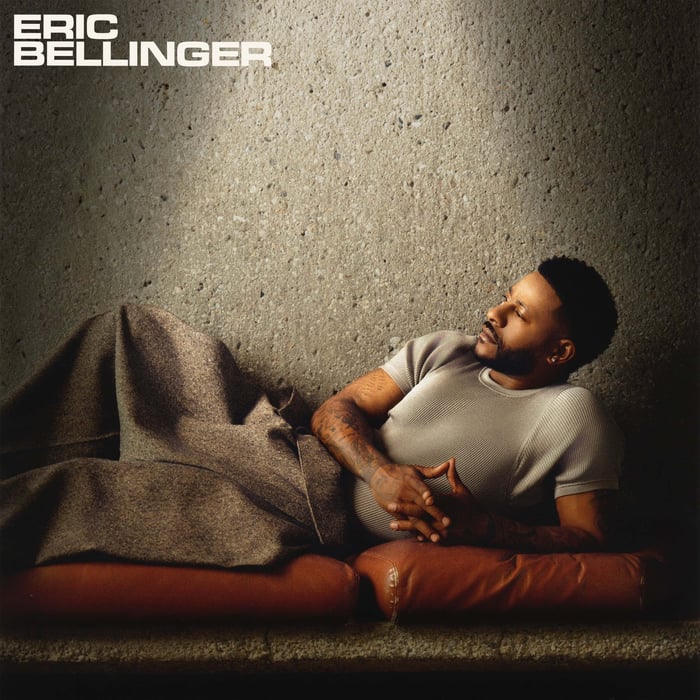
Eric Bellinger Album Review: Ten Songs About Staying Home (Fight Me)


 See more Architeg Prints stories on Google.
Eric Bellinger Album Review: Ten Songs About Staying Home (Fight Me)
Eric Bellinger crafts a deeply personal and domestic-themed R&B album, blending grief, faith, and everyday struggles into a clean Motown-inspired sound with the help of legendary producer Rodney Jerkins.
Most self-titled records are victory laps or rebrands. Eric Bellinger (the album) feels like a man locking the door, turning his phone face-down, and daring you to call it boring.
What hit me first wasn’t some grand sonic reinvention—it was the weird insistence that the most “album-worthy” material here is stuff people usually hide: parenting fatigue, marriage maintenance, old mistakes that still itch, and yes, the kind of adult anxiety that shows up in your credit score. That’s the thesis. Not “watch me shine,” but “watch me hold it together.”
And the gamble is obvious: if you came for escapism, this thing will hand you a calendar, not a fantasy.
Tamla’s ghost is in the room, whether the music admits it or not
Before the first note even matters, the context matters—because this album behaves like it knows its label history is watching. Tamla began as the scrappy homegrown seed that Berry Gordy planted with an $800 family loan in Detroit, inside what he called Hitsville U.S.A. That story has always been bigger than nostalgia; it’s about building a machine that could carry Black music into every home in the country.
Tamla went dormant for decades. Then, in April 2025, it came back as a gospel division under Capitol Music Group—positioned inside “Motown Gospel,” headquartered in Nashville, with a stated mission of pushing “positive, life-changing music,” and led by Walter Thomas. That’s not just corporate reshuffling. It’s a values statement, whether anyone wants to admit it.
And you can hear the pressure of that mission in the way Eric Bellinger keeps leaning toward “uplift,” even when the subject matter begs for mess.
Rodney Jerkins isn’t chasing hits here—he’s chasing meaning
The producer-story underneath this album is almost too neat, like a parable with studio monitors. Rodney Jerkins—raised in Galloway Township, New Jersey, fourth child in a Pentecostal family—started playing piano at five by following his brother and dad into church. His father, Reverend Frederick Jerkins, pastored a local Holiness church; his mother Sylvia directed the choir. The church isn’t a fun fact here. It’s the wiring.
As a kid, he’d sneak into his older brother Fred’s room to mess with the drum machine and keyboard. The family investment turned literal in 1990: after a year of fighting between the brothers, the Reverend borrowed $1,900 against his life insurance policy to buy Rodney his own gear. That’s the kind of “support” that doesn’t feel inspirational until you realize what it risked.
Then Jerkins went on the kind of run that makes résumé lines sound fake: a worldwide publishing deal with EMI by 17, and by 20 he produced Brandy and Monica’s “The Boy Is Mine,” which sat at No. 1 on the Billboard Hot 100 for 13 weeks. His catalog sprawls across Whitney Houston, Destiny’s Child, Jennifer Lopez, Michael Jackson, Beyoncé, Lady Gaga, Sam Smith—the “everyone” list. As of this year, he’s tied to over 40 billion streams from songs he’s produced.
But here’s the part that actually matters for Eric Bellinger: his first album was a gospel rap tape he made with his brother at his father’s church. And now he’s a partner at Tamla—the same label whose origin story is basically “a family loan became a cultural empire.”
That’s why this album feels less like a “new era” and more like a return to the kind of music somebody’s mother could sit through without flinching.
“I will work with anyone that is different because it’s a challenge.” — Rodney Jerkins
Eric Bellinger’s real flex is that he stops networking on the record
Rodney’s first major Tamla signing under this setup is Eric Bellinger, born in Compton, who’s spent the last decade being the guy behind other people’s moments while also dumping his own projects onto streaming like a habit. He’s written on hits like Usher and Chris Brown’s “New Flame.” His independent output is massive—more than forty projects—earning him two Grammy nominations, including Best Progressive R&B Album in 2021 for New Light.
Then in March 2026, Bellinger signs with Jerkins’ EVOLVE Music imprint as Tamla’s first act, and the self-titled album lands: ten tracks, produced with Jerkins, written only by Bellinger, no features, and (this detail matters) a timeline that stretched to nearly three years to finish.
When I saw “no features,” I assumed it would feel like a control move—like he was trying to prove he could carry a whole runtime alone. On second listen, it reads differently: he’s trying to remove excuses. No celebrity cameo to distract you. No duet to soften the emotional accountability. If you don’t like what he’s saying, you can’t blame the guest.
That’s bold. It’s also risky, because it means there’s nowhere to hide when a lyric lands a little too neatly.
The album’s concept is “emotions, not singles,” and it mostly commits
The loudest creative decision is the refusal to chase club math. The writing aims for emotional coverage—like he’s checking rooms in a house rather than chasing a radio hallway. You can feel the “what emotion did we not tackle?” mindset in how the tracklist behaves: it keeps pivoting between gratitude, burden, remorse, and domestic pride.
Two songs act like load-bearing beams in that structure: “Thank You for Telling Me No” and “Heavy Is the Crown.” The album treats them like burdens turned into usable fuel—stuff he might’ve preferred to bury, but instead he sets it to melody and lets it walk around.
And I’m not completely sure I buy the “I made this only for me” posture. Parts of this record feel intensely personal; other parts feel like they’re auditioning for a poster in a high school counselor’s office. The tension between those two impulses is basically the album’s personality.
“Just Like You” is grief with posture: it refuses to collapse
The song that clearly cost him the most is “Just Like You,” the one centered on his mother who died. You can hear the writing wrestling itself into shape.
There’s a version of this track that could’ve been pure sadness, and the album basically admits it: it started with a different title (“To This Day”) and a heavier focus on his grief. What we get instead is a reframed portrait that leans into celebration—crediting her for teaching him without saying much, for moving with purpose, for praying over him the whole time.
The second verse stacks specific images: adversity met with head held high, her wedding ring held onto, and a line that becomes both doctrine and tattoo—Philippians 4:13 (“I can do all things through Christ who strengthens me”), inked on his chest.
It’s effective because it doesn’t sound like a Hallmark synopsis. It sounds like the kind of reverence that comes with a little stiffness—like he’s trying not to break while he sings. A reasonable listener could say it’s too polished for the topic. I’d argue the polish is the point: he’s honoring her by staying upright.
“Closure” is an apology that doesn’t ask permission
“Closure” is the most blunt narrative cut here, built around an affair from roughly a decade earlier. It opens with a monologue that drops you right into the aftermath, long after the act but not long after the damage:
“It been like ten years now since you found out / And the news went loose on the internet / That your man having a baby by somebody else.”
That opener isn’t trying to sound pretty. It’s trying to sound true.
From there, the second verse starts laying out the timeline and the cowardice: they said they were “on a break,” he admits he could’ve said something earlier, he describes the other woman running late, and then hits the part that makes the whole thing sting—he couldn’t even look her in the eyes, so he chose leaving over owning it.
The hook expands into the actual thesis: “I know I left you confused / Something you didn’t deserve / But now that it’s over / This is our closure.”
A lot of R&B will dramatize betrayal like it’s a movie role. This one plays it like paperwork you should’ve filed years ago. It’s not romantic. It’s not heroic. And that’s why it works.
If you wanted “toxicity bangers,” this track will feel like it’s taking your keys away.
“Heavy Is the Crown” makes fatherhood sound like an endless shift
When “Heavy Is the Crown” hits, the album’s routine-song formula is already established, but this is where it gets teeth. He maps the day like a loop: wake up, thank God, lean right and kiss his partner, try to meditate before the phone, then grind through the hours on almost no sleep.
He even pins it down with a number—4 a.m. to 4 a.m., running on three hours. Two kids counting on him. Wife counting on him. Team counting on him.
This is where the album quietly flexes: it treats responsibility like a physical weight, not a virtue signal. And it’s an arguable move to make the “crown” metaphor domestic instead of glamorous. Some listeners will say it drains the fantasy from R&B. I think it finally tells the truth about what grown love costs.
“Everything Is In Order” turns a credit score into a hook (and somehow survives)
Then there’s “Everything Is In Order,” the song that shouldn’t work on paper. It’s about infrastructure—the boring scaffolding that holds a life upright. And yes, it includes the detail that he worked up to an 820 credit score, with payments on automatic debit. He calls it “lifestyle design at its finest,” credits God’s timing, and describes the relief: feet up, no concern over bills, friends cut down to size, life streamlined.
The funniest part is that the song doesn’t treat this like a joke. It treats it like victory. And honestly? That sincerity is the whole trick. A lot of artists pretend they’re too cool to care about stability. Bellinger walks in and says stability is the flex.
I rolled my eyes the first time the credit score line came up—I won’t lie. Then I caught myself on the second listen, nodding along, because the hook sells it. That’s the album in miniature: corny premise, convincing execution.
“Thank You for Telling Me No” is where the writing slips into bumper-sticker mode
Here’s where I have to be a little harsh: “Thank You for Telling Me No” has a great title and a believable premise—rejection as protection—but the lyrics lean too hard on phrases that already exist on coffee mugs.
“Turns out your rejection was my protection.”
“Everything happens for a reason.”
“It’s just a season.”
“What doesn’t kill you makes you stronger.”
Even the bridge—“God doesn’t play about me”—lands more like a caption than a revelation.
The issue isn’t that the sentiment is wrong. The issue is that the language is so worn it stops sounding like him. It could belong to anyone. And on an album that’s selling “people learning me for real,” this is the one moment where it feels like he hands the pen to the inspirational quote industry.
A reasonable listener could argue this is the point: Tamla’s rebirth is tied to positivity, and this track is him planting that flag. I get it. I just think it’s the least specific writing on the record.
“Cry In Front of You” is intimacy as a practical skill, not a mood
“Cry In Front of You” brings the album back to its strongest lane: concrete vulnerability. He describes living with his guard up, finding it hard to let anyone in, and then meeting the person who made his old rule impossible to maintain.
The chorus pins the turning point to one moment: realizing it when he cried in front of you. Not “I opened up.” Not “you healed me.” Just that bodily, embarrassing proof that he felt safe.
The second verse is the real tell, because it loves the mundane mechanics of trust:
“Tell you all my problems / Love how I can vent to you / Nothin’ like that in my past / They don’t know what to do.”
And the closer zooms in on an image that feels almost too human for pop songwriting: dried tear stains on a collar, and every drop hitting harder than before.
If the album has a mission statement about “real music” and “really singing,” this track is where that promise pays rent.
Legacy talk, ambition talk, and the quiet irony of “ten songs about staying home”
By the end, the album starts talking about legacy in a way that reaches past wife-and-kids domesticity. The idea is basically: plant seeds, accept you may not see them blossom. He wants to tour the whole album front to back next year so people can experience Eric Bellinger “in its entirety.”
And then ambition enters the chat. He admits he hadn’t been treating it like competition, but now he wants the big stuff: a No. 1 album, four Grammys. It’s an interesting pivot, because the music itself spends so much time shrinking the world down to a household schedule. The dream is stadium-sized; the content is bedtime-sized.
But maybe that’s the actual point: Gordy’s original assumption was that Black music made in a converted Detroit studio could end up in every home in America. Now you’ve got a pastor’s son who once relied on borrowed life-insurance money to buy equipment, returning to that same label lineage to develop artists making music a church mother could tolerate. And the artist he signs shows up with ten songs about staying home.
That contradiction—big legacy built from small rooms—is the album’s most honest through-line.
The tracks I keep going back to
I’m not pretending these are the “best” in some universal sense. They’re just the ones that keep tugging my sleeve:
- “I Need Help” — the title alone signals the album’s real agenda: not swagger, but admission.
- “Closure” — the writing does the rare thing and actually takes responsibility without romanticizing it.
- “Everything Is In Order” — it turns adult maintenance into a chorus, which is either ridiculous or brilliant. Somehow it’s both.
Conclusion
This self-titled swing isn’t trying to seduce you with mystery—it’s trying to convince you that ordinary life is dramatic enough if you tell the truth sharply.
Our verdict: People who like R&B when it’s grown, detailed, and a little “too real” will love Eric Bellinger. If you need your love songs to sound like a night out instead of a morning routine, you’re going to bounce off this record and call it homework.
FAQ
- What is the core theme of Eric Bellinger?
It keeps circling domestic reality—marriage, kids, grief, faith, and the long-term consequences of old choices. - Does Eric Bellinger have any guest features?
No. It’s ten tracks with no features, which makes the album feel intentionally personal and a bit stricter. - Which song deals with his mother’s death?
“Just Like You,” and it leans into honoring her influence rather than sitting in pure sadness. - What’s the most controversial songwriting moment on the album?
“Thank You for Telling Me No” leans hard on familiar inspirational phrases; some will find it uplifting, others will find it generic. - What are the standout tracks to start with?
“Closure” for narrative clarity, “Everything Is In Order” for the oddly satisfying life-flex, and “Cry In Front of You” for intimacy that feels earned.
If this album’s “staying home” energy is your kind of mood, a great companion piece is a clean album-cover poster on your wall—browse options at our store: https://www.architeg-prints.com/
 | DISCOUNTGET 30% OFF*Use code on your next order:
|
* This post may contain affiliate links, meaning we earn a commission if you make a purchase through these links, at no additional cost to you.