Gone With Devil Review: Greek Black Metal Goes Symphonic (Oops)


 See more Architeg Prints stories on Google.
Gone With Devil Review: Greek Black Metal Goes Symphonic (Oops)
Gone With Devil tries to upscale Greek black metal into a glossy arena ritual—sometimes it’s thrilling, sometimes it’s awkwardly “3am, witching hour.”
Let’s not pretend this album is “just black metal.”
I put on Gone With Devil expecting the usual Hellenic bite—mid-tempo heat, grit under the fingernails, that familiar ancient-smoke vibe. Instead, Yoth Iria comes bursting in like they’re trying to build a cathedral on top of a mosh pit. And honestly? For the first stretch, I bought the whole renovation.
Greek black metal isn’t the Nordics—and that’s the point
The Greek scene never chased that frozen, minimalist Nordic mood. It’s always felt more sunlit and serrated—abrasive, yes, but also strangely regal. You hear it in the lineage orbiting bands like Rotting Christ and Varathron, and you can feel that history clinging to this album too, especially knowing Jim Mutilator has lived inside both of those worlds.
He started Yoth Iria in 2019, and the pace since then is kind of ridiculous in the best way: Gone With Devil lands as their third album in five years. That speed matters—you can hear the confidence of a project that isn’t asking permission anymore.
The opener telegraphs the real agenda: “bigger than black metal”
Here’s the tell: from the opening of “Dare To Rebel,” the record isn’t trying to sound “trve” or underground. It’s trying to sound important. There’s a grand, traditional-heavy-metal kind of sweep—except it’s wearing black metal’s face paint.
Woodwinds, strings, classical flourishes—stuff that could’ve sounded corny if handled wrong—show up like they belong there. The drums and riffing still hit with weight, but the arrangement keeps nudging you toward something theatrical.
I thought they were borrowing from Iron Maiden at first, but on second listen it felt flipped: like Iron Maiden got mugged in an alley by black metal and woke up writing symphonic passages.
That’s an arguable take, sure—but it explains why the album’s first minutes feel so cocky.
The first three tracks set a standard the album can’t comfortably live with
The early run is the album at its most maximal. “Woven Spells of a Demon” keeps throwing ingredients into the pot—dramatic guitar lines, string accents, pinch harmonics that are so obvious they might as well be highlighted in neon. It’s strident, even triumphant.
And then there’s that chorus—big enough to flirt with power metal, just… slowed down, like it’s marching instead of sprinting. Some people will hear that pacing as “warmer” or “more Greek.” I hear a band deliberately choosing mid-tempo because they want the hooks to loom, not blur.
Vocally, He (now established as the frontman after replacing The Magus before 2024’s Blazing Inferno) is doing a useful balancing act: cutting growls when the songs need teeth, and clean, sonorous lines when the music wants to feel like a ceremony. I don’t think the cleans are there to soften the band—I think they’re there to sell the grandeur. Whether you enjoy that depends on your tolerance for drama.
“The Blind Eye of Antichrist” is the one that haunts you
The undeniable centerpiece is “The Blind Eye of Antichrist.” This is the moment the album stops hinting and just declares itself.
There’s a huge choral hook that loops again and again, and it’s the kind of melodic obsession that follows you around after the song ends. It’s not subtle. It’s not supposed to be. It’s engineered to be an earworm inside a genre that sometimes acts allergic to the idea of memorability.
Then the band punches holes through the grandeur with full-throttle double kicks and shredding—high-energy, hard to get tired of, like they finally aligned all their impulses instead of letting them wrestle.
If the whole album lived at this level of focus, we’d be having a different conversation.
Then the record does the thing I didn’t want it to do: drift
After those highs, the album starts behaving like it used up its best argument early. I kept waiting for another track to match the single’s conviction, and… it doesn’t quite happen.
“I, Totem” has moments, but the vocals sometimes wander into a register that hits my ears as grating rather than vicious. Maybe that’s the intent—ugly, confrontational, anti-pretty—but it doesn’t land as effectively as the earlier “grand evil” approach.
“3am” is where the spell really thins out. Musically, it feels too generic compared to the opening run, like the band is temporarily auditioning for a version of themselves that doesn’t actually exist. And lyrically, the reheated devilry leans hard on clichés—“3am, the witching hour”—the kind of line that sounds older than a 1993 record even if you dress it up in modern production.
That’s extra funny (and not in a good way) when the band’s name, Yoth Iria, comes from a demonic avatar imagined by Jim Mutilator, first appearing back on Rotting Christ’s Thy Mighty Contract. The concept has legacy. The “witching hour” line feels like it came from a novelty candle label.
I’m not saying lyrics have to be genius in black metal. I’m saying if you’re going to build an album around grand ambition, don’t hand me bargain-bin incantations in the middle.
The guitars are the glue—sometimes the only glue
When this record works, it’s often because the guitars refuse to let it collapse. Nicolas Perlepe and Naberius bring the kind of melodic sense that makes even the less-focused tracks feel worth sitting through.
There are big riffs and memorable lead shapes all over the place, and it’s not just “playing fast.” It’s composing—trying to plant melodies that stick. Even when the pacing stays mid-tempo, the guitars keep the songs from feeling sleepy.
“Give ’Em My Beautiful Hell” is the best example of a track being rescued mid-flight. The song can feel disjointed, like stitched sections that don’t totally agree with each other. But then it hits that fist-in-the-air power-chord riff in the middle and suddenly it’s working again. Not because it’s seamless—because it’s bold enough to be fun.
That’s the album’s personality in a nutshell: messy confidence.
The drums: flashes of personality trapped in a grid
This is where I’m torn, and I’ll admit I’m not 100% sure if it’s a performance issue, a writing issue, or a production choice.
Vongaar clearly has chops. Near the end of “I, Totem,” there’s a roughly 30-second burst of busy, unorthodox patterns that actually makes the track feel alive—like the kit is arguing with the guitars instead of just escorting them.
But too often the drumming drops into an on-the-beat kick/snare pattern that feels weirdly “designed,” like it’s calibrated for a rhythm-based video game. Then come the expected shifts into blastbeats and double-kicks—competent, but a little formulaic in how they arrive.
The relief comes when “Blessed Be He Who Enters” finally breaks the grid and finds syncopation, especially in that blurry post-metal-ish midsection where the kick pattern stops marching and starts swaying. That section doesn’t just sound better—it proves the album could’ve had more rhythmic character across the board.
Late album: the grand costume comes off, and the band breathes
In the later stretch, Gone With Devil starts shedding the ornate framing and leaning back toward black metal’s raw nerve. And the wild part is: it gets sharper.
“The End of the Known Civilisation” drops the slower mid-tempo dirges and major-key glow. Instead you get a blitz—drums, screams, panic-laced riffs, and some of the best shredding on the record. It sounds like the band stopped trying to impress a balcony full of imaginary nobles and started trying to set something on fire.
Closer “Harut, Government, Fallen” goes for the statement finish: cascading drums, insane-speed picking, overlapping vocals. It’s a big swing and, yeah, it’s a fun attempt. Not flawless, but committed.
And commitment matters, because the album’s biggest contradiction is right here: the glossy, busy production makes the maximalist songs shine… but it also sands down the raw, unfiltered fun that traditional Hellenic black metal thrives on. The sheen helps the “big” moments, but it dulls the grimy ones.
So what is Gone With Devil actually doing?
This record feels like a band trying to live in two rooms at once:
- Room one: maximalist hooks, choral earworms, heavy metal grandeur dressed in black.
- Room two: Greek black metal’s legacy—direct, gritty, sharp-edged, less interested in “sophistication.”
The opening tracks and “The Blind Eye of Antichrist” are the album’s best argument for the crossover approach. The closing tracks remind you the band can still hit with feral urgency when they stop polishing everything.
The middle, unfortunately, is the hallway where the album gets muddled. Not empty—there’s plenty of tasty shredding—but not decisive either.
I can’t fault the attempt. It’s a big swing, and at its highest points it really does soar. But it’s also the kind of album where you can hear the version that could’ve been truly exceptional if the balance were slightly better.
If I had to slap a number on how this all lands, 7/10 feels fair—not as a “grade,” but as a signal that the peaks are real and the dips are hard to unhear.
Conclusion
Gone With Devil is at its best when it stops apologizing for wanting hooks and grandeur, and at its worst when it coasts on cliché and safe rhythms. The frustrating part is how close it gets to greatness—then chooses “fine” for a few tracks before snapping back into menace at the end.
Our verdict: People who like black metal with big choruses, shiny edges, and the occasional “whoa, that melody rules” moment will actually have a great time here—especially if they loop “The Blind Eye of Antichrist” until it imprints on their brain. If you want your Greek black metal raw, stubborn, and allergic to symphonic polish, you’ll spend the middle of this album checking the timestamp like it owes you money.
FAQ
- What is the core vibe of Gone With Devil?
Grand, mid-tempo Greek black metal that keeps reaching for heavy-metal-sized hooks and classical decoration. - Which track is the clear standout?
“The Blind Eye of Antichrist.” The choral hook is ridiculously sticky, and the energy actually matches the ambition. - Does the album stay consistent after the opening run?
Not really. The first stretch sets a high bar, the middle drifts, and the late tracks regain bite by leaning back into black metal. - What’s the biggest strength on the record?
The guitar work—big melodies, memorable riffs, and shredding that feels purposeful instead of just athletic. - What’s the biggest thing holding it back?
Some drum choices feel locked to a straight grid, and a few lyrical moments (“3am” stuff) lean into tired occult shorthand instead of selling the myth.
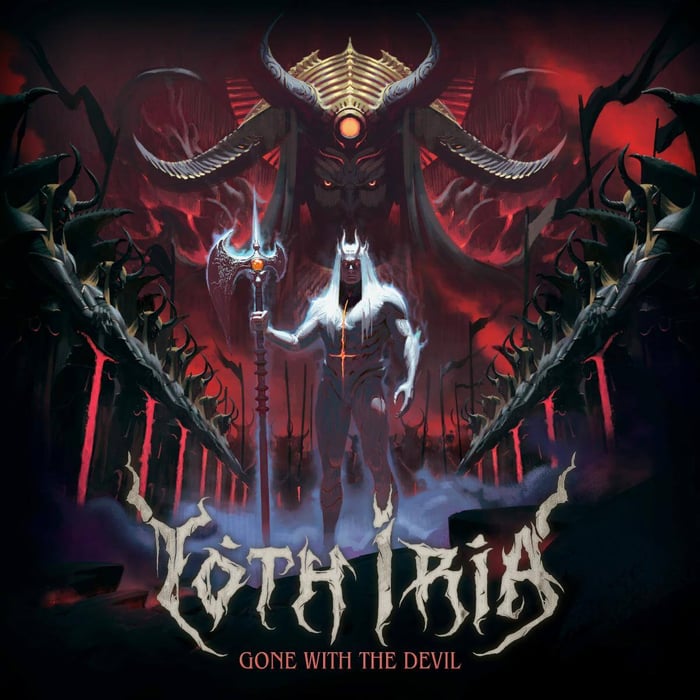
If this album’s cover art (or the whole “grand evil” aesthetic) is your kind of wall mood, you can always pick up a favorite album cover poster over at our store.
 | DISCOUNTGET 30% OFF*Use code on your next order:
|
* This post may contain affiliate links, meaning we earn a commission if you make a purchase through these links, at no additional cost to you.