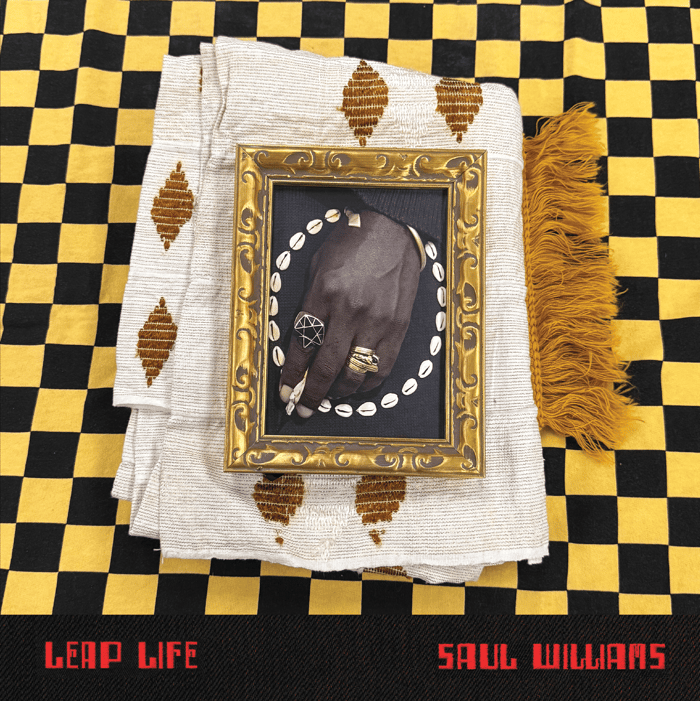
Leap Life Album Review: Saul Williams Turns Sprawl Into a Weapon


 See more Architeg Prints stories on Google.
Leap Life Album Review: Saul Williams Turns Sprawl Into a Weapon
Leap Life album sounds like five records arguing—until you realize that’s the point.
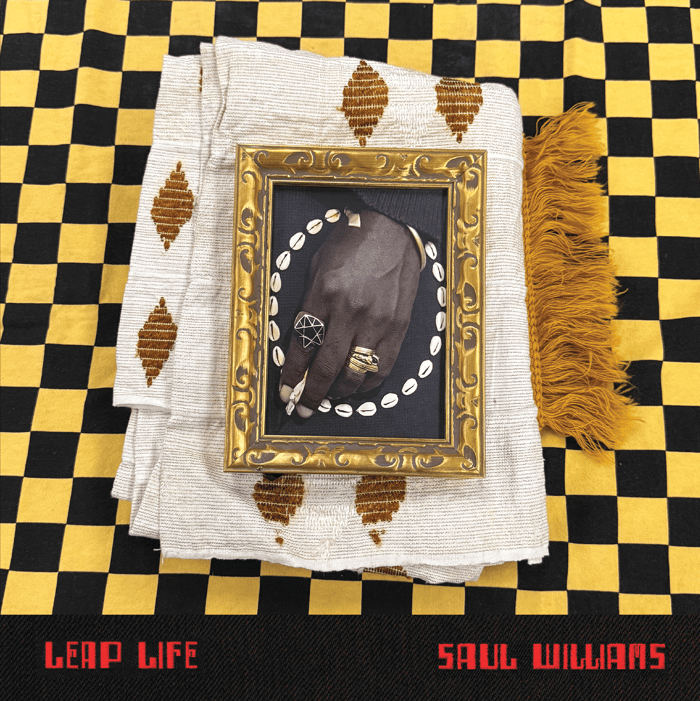
Courtesy of Big Dada.
A record that dares you to keep up
Some albums try to impress you with polish. Leap Life album tries to outlast your attention span, then quietly punishes you for having one.
This isn’t Saul Williams picking a lane. This is Saul Williams dragging every lane into the same room and making them negotiate.
Saul Williams isn’t “back”—he never stayed put
The first thing that hits me is how little this feels like a normal “rapper/poet releases a new album” situation. Williams moves like someone who’s spent decades refusing the job title. You can hear it in the way the music doesn’t settle into a single mode for your convenience.
I keep thinking about how his life in art already looks like a multi-tab browser session: he co-wrote and starred in the film Slam (1998)—the one that snagged Sundance’s Grand Jury Prize and the Cannes Camera d’Or—and then proceeded to release solo albums, publish six books, co-direct a feature film with partner Anisia Uzeyman that premiered in Cannes Directors’ Fortnight, and show up acting as a preacher in Ryan Coogler’s Sinners. That resume doesn’t read like ambition; it reads like restlessness.
And that restlessness matters here, because Leap Life album doesn’t sound like a “new era.” It sounds like a person who’s been making things for so long that the real challenge isn’t inspiration—it’s deciding what even belongs together.
Arguable take: the album’s biggest flex isn’t its content; it’s the refusal to act like one discipline can explain the others.
Carlos Niño is the hidden author of the album’s logic
Here’s what I think is actually happening: Carlos Niño is the one who answers the most brutal question in Williams’s kind of career—what belongs on the same record? They’ve known each other for decades (Niño first asked him to perform in Los Angeles in the late ‘90s), and that long history shows up as trust, not nostalgia.
In 2022, Williams played Niño a stack of unfinished instrumental sketches from across his career, plus pandemic-era amapiano tracks and these improvisational ambient sound collages. Williams didn’t even think they were related. Niño did. And I believe Niño, because the sequencing here feels like someone building a path through a messy attic and somehow making it a house tour.
Williams even admits Niño set the sequence before studio time—an absolute power move that most artists would never allow, and that’s probably why it works. That sequence became Leap Life, recorded with musicians across Los Angeles, South Africa, Mexico, Bristol, and Paris. You can hear the geography, but more importantly you can hear the curatorial hand: not “let’s make it cohesive,” but “let’s make the collisions speak.”
I thought, on first listen, that the album was just scattered. On second listen, it hit me that the scatter is arranged—like someone tipping a box of nails onto a magnet.
Arguable take: Niño isn’t just producing—he’s editing Williams’s entire archive into a single argument.
Improvisation as an actual risk, not a buzzword
A lot of records claim improvisation and still feel tightly fenced in. Here, Williams sometimes walks into the studio without lyrics and just starts singing over players like Kamasi Washington (tenor sax), Aaron Shaw (flute), Nate Mercereau (guitar), with Niño on keys and percussion. That approach can be thrilling—or it can be a mess. And honestly, I wasn’t sure which one I was hearing at first.
Then “Baobab Constellation” comes along and proves the point by not proving anything neatly. The lyric lands like live wiring:
He’s talking about the uniqueness of experience as something “as wondrous as the silver barked baobab,” then the branches growing through abuse, whole families buried inside “me and you.” And then he starts naming his own constellations—bird calls, whale songs, volcanic sunlight, plant medicine—before tossing out a question that hangs there like smoke: what do fishermen dream of when they fall asleep in their boats?
That’s the kind of writing you only get when you let the moment steer. It doesn’t polish itself into a slogan. It just sits there, unsettling.
“What does it mean to trust the moment?” —Saul Williams
Arguable take: the album’s best lines aren’t “written,” they’re caught, and that makes the weaker moments feel weaker by comparison.
“Great, Great-Grandmother” is the album’s most dangerous idea
If “Baobab Constellation” is improvisation as wonder, “Great, Great-Grandmother” is improvisation as a gamble with real stakes. Williams is turning pages of These Potatoes Look Like Humans—a South African book about colonial land dispossession—and speaking back to whatever hits him.
The instrumental choices matter: Sibusile Xaba on storotoro and mouth strings, and William on khaen and bamboo flute. That palette doesn’t “support” the vocal; it makes the vocal feel like it’s trespassing into a story that was here before him.
The lyric pulled from the book is blunt and nightmarish: imagine being lost in a twisted world, bleeding, screaming, and no one comes—then imagine it’s not imaginary at all, it’s your home. The track doesn’t dramatize it with orchestral grief. It just lets it be unbearable in plain language, which is almost worse.
Arguable take: this track isn’t trying to educate you; it’s trying to corner you.
Aztlan Unearthed drags Williams somewhere jazz never could
Niño’s sequencing does something sly: it puts these improvisational pieces next to musical traditions Williams hasn’t lived in, which forces a different kind of performance out of him. The Aztlan Unearthed material—Yaotl Mazahua, Joe Galarza, Caxo, Bulldog, Atlakatl Ce Tochtli—brings conch, rattles, bird calls, drums, flute, percussion. And Williams doesn’t float above it; he locks into it.
“Mazahua” comes framed in parentheses like a vow: “(On this day I plant my flag/I plant my feet/I root my breath…)” That framing matters because it tells you how to listen: not like a “song,” but like a stance.
Then you get those repetitions of “We destroy those systems,” interspersed with Williams recalling a child throwing a rock at a tank: “It’s not the size of the rock/It’s the precision.” The final parenthetical shifts into something like a field report: “900 dead/Not one name given…A question of worth.”
Williams programs beats and keys himself alongside the Aztlan Unearthed musicians, and that match—indigenous instrumentation with his delivery—sparks some of the sharpest writing he’s done in years. It’s not because he “sounds inspired.” It’s because the setting won’t let him fall back on easy cadence.
Arguable take: “Mazahua” proves Williams is most compelling when the music refuses to behave like a polite backdrop.
Chanting versus theorizing: two different kinds of power
What Aztlan Unearthed pulls out of Williams is a chant—grounded, communal, almost physical. What Robert Del Naja pulls out of him is a theory that keeps unfolding.
“Controlled Is Not Controllable” is built by Del Naja (an original member of Massive Attack) with Euan Dickinson, and the track feels like it was engineered for Williams to pace inside it. He lays out a claim about how climate and material comfort shape language—how self-satisfied cultures project ease into inflection, how harsh climates and survival pressure produce more guttural tongues. Then he pivots into the line that stings because it’s said like a fact, not a complaint: “We are the students forced to educate our teachers.”
He keeps pushing until images get strange: the pencil sharpening itself, ink “no longer needed.” The piece feels powerful partly because it comes from outside the spoken-word comfort zone; the production doesn’t bow to the voice, it challenges it.
Mild criticism, though: the sustained-idea approach risks sounding like a lecture if you’re not in the mood for it. I was fully locked in, and then a phrase or two made me drift—like my brain went, okay, professor, I get it, and I had to pull myself back.
Arguable take: this is the album’s most “important” track, but not necessarily the one you’ll replay.
“Une Photographie” stops the album cold—and that’s deliberate
Right in the middle of a flow of English, Anisia Uzeyman shows up with an entire song in French. Williams writes the tracks underneath her singing—bass, keyboard, production—but he doesn’t write the lyrics. That separation is audible: his role becomes architectural, hers becomes cinematic.
“Une Photographie” describes a photograph of a Black woman holding a child, submachine gun in hand, the child turned forward. Uzeyman interrogates the image: is the boy alive, does the woman think about afterward, does the boy have a mother and father? She says the woman has a name she loves—a flower name, a rose name—and she remembers it. She speaks of the child’s bright eyes being forgotten by the world.
Then the song expands outward into a kind of grief-poem: every flower deserves summer and spring; every river carries memory of the world and its wars, the blood of flowers. And then the gut-punch turn: she didn’t know what to say, and returns with sadness without end.
Niño placing it mid-album makes it sit “like a picture in a documentary”—a still image you can’t scroll past. It’s a disruption, and it’s supposed to be.
Arguable take: the French isn’t here for flavor; it’s here to make the album feel briefly untranslatable.
“Conspiracy” is instruction manual nihilism, delivered in second person
The first single, “Conspiracy,” is also the album’s longest track, and it’s stacked: Williams, Moor Mother, Gonjasufi on vocals; Niño on effects and percussion; Mercereau on bass. It’s written in second person and barely ever breaks that instructive grip—like the song is grabbing your collar and giving you directions in a burning building.
“This world will kill you,” it insists, preventing you from “writing while torturing you for information.” Then it hits the blunt triad that’s basically the thesis in plain clothes:
“Death is a conspiracy/Violence is reality/Love is in development.”
And then it ties economics to extinction with those four lines about fossils fueling enterprise, demise, holding no memories, being purely energy. Near the end, Williams says he’s here when he disappears, and Moor Mother and Gonjasufi fold in and out behind him through Niño’s effects like ghosts who refuse to form a choir.
I kept waiting for a traditional hook—something to “catch”—and it never arrives. Instead, the track uses duration as pressure.
Arguable take: “Conspiracy” isn’t a single because it’s catchy; it’s a single because it explains the album’s emotional rules.
“Vengeful Spirit” makes a brutal pivot and refuses to apologize
One of the hardest moments on the record lands in “Vengeful Spirit,” specifically in the refrain: “If they try to get away, we will catch them, we will catch them.” It’s a line that can sound like justice or threat depending on your week, and the song refuses to clarify—which is exactly why it lingers.
Then Williams does something almost offensively casual: he talks about his cats (“My cats indoor, outdoor/I know it’s negligent/Please forgive me”) and then slams the timeline into view: “The cats in Gaza, on the timeline/Never TV.”
There’s a pivot from an indoor cat wrestling to a visual of the Gaza strip, from a baby snake brought into the house (which he saves) to a captured soldier: “Today we got a soldier/Thought I told ya, call that ‘History’.” The move happens in the time it takes to say it. No swell, no warning. Just a hard cut.
Georgia Anne Muldrow, Jimetta Rose, Moor Mother, and Gonjasufi provide vocals, and then the refrain returns as if nothing happened in between. That’s the point: the world keeps returning to its chorus even after the verse breaks you.
Arguable take: this track is intentionally “too fast” emotionally—because that’s how scrolling through reality feels.
“Coming Forth” is where Williams stops theorizing and just walks
Between field recordings, “Coming Forth” opens on a street in Cairo and immediately plants both feet on the ground. There’s a distant minaret above mayhem, a nonstop corridor, “Ancient Egyptian goods made in China,” and then the line that hits like a grim self-awareness: “Suddenly I’m just another nigga in the crowd.”
He moves through the marketplace, thinking out loud in motion, zigzagging the streets. Then he drops the question that flips the scene into paranoia and prayer at once: “Am I praying or am I under arrest?” He notes there’s no police in sight, nobody white, and then—almost absurdly—he breaks open the entire track with “Fresh juice! Oh God. Oh God!”
That fresh-juice exclamation, tossed between minaret and market, makes the song feel alive. Not curated. Not staged. It’s the sound of a person reacting in real time, the way you do when a place overwhelms you and the only honest response is something small and bodily.
Surya Botofasina plays keys, Aaron Shaw brings reeds and effects, and Dwight Trible and Roba El-essawy add voices. This is Williams at his clearest: not chanting, not building a theory, just reporting with eyes open and letting the place talk back.
Arguable take: “Coming Forth” is the album’s most human track precisely because it refuses to be “deep” on purpose.
Conclusion
Leap Life album isn’t trying to be seamless—it’s trying to be true to a life that didn’t happen in straight lines. Niño’s sequencing turns unfinished sketches, improvised writing, indigenous instrumentation, French chanson-like documentary stillness, and second-person warnings into one long confrontation: you either accept the jumps, or you don’t get the point.
Our verdict: People who like spoken-word that bleeds into real composition—and who don’t need every track to behave like a “song”—will love this. If you require tidy choruses, clear genre signage, and emotional pacing that asks permission, this album will feel like getting dragged through someone’s brain at jogging speed.
FAQ
- What is the core vibe of Leap Life album?
A deliberate collision: improvisation next to structured theory, intimate details next to geopolitical shock, and sequencing that dares you to follow. - Is this more poetry or more music?
It depends on the track. “Mazahua” feels built from rhythm and stance; “Controlled Is Not Controllable” feels like an idea riding production; “Une Photographie” plays like a documentary insert. - Which track best represents the album’s approach?
“Conspiracy.” It’s long, second-person, and relentless—more like instruction than entertainment. - Does the album ever feel messy?
Yes, and on purpose. Still, there are moments where the theorizing can flirt with “lecture,” even if the production usually rescues it. - Where should I start if I’m new to Saul Williams?
Start with “Coming Forth” for clarity and place, then jump to “Vengeful Spirit” to understand how fast this album is willing to pivot.
If you’re the kind of listener who remembers album art as part of the experience, you can shop a favorite album cover poster at our store—quietly, tastefully—over at https://www.architeg-prints.com.
 | DISCOUNTGET 30% OFF*Use code on your next order:
|
* This post may contain affiliate links, meaning we earn a commission if you make a purchase through these links, at no additional cost to you.