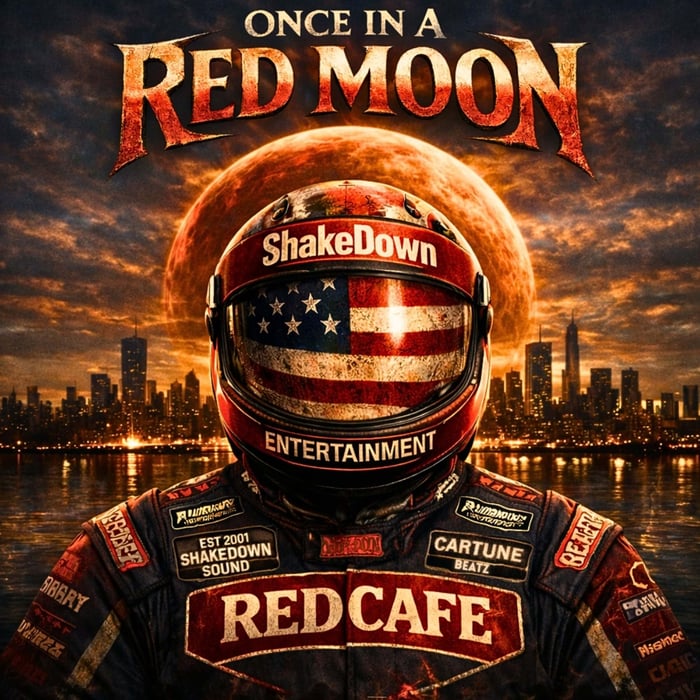
Once In a Red Moon: Red Cafe’s “Rare Event” Album Is Just… Routine


 See more Architeg Prints stories on Google.
Once In a Red Moon: Red Cafe’s “Rare Event” Album Is Just… Routine
Red Cafe turns Once In a Red Moon into a blunt inventory of survival, luxury, and the paperwork underneath—over beats that refuse to flirt with modern tricks.
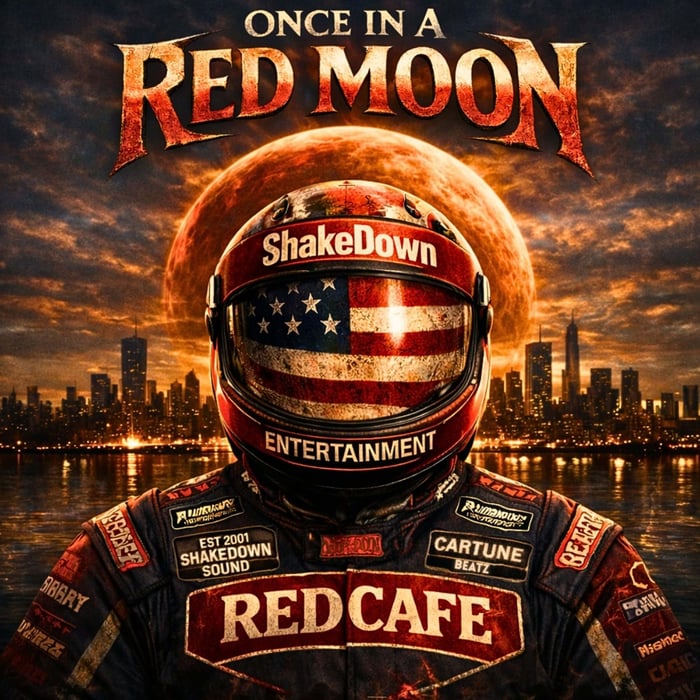
Image courtesy of Shakedown Entertainment.
A “Rare” Title for a Very Specific Kind of Familiar
The phrase “once in a blue moon” is supposed to mean almost never. So when Red Cafe flips it into Once In a Red Moon, he’s not just being cute—he’s basically telling you this drop is an exception, not a new era. And listening through it, I buy that: this album doesn’t sound like a guy chasing the moment. It sounds like a guy cashing a receipt he’s been holding for years.
Red Cafe—Jermaine Alfred Denny—was born in Guyana in 1976 and got raised in Flatbush from age six. That Flatbush detail matters because he raps like the neighborhood is a filing cabinet: pull a drawer, name a block, quote a price, mention who didn’t make it. His stage name isn’t some marketing brainstorm either; it comes from his father’s nickname, Red—something that was stamped on bags of product before it ever got printed on a flyer. That’s a grim origin story, and the album doesn’t try to soften it.
He did four years in a New York state prison starting in 1992—when he was fifteen. That’s not a trivia fact on this record; it’s the reason his voice stays so flat even when he’s saying things that should sound emotional. Flat delivery is a defense mechanism. Or maybe it’s a flex. I’m not totally sure which one he means, and that uncertainty is part of what keeps the songs from turning into pure nostalgia.
The Long Route to a “Debut” That Never Happened
The weirdest tension in this project is that it feels like it’s arriving late on purpose.
Across two decades, Red Cafe signed with Violator, Arista, Capitol, Konvict Muzik, and Bad Boy. There was even a major-label debut, The Shakedown, that got scheduled for 2012, moved to 2013, then shelved entirely. That sort of industry limbo can either break an artist or teach them how to stop asking permission. This album sounds like the second option: he’s not begging you to validate him—he’s reminding you he was in rooms you weren’t.
He’s written, produced, or ghostwritten for a stacked list—Diddy, French Montana, J-Lo, Rick Ross, Future, Chris Brown, Busta Rhymes, E-40. And yeah, you can hear the professional muscle in the way he sets up punchlines. But what’s more revealing is what he doesn’t do: he doesn’t reach for pop structure, he doesn’t sand down his edges, and he doesn’t perform hunger like it’s an audition tape.
He even played the opponent in the Notorious B.I.G. biopic—delivering the real battle lines that were actually said to Christopher Wallace in a Brooklyn battle back in the ’90s. That’s the kind of detail that tells you how close he’s been to rap history without ever being crowned by it. Once In a Red Moon Vol. 1—released this week on his own Shakedown Entertainment—feels like him finally putting his own stamp on the folder.
Cartune Beatz Builds a Late-’90s Time Machine—and Refuses to Update It
Here’s the creative decision that defines the whole record: every beat is produced by Cartune Beatz, and Cartune commits to a strict, late-’90s East Coast blueprint.
These aren’t maximalist, glitchy, dopamine-engineered instrumentals. They’re simple architectures: chopped soul-sample horns, knotty bass figures, thudding drum patterns, almost no melodic decoration. The kicks and hi-hats land exactly where your body expects them to. There are no beat switches, no “wait for it” drops, no obvious attempts to go viral.
That’s admirable… and, on my first run through the album, I’ll admit it made a few tracks blur together. I kept waiting for one beat to misbehave—just once. On second listen, though, I realized the sameness is the point: Cartune’s restraint turns the album into a test of whether Red Cafe’s writing and presence can carry the whole thing without production theatrics. It’s a confidence move. Also a gamble.
And the gamble mostly works—because Red Cafe treats these beats like concrete. He doesn’t decorate them. He paces.
“Private Room @ 2AM” Is the Album Explaining Itself
This is one of only two solo cuts, and it’s basically the thesis statement dressed in luxury.
The hook stacks up the imagery fast—big ice, champagne, Bottega Veneta, sliding to STK, ordering “the usual.” But then he slips the blade in: he’s sick of loss, sick of snitches, sick of going to funerals. That’s the album’s real tone right there—nice things, ugly memories, no dramatic music to tell you how to feel about it.
The first verse moves like a camera pan:
- casino math (“bet the chips on red, now it’s all or nothing”)
- watch talk (Patek + Rollie, called “a menage”)
- street athleticism (“ball in the street more than I ball in the park”)
Then he spells it out: “I’m a D-E-A-L-E-R.” Not “I used to be.” Not “I escaped it.” Just identity, stated like a license plate.
What surprised me is the second verse: it pivots inward without changing the tone. He raps about burning bridges, fine dining, and then his father’s funeral—“Pops’ funeral, I said I wouldn’t, but I cried”—followed immediately by a survival line: “Every time they left me for dead, I came alive.” He ends up in that classic contradiction he seems to enjoy living inside: washing an AP in champagne while admitting some things won’t ever change, even if you’re “in them offices.”
If this track doesn’t land for you, the album won’t either. Because this is Red Cafe telling you he’s not here to transform—he’s here to testify.
The Guest List Brings the Same Kind of Evidence
The features don’t feel like “special appearances.” They feel like additional sworn statements.
Benny the Butcher shows up on “TSA Pre-Check” talking Royal Oak APs soaking wet and dropping a line that says everything about the worldview here: “I told my lawyer I’m too rich for a crime cell.” He closes with “Sold so many bricks, I hope I’m getting into Heaven. Pray for me.” That’s the album in miniature—money, confession, and a prayer that sounds more like risk management than repentance.
“ElCamino” on “Redrum” slides from a whip he hasn’t driven yet into a blunt ethic: if you’re getting money, give your mom something. That line hits harder than the jewelry talk because it’s the one moment that feels like a rule instead of a flex.
“RJ Payne” opens “Payne Cafe” with “I seen my mother die, nothing was the same that day.” No warm-up, no easing in. Just trauma dropped onto Cartune’s steady frame like a weight.
“Boldy James” on “You Lucky” namechecks the Peter Pan bus line drug runners once used between cities—“Came up off the Peter Pan like I’m Captain Hook”—and then turns it into regional pride: “I’m so Detroit…” It’s funny how a single line like that can make the whole song feel colder, like you just stepped outside.
“So Rich” on “Water & Flour” walks through first smiffin’ at fifteen from Benz, first gram from Flatline, and the partner whose name sat on paperwork while he was inside. It’s procedural, not sentimental—like he’s narrating case notes.
And “Max B” closes out “Wish Me Well” with himself and Rozay smoking “up in the big house.” That line lands like a postcard from a different timeline.
Arguably, the guests are doing more emotional heavy lifting than Red Cafe himself—because they let cracks show. Red Cafe tends to keep his face still, even when the room is on fire.
“Pray for Me” Is Simple on Purpose—and That’s the Trap
The second solo cut, “Pray for Me,” opens with a hook that’s basically a mantra: pray that I make it home safe; pray I never catch another case.
Then Red Cafe spells himself out again: “Kinda hard being R-E-D C-A-F-E from the SD.” That spelling habit could’ve felt corny, but here it plays like branding and self-defense at the same time—like he’s reminding himself who he is before the world tries to rename him again.
He mentions an ER visit caused by his chain—“said my chain too heavy”—which is such a ridiculous sentence that it loops back into being real. That’s the particular comedy of street-luxury rap: you can nearly die from jewelry and still report it like a weather update.
Then he lists the movies he came up on—Shottas, Money and Violence, Belly. And the verse closes with the kind of line this album is built on: “Me, my blick, and my bitch, all we got is us.” It’s not romantic. It’s not inspirational. It’s a boundary.
If you’re looking for growth arcs, this is where you’ll get annoyed. The album isn’t trying to teach lessons. It’s trying to preserve a mindset.
When the Album Gets Hyper-Specific, It Gets Dangerous
The best moments on this record aren’t the punchlines—they’re the coordinates.
When Red Cafe raps “I could whip it to a cookie or a pancake” on “Once In a Red Moon Pt. I,” it doesn’t feel like metaphor. It feels like he’s back in a real Brooklyn kitchen from the late 1980s, remembering the heat and the routine.
When he says “My kitchen counter touch more cocaine than Rick James” on “Payne Cafe,” it’s not just a bar for shock value—it’s him pointing at a specific apartment he lived in before Violator signed him. That’s the pattern: he keeps attaching the rap clichés to actual rooms he stood in, which makes them heavier.
And on “Redrum” he raps:
“Back on Flatbush Ave, I had the cheap rocks
Pandemic season, we had the tree spot
We got it fifteen-five, that’s the sweet spot.”
That’s a block, a time period, a price point. It’s the kind of specificity that doesn’t sound invented. Everyone on the guest list brings that same vibe—like everybody’s carrying paperwork, and the songs are just the spoken version.
The Closing Stretch Turns Into Brand Names—and I’m Not Sure It Helps
By the end, Cartune’s uniform beat style has done its job: it puts the difference between tracks almost entirely on Red Cafe.
On the album’s closing song, Red Cafe rides another Cartune beat cut from the same template—hook repeating “Anybody can get it” eight times—then his verse runs through branzino at Wynn, a penthouse at the Aria, McQueen on his feet, a Jersey move, and the line “I’m a black IP, still I move the Fergie.”
Here’s my mild complaint: the late-album brand-name parade can start to feel like he’s filling space with expensive nouns. I get the intent—luxury as proof-of-life, wealth as revenge, success as documentation. But sometimes the cataloging dulls the emotional edge that made earlier details hit. The hook repetition doesn’t help either; eight times is a choice, and it’s a slightly numbing one.
Still, there’s something revealing in that numbness. Maybe that’s the point: when you survive long enough to eat branzino at the Wynn, you’re still the same person who learned to go emotionally blank.
Shakedown Entertainment Is the Punchline and the Proof
The label putting the album out—Shakedown Entertainment—shares the name of that shelved major-label debut that got scheduled, rescheduled, then canceled. That’s not a coincidence; it’s Red Cafe taking the thing that never happened and making it happen on his terms.
The Guyanese jewels he shouts out on track one aren’t random jewelry talk either—they’re his father’s jewels. That detail ties the “Red” name back to bloodline instead of branding.
And at 49, after spending years ghostwriting hit singles that other people got to sign their own names to, he drops the line on “Private Room @ 2AM”: “I did it my way, middle finger to the critics.”
That line could’ve been corny. Somehow it isn’t—because the whole album sounds like a person who genuinely stopped caring whether the gatekeepers clap. If anything, the album’s biggest flex is how little it begs.
Conclusion: The Album Isn’t Rare—It’s Just Finally Uncanceled
Once In a Red Moon doesn’t try to modernize Red Cafe. It tries to freeze him in place—Flatbush memory, prison time, industry near-misses, luxury as survival proof—over beats that refuse to do backflips for attention. The uniform production sometimes blurs the edges, and the back-end brand talk can drift into autopilot, but the best lines hit because they’re anchored to real rooms, real blocks, and real consequences. This is less a comeback than a late-arriving document that doesn’t ask permission to exist.
Our verdict: You’ll actually like Once In a Red Moon if you want grim, specific street rap over classic East Coast skeleton beats—no beat switches, no sugar, no “please stream this” energy. You won’t like it if you need big musical moments, catchy pivots, or an artist pretending they’ve moved on; this album isn’t therapy, it’s a ledger—with a nice watch on top.
FAQ
- Is Once In a Red Moon a polished, modern-sounding rap album?
No. It’s intentionally rooted in late-’90s East Coast structure—steady drums, chopped soul textures, and minimal tricks. - How many producers are on the album?
Just one: Cartune Beatz handles every beat, which makes the project feel deliberately uniform. - Does Red Cafe carry the album, or do the features steal it?
The features add emotional volatility, but Red Cafe carries the identity thread—deadpan, specific, and stubbornly consistent. - What are the two key solo tracks?
“Private Room @ 2AM” and “Pray for Me” are the two solo cuts, and they function like the album’s clearest self-portraits. - What’s the main weakness of the record?
The production sameness can make tracks blur, and the late stretch leans hard on luxury name-dropping when the hyper-specific storytelling is more interesting.
If this record put an image in your head—Flatbush corners, casino reds, a chain heavy enough for the ER—you might want that feeling on your wall. You can shop a favorite album cover poster at our store here: https://www.architeg-prints.com
 | DISCOUNTGET 30% OFF*Use code on your next order:
|
* This post may contain affiliate links, meaning we earn a commission if you make a purchase through these links, at no additional cost to you.