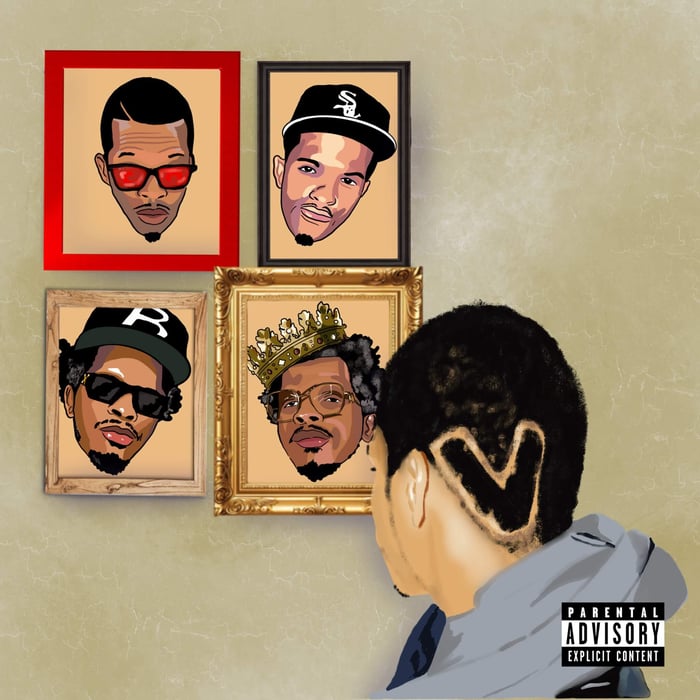
Stephon Barbury Album Review: A Punchline Gym That Actually Learns to Breathe


 See more Architeg Prints stories on Google.
Stephon Barbury Album Review: A Punchline Gym That Actually Learns to Breathe
Stephon Barbury turns “pure” boom-bap into a pacing flex—bars piled high, then suddenly human. It’s Stephon Barbury playing offense on itself.
Let’s not pretend this is “just” an underground rap album
At first, I figured Stephon Barbury was going to be one of those fundamentalist throwback records—the kind that confuses restraint with discipline and calls it a philosophy. You know the type: drums that refuse to smile, loops that glare at you, rapping that’s technically dense but emotionally sealed in plastic.
Then the album started slipping the spectacle into the punchlines, and I had to adjust my posture a little.

Courtesy of MGNTK.
The “Oh Lord” move: discipline cosplay, but the joke’s on you
This record basically dares you to misread it. Early on, “Oh Lord” runs a Stephon Marbury broadcast clip over the intro, and it sounds like a thesis statement: discipline, fundamentals, boom-bap purity, the usual “real hip-hop” posture.
Except that’s not what the album’s actually doing. The control-freak energy is there, sure—but it’s staged inside the bars, like UllNevaNo is building a museum exhibit called “Look How Much I Can Fit In Here” and then quietly setting fire to one of the rooms.
Take “Ankle Injury.” In one stretch alone, he sets Ben Grimm on fire, breaks ankles “like Stephon in Air One sneakers,” and uses Capadonna’s album cover as shorthand for his own rhyme density. That’s not restraint. That’s a magician sawing his own stage in half because he’s bored.
And yeah—I’m not totally sure the album wants you to enjoy how packed it is at first. It almost plays like a test.
UllNevaNo’s one-producer rule finally meets a producer who argues back
UllNevaNo’s “one-producer” approach has been a running experiment: lock into one sonic palette and treat fidelity like a workout. That’s the vibe I hear across his color-tape run—rapping over Kev Brown on The Color Brown, then 9th Wonder on I WONDER what color ima use next like he’s proving he can keep the same pen temperature in different rooms.
Then you get Shammgod with MANHE—punchline-stacked, sharp, almost combative about how much it can hold at once. Baby Jordan keeps that density, too.
And when The Ghost of Reggie Lewis (with God Sense Beats, back in 2022) happens, it doesn’t feel like a mere pairing anymore—it lands like an elegy. The air changes. The idea of “theme” stops being decorative.
So when Stephon Barbury hits, this is where it finally sounds like the producer—Philth Spector, tied to the $$$ collective—wins an argument about pacing. Not about quality. About when to let things breathe.
Philth Spector’s approach here feels almost academic in the best way: working chronologically through the Philadelphia International catalog like it’s a sample-selection course, not a grab-bag. “I Understand It Now” lets that old-school sample sit proud while UllNevaNo talks like he owns the room.
And he kind of does.
“AND1 Trash Talk Tee” proves the guest feature isn’t decoration
Here’s where the album stops acting like a solo exhibition and starts acting like a game.
Life L.O.N.G. shows up on “AND1 Trash Talk Tee” with this raspy, cartoon-elastic delivery—like his voice is made of rubber bands and bad intentions. It bounces right off the snare. After UllNevaNo spends so much time packing references into a smooth, grounded cadence, the feature jolts the track into motion:
“Shake, shake, you erase your picture like Etch A Sketch…
Me and you never know, double up and break ankles next.”
And UllNevaNo doesn’t try to out-stunt him. That’s the point. He tightens up and plays the baton pass clean: “Contemporary, classic urban sportsman reporting live from Manhattan.” It sits in the pocket like leadership, not competition.
Life L.O.N.G. brings the tumbling—“Skip to my lou, doing tricks / Double dribble, punch kick”—the physicality UllNevaNo had just described in words as “Complex syllable syncopations / The vocal gymnast.” The feature doesn’t just add flavor. It proves the song’s idea in real time.
Arguable take: this is the moment the album admits it’s not only about penmanship—it’s about movement.
“Yellow Jackets” sounds like a posse cut with no posse
“Yellow Jackets” opens on triumphant horns—big, bright, almost arrogant—before UllNevaNo even settles into his first bar. And then he does that thing he loves: cramming eight bars with a ridiculous number of punchlines:
- Bruce Leroy glow talk
- writing-from-Iceland coldness
- crop-circle hover imagery
- “different types of wordplay and techniques I discover”
- rhymes compared to Capadonna’s album cover
It’s flexing, but it’s also a little theatrical—like watching someone shadowbox in a mirror and still manage to land a hit.
DJ illMEASURED’s scratches matter more than they usually do in records like this. They cut into the track like controlled interruptions, giving you a pocket-restoring breath between verses. It’s basically an editor walking into the room and saying, “Okay, enough—let the reader blink.”
And the energy is Wu-style posse electricity… even though there isn’t a posse. That’s the trick: the song feels crowded with voices because the references behave like extra people in the booth.
Then the next verse reroutes to Baltimore: “From B-More, home of the Ouija board / Got a lot ghosts, Annie Holiday / I use your debut album as an ashtray.” And late in the verse, a line like “Healing factor, womb trap body armor, is still heather gray” opens up like a clearing in the density.
Arguable take: “Yellow Jackets” isn’t trying to be catchy—it’s trying to be undeniable, and those are not the same thing.
“Flowers Given” turns proper nouns into a whole timeline
“Flowers Given” opens on the kind of grief math that doesn’t ask for your permission—two funerals in one day, “Transition from natural causes and not the gunplay.” Then UllNevaNo starts building the whole song out of names and places like he’s pinning receipts to a wall.
You get scenes, not summaries:
- Mookie with a copy of The Source
- Tim dubbing Mobb Deep tapes
- a basketball dream chased on a military base
- sandals crossing Kansas winters while Ken’s family takes him in over school break
- November sending him to Long Beach with Cam “helping to devise a plan, word”
- Adrian and Monstra riding the same elevator
Then it runs through cyphers “in front of the barracks” with Jay and Pressure “every third Monday,” through Season of the Microphone, through abandoned row homes. Mind the People’s passion for MF DOOM points him toward Below the Heavens on MySpace.
It’s like forty bars of proper nouns, and instead of feeling like namedropping, it feels like proof of life. And only at the end does it land on the point:
“Flowers given, move like a transmission / For the transition, I switch my position / Had to stop speaking and listen.”
Arguable take: this is the album’s real spine, not the sports concept—because it’s the first time the density feels like it’s serving something besides the flex.
The bar-density “tic” is real—and the album knows it
There’s a specific habit that shows up across tracks: the eight-bars-open-six-universes approach.
“I praise a Bruce Leroy, I found the glow / This writing in Iceland, they say my sound’s so cold / Over crop circle, field planes hover…”
That same metric shows up again on “AND1 Trash Talk Tee” with a string like “Hampton burger helper gloves backhanded / Shoot up your establishment / Flame aces, trench coats, Gambit,” and again with the Baltimore-ghosts-Annie-Holiday ashtray run.
Some listeners are going to call that “lyrical.” I call it a very specific kind of attention demand. Somewhere around reference five, your brain stops listening and starts watching. It turns into spectatorship—like you’re observing technique more than feeling meaning.
Then “I Got Time Today” does something smart: it nods to MF DOOM up top and holds one thought still for two bars—“Today’s penmanship is not taken serious / It’s easier in acceptance.” Two bars, one register, zero swerves.
That’s when it hit me: the density is a switch, not a compulsion. The record can turn it off. It just usually doesn’t want to.
Mild criticism, though: sometimes the flex is so constant that the emotional cues get buried. I caught myself rewinding not because I felt something, but because I didn’t want to “miss” something. That’s a different relationship with music, and not always the healthiest one.
“Newlyweds” is where the album stops performing and starts talking
“The standout track” label gets thrown around too easily, but “Newlyweds” actually earns its special treatment because it changes the album’s posture before the verse even arrives.
UllNevaNo names it. He basically clears his throat and tells you what’s coming: he’s about to get vulnerable, and October 16th is when his life changed. Then he promises the verse won’t be filled with syllable-acrobatic punchlines.
And for once, he’s not bluffing.
The album’s reference-tournament behavior goes dark for four minutes. The scene-setting is blunt and specific: from the Bella Aduce hotel to marriage counseling. “Homies from BWY.” Traveling through 695 for the first time. “Seeing the Ravens fading good morning skyline.”
Then the wedding walk lands with a kind of unguarded clarity that the rest of the record keeps dodging:
- under a black bow, strutting until he’s got her open
- groomsmen forming a line
- the deep breath
- “To see my bride, God’s long-awaited prize / Goddamn, she’s fine”
- trying to be tough, then tears
And the closer is quietly wild: pics attached with the hashtag on Instagram, “Thomas” engraved on the floor like a hologram, and then—almost casually—“by the time you hear this, celebrate the sonogram.”
A wedding-day verse that gets a sonogram in. That’s not “conceptual.” That’s just life showing up and refusing to be edited.
Revised first impression: I thought this album was going to be discipline cosplay. “Newlyweds” makes it obvious the discipline is just the frame—what matters is what slips through it.
Why Stephon Marbury matters here (and why the album uses him like a mirror)
Stephon Marbury is the kind of athlete people reduce to a myth: left the NBA, sold a basketball shoe that performed as well as the $150 ones, then won three CBA titles with the Beijing Ducks on his own terms.
The “Oh Lord” interlude lifts the broadcast clip—“Passed to himself… deflected it off D-Miles… three in a row… most unique maneuver… I don’t know if he actually makes contact”—and that uncertainty is the whole point. Did he touch it? Did it count? Did it work because it was clean, or because it was bold?
UllNevaNo merges his name with Marbury’s on the spine like a dare. Then he puts a wedding vow verse and a punchline tournament on the same record. Then he gives one Philadelphia producer space to work chronologically through Philadelphia International’s shelves until the room feels right.
The album’s message isn’t subtle: pass to yourself off somebody else’s skull, and still call it a play. Stomp the loop in your own sneaker.
Arguable take: Stephon Barbury isn’t romanticizing fundamentals—it’s showing how “fundamentals” can be a disguise for someone who wants total control.
The tracks I keep coming back to (even when the record tries to outsmart me)
I’m not going to pretend every moment here is equally replayable, but a few songs keep pulling me back because they do different jobs:
- “Yellow Jackets” for the horn-strut energy and scratch-breath pacing
- “Flowers Given” for the proper-noun timeline that actually lands emotionally
- “I Got Time Today” for proving the density is optional
- “Newlyweds” for dropping the mask without turning it into a sermon
And yeah, I still don’t know if the album always realizes when it’s asking you to admire it instead of feel it. But when it chooses to be direct, it’s weirdly disarming.
Stephon Barbury doesn’t “balance” anything. It stacks extremes in the same room and lets you hear the contradiction. The punchlines aren’t here to make you laugh—they’re here to prove the architecture holds. And when UllNevaNo finally stops doing verbal parkour long enough to tell the truth on “Newlyweds,” it retroactively makes the rest of the record feel less like showing off and more like bracing for impact.
Our verdict: People who like boom-bap as a craft—snare placement, scratch cuts, internal rhyme pressure—will love Stephon Barbury because it treats rap like a skill sport. If you want choruses, softness, or even a little empty space without earning it, this album will feel like being talked at by a guy who reads the dictionary for cardio.
FAQ
- What is the core idea behind Stephon Barbury?
It uses Stephon Barbury as a way to talk about self-made moves—control, independence, and doing something “your way,” even if it looks strange in real time. - Is this album more about storytelling or punchlines?
Mostly punchlines and technique—until “Newlyweds,” which flips the ratio and makes the emotional sections count harder. - Does the production stay consistent throughout?
Yes, and that’s intentional. Philth Spector’s sampling approach feels studied and chronological, like the album is building a sonic argument rather than chasing variety. - Which track best represents the album’s pacing strengths?
“Yellow Jackets,” because the scratches and horn energy create breathing room without lowering the bar density. - What’s the most surprising moment on the record?
UllNevaNo promising—then actually delivering—a verse on “Newlyweds” that avoids the syllable gymnastics and still hits.
If you’re the type who gets attached to album artwork as part of the whole ritual, you can always shop a favorite album cover poster at our store: https://www.architeg-prints.com. It fits this record’s vibe—bold choices, clean presentation, no apology.
 | DISCOUNTGET 30% OFF*Use code on your next order:
|
* This post may contain affiliate links, meaning we earn a commission if you make a purchase through these links, at no additional cost to you.