Trip Meadow Album Review: Druidess Bring Doom Rock Back (Too Much?)


 See more Architeg Prints stories on Google.
Trip Meadow Album Review: Druidess Bring Doom Rock Back (Too Much?)
Trip Meadow turns Druidess into a time-traveling doom rock act—fuzzy keys, long builds, and big choruses, even when the songs start to blur together.
Let’s be honest: this album wants your brain in 1971
Rock doesn’t “need” to go back to basics, but Trip Meadow clearly thinks it does. Druidess come off like a band that looked at modern rock’s polished edges and decided to sand them down with a brick. The result is a debut that keeps reaching for that old-world, head-shop haze—fuzzy keys, classic riff shapes, and a doom-ish weight that’s less about heaviness and more about mood as a blunt instrument.
They’re not cosplaying the past, exactly. They’re rebuilding it—then wiring in modern hard rock muscle where it suits them. Sometimes that mash-up is exciting. Sometimes it feels like they found one candlelit corridor and kept walking it, door after door, because the echo sounded cool.
And yeah, I’m calling it doom, but there’s an almost psychedelic stubbornness to the whole thing: Druidess don’t just want songs; they want scenes.
“The Hermit Of Druid’s Temple” starts strong… then circles the same stone
The opener, “The Hermit Of Druid’s Temple,” makes its mission statement immediately: those fuzzy keys show up like a dusty organ dragged out of a 60s garage. It’s a smart first move, because it tells you the band cares about texture, not just riffs.
But the track also shows the album’s first bad habit: the main melodic ideas are so similar for so long that by the end I caught myself waiting for a turn that never really arrives. I’m not saying repetition is automatically lazy—doom lives on repetition—but here it flirts with boredom before the song earns the trance.
Where it does land is the vocal approach, especially when the chorus hits and the whole thing drops into a half-tempo lurch. That slowdown gives the chorus the ambience it desperately needs, like someone finally dimmed the lights. The instrumental break is surprisingly short and doesn’t introduce much new material, then there’s a brief vocal-led bridge that slides you into the final chorus—repeated, then sped up right at the end like the band remembered they’re allowed to leave the room.
The vibe is right. The pacing, less so.
A quick detour: the video that gives away their obsession
Right after that opener, it’s worth sitting with what Druidess look like when they “go official,” because it matches what the album’s trying to do: make rock feel ritualistic again, not casual.
The title track “Trip Meadow” is where they stop playing “retro” and start experimenting
Then comes “Trip Meadow,” the title track—and it’s not subtle about being the centerpiece. At 10 minutes and 6 seconds, it dwarfs everything else and basically announces: we’re not here to write tidy little rock songs; we’re here to wander.
It’s loaded with synths alongside the expected guitars and drums, and there’s also a hint of saxophone floating around—never screaming “jazz band,” more like a ghost instrument haunting the edges. The first three minutes are fully instrumental, and they swing between heavily distorted passages and moments that feel eerily peaceful, like the song can’t decide whether it wants to crush you or gently mislead you.
Just after the three-minute mark, the vocals arrive—soft, almost blended into the instruments instead of perched on top. At first I thought, oh, they’re going to stay delicate here. But then the track leans doomier after the first verse, and the chorus locks into this gloomy, dark riff that actually fits the band like a glove. It’s one of those choruses that doesn’t “lift” so much as it sinks with purpose—and it works because the band commits to the descent.
The second verse speeds up noticeably; the drum beat gets uniquely rapid, and the vocal melody finally feels like it’s reacting to the rhythm rather than drifting through it. The bridge is the big dynamic flex: it starts mellow and peaceful, then gradually builds, pushing into a third and final verse where the track picks up velocity again. After another chorus, there’s a second bridge that becomes the fastest part of the whole song, like they’ve been storing motion for eight minutes and finally spend it.
Then, instead of ending, the track moves into another instrumental section that echoes the verse feel—serving as the passageway to the final chorus.
If the opener hinted at a band with a single lane, the title track argues the opposite. It’s basically Druidess saying: we can do long-form structure, we can pivot dynamics, and we’re not afraid to stitch “peaceful” and “punishing” together in the same garment.
Do I love every minute of it? I’m not totally sure. But I respect the nerve.
“Mandragora” proves they can hit hard and leave quickly
By the time “Mandragora” shows up as the fourth song, it feels like the album knows it owes you something more direct. It’s the shortest track here, and it behaves like it: quick entrance, quick punches, no unnecessary sightseeing.
It opens on another classic-sounding riff—no shame, no apology—then the vocals rush in for the first verse. The chorus arrives shortly after, and this is where Druidess’ best skill shows up: layering. The vocals and instrumentation stack in a way that makes the hook feel larger than life, like the band’s trying to turn a small club into a theatre without changing the room size.
Then comes a groovy second verse into another chorus you can’t really dodge. And then—finally—the record drops its first guitar solo, and it’s short, sharp, and exactly as long as it needs to be. Honestly, it made the earlier tracks feel slightly under-dressed. This is one of the few times on Trip Meadow where a “classic rock move” doesn’t feel like a reference point—it feels like a decision.
The song ends by returning to the chorus after that solo, giving it a satisfying finish. If you wanted proof Druidess can be courageous without being long-winded, “Mandragora” is your exhibit.
“The Forest Witch’s Daughter” closes the record like it finally remembered speed exists
The closer, “The Forest Witch’s Daughter,” is a genuine pacing rescue. After the heavier, more lumbering stretches before it, this one comes in faster, like a window cracked open.
The synths mirror the energetic guitar riff, and when the vocals arrive, the first verse feels rhythmic in a way the album sometimes avoids—more locked to the groove, less floating above it. The chorus turns cinematic, not just in tone but in its change in rhythm: it pivots like a scene cut, and it’s the kind of moment this band seems to chase.
After the chorus there’s another guitar solo—still rare on the record, still a pleasant surprise. And then the track pulls its best trick: the second chorus slows down, leaning into a Black Sabbath kind of weight. It’s not subtle, but it doesn’t need to be. That slowdown makes the chorus feel heavier without adding anything fancy—just mass. Then it repeats again in its normal version, returning to the initial energy like the band’s showing you both faces of the same hook.
A short instrumental section follows, mostly functioning as a segue into the bridge, and that bridge leads into a massive, concert-level ending—the kind of finish that feels designed for hands in the air, even if you’re alone in your kitchen pretending you aren’t impressed.
The real story of Trip Meadow: identity first, variety later
Here’s the thing: Trip Meadow has something a lot of debuts fake with aesthetics—an actual identity. Druidess sound like they know what they want to be. They aren’t throwing random influences at the wall to see what sticks; they’re building a specific house and inviting you inside.
But the same identity is also the album’s limitation. At times, it turns one-dimensional—not because the playing is weak, but because several tracks lean on similar structures and similar shapes, and that similarity becomes noticeable if you’re listening straight through. The band loves a certain kind of riff-and-chorus gravity, and sometimes it feels like they keep picking the same lock with different keys.
I’ll admit: my first impression was that the album was going to be a full-on retro revival—warm, familiar, maybe even safe. On second listen, I heard more risk in it than I gave it credit for, especially in how the title track swings between distortion and calm, and how the closer messes with tempo like it’s trying to bend time. Still, I can’t pretend every idea here gets developed enough to justify how closely the songs resemble each other in places.
What does that mean long-term? It means Druidess have done the hard part early: they’ve made a record that sounds recognizably like them. Most bands take years to earn that. If they keep going, the obvious next step isn’t “find a sound”—it’s complicate the one they’ve already claimed.
Release details (because yes, this matters)
Before anyone tries to hunt it down blindly: Trip Meadow is set for release on June 26 as a self-release.
And if you’re the type who likes keeping up with bands the old-fashioned way, Druidess are on Facebook:
https://www.facebook.com/druidessuk/
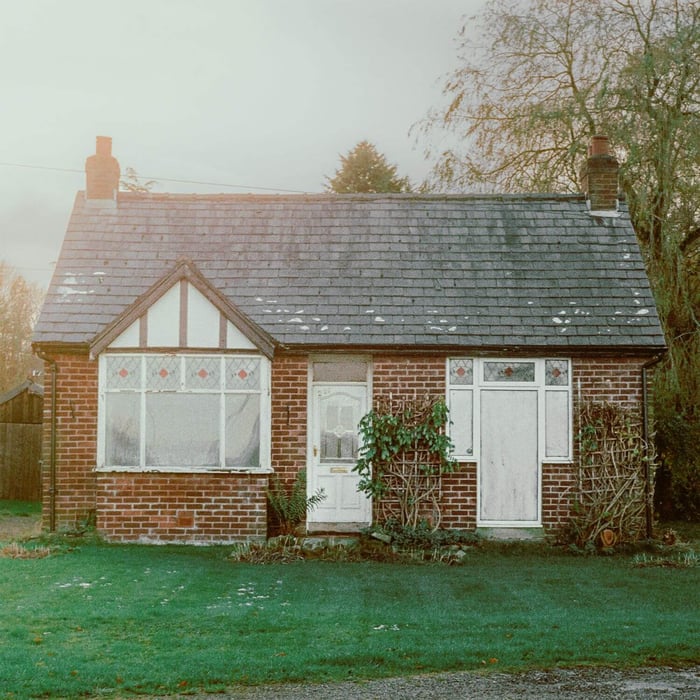
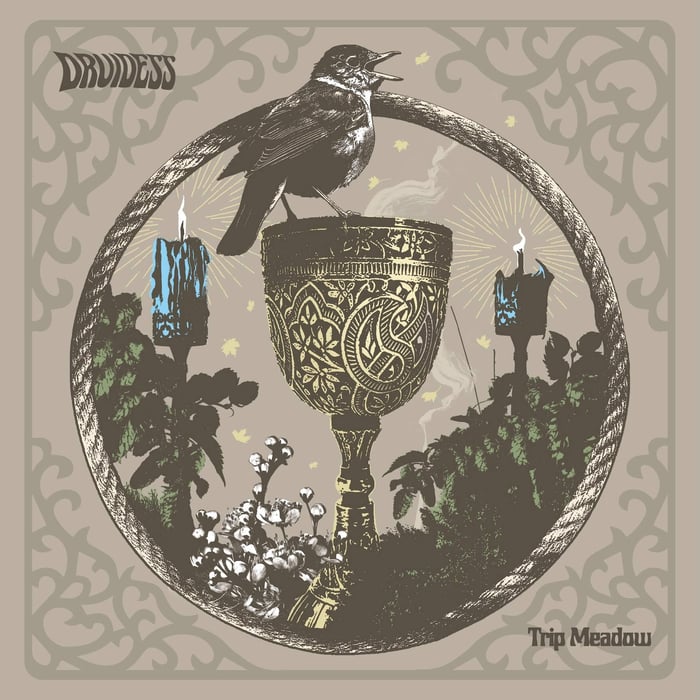
Album art: it looks like the music sounds
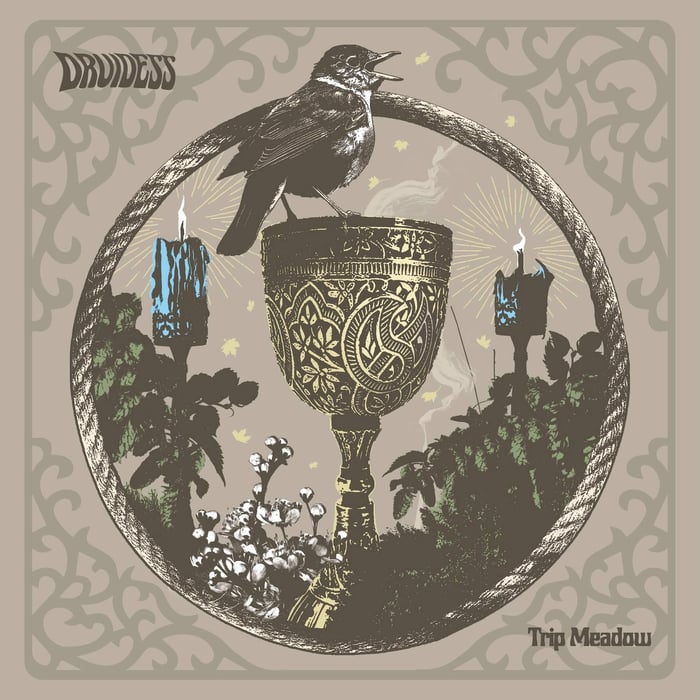
The cover doesn’t try to modernize the vibe. It leans into the same world the music insists on living in—mythic, earthy, and slightly ominous.
Conclusion
Trip Meadow doesn’t feel like a band auditioning for attention; it feels like a band staking a claim. The strongest moments—“Trip Meadow” when it shifts gears, “Mandragora” when it cuts clean, and “The Forest Witch’s Daughter” when it goes cinematic—prove Druidess can do more than worship the past. The weaker moments happen when the album leans so hard on its own identity that it forgets to surprise itself.
Our verdict: People who actually like doom-leaning rock with fuzzy keys, big choruses, and long, moody builds will eat Trip Meadow up and ask for seconds. If you need constant left turns, modern sheen, or songs that wrap up fast and politely, this album will feel like being trapped in a very stylish fog machine.
FAQ
- Is Trip Meadow more classic rock or doom?
It plays both sides: classic rock textures and riff language, with doom pacing and weight—especially when the choruses slow down and get heavier. - What’s the most experimental moment on the album?
The title track “Trip Meadow”—the long instrumental opening, the dynamic swings, and that hinted sax presence make it the album’s main risk. - Does the album have guitar solos?
Yes, but they’re used sparingly. The first notable one lands in “Mandragora,” and it’s short but genuinely effective. - Which track feels most “live” or crowd-ready?
“The Forest Witch’s Daughter.” The ending aims for a concert-sized finish, and the chorus tempo change is built for drama. - What’s the biggest downside if I listen front-to-back?
Some tracks share similar structures and vibes, so parts of the album can start blending together if you want sharper contrast.
If this album’s world is your kind of weather, it might be worth putting that obsession on your wall too—album art just hits different at poster size. If you want, you can shop a favorite album cover poster at our store: https://www.architeg-prints.com/
 | DISCOUNTGET 30% OFF*Use code on your next order:
|
* This post may contain affiliate links, meaning we earn a commission if you make a purchase through these links, at no additional cost to you.