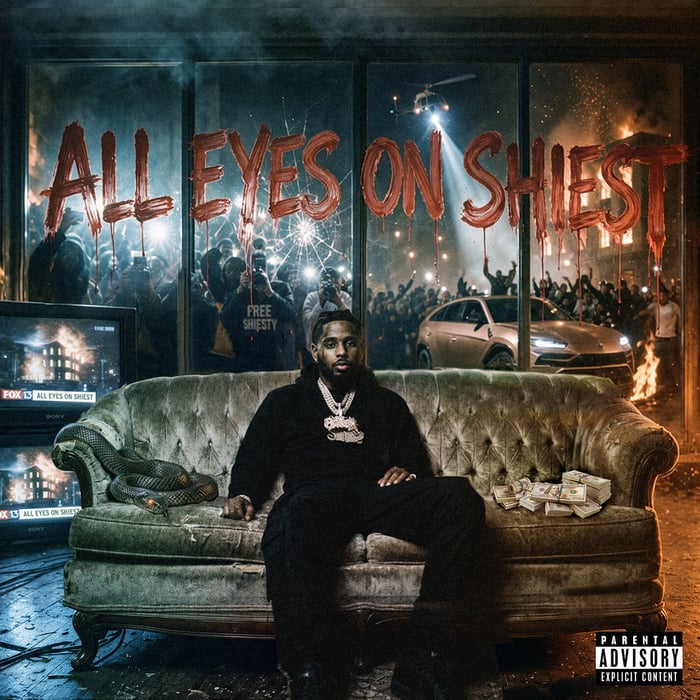
All Eyes On Shiest Review: A Street-Rap Album With Court Dates Attached


 See more Architeg Prints stories on Google.
All Eyes On Shiest Review: A Street-Rap Album With Court Dates Attached
All Eyes On Shiest sounds like a man rapping with one eye on the mirror and one on the docket—money talk, grief, and consequences fighting for the same mic.
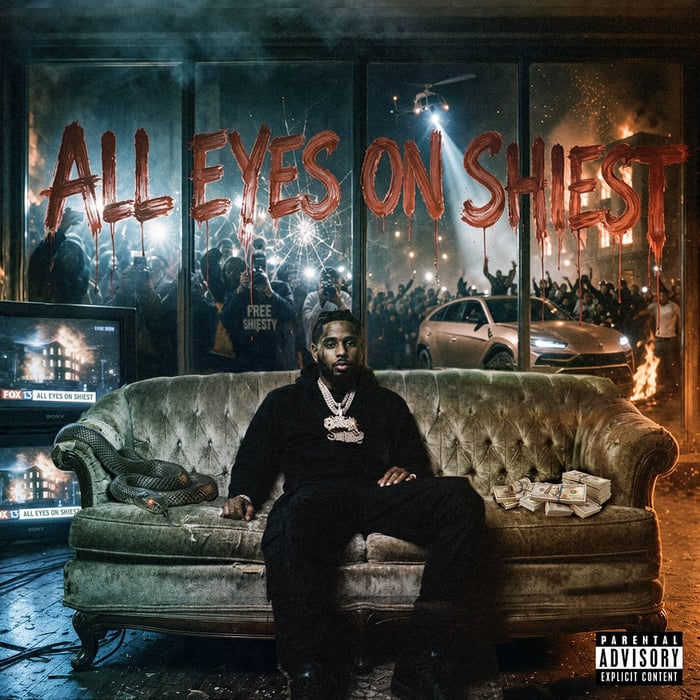
The Setup: This Album Drops With a Shadow Over It
You can hear it fast: All Eyes On Shiest isn’t trying to be “timely.” It’s trying to be useful. Like a document you leave on the table before you walk out the room.
The backdrop is ugly and specific. Prosecutors are alleging that in January 2026, a group robbed and kidnapped three people inside a Dallas recording studio—one of them being Gucci Mane—and forced him at gunpoint to sign a release from his contract with The New 1017 Records. Nine defendants are named in that case, and that list includes Pooh Shiesty, Shiesty’s father (Lontrell Williams Sr.), and BIG30—who also pops up on this album. Shiesty was arrested in April, pleaded not guilty, and yet here we are: his second album still arriving through 1017 Global, the label founded by Radric Davis… who is also one of the people prosecutors say was held hostage.
That contradiction alone tells you what this album is actually doing. It’s not a redemption arc. It’s a flex that doubles as a stare-down.
The Clock: Trial Dates, Delays, and the Feeling of Waiting
This record carries the slow dread of paperwork. The trial date moved from last July because his lawyers asked for more time with discovery, and it’s now scheduled for February 22, 2027. That’s not a fun little trivia note—it’s a tempo. Waiting changes people, and Shiesty raps like somebody trying to control the parts he can control: money, reputation, fear, and narrative.
I kept expecting a full-on “I’m misunderstood” album, some big speech about growth. That’s not what happens. The move here is colder: he treats the future like it’s already written, then raps like he’s negotiating the font size.
“I’m Back”: Money First, Morality Later (If Ever)
When Shiesty says he was thinking about money before he ever made any, I believe him—not because it’s profound, but because it’s blunt in that slightly boring way people tell the truth.
“I’m Back” sets the tone: plans for wealth that sound pre-loaded, like he’s reading from a blueprint he trusts more than people. He raps, “Being rich, part of the plan, I got premade millions,” and instead of pausing to let it land, he keeps going into logistics—threats, pressure, movement. There’s a verse that gets into putting a bounty on a young crew member, starting at $20,000 and aiming to push it up to $50,000 by tomorrow. The numbers are delivered like grocery totals. No drama. Just business.
Even the details that sound like they should be cinematic—Jammed 300 Blackout, a truck with bowls he can’t sell until a deal goes through—are presented like inventory. And that’s the point: the album keeps refusing to be emotional in the places you’d expect emotion, then hits you with it sideways later.
“Being rich, part of the plan, I got premade millions.”
— Pooh Shiesty
“Last Man Breathin”: Prison Details That Don’t Ask for Sympathy
“Last Man Breathin” is where the “street rap album” frame cracks and you glimpse the person underneath it. Not a confessional—more like a man explaining what reality did to him while keeping his face straight.
He talks about burning his prison uniform when he gets out. He talks about six months in isolation teaching him patience and teaching him who’s real versus who’s only acting like they want him free. He says they kicked him out of the FCI. And what really gets under his skin isn’t just the time already served—it’s the halfway house and home confinement after, that slow leash that keeps you “outside” while still owned by the system.
At one point he says, “This is Federal Reality.” And the song backs that up with small humiliations: police storming into his cell searching for a phone because they think they smell a wick; nobody selling him a knife so he cuts a shank out of his locker. It’s not presented like a lesson. It’s presented like weather.
I’m not totally sure if the song wants you to feel fear or pride. On second listen, I think it’s both—and that’s exactly why it sticks.
“Reckless Living”: Grief Shows Up, Then Gets Cut Off Mid-Sentence
“Reckless Living” is where Shiesty lets grief into the room—briefly—and then slams the door like he heard footsteps in the hallway.
He mentions his late younger brother in roughly half a verse, and the images come fast: the car that should’ve turned left, a soul wrecked, still holding one of the kid’s poles, still posted by the window, still choosing blood over his own peace. He says, “I hate I can’t hug you, lil bro, still dishin’ out slugs for you, though,” and then he names the mother whose love outruns everybody else’s.
That’s a brutal little emotional flare, and the album doesn’t “resolve” it. It just moves on—because that’s what people do when they can’t fix something and they’re allergic to looking weak.
He also folds in other losses: on “I’m Back” he says he was sleeping when Nuski got killed and AP woke him up to tell him; he missed his big brother’s last breath. These aren’t polished diary entries. They land more like interruptions—memories that barge in while he’s trying to stay on script.
“Trip”: Fame Isn’t a Halo, It’s a New Kind of Problem
On “Trip,” there’s advice from a brother who’s still alive: “You ain’t a robber no more, you famous, stop killin’, but still stay dangerous.” That line is the album’s whole moral math problem. “Stop,” but also “don’t stop.” Change, but don’t change.
And Shiesty’s reaction is the kind of honesty people don’t like: he says he might listen once four more people get spray-painted. It’s ugly. It’s also the record refusing to fake personal growth for applause. The album would rather be incriminating than inspirational.
That’s a choice. A risky one. Probably intentional.
“Reap What You Sow”: War Stories With Designer Price Tags
“Reap What You Sow” is where Shiesty stitches past and present together with zero sentimentality. K-Dog pulls a black flag off his head to stop bleeding. A shot comes through a car door. There’s blood all over the helicopter. His arm still aches in cold weather.
Then—same verse—he’s hiding a knife near his genitals to pass a metal detector, and getting caught buys him six more months in the hole. The song makes violence feel procedural, like he’s describing how to change a tire.
He flips the contrast harder: now he rides in a bulletproof Cybertruck, but he used to ride the MATA bus. He grew dreads for a job and then cut them off immediately after. An outfit costs him $8,000 and he has to wear it again another day. That last detail is weirdly telling: it’s not just flexing wealth—it’s complaining about the boredom of wealth. Like money solved the chase but not the itch.
“Booty Club” and “Collecting Tears”: Where the Album Loses Its Grip (A Bit)
Here’s where I’ll be a little annoying: not every detour on All Eyes On Shiest earns its seat.
“Booty Club” is a strip-club record produced by Tay Keith, complete with the tag, and it honestly could belong to anybody. It’s not terrible—it’s just generic in a way that makes the rest of the album feel sharper by comparison. When Shiesty is specific, he’s hard to ignore. When he goes “standard club record,” he blends into the crowd he usually claims to tower over.
“Collecting Tears” starts with an actually interesting idea—loving a Micro Drac’ more than a woman. That’s not romantic; it’s revealing. But then the verses slide into Casamigos talk and Al-Qaeda punchlines, and the initial insight kind of evaporates. I thought the song was going to get colder and more personal. It swerves into привычное braggadocio instead. (And yeah, I’m aware the whiplash may be the point—still doesn’t fully land for me.)
Features That Tell You What World This Album Lives In
The guest spots don’t feel like “playlist bait.” They feel like neighborhood cameos—people walking into the scene with their own agendas.
- K Carbon opens “New One” and flips the title into a triple-meaning: money, men, and wigs. She tells a woman her lace is lifting and she needs a new one. There are choppers under chandeliers. She wants $30,000 before she even agrees to see anybody. It’s materialistic, sure, but it’s also control—pricing access like it’s a security system.
- Sexyy Red comes in needing a rich man to match her, too turnt to drink her liquor, paying the babysitter on her way out the door. It’s casual chaos—flexing adulthood and irresponsibility in the same breath.
- BIG30 appears on “Still On Timing” and “CMO Freestyle.” Considering he’s also charged as a co-defendant in the same case, his presence feels less like music-business networking and more like a statement: the circle stays the circle. He estimates the value of his neck at 300 bows—a line that’s half metaphor, half accounting.
Shiesty’s Core Claim: He Wants Credit for Being Two Things at Once
At the center of the album is Shiesty insisting that it’s hard work to be both a rapper and a killer. And the way he says it isn’t braggy in the usual way—it’s almost like he’s demanding overtime pay for living like this.
Later he draws a bright line: “I’m a smacker that be rappin’, not no rapper, don’t confuse it.” That’s the thesis, whether you like it or not.
He also frames parts of the album like a recitation of what the feds told the judge during sentencing, and he gives a pointed warning: if you haven’t killed anybody in the past three years, burn the shiesty mask. That’s him trying to separate cosplay from consequence—basically calling a chunk of his own audience unserious.
On “FDO,” he insists he raps when he has something to say, not when somebody tells him to. That line matters because the whole album feels like him refusing outside framing—label expectations, public sympathy, court-of-public-opinion narratives. He’s not begging to be understood. He’s insisting you take him as-is.
“MANE.”: The Album’s Sharpest Moral Twist
“MANE.” lands like a cold shower.
Shiesty says he knows rats with money. He knows snitches with bodies. And he spits the kind of line that sounds obvious until you realize how rarely people say it out loud:
He basically argues that money doesn’t make you real and a body doesn’t make you gangster—because he’s seen both worn like costumes by people who aren’t what they claim. It’s an anti-myth line inside a myth-making genre, and that’s why it hits.
Then GloRilla takes the other verse: $2 million made, a limp she calls pimping, certified before she went platinum. She sounds like she’s walking through success with her shoulders squared, daring you to argue.
By the time the track ends, the album has quietly admitted something uncomfortable: the “street” isn’t a moral category. It’s a marketplace. And plenty of people are lying about their inventory.
Where I Land: A Solid Album That Doesn’t Pretend to Heal
By the end, it’s hard not to hear All Eyes On Shiest as a street rap album released while grieving, with bond denied and a trial date looming. It doesn’t reach for grace. It reaches for control.
My first impression was that the record would be nonstop aggression—just bars as body armor. But the longer I sat with it, the more the album felt like a man leaving notes for himself: what hurt, what changed, what didn’t, and what he refuses to apologize for.
If I’m nitpicking, the most “normal” tracks (“Booty Club,” parts of “Collecting Tears”) flatten the edge the album earns elsewhere. But when it’s on—when Shiesty gets specific about confinement, loss, and the fake morality people perform—it’s hard to look away.
Favorite tracks I keep going back to: “Last Man Breathin,” “Reckless Living,” “JPay & CorrLinks.”
Conclusion
All Eyes On Shiest doesn’t try to make you comfortable—it tries to make you accept the math Shiesty is living by, even when the numbers don’t add up cleanly. The album’s real power is how often it sounds like survival notes written in permanent marker, not a product designed to be liked.
Our verdict: People who like street rap when it’s specific—prison details, grief flashes, and contradictions left unedited—will actually like this album. If you want tidy “growth,” clean morals, or club songs that pretend nothing’s wrong, you’re going to bounce off it and call it repetitive… which is fair, but also kind of the point.
FAQ
- Is All Eyes On Shiest more personal than Pooh Shiesty’s earlier stuff?
It gets personal in quick bursts—especially on “Last Man Breathin” and “Reckless Living”—but it refuses to linger like a therapy session. - What’s the most revealing track on the album?
“Last Man Breathin” feels like the clearest window into what confinement did to his patience, paranoia, and priorities. - Do the features matter or feel tacked on?
They matter. K Carbon, Sexyy Red, BIG30, and GloRilla all feel chosen to reinforce the album’s world, not soften it. - Does the album have any weaker moments?
Yes—“Booty Club” feels interchangeable, and “Collecting Tears” starts with a sharp idea before drifting into safer punchlines. - Who is this album not for?
Anyone who needs an artist to sound remorseful on schedule, or who mistakes “club-ready” for “alive,” is going to get irritated.
If you’re the type who judges an album by the cover as much as the confessions inside it, you can always shop a favorite album cover poster at our store: https://www.architeg-prints.com —hang the contradiction on your wall and call it interior design.
 | DISCOUNTGET 30% OFF*Use code on your next order:
|
* This post may contain affiliate links, meaning we earn a commission if you make a purchase through these links, at no additional cost to you.