Better Than McDonald’s Review: Gangrene’s Ugly Beats Taste Expensive


 See more Architeg Prints stories on Google.
Better Than McDonald’s Review: Gangrene’s Ugly Beats Taste Expensive
Better Than McDonald’s is Gangrene (The Alchemist & Oh No) turning rap into a greasy menu of threats, loops, and flexes—ugly on purpose, proud of it.
A quick warning: this album isn’t trying to be liked
Some records walk into the room and offer you a handshake. Better Than McDonald’s walks in chewing loudly, makes eye contact, and double-dares you to complain about it.
Gangrene—The Alchemist and Oh No—sound like they made this project to get away from “client work,” that polished, daylight rap-production world where everything has to be palatable and rentable. Here, they pick loops for how wrong they feel, then rap like they’re stoned, irritated, and quietly thrilled with themselves. The whole thing runs on food talk, beef, and murder threats—served over samples that feel like they’d get you fired if you tried to pitch them to an artist with a brand meeting at 3 p.m.
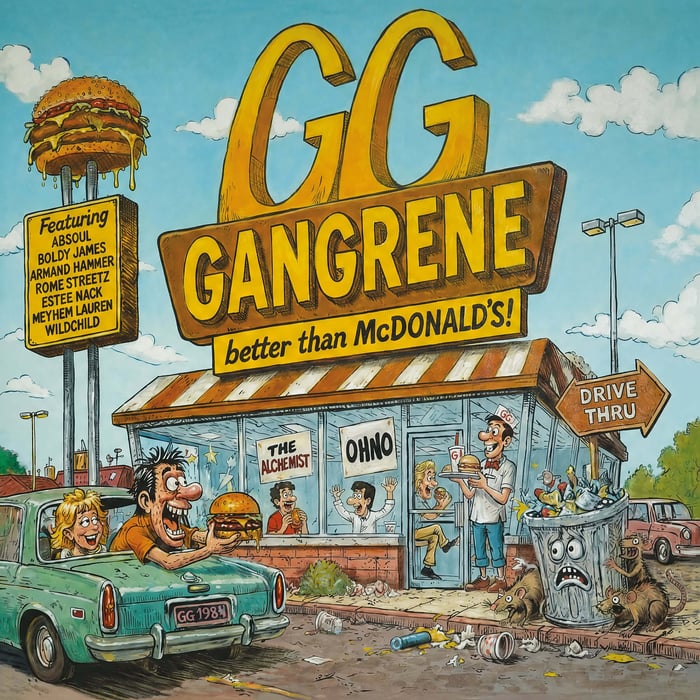
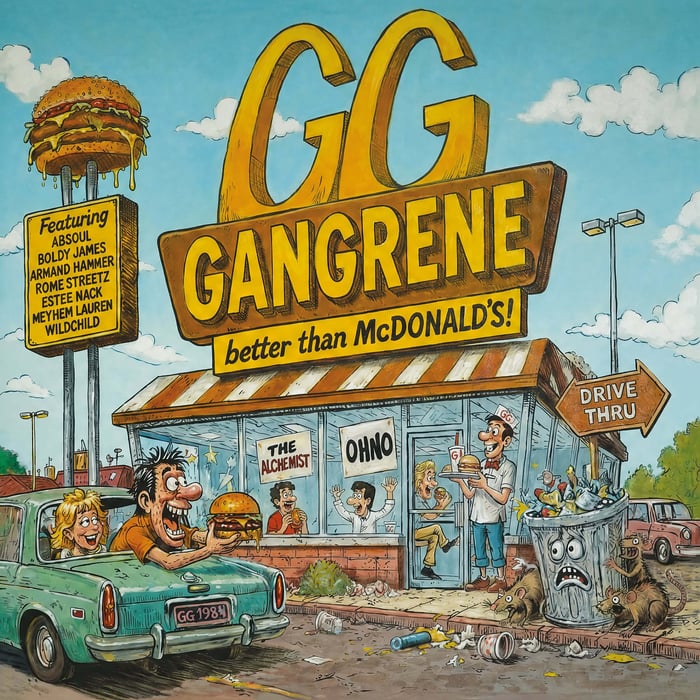
And yeah: that cover is… a choice. I rolled my eyes at it before I pressed play. Annoyingly, the music started winning me over fast enough that I had to stop pretending the cover mattered.
Gangrene’s real premise: “ugly” is the point, not a side effect
Here’s what I think is actually happening: they’re treating “bad taste” like a luxury material. Like marble. Like gold leaf. They’re not failing to smooth things out—they’re refusing to.
Together as Gangrene, they sound like half the underground rap production scene condensed into one grimy kitchen, where the rule is simple:
- if the loop is too pretty, it’s suspicious
- if it’s a little nauseating, it’s perfect
- if it sounds like no sane producer would hand it to a paying customer, that’s dinner
That’s the entire Better Than McDonald’s thesis: stop asking for clean flavors. Eat what’s in front of you.
The Alchemist’s side: heavy, detached, and weirdly precise
The Alchemist moves like he’s allergic to warmth. His beats here don’t “invite” you—they sit there, heavy and slightly removed, like he’s daring you to lean in. And when he raps, he does it in dry, exact chunks, like he’s reading threats off a notepad without changing his facial expression.
On “Note Ascension,” that rising organ melody feels like it’s climbing a staircase in a haunted courthouse. He crowns himself the most dominant piece on the chessboard and drops a line about running cold—like when you turn over the pillowcase. That’s such a specific kind of flex: not “I’m hot,” but “I’m the unpleasant relief you didn’t know you needed.”
My arguable take: Alchemist’s best trick here isn’t the loop choice—it’s how he raps like he’s above his own bragging. The boredom is part of the intimidation.
Oh No’s side: punchier, busier, and more openly unhinged
Oh No comes in like the guy actually willing to get his hands dirty. Where Alchemist deals in minimal heaviness, Oh No builds with more punch—jumpy mid-range loops and busy drums that feel like they’re constantly tapping you on the shoulder mid-threat.
On “Note Ascension,” his response is pure scene-setting: rubber boots, janitor energy, ready to clean up whatever’s left after the violence. He’s feeding dead rivals’ peanut brains to circus elephants. It’s ridiculous, but it’s the good kind of ridiculous: committed and said like it’s ordinary.
Then you hit “Run Downs,” and that one’s the pick of his style here. There’s this irritating phrase looping over a static snare pocket, and he uses that annoyance like a weapon. He’s cutting stones out of quarry bedrock, leaving a rival’s head hanging in the wind like Ned Stark’s, clearing fiends like NasoneX. The beat doesn’t “progress” so much as it grinds—like a machine you can’t turn off once it starts.
If you disagree, fair. But to me, “Run Downs” proves Oh No doesn’t need beauty—he needs a loop that nags.
“Muscle Head” and the art of doing almost nothing (and getting away with it)
Next step from Alchemist: “Muscle Head.” Minimalism pushed even further—basically a single low loop, stubborn as a bruise. He seasons it himself, calling himself Jimmy Spice, adding pepper, jamming hard rock for a world he seems to perceive as disco.
This is where I hesitated, honestly. On first listen, I kept waiting for the beat to do more. Then it clicked: the refusal is the point. It’s like he’s saying, “You want variation? Go listen to someone trying to impress a playlist editor.”
Also, he’s personally offended about something on this record in general, and he lets you know. He complains about too much pretty and fluffy things in rap, loosening cufflinks like Frank and Sam before they slapped him on the Tropicana. It’s oddly specific, and it lands because the music is already acting out that complaint.
Mild criticism, though: sometimes this minimal approach flirts with undercooking. Not raw on purpose—just a little too bare for the runtime it demands.
The food-menu threats aren’t a gimmick—they’re a mission statement
A lot of the threats here come straight off a menu, and they say them like it’s normal conversation. Oh No on “Forever”: We making OG chicken like it’s Church’s, offering to split a rival in a two-piece. That’s the Gangrene brain: food talk as violence talk as brag talk.
But the funny part? “Forever” isn’t really about the food line—it’s built around durability chants, and the duo sells those chants more enthusiastically elsewhere on the album. Here the drum patterns do most of the forward motion while the loop just… stays put. It feels like pacing in place, like shadowboxing.
Arguable claim: “Forever” works more as texture than as a centerpiece—good grime, not the sharpest knife.
“King Taco” explains the whole Gangrene job description
“King Taco” is where the duo nails their idiom. Alchemist adds hours, minutes, and seconds to his weightlifting routine, and then he drops the line that basically defines Gangrene’s whole attitude:
He’d rather be doing the serving than critiquing how the burger tastes.
That’s it. They’re not here to run a tasting panel. They’re here to slap the plate down and move on.
Ab-Soul slides in perfectly—floating between calling himself the prophet people fear and offering that nasty little truth: A little bit of hate’ll take you a long way. He sounds comfortable in the grime, like he’s used to working in rooms where the lights are dim on purpose.
Estee Nack turns “The Xtract” into a syllable obstacle course
The guest turns on this album aren’t casual. They’re tailored—each guest gets a beat shaped to their voice, not just a generic “here’s an open verse” situation. That’s one of the slyest flexes on Better Than McDonald’s: the hosts are controlling the rooms they invite people into.
Estee Nack on “The Xtract” is the most extreme left-turn. The track has this chopped-up tightness, and he twists it around his syllables like he’s trying to wring the beat out like a towel. He’s describing addicts jumping around wearing their clothes backwards like Kris Kross, repeat customers glitching like the Matrix, and then he ends with a rant about mustard gas and opium.
And somehow that rant is funnier than punchlines from rappers who allegedly “write jokes.” Not because he’s doing comedy—because he’s going so far past normal that it circles back into absurd clarity.
Rome Streetz hits “Gas Factory” like he’s mad at the speakers
Then “Gas Factory”: industrial, cold, hard-edged. Rome Streetz carves through it with more aggression than both hosts, like he took the beat personally. He beats a competitor like a stepchild, leaves bodies from Brooklyn to Britain, and rides away flipping off people on camera in a whip bumping “Broken Language.”
That’s not subtle. It’s not supposed to be. The track is built to make him sound like a moving object.
Arguable take: Rome Streetz out-energizes the whole album in his moment—almost to the point of making the hosts sound a little too relaxed in comparison.
“Broken Language” is served raw, on purpose
The Alchemist sets “Broken Language” up like a cruel little skit: he introduces a rival, serves him uncooked chicken, and takes a pot of gold from a leprechaun. It’s cartoon logic, but delivered with that deadpan tone that makes it land.
This is the Gangrene magic trick again: take something ridiculous, rap it like it’s workplace routine, and suddenly it’s not a joke—it’s a worldview.
“Errybody” sounds like a boxed-in basement—and billy woods likes it there
“Errybody” is low and boxed up, like the beat is trapped in a small room and refuses to complain about it. billy woods fits instantly, staying remote from a studio apartment that might as well be a castle surrounded by a moat. He’s running from the stove like the gingerbread man, and he drops the line:
Footprints in the sand was man’s walkin’ in circles.
ELUCID’s hook—Can’t be everything to errybody—isn’t a comforting mantra here. It’s resignation with grit under it.
What surprised me is how well the hosts keep up with woods’ gravity. Oh No tells you flat-out you’ve got the wrong doctor if you think he came to heal you. And Alchemist, for a second, starts acting like he’s conducting—like rap’s Serge Rachmaninoff—before dunking his head in a sink and shutting off the tap. Dramatic, yes. Effective, also yes.
“Microscopic Matter” slows the crawl—and Meyhem Lauren sells patience
“Microscopic Matter” moves slower, like the record is deliberately lowering its voice. Meyhem Lauren sounds at home in that crawl—married to the game, with cocaine and paper as his best man. His whole pitch is patience, and the beat gives him absolutely no reason to rush.
Arguable claim: this slower pocket makes the hustler talk hit harder than the faster tracks, because it sounds like someone counting money with no urgency—just certainty.
“Sasquatch” gives Boldy James the best room in the house
Boldy James gets the best suite on the album: “Sasquatch.” The Alchemist builds an intense, solid pocket—tight enough to feel expensive, dirty enough to feel real. Boldy walks in with that lazy swagger he does so well, grown into a man who lists Sex, money, murder, dope, and guns as love.
Then he lands the line that tells you exactly what kind of world this song lives in:
Gangsters don’t dance, nah, baby, we don’t hold hands.
Meanwhile, Alchemist raps right behind him in an almost giggly way—chain attached to his genitals, Hennessy in his veggies—while Oh No drives crazy metal between them with a sweet tooth. It’s a bizarre combination: menace delivered with the vibe of people enjoying themselves a little too much.
On second listen, I realized “Sasquatch” isn’t just a highlight because of Boldy—it’s the clearest example of Gangrene’s whole tactic: make the beat a room, then decorate it with threats and snacks.
So yeah: it’s “Great,” even if it’s not polite
I’m not going to pretend every bar or loop lands with perfect timing. A couple moments lean so hard into the grimy stubbornness that I briefly wondered if they were daring me to turn it off just to prove a point. But the album keeps snapping back with performances and pockets that feel custom-built.
If I’m being blunt: Better Than McDonald’s is great at what it’s trying to do—ugly, confident, and weirdly disciplined.
And the tracks that stuck hardest with me were:
- “Gas Factory”
- “Errybody”
- “Sasquatch”
Conclusion
Better Than McDonald’s doesn’t want to be your favorite meal—it wants to be the place you go when you’re tired of food pretending to be friendly. Gangrene sound like they made this record to remind themselves (and you) that rap can still be nasty, funny, and proudly unmarketable without losing craft.
Our verdict: People who like their rap loops a little “wrong,” their drums gritty, and their flexes delivered like deadpan threats will eat this up. If you need hooks to smile at you, or you want every beat to feel like it’s been polished for broad appeal, you’re going to hate this album—and you’ll probably call it overrated while it’s still playing.
FAQ
- What is the core vibe of Better Than McDonald’s?
It’s grimy, food-and-violence talk over deliberately ugly samples—like a luxury meal served in a back alley on purpose. - Do The Alchemist and Oh No sound different from their usual “client” production work?
Yeah. Here they lean into heaviness, detachment, jumpy loops, and beats that feel intentionally unpitchable to mainstream artists. - Which track best sums up the album’s attitude?
“King Taco,” especially the line about serving instead of critiquing the burger. That’s Gangrene in one sentence. - Are the guest features actually integrated or just pasted on?
Integrated. Each guest sounds like they got a beat tailored to their voice and cadence, not a generic open verse. - What are the standout tracks?
“Gas Factory,” “Errybody,” and “Sasquatch” hit the hardest—aggression, claustrophobia, and a flawless pocket, respectively.
If this record’s whole “serve it messy” energy got under your skin, a poster of your favorite album cover kind of fits the ritual. Keep it subtle and let it glare at you from the wall: https://www.architeg-prints.com/
 | DISCOUNTGET 30% OFF*Use code on your next order:
|
* This post may contain affiliate links, meaning we earn a commission if you make a purchase through these links, at no additional cost to you.