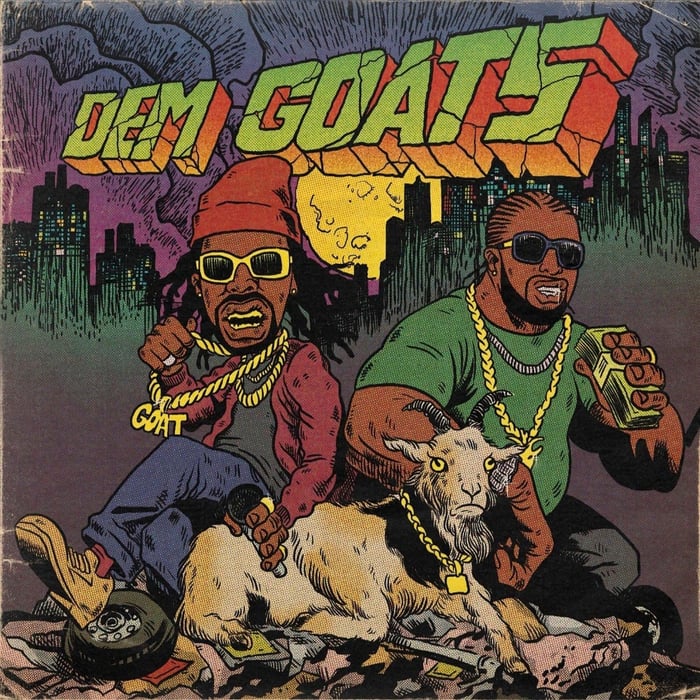
Dem Goats Album Review: Juicy J & Project Pat’s “Grown-Man Menace”


 See more Architeg Prints stories on Google.
Dem Goats Album Review: Juicy J & Project Pat’s “Grown-Man Menace”
Dem Goats turns street-rap nostalgia into a surveillance-era warning label—and it’s way less fun than you think (on purpose).
First, here’s the trick they’re pulling
This album doesn’t want to “take you back.” It wants to sit you down. Dem Goats is Juicy J and Project Pat using the same North Memphis DNA they’ve always had—chants, lagging cadences, blunt threats—but aiming it at a different enemy now: paperwork, cameras, informants, and the slow grind of consequences.
And yeah, the obvious headline is that these two have been circling each other for decades—Juicy J as a foundation stone of Three 6 Mafia, Project Pat running parallel with his own legend status, especially after Mista Don’t Play basically got stapled into Memphis scripture. But the real point here is simpler: both guys are past fifty, and they finally sound like it—in the best and worst ways. The album keeps reminding you that the “young niggas heading for the penitentiary” are still doing the same stuff… except the system is better at catching them now.
I wasn’t expecting this much lecturing. On first impression, I figured we were getting a victory lap. On second listen, it’s more like a public service announcement delivered by two guys who’ve already seen the ending.
The intro energy: Pat basically says he’s done pretending
Right away, Project Pat frames himself like a retired vet who still knows where everything is buried. He talks about doing TV, radio, podcasts, even prison tours—like the “gangsta rap” lane is now mostly for the kids sprinting toward a sentence.
That stance is an arguable choice, because a lot of rappers hit fifty and keep cosplaying as 23. Pat doesn’t. He’s doing the opposite: he’s acting like the genre’s grumpy uncle, the one who still tells the best stories but also ruins the party by telling you what those stories cost.
And Juicy J? He doesn’t sound retired at all. He sounds busy. Not “young,” not “trendy”—just wired, sharp, and weirdly specific.
“Out of Order” and the new villain: not opps, paperwork
The album’s violence doesn’t vanish—it just gets re-aimed. On “Out of Order,” the threat isn’t some rival across town. It’s your partner turning into the prosecutor’s helper. That’s the paranoia setting in, and it’s not decorative paranoia either; it’s procedural.
Project Pat runs through the ritual like he’s reading the menu:
- plea of not guilty
- extra charges for brandishing Ks
- the slide into federal prosecution
Juicy J opens with a rule that sounds old-school—don’t owe anybody anything—then swerves into details that feel painfully current: testing your own weed with fentanyl strips, mama sitting in the front row while somebody tells.
That’s the album’s first big tell. Dem Goats is street rap in a surveillance era, where “street smart” now includes technology, evidence chains, and snitching that happens with a smile and a login.
“These Streets” and “Eye for a Eye”: the kids are already cooked
The middle of the album keeps circling a nasty point: the young listener is not “next up.” He’s next processed.
“These Streets” plays like a lesson plan—move alone, watch the guy who can’t look you in the eyes, and keep the movie Juice waiting at home like a warning tape. It’s Juicy J talking like the fun uncle who suddenly turns serious because he’s seen too many funerals.
Then “Eye for a Eye” drops a detail that lands like a brick: a sixteen-year-old already charged as an adult, already caught a body, not even old enough to vote. That’s not poetry. That’s just the country we live in, delivered in a flat voice.
An arguable take: this album isn’t trying to scare you straight—it’s trying to scare you into staying home. The “streets” here aren’t a proving ground. They’re a conveyor belt.
“Don’t Do It”: Juicy J turns into the guy explaining the cameras
“Don’t Do It” is where Juicy J gets almost annoyingly practical, but it works because he’s not being abstract. A judge tied to the sentencing of XXXTentacion’s killers gets mentioned, and the track leans hard into the idea that the death penalty can be part of the deal even while you’re alive serving time.
Then Juicy piles on the real modern horror: shot spotter tech, GPS in the car, drones, phone records, service logs—this sense that infrastructure itself is closing in.
And he seals it with a line that doesn’t sound clever; it sounds tired:
This not GTA, this real life.
That’s the album’s core argument in one sentence. The fantasy is over. The map has cameras.
“Life Be Lifing” and “To Be Real Witcha”: snitches aren’t mythical, they’re domestic
“Life Be Lifing” flips the paranoia inward. Feds kick in the door, baby mama as informant, ATF enjoying your Instagram pics. That last detail is such a grim modern touch it almost made me laugh—then I remembered it’s probably true. Social media isn’t “evidence later.” It’s evidence now.
Hanumankind shows up and, honestly, brings more movement to the beat than anybody else in that moment. It’s like the song briefly remembers rhythm can still dance, even while the lyrics are describing the walls closing in.
“To Be Real Witcha” goes further: it drops the 95% federal conviction rate like a statistic you’re supposed to swallow with your breakfast. Camera feed as all the evidence needed. Project Pat mentions spending over 100K on bail yet still serving all his days—money doesn’t buy freedom, it buys a nicer waiting room.
Snoop Dogg pops in describing the homie who PC’ed up and basically helped the case against himself for the alphabet boys. The vibe isn’t “legend cameo.” It’s “cautionary tale guest lecture.”
Arguably, this is the least escapist “street” album you’ll hear: it’s obsessed with how boring the downfall actually is—forms, footage, logs.
“Still the Same”: Pat’s lag-behind-the-beat becomes the whole point
Project Pat still does that thing where his lines sit a hair behind the drums. Over the dark piano loop and hard bounce of “Still the Same,” that lag turns into a kind of gravity. He sounds repentant, and not in a performative way—more like a man admitting he learned the lesson before the feds caught him, but not early enough to avoid the lesson entirely.
Juicy J works the opposite pocket: chants, ad-libs, roomy phrasing. He sounds like he’s building a warning siren out of catchphrases. And the warning isn’t “the opps are out there.” It’s
your next of kin might end you.
That’s harsh, maybe even too harsh—but it’s consistent with what the record keeps pushing: betrayal is normal, and the state is patient.
“Southern Hospitality”: the crown talk is half flex, half grievance
“Southern Hospitality” is Juicy J going full host mode, arguing the crown is overdue because so much new stuff basically sounds like him. Project Pat backs him: lots of cappin’ in rappin’, and if you’re sampling the sound, you should crown the source.
This is where I hesitated a bit. Not because the claim is crazy—Juicy’s influence is obvious—but because the track flirts with turning the album into a self-congratulatory seminar. It doesn’t fully fall into that trap, but it gets close enough that I started side-eyeing it.
Then Gangsta Boo’s voice slides into the last part of the song. She died in 2023, and her presence hits different: it’s not nostalgia, it’s a quick chill through the speakers. She’s chasing away player-haters with a .32, talking like she never left—and for a second, the whole crown conversation widens to include her too.
Arguably, that moment is the emotional center of the “legacy” theme: not “we’re still here,” but “not everybody made it.”
“Bank Of,” “Wasting Time,” “Tap”: guests as pressure tests
The Mexican OT shows up on “Bank Of” and stuffs more syllables into the pocket than the beat seems to allow. He feels like a rapper who looks like a scammer—said affectionately, because the nimble cadence sells it. Meanwhile Juicy J paints the city like a Home Depot where everybody has a hammer, and Project Pat talks like a man who’s been close enough to cartels to stop romanticizing them. He turns from a thousandaire into mils while people back home are DOA. No triumphalism, just math.
“Wasting Time” gets its center shifted by Anderson .Paak, who changes the feel through timing and phrasing—like he’s moving the furniture around while the song is still playing. Project Pat drops an image that feels like a quiet payoff: his mama in a black dress thanking God for the lack of stress. It’s the kind of line that doesn’t “hit hard” in a hype way; it hits because it sounds like relief after decades of noise.
Then “Tap”: KARRAHBOOO is dry, succinct, and kind of steals the track. The line about not hitting women but not making her hit one lands like a cold slap of reality. While the two men play with switches, she slices through with the simplest posture: don’t start what you can’t control.
Arguable claim: the guests aren’t decoration—each one exposes something about Juicy and Pat. OT shows agility, .Paak shows feel, KARRAHBOOO shows restraint. The brothers sound most “old” when they’re next to somebody who moves differently.
“Hold On” and the relationship mess: toxic love with a muzzle line
A couple argues about Instagram likes at the start of “Hold On,” which is modern and petty in the most believable way. Juicy J calls the love toxic and begs her to stay in the same breath, saying he’s scared. It’s messy and weirdly human—then Project Pat says something about putting a muzzle on her mouth.
That’s where the part of the album lost me for a second. Not because it’s shocking—this is their world, their language—but because it feels lazy inside an album that’s otherwise trying to be surgically specific about consequences. The line plays like a reflex from an older playbook.
Still, the song’s tension works: it’s not romance, it’s mutual damage dressed up as attachment.
“Cut All That” and “Red Carpet Treatment”: similar grids, different hooks
“Cut All That” brings “stand on business” talk, and “Red Carpet Treatment” goes into flex mode. The beats feel like close cousins—grids so tight you could swap them—so the hooks have to do the separating.
There are lines that should hit harder than they do: an eighty-grand walkthrough, a wife serving grapes like the prince of Zamunda. Good images, but they sit idle, like the album doesn’t want to linger in luxury long enough for it to become fantasy.
Arguably, that’s intentional: the record keeps refusing to turn flexing into escape. It flashes money, then drags you back to court dates and camera feeds.
“Free My Dog”: the ugliest story gets the most “church”
Project Pat opens “Free My Dog” with a self-interrogation that actually sticks: facing thirty years, who sat him down?
I sat me down.
Then the hook asks for somebody’s freedom, and the story that follows is brutal: a man steals a pistol from an old man for a few hundred, robs him, beats him until he defecates, gets shot by the same man, loses a limb, and is born and dies degraded. It’s not a “street legend.” It’s a punishment loop.
There’s also faith—mustard seed sized—sitting beside the horror.
Fall asleep to the cries of a grown manisn’t a flex line. It’s a haunting.
Kenneth Whalum’s horn makes the track feel church-like, and Lecrae comes in carrying grief like a real object, praying that the song will be how lost partners get remembered. Not glorified—remembered.
Arguable take: this is the album’s boldest move, because it risks making listeners uncomfortable instead of entertained. And it doesn’t blink.
“Never Coming Back”: Juicy J stops performing invincibility
Before “Never Coming Back” even properly starts, Juicy J brings up lost friends and school shootings. Then he gets painfully plain: depression over the years gone by; a friend who lost his appeal, left when his daughter was two, and now she’s grown; death stacking up until grieving stops working.
And then the darkest admission on the album:
Drugs the only thing that’s solvin’ it, so I’m dissolvin’ it.
I didn’t expect Juicy J to sound that exposed. I’m not even fully sure how to take it—confession, character, both?—but it changes the temperature of the whole record. The “party” architect is standing in a different room now, and it’s quiet.
Project Pat follows by asking how his best friend became a witness, then rewinds further back: stealing food in the forties to survive, Section 8 apartments loud with roaches and rats, going to bed a child and waking up a grown man in chains.
Arguably, “Never Coming Back” is the real centerpiece, because it’s the moment the album stops teaching lessons and starts showing wounds.
“Choose Wisely”: one life story, no happy ending, no mystique
Killer Mike shows up on “Choose Wisely” and tells one street story that stretches across a whole lifetime. It’s the same ugly arc—stealing a pistol, pulling it on junkies, robbing a man, beating him until he defecates, getting shot, losing a limb, born and died degraded—except now it’s framed as glory stories exaggerated “all the way.”
Anthony Q. sings the sentence over it: this is the life that made you choose.
Then Juicy J fills in collateral damage like he’s reading off a list nobody wants: a shootout in the park, an innocent kid dead, a man staring down fifty-five years at 85% time. The man expects flying cars and floating cities on the other side.
Juicy says it almost like announcing tour dates: the man will be right. The future will show up. It just won’t wait for him.
Arguable claim: this song is more anti-fantasy than anti-crime. It doesn’t just warn you about prison. It warns you about missing time—the only thing you can’t earn back.
What “Dem Goats” is really doing (and why it works)
By the end, the album feels like two brothers building a cage out of details: not to trap you, but to show you what the cage looks like now. It’s not just bars and a bunk. It’s an informant in your bed, a camera on the corner, a phone log in a courtroom, and a moment of ego that turns into thirty years.
My revised take is this: I came in wanting big hooks and nostalgic menace. I left thinking they were more interested in consequences than bangers—and that’s why the album sticks, even when it isn’t “fun.”
The one drawback is that a couple moments lean on old reflexes (that “muzzle” line still feels like a misfire), and a few flex images don’t fully ignite. But when the record is locked in—“Don’t Do It,” “Never Coming Back,” “Choose Wisely”—it doesn’t just sound good. It sounds like somebody trying to interrupt the cycle in real time.
Conclusion
Dem Goats doesn’t celebrate the past; it audits it. Juicy J and Project Pat sound like they’re documenting how the streets changed shape—same temptations, tighter net—and they’re blunt enough to make it uncomfortable. That discomfort is the point.
Our verdict: This album will hit people who like Southern rap when it’s grown, specific, and a little haunted—listeners who don’t need the fantasy to feel “real.” If you want nonstop turn-up or a clean nostalgia trip, this record will feel like your fun uncle turning off the music to explain bail and conviction rates. And honestly? He might be right to do it.
FAQ
- Is “Dem Goats” more of a throwback or something new?
It uses classic Memphis DNA, but the obsession is modern: surveillance, evidence, informants, and systems that don’t miss. - Do Juicy J and Project Pat sound different from each other here?
Yeah—Pat drags just behind the drums like always, and Juicy fills space with chants and ad-libs. The contrast is the engine. - Does the album glamorize street life?
Less than you’d expect. Too many songs dwell on the boring, administrative reality of getting caught for this to feel like glamour. - Do the guest features matter or are they just names?
They matter. The guests shift rhythm, tone, and tension—especially Anderson .Paak, KARRAHBOOO, and Killer Mike. - What tracks carry the album’s heaviest themes?
“Don’t Do It,” “Never Coming Back,” and “Choose Wisely” are where the record stops posturing and starts bleeding.
If you’re the type who treats album art like part of the message, you can shop a favorite album cover poster at our store here: https://www.architeg-prints.com. It fits this record’s vibe—bold on the wall, uneasy in the gut.
 | DISCOUNTGET 30% OFF*Use code on your next order:
|
* This post may contain affiliate links, meaning we earn a commission if you make a purchase through these links, at no additional cost to you.