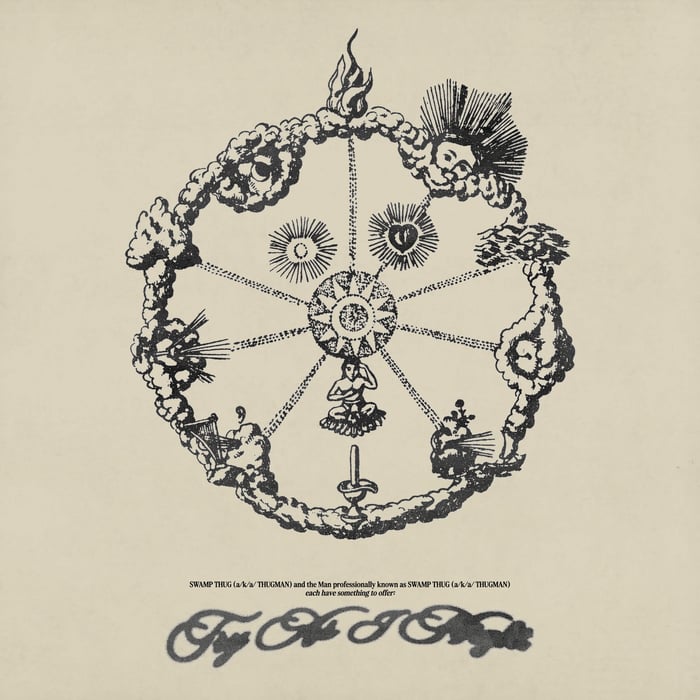
TRY AS I MIGHT Review: SWAMP THUG’s Hustle Diary Won’t Pay Rent


 See more Architeg Prints stories on Google.
TRY AS I MIGHT Review: SWAMP THUG’s Hustle Diary Won’t Pay Rent
SWAMP THUG’s TRY AS I MIGHT raps like a factory line: fast, sharp, and bleak about money, output, and pride when the math won’t work.
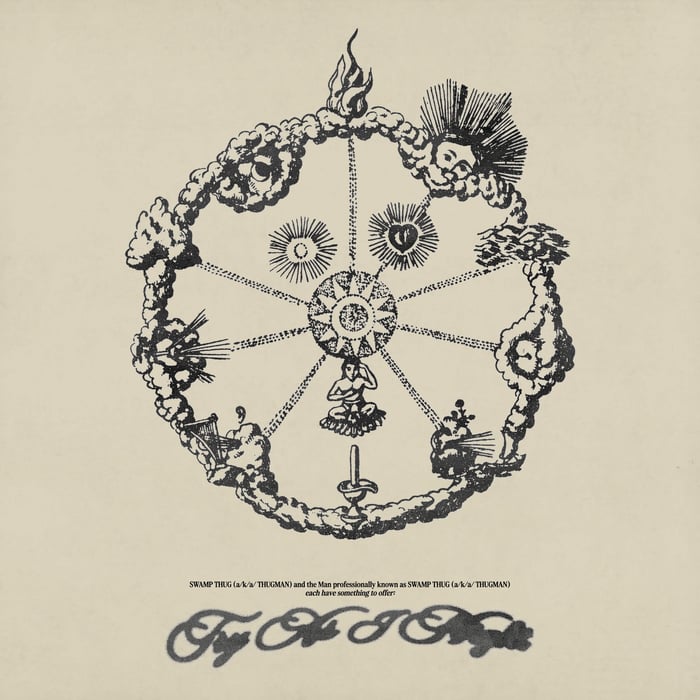
This album isn’t “prolific”—it’s cornered
If you’ve spent any real time on Bandcamp, you know the vibe: name-your-price downloads, bottomless releases, and an economy that treats musicians like content farms. TRY AS I MIGHT sounds like someone finally admitting what that pace costs—because SWAMP THUG raps like a person who’s been sprinting for years and just checked the bank balance.
He’s been flooding the zone: two SHOCKINGLY RAW volumes only a month apart, plus GET IT IN: OHIO EDITION—a Cleveland Heights posse tape with Josh The Author, AxL Urameshi, and Day Solo. Then there’s the steady drip under THUG ZINE and bromethugzine banners. That kind of output can look like ambition from the outside. On this record, it lands more like necessity. He’s not “building a catalog.” He’s trying to survive the week.
And the punchline, repeated until it stops being funny, is that the payment for all this work is basically nothing.
“make sumn shake” opens with the bill collectors in the room
The first thing TRY AS I MIGHT does well is refuse to warm up. Over GAWD’s bass and thick 808 thump on “make sumn shake,” SWAMP THUG goes straight to the economics of being alive right now—stretching dollars without “bending” them, worrying about a mother with no pension, making songs that don’t get attention.
It’s not motivational struggle-rap. It’s the opposite: he’s documenting how optimism gets rationed.
One line lands like he wrote it at 3 a.m. with the screen brightness turned way down:
“Don’t wanna die, but getting tired of existing / Try as I might, I cannot make a living.” — SWAMP THUG
What surprised me is how little he slows down to sell the pain. The rapping stays urgent, almost brisk, like speed is the only remaining advantage. He’s turning desperation into momentum on purpose—because if he pauses, the whole reality catches him.
He even flips backward in time during the second verse: a kid in 2016 making music with no dreams, pretending he expected something from it while privately praying to God. That “pretending” detail matters. This album isn’t just broke—it’s ashamed of having hoped.
The title track basically dares you to call it effort
From there, the title track “TRY AS I MIGHT” picks up the thread over a Camoflauge Monk loop and does something gutsy: it makes his own motivation unstable. He opens by exposing the soft underside of the persona—almost making a joke out of the concept of trying:
“I can’t promise I’ll try, but I’ll try to try / Try as I might, I might never try.”
That’s not laziness. That’s burnout dressed as philosophy. The track even catches itself mid-thought, a little self-correction after he says a line and then tightens it: “If no one listen, I’m tight.” It’s the sound of someone who can’t fully commit to despair because pride won’t allow it… but can’t fully commit to hope because experience won’t allow it either.
I’ll admit, on first listen I thought the “I might never try” thing was going to be a clever pose. On second listen it reads uglier: he’s describing the mental trick you use when effort starts feeling like a scam.
He raps like a lab manual set on fire
From here, the album leans into density—not the “lyrical miracle” kind, but the kind where he’s stuffing the verse with reference points like he’s trying to short-circuit your attention.
On “Ramaseeana,” Camoflauge Monk’s drums churn under him while SWAMP THUG runs threats through a blender of lab equipment and consumer tech: positrons, tomography, a Tamagotchi, polyethylene terephthalate, Clippy, and even a guest appearance reference tied to Eric Andre’s first season. It’s ridiculous on paper, and that’s exactly why it works: he’s building a world where everything is an object, everything is disposable, and he’s just another item getting processed.
Then DW shows up—his collaborator again since 2024’s Programmatic—and sounds like he’s been sharpening the same blade for years. The verse hits like somebody who’s clocked “ten thousand hours” in rap and still hasn’t lost the appetite. There’s a straight-edge severity to it, like he’s aiming a bayonet at anyone who wants credit without output, talking about buying back masters and leaving quickly: “A hundred million meters in the blink of an eye / I’m gone.” It’s not subtle. It’s meant to embarrass.
And honestly, this record likes embarrassment. It uses it as fuel.
“quadrivial” is where the gloves come off (and stay off)
The put-downs get nastier on “quadrivial,” where everything under his voice stays alive—no dead air, no gentle padding—while he talks directly to someone “inheriting the buzz.” He frames success like a stolen inheritance and failure like public humiliation.
He lands on specifics that feel designed to sting: the embarrassment of being a child without a Wikipedia page while your parents have one. That’s such a modern, petty metric of legitimacy that it loops back into tragedy. Then he zooms out into the math of losing: the slightest tweak of a variable and you’re done. He signs off with “You fucking cattle,” which is a wild way to end a verse if you’re trying to be likable.
I’m not totally sure whether this level of contempt is protective armor or just his natural posture. Maybe both. Either way, it’s the sound of a rapper deciding that politeness doesn’t pay either.
“SWAMP THUGGEE” crams a whole library into one breath
The second verse of “SWAMP THUGGEE” is the same dense style with the brake line cut. He stacks Miss Trunchbull, The Manchurian Candidate, Candide, and Kali Yuga in one run, with chopped-up wordplay sliding under the flow like he’s sweeping glass off a floor while still walking across it.
This is the point where a mild criticism kicks in: sometimes the reference-pileup feels like it’s daring you to keep up more than it’s trying to communicate. I like being challenged, but there are moments where the flex blocks the punch. The good news is he usually pulls it back before it becomes self-parody.
Camoflauge Monk vs. GAWD: two producers, two kinds of hunger
A lot of TRY AS I MIGHT is about pockets—where the drums sit, how the bass fills space, and how SWAMP THUG slices his phrasing to live inside that architecture.
Camoflauge Monk’s lane here is hard drums with rough, repeated sample phrases—loops that don’t smooth out, they grind. They become the pocket. SWAMP THUG responds by splitting his phrasing into short clusters so the bass can hit between them. It’s a practical approach: the beat isn’t going to make room for you, so you learn to move like you’re in traffic.
GAWD, on the other hand, is a minimalist with a cruel streak. “iAngola” gets stripped down to deep sub-bass and skeletal programming—bass doing basically all the physical work. And in that stark frame, SWAMP THUG drops what might be the harshest economy verse on the whole project.
There’s even a hook with smoke in the air that “smell like asparagus piss,” which is such an unglamorous sensory detail that you can practically taste the stale room. Under that, he goes after the guys trading verses with the weakest rappers in the scene for $15 every five weeks—while he’s paying fee after fee just to cover the Denon and the MPC he uses to rap. He calls it a “burgeoning trick,” and suddenly the earlier broke talk stops being just personal misfortune. It has a target: a local economy of scraps, where everyone is extracting from everyone else because nobody has actual leverage.
It’s one of the album’s smartest moves: he turns the complaint outward without turning it into a sermon.
The GAWD run blurs on purpose—and that’s the point
Differentiating the GAWD tracks comes down to vocal pressure more than arrangement. “XZ” and “XSWL” both ride sub-heavy skeletons with very little happening around them. They’re like two rooms in the same basement.
On “XZ,” the gorilla-exhibit hook gives it motion, and there’s a line explaining his prices—plus the blunt “no fentanyl in the product”—that makes the track feel like a tense, street-lit transaction. “XSWL” is more of a quick strike: it laughs, then dies inside the same hook before the pocket thins out.
Then “MAN THUG” ends similarly: almost all bass pressure under a short hook, cut off abruptly. Not triumphant—grounded. Like the song doesn’t “finish,” it just stops because time ran out.
All three stand alone, but when you play them next to the Camoflauge Monk tracks, they start to blur together. I kept waiting for one of them to open up with a new melodic idea, and it never really does. That could frustrate you. Or you could take it as the concept: the days blur when you’re doing the same work for the same non-money.
bromethazine brings the weirdest loop—and traps him inside it
The most peculiar loop belongs to bromethazine on “LOCUST of control (phenylacetonitrile).” The phrase doesn’t lie under SWAMP THUG’s voice—it scratches the track, like the beat itself is irritated. The cadence gets boxed in to match it, with lines fitting into the beat with no room for lift. It’s claustrophobic on purpose.
The first verse is heathen talk: belief in nothing but himself, allegiance to no pledge. No faith, no institution, no patriotic comfort blanket. Then the second verse walks outside into policy reality: blocks where dogs bury kids early, a country where a living wage is rare, government assistance used to placate, a system that goes ghost when it’s time to litigate, welfare flowing uphill to people who already have it, Spaghetti-Os barely available.
On other tracks, money trouble stays personal—his bank account, his gear, his fees. Here, he names it as policy. And the verse ends moving toward the polls with his friends, which is a subtle pivot: not optimism exactly, but a refusal to fully detach.
I’m a little unsure if the beat’s constriction helps that message or smothers it. But I can’t deny it makes the whole thing feel like being trapped in a system that won’t let you breathe.
“teeth skin” finally lets air in—and it hits harder because of it
After so much sub-heavy compression, “teeth skin” feels like a window cracked open. August Fanon gives it more upper grit and movement; the loop is scratched open at the surface rather than buried underground. And metroworldpeace (another Programmatic alum) drops in—not as a hook singer, but as a second underground rapper, which keeps the track honest.
SWAMP THUG starts by describing life from windfall to windfall, with occasional stretches where everything is just bad. He’s carving scrimshaws with thin jaws—such a grim image—and hoping they don’t clench before he dies. By the second verse, his appetite is gone, but he keeps eating anyway. That’s not a metaphor that needs explaining; it’s a bodily description of depression that still has to clock in.
He calls himself a passenger who’s been sitting longer than anyone can imagine, insists he isn’t bashful, says he’s a man of conviction. And then he drops the line that sums up the whole album’s rhythm:
“Get a grip and then I lose it / Then I get a grip, and then I lose it… Money like the mental is elusive.”
Ten years of unpaid labor sit inside that. Palms itching. Counting M’s until hands cramp. Shaking hands trying to get in wherever possible. It’s the first time on the record where the struggle feels less like a rant and more like a diagnosis.
And yeah—this is one of those moments where I had to revise my own assumption. I thought the album’s best weapon was going to be its cruelty. Turns out it’s the exhaustion. The mean lines are just the sparks.
Conclusion: SWAMP THUG raps like he’s invoicing the void
TRY AS I MIGHT doesn’t beg for sympathy. It documents what happens when output becomes your identity and the world still pays you in “exposure” and local-scene crumbs. The sharpest parts aren’t even the threats—they’re the moments where he admits effort itself has started to feel like a rigged game, and he keeps playing anyway.
Our verdict: People who like rap that treats money like a real villain (not a motivational prop) will lock into TRY AS I MIGHT fast—especially if you enjoy dense writing and beats that don’t hold your hand. If you need big hooks, glossy variety, or a sense that the artist is “having fun,” this album will feel like doing invoices at midnight. And that’s kind of the point.
FAQ
- What is the core theme of TRY AS I MIGHT?
It’s SWAMP THUG airing out the cost of constant output—financially, mentally, and socially—without turning it into inspirational wallpaper. - Which tracks hit the hardest on first listen?
“make sumn shake” for the economic gut-punch, “quadrivial” for pure venom, and “teeth skin” for the moment the album finally breathes. - Do the producer styles change the mood a lot?
Yes. Camoflauge Monk pushes grinding momentum, GAWD strips tracks to bass-and-bones pressure, and bromethazine brings a loop that feels like confinement. - Is this album accessible for casual listeners?
Not really. The reference density and stripped arrangements can feel like a closed door if you’re expecting easy choruses or bright dynamics. - Does SWAMP THUG sound hopeful anywhere on the record?
Barely—but there’s a flicker when the lyrics shift from personal broke talk to naming policy and moving toward action, even if it’s reluctant.
If this record’s bleak little universe stuck with you, a poster of your favorite album cover isn’t a bad way to memorialize the mood—quietly. You can browse prints at our store: https://www.architeg-prints.com
 | DISCOUNTGET 30% OFF*Use code on your next order:
|
* This post may contain affiliate links, meaning we earn a commission if you make a purchase through these links, at no additional cost to you.