Don & Eye Album Review: The Trilogy That Treats Flexing Like a Job


 See more Architeg Prints stories on Google.
Don & Eye Album Review: The Trilogy That Treats Flexing Like a Job
Don & Eye turns “a good night out” into a thesis—funny, tense, and a little too polished for comfort.
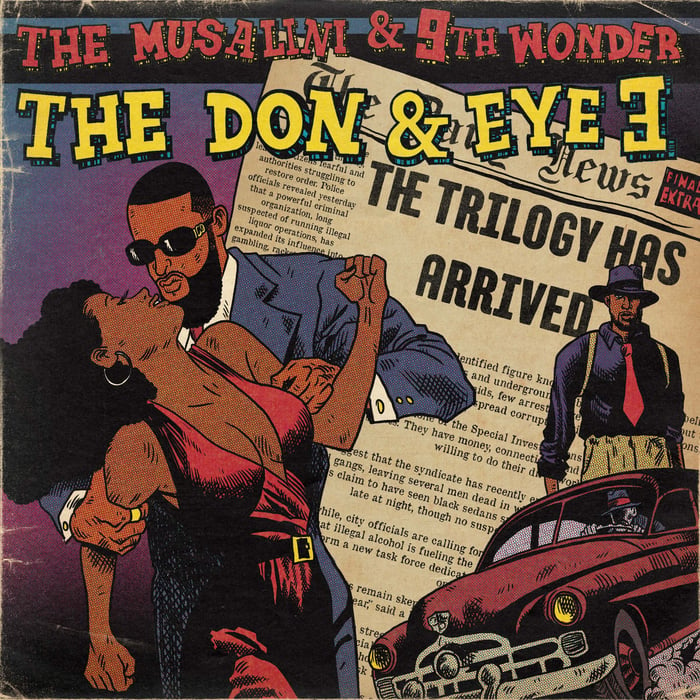
Courtesy of Perfect Time Music Group.
A Trilogy That Doesn’t Pretend It’s an Accident
The Musalini doesn’t rap like he’s telling you a story. He raps like he’s presenting a case. And on Don & Eye, that case is simple: a “good night out” isn’t random luck—it’s a lifestyle you plan, finance, and defend like you’re in court.
The first thing you notice is how hard this album insists on its own inevitability. Three albums deep with 9th Wonder producing every second, Don & Eye doesn’t act like a new chapter; it acts like a stamped document. The intros, the hooks, even the little asides come off like a waiter confirming your usual order before you’ve opened your mouth.
That’s a risky vibe, honestly. Continuity can be classy, or it can be complacent. Here it’s mostly the first one—because the record keeps reminding you that routine, when you’ve earned it, is the flex.
“Two Letters” and the Comedy of Taking Yourself Seriously
This album’s sense of humor isn’t jokes—it’s how dead-serious Musalini is about ridiculous things. On “Two Letters,” he calls himself a “walking billboard,” then starts pricing out his own metaphors like he’s doing inventory. A quarter million for the fly talk. And then—crucially—he cuts the chorus short just to clarify the terms: this isn’t romance. It’s branding.
I thought that move was corny at first, like he was trying too hard to control how we interpret him. On second listen, it hit differently: it’s not insecurity, it’s discipline. He’s not asking you to like him—he’s setting boundaries so the night stays on schedule.
“Shrimp Lo Mein” Turns Bragging Into a Phone Call
The last couple minutes of “Shrimp Lo Mein” are basically Musalini circling the same idea from different angles: brutal markets, long nights, wolves in the crew who still got eaten. It’s bragging, sure—but the tone is what sells it. It starts to sound like someone calling a friend the next day like, “You really missed it,” still weirdly stuck on how good the shrimp was.
That’s the trick on Don & Eye: the luxury isn’t presented like fantasy. It’s presented like evidence. And if you think that makes it shallow, I’d argue the opposite—because he’s showing how the surface details are the point. If the furniture becomes normal, the whole spell breaks.
“Salt Box” and “Capital Grille” Play Dress-Up With Menace
On “Salt Box,” he’s hustling with alligators at the Bronx Zoo over grilled calamari and catfish—like the animal imagery is just another seating arrangement. Then he flips into that streetwise casting call: somebody’s fronting like a Gotti but really they’re a Sammy. The album loves this: assigning roles, exposing frauds, deciding who gets to sit at the table.
And then “Capital Grille” pulls the camera back: top of the hill, moonlight, candlelight, reservations for nine, honey apple wings, beefsteak with his queen, ice on chill. It’s so specific it almost dares you to call it indulgent. Eli Tha Don slides in on the second verse with a short teal dress detail and a “Key & Peele back at the crib” kind of domestic punchline—like even the jokes are expensive.
No one ever says a number, and that’s not an accident. The album avoids exact figures the way truly wealthy people avoid talking about rent. If you need receipts, you’re not invited.
“Off the Books” Admits Rap Is Labor (Then Immediately Denies It)
The most revealing moment might be “Off the Books,” when Musalini says he’s got “a safe full of these rhymes,” then treats them like assets: art that increases in value. That’s one of the only times he admits the craft part—the work part.
But he can’t stay there long. He snaps back to creed-talk: money over fame, while other guys try to buy planes. It’s a blunt worldview, and a reasonable listener could call it joyless. I hear it more like self-defense: he refuses to sound impressed by anyone else’s toys because he’s trying to keep his own head straight.
Le$ on “Lay Low” and the Quiet Flex of Speaking Only When It Matters
Le$ shows up on “Lay Low” and does something sly: he claims victory before it arrives—in his head it’s already his; he just doesn’t have it yet. Then he says he only speaks when he has something to say.
That line lands like a little jab at the whole album’s concept, because Don & Eye is absolutely a talk-heavy record. It’s Musalini narrating the night, policing the vibe, re-litigating the rules. Le$ strolls in and basically implies: real power doesn’t need this many words. Whether that’s true or not, it’s a great tension to introduce into such a controlled environment.
“Pocket Full,” “Fast Life,” and the Problem With Luxury as Wallpaper
Here’s where the album almost loses me—briefly. “Pocket Full” drifts around a beach house in the Outer Banks with bricks in the vault and summer heat trapped in a Porsche, but the scene never quite grips. It floats. The line between “effortless” and “weightless” gets thin.
That’s the mild flaw with the record’s obsession: if everything is premium, nothing stands out. The furniture becomes nothing special. The flex turns into wallpaper.
“Fast Life” gives you one tangible anchor: a quick break at Shake Shack. Weirdly, that’s when the world feels most real. “Picture Me Rollin’” stacks up cappuccino mornings, toast butter charred just right, breakfast on a balcony with skyline views—beautiful, sure, but also eerily like something any decent hotel could sell you. The album is smart enough to show that: sometimes luxury is just a package.
Swank Brings the Rain Into the Penthouse
Swank shows up and changes the air pressure. On “Can You Stand the Rain,” he’s writing raps with his mother’s voice in his ear warning him the streets aren’t for him—
be damned if you die here.In the same verse he drops the kind of line that sticks because it’s so cold it’s domestic: bullet holes that redecorate your home like Ikea.
He carries that heaviness into “Pretty Lady,” where the roof has a hole and the rain gets caught in pans and a cup. There’s also that run of funerals for people he loved—no poetry contest, just the fact of it. Then he swings to SoHo: four hundred dollars on jeans, remembering when twenty was everything.
If Musalini’s whole album is about curating a night, Swank is the guy reminding you the night doesn’t erase the past—it just dims it for a while. And I’ll say it: those Swank moments hit harder than some of the fancier “we made it” scenes, because he sounds like he actually doubts the safety of the room he’s in.
King Draft Hijacks “Car Keys” Like He Owns the Place
King Draft steals “Car Keys” so casually it’s almost rude. He raps like he’s flipping through a photo album he hates: a classmate from kindergarten bringing a knife to show-and-tell, half the people he knows seeing hell or a cell, the government as the terrorist, the block as an oval spinning for a hundred years.
And then—this is the punch—inside a song surrounded by crab cakes and canyon cribs, he admits he doesn’t have a house either. Not even a home. He wants a Louis belt.
You could argue that’s materialism. I think it’s worse than that—and more honest. It’s what happens when the culture sells “success” as props: you start grabbing at symbols because stability feels like a rumor.
“Memories” Is the One Track That Actually Charges a Price
Heather Victoria sings on “Memories,” and it’s the one time the cost of this lifestyle lands on someone else. She can’t keep it to herself—she still thinks about him. When Musalini responds that she has to get over it, that she’s a memory now, he does the one thing this format usually avoids: he admits it’s not her fault.
Nothing wrong with you, girl—it’s more about me.
That’s the closest the album gets to vulnerability, and it’s almost awkward because he moves past it quickly. Part of me wanted him to sit in that discomfort longer. Another part of me suspects he can’t, because the whole Don & Eye concept depends on keeping the night moving. Even here, she gets the last word on the chorus. It’s a controlled kind of grace.
“Live from Tokyo” and the Only Topic He’ll Really Argue About
On “Live from Tokyo,” Musalini admits the independent life is nice—then immediately points out the majors will want a piece soon enough, trying to profit off him. It’s the only topic on the album that feels like a live wire. For a moment, he sounds like he’s not having fun.
Smoke DZA handles the suits conversation differently—and better—on “Premium Plush,” turning the chase for a hundred million into an actual meeting, calling himself the stalking horse at the auction. That’s a sharper way to frame it: not paranoia, just strategy.
Then “Owe It All” brings Musalini back around on the far side of the deal: bigger budget energy, out of the hole, teeing off, dropping new tapes every other month for the streets.
I’m not totally sure whether this is triumph or compulsion. The album presents it as winning, but it also sounds like someone who can’t stop proving the same point in slightly nicer rooms.
Why This Album Keeps Coming Back for “Round Four”
By the end, the message isn’t subtle: Musalini decided a long time ago that a good night is worth defending for thirty-five minutes, like it’s a professional grown-up principle. And Don & Eye feels like he’s made that argument three times now—loudly, meticulously, sometimes hilariously—and he’s clearly not done.
If you wanted growth in the traditional sense, you might leave annoyed. If you want a world that’s consistent, sharply decorated, and slightly paranoid about who’s trying to take it away, this album gives you exactly that—no refunds, no apologies, no numbers spoken out loud.
Musically and narratively, Don & Eye is a guided tour through a lifestyle where the flex isn’t the money—it’s the control. It works best when the luxury details collide with a darker memory (Swank, King Draft) or when Musalini’s confidence briefly slips and you hear the stress under the silk.
Our verdict: This album will hit for listeners who like grown-man rap that treats status like a daily practice—menus, morals, and minor threats included. If you need obvious emotional confessionals or you get bored when someone describes a night out like they’re defending a thesis, you’ll tap out fast and call it “all the same,” which is exactly the kind of person this record would leave on read.
FAQ
- What is the core vibe of Don & Eye on this project?
A tightly curated “good night out” where every detail—food, cars, rooms—feels like proof of legitimacy, not decoration. - Which tracks best represent the album’s braggadocio-with-a-wink side?
“Two Letters,” “Shrimp Lo Mein,” “Salt Box,” and “Capital Grille” lean hardest into the deadpan luxury narration. - Where does the album get emotionally heavier?
Swank’s appearances (“Can You Stand the Rain,” “Pretty Lady”) and King Draft on “Car Keys” bring real weight into the polished world. - Is there a moment where the lifestyle feels less glamorous?
“Pocket Full” and parts of “Picture Me Rollin’” flirt with luxury becoming generic—like the vibe is expensive but a little too pre-packaged. - What’s the album’s biggest conflict beneath the surface?
Independence versus industry gravity—“Live from Tokyo” and “Premium Plush” make the label pressure feel like the only argument worth having.
If you’re the type who wants the visual of an album to hang around as long as the hooks do, you can shop a favorite album cover poster at our store: https://www.architeg-prints.com.
 | DISCOUNTGET 30% OFF*Use code on your next order:
|
* This post may contain affiliate links, meaning we earn a commission if you make a purchase through these links, at no additional cost to you.