DOOMED Album Review: Open Mike Eagle & Kenny Segal’s Breakup Trapdoor


 See more Architeg Prints stories on Google.
DOOMED Album Review: Open Mike Eagle & Kenny Segal’s Breakup Trapdoor
DOOMED album turns one breakup into fifteen weird mirrors—funny, petty, bruised, and way too relatable if you’ve ever “moved on” while still checking the door.
A breakup record that refuses to act normal
You can tell in the first stretch that this isn’t here to be “a heartbreak album.” This thing wants to be a whole system. DOOMED album doesn’t just document a split—it keeps re-rendering it in different art styles like the same fight got modded by five different fandoms and a stressed-out brain.
Kenny Segal’s role feels like the initial problem that kicked the door open: he didn’t want to keep being the guy who slides a beat or two into someone else’s universe. The move here is commitment—build the whole room, then let Open Mike Eagle pace in it. And once Eagle loses a girlfriend mid-process, the record stops being hypothetical. You can hear the moment it becomes necessary.
What’s slick (and kind of dangerous) is the framing: comic-book panels, pro wrestling logic, video game controls, parallel-universe laws. The breakup is the “plot,” but the real trick is how quickly it mutates into every possible version of that breakup. I kept thinking it would stay pinned to one relationship, one storyline—but it spreads. It becomes a multiverse of the same hurt, just in different costumes.
He’s mapped relationship collapse before on Anime, Trauma and Divorce—but here the tragedy shows up wearing clown shoes and refuses to take them off. With a different rapper, the jokes would feel like deflection. With Eagle, the jokes feel like the only way to say it out loud without dissolving.
“Out to Lunch” is the thesis: funny lines with real teeth
From the jump, “Out to Lunch” lays out the central mismatch like it’s a punchline you’re not supposed to laugh at—except you do, then you feel a little gross about it. “She showed up with a bomb/And I signed up for the knives” is the kind of line that’s funny for half a second, then turns into a diagnosis.
“She showed up with a bomb/And I signed up for the knives”
This song is where Eagle does the thing he’s almost unfairly good at: tossing cartoon metaphors that land like therapy homework. He compares himself to Roger Rabbit—he can’t help how he’s drawn—which sounds cute until you realize he’s saying, I’m built this way and it ruins things. He runs through the domestic details: watching her favorite shows, joking with her dad, even using each other’s EBT card. That’s not “relationship color.” That’s lived-in closeness. And that’s why it stings.
Then he drops those little bodily tells: the blue top sheet giving him a cold sweat, plating only one plate when he eats now. It’s mundane, almost sitcom-simple, and that’s exactly why it hurts. He even asks to be taken to the moon because she lives right next door—an absurd request that sounds like comedy until you catch the real meaning: distance is the only medicine and he can’t get any.
Arguably, “Out to Lunch” is the record’s most honest moment because it doesn’t hide behind concept. It uses concept as lighting, not armor.
The title track widens the blast radius—on purpose
Once you hit “DOOMED!,” the breakup stops being a single event and turns into a curse that leaks into unrelated parts of his life. The scope gets almost pettily cosmic: it reaches the therapist who repeats herself without realizing it, the barber who ghosts him, and even the logistical punchline of a marriage ending—his primary care physician—because he had her insurance.
That’s the move: the record insists a breakup isn’t a clean cut; it’s a chain reaction. And the hook floats above it with Ryan Crosby’s bass holding the bottom:
“Doomed, snake-bitten, star-crossed / Cursed, ill-fated, it won’t launch.”
The descriptors work like a relationship obituary and like a failed rocket launch. Same energy: you built the thing, you believed in it, it sits there anyway.
What surprised me is how many times he replays essentially the same gag—different permutations of doomed-ness—without it getting old. Or maybe it should get old, and the point is that he can’t stop. When you’re stuck, you repeat yourself. The album isn’t shy about making you sit in that.
“Unfinished Concrete Initials” brings winter in and doesn’t thaw it
From there, the record shifts into something colder with “Unfinished Concrete Initials.” Eagle’s behind the wheel, head down, snowblind—driving into the pavement emotionally, not literally. The hook is the image you can’t shake: writing his initials in wet concrete with a pipe that freezes before he reaches the M-E.
It’s such a specific failure: you start the mark, you commit to being remembered, and the world hardens halfway through. No redemption arc. No melt. Just incomplete proof you were there.
And here’s where I had my first wobble of uncertainty: I wasn’t totally sure on first listen whether the heavy imagery was going to drown the humor that makes Eagle sharp. It flirted with that “too poetic to breathe” zone. But it doesn’t linger in self-serious fog—he keeps moving, keeps cutting the scene with awkward specificity.
Arguably, this is one of the record’s smarter decisions: it uses bleak weather like a beat drop, not like a whole aesthetic.
The instrumentation is prettier than the arguments deserve
Then the album does something kind of rude: it dresses the quiet misery in gorgeous musicianship.
On “Out to Lunch,” Aaron Shaw’s saxophone and Jordan Katz’s horns slide into a track that’s basically about the hush of a house after the fight. That contrast is nasty in the best way—beauty showing up where it shouldn’t, like sunlight on a day you didn’t earn.
On “She Swear I’m Colorblind,” Shaw switches to flute and Diego Gaeta brings in Rhodes. The couple cleans the kitchen silently, and the music makes it feel like the room is holy even though the relationship is corroding. The beauty settles over both scenes like a scenic overlook you pull into right after your car breaks down.
If you want an arguable claim: the prettiness here is a weapon. It makes the emotional mess feel more embarrassing, not less—like crying in a museum.
“She Swear I’m Colorblind” is petty… and then it isn’t
At first, Eagle’s verse on “She Swear I’m Colorblind” plays like a list of mutual failures—small misunderstandings stacking until the whole thing tips. He runs through those intimate misreads:
- she sees his inner color as dark blue
- he doesn’t recognize her face without coke
- he didn’t realize she was a smoker
- they fall apart when he goes on tour
- he “hooks the seven-ten split with a gutter ball”
It’s a brutal way to say, we were never reading the same manual. The bowling image especially—landing a technical miracle as a mistake—feels like him admitting even the wins are accidents.
Then billy woods steps in on the second verse and the temperature drops. Now it’s not just confusion; it’s aftermath. He’s left alone in the apartment after the argument, and the kitchen sparkles like an ice rink. You can hear a pin drop. Tense like a slingshot. That’s not a cute metaphor. That’s the body anticipating impact that already happened.
I’ll admit: my first impression of this track was that it might be too clever—too many “look how writerly I can be” turns. On second listen, I heard the resignation underneath the wordplay, and it hit harder. The cleverness isn’t there to show off. It’s there because plain speech would be unbearable.
Arguably, this is the album’s best example of concept serving emotion instead of replacing it.
“Sweetheart Jail” turns fandom brain into a moral courtroom
The next pivot is where the DOOMED album worldview really shows its teeth: the way Eagle stuffs his obsessions—comics, wrestling, video games, lyric gymnastics—into the emotional narrative and lets them misbehave.
“Sweetheart Jail” is the clearest: he imagines locking up the person he loves in a cell that’s “edifying” in the cruelest way—dirt floors, terrible food—then actually stops to consider how cruel and unusual that is. No phone call. Meanwhile, protesters rage outside with signs and memes. It’s absurd, and it’s also uncomfortably accurate to how we turn relationships into public trials in our own heads.
He admits modeling himself after Kitty Pryde jumping to Colossus, which is a nerdy way of confessing he wants to be heroic in the middle of the chaos. But the fantasy turns malignant: he chronicles an imagined scenario of shooting a man in a jail full of toxins, with the “handcuffs” being evidence for a jury made of science fiction and fantasy. In other words: he puts his own brain on trial using the only language it trusts.
There’s even a borrowed cinematic death-whisper—Spider-Man’s “Mr. Stark, I don’t feel so good”—and Eagle answers it with a body-horror punchline: a nervous system weighing seventy pounds, cortisol leaking from feet to lungs. Then he undercuts the whole meltdown with a question that sounds like the realest form of denial: is this the end… or does he just need to pull more ice cubes from the booze before it runs out?
If you’re looking for a mild criticism, it’s here: the maximalist referencing can pile up so fast that the emotion briefly gets smothered under the cosplay. It doesn’t happen often, but when it does, you can feel the song straining to hold all its toys at once.
“The Irredeemable Magic Man” and the art of disappearing badly
In “The Irredeemable Magic Man,” he vanishes in a puff of smoke and hopes the bystander will magically grow horse legs to gallop home—while knowing they’re trained to human legs.
That image is ridiculous in the calmest way, and it reads like a confession: he wants escape routes that don’t exist, and he wants other people to adapt to his vanishing act. The joke lands because it’s an indictment of the urge to bail and still be loved for it.
Arguably, this is Eagle at his most blunt without raising his voice. He’s not saying “I run.” He’s saying “I disappear and expect you to grow new anatomy.”
“Schrödinger’s Green Room” turns anxiety into a DJ set
“Schrödinger’s Green Room” feeds the breakup back through an interactive frame—ambient dread that becomes a list of intrusive thoughts, imagined as a DJ inside his head. It’s silly, and he knows it’s silly, and he even acknowledges the social media response: he posts, they call him goofy.
“I make what I make, period.”
His reply—“I make what I make, period”—doesn’t sound like bravado. It sounds like survival. Like he’s not negotiating with the comment section while his brain is on fire.
And honestly, the reach mostly pays off. The album’s big trick is that the metaphors aren’t decoration; they’re coping mechanisms you can hear functioning in real time.
When the album gets too specific, it briefly loses me
Then there’s “Trying to Remember What I Aimed At,” and this is where the record makes a move I didn’t fully buy. The “vent” here feels like a return to particulars that aren’t as sharply drawn as the relationship stuff: execs standing outside to catch their fiends, the public tricked left and right.
Eagle’s writing is still quick—he doesn’t suddenly forget how to rap—but the target gets hazy. It might be a trick of the light, or it might be the point, but I kept waiting for the song to pick a face to argue with. It’s not that he doesn’t have subjects and objects; it’s that he starts swapping them like they’re interchangeable. Confusing the villain doesn’t always make the world feel more complex—sometimes it just makes the punch miss.
Arguably, this track would hit harder if it trusted the breakup lens instead of stepping outside it.
The one-person movie: loneliness as a punchline that sticks
“Watching a Movie Called Freedom By Myself” sits in the “quietly devastating” pocket the album keeps earning. Even the title sounds like someone trying to hype themselves up and failing. It’s loneliness framed as an activity, which is the most modern kind of sadness: scheduling your solitude like it’s self-care.
This is where the album’s humor does its best work—because it doesn’t relieve the pain, it just gives it a shape you can carry.
Standout + favorite tracks (yes, I’m picking sides)
This is the kind of record that basically begs you to choose your anchors.
- Standout: 4.5/5 (near-perfect execution of a very specific emotional machine)
- Favorite tracks: “Out to Lunch,” “DOOMED!,” “She Swear I’m Colorblind,” “Watching a Movie Called Freedom By Myself”
Arguably, if those four don’t grab you, the rest won’t “convert” you—it’ll just elaborate.
Conclusion: the album isn’t healing—it’s documenting the malfunction
DOOMED album feels like watching someone build a haunted house out of their own breakup receipts, then invite you in—not to scare you, but to prove the lights still work. It’s funny for longer than it should be, and when it stops being funny, it doesn’t announce it. It just lets the room go quiet, and that’s worse.
Our verdict: People who like rap that thinks in metaphors, spirals, and ugly little domestic details will love this. People who want clean catharsis, tidy closure, or “just play the hits” energy will hate it—or pretend they didn’t, while replaying “Out to Lunch” in private like it’s not reading their mail.
FAQ
- Is DOOMED album more comedic or more painful?
It’s comedic the way a bruise is colorful. The jokes are real, but they’re carrying weight. - Does Kenny Segal’s production stay in the background?
No—it’s the architecture. The beats don’t just support; they steer scenes into place. - What’s the most emotionally sharp track here?
“She Swear I’m Colorblind,” especially once billy woods shows up and the apartment turns into an ice rink. - Is the concept (comics/wrestling/games) just gimmick?
Mostly no. It reads like Eagle’s native language. One or two moments flirt with overload, but the intent holds. - Where should I start if I’m new to Open Mike Eagle?
Start with “Out to Lunch,” then “DOOMED!”—if those don’t hit, this particular universe probably won’t.
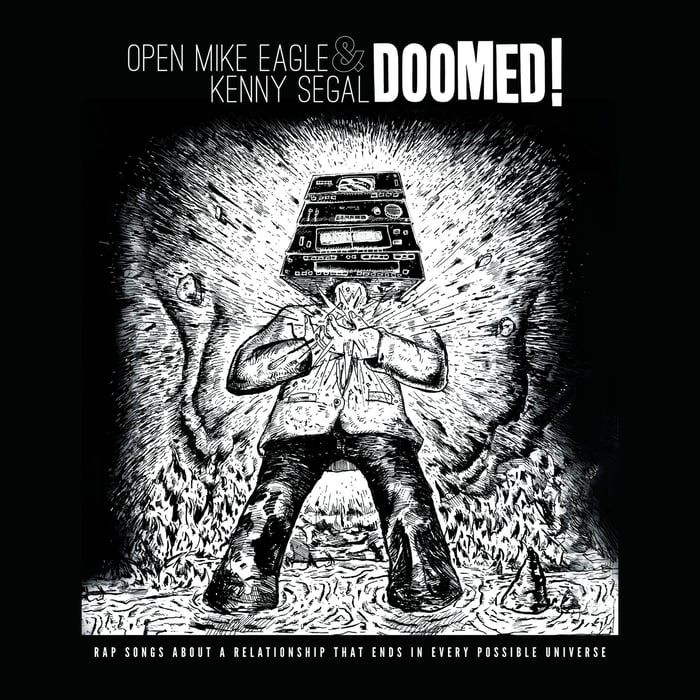
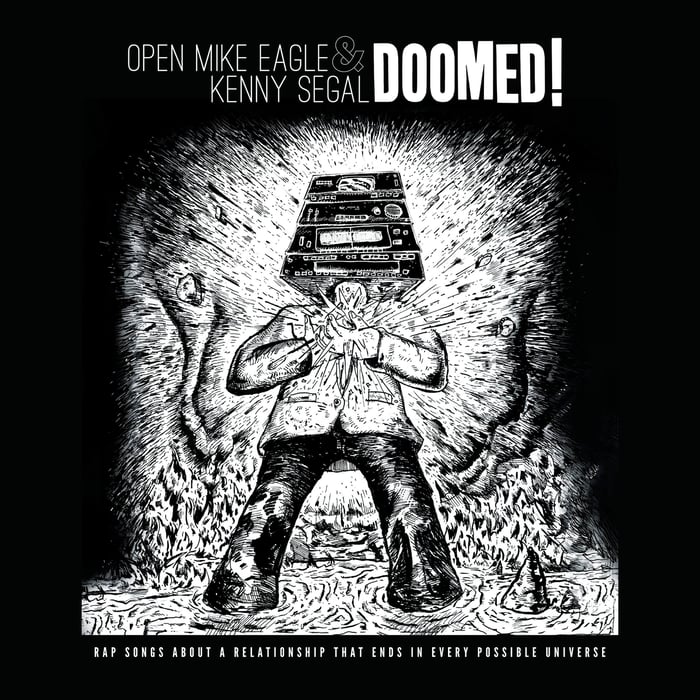
If this record put you in a “staring at the cover art too long” mood, you can shop a favorite album cover poster at our store here: https://www.architeg-prints.com — the cleanest way to hang a little chaos on your wall without texting your ex.
 | DISCOUNTGET 30% OFF*Use code on your next order:
|
* This post may contain affiliate links, meaning we earn a commission if you make a purchase through these links, at no additional cost to you.