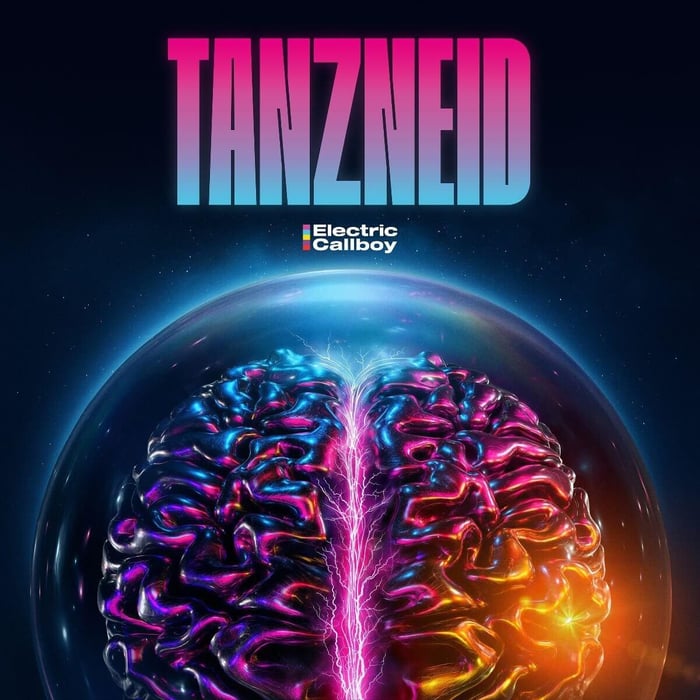
Tanzneid Electric Callboy Review: The “Album” That Won’t Sit Still


 See more Architeg Prints stories on Google.
ALBUM REVIEW: TANZNEID – Electric Callboy
A wild, loud, and chaotic mix of Eurodance, metalcore, and boyband vibes, Electric Callboy’s TANZNEID delivers individual bangers but struggles to form a cohesive album experience.
This isn’t an album so much as a mood swing with kick drums
Electric Callboy have spent years turning identity crisis into a party trick: Eurodance shine, boyband posing, and metalcore violence all fighting for the same spotlight. On Tanzneid Electric Callboy, they don’t try to blend those instincts—they stack them like mismatched drinks and hand you the keys.
The result is fun in the way a chaotic night out is fun: you’ll remember the big moments, you’ll forget how you got there, and at some point you’ll ask, “Wait… is this really the plan?” Track by track, most of this stuff works. As a full listen, it’s a grab bag where every other candy is a different flavor, and the bag is suspiciously full of candies you’ve already eaten before.
The title track “TANZNEID” sets the rules—then immediately repeats them
The opener, “TANZNEID,” is Electric Callboy doing the thing they’ve basically weaponized: bright, bouncy pop hooks riding fast techno, then getting clotheslined by guttural metal vocals. It commands movement right away—hips, feet, whatever you’ve got. The chorus is sticky on impact, the kind of refrain your brain agrees to carry without asking permission.
And that bridge? A hard-techno breakdown that feels like the band’s signature stamp, delivered with the kind of confidence that says they know exactly what their crowd came for.
But I’ll say the quiet part: the lyrics start looping a little too comfortably. It’s a reliable banger, not a mind-melter. Which made me pause—naming the whole record after this track feels slightly odd, like they titled the movie after the trailer. Still, as an opening thesis statement, it does the job: this record is here to party, not to persuade.
“RATATATA” with BABYMETAL is the confetti cannon that never stops
“RATATATA” hits next, and it feels like the room suddenly doubles in size. This is main-stage energy—big, shiny, and engineered for people who like their adrenaline served in neon. BABYMETAL are such an obviously smart fit here that it’s almost unfair; their hyper-melodic bounce doesn’t just add spice, it adds lift.
The trade-off vocals, the electronic flourishes, the metal crunch—everything locks together more cleanly than it has any right to. It isn’t the heaviest thing Electric Callboy have ever done, but that’s the point: the track doesn’t need more weight, it needs more bodies jumping in sync. If you can’t picture a crowd yelling this back with zero dignity left, you’re imagining the wrong band.
Arguably, it’s also the first moment where Tanzneid Electric Callboy starts hinting at a problem: this song feels like a centerpiece… and it arrives immediately, like they’re blowing the fireworks budget in the first ten minutes.
“Hypercharged” tries to sell modern EDM—and I’m not fully buying
Three tracks in, the momentum wobbles. “Hypercharged” leans into glossy, current-feeling EDM textures right away, but it can’t quite shake a lingering 90s corniness. At first I thought that throwback awkwardness might become charming—like a deliberate cheese move—but the longer it plays, the more it feels like the track needs a bigger surge than it delivers.
The chorus should explode. Instead, after the first refrain, the energy levels off like a roller coaster that never gets to the drop. There’s a weird sense of a missing piece in the production—like there’s space reserved for a more violent hook or a nastier switch-up, and it just… doesn’t show up.
I’m not even calling it bad. It’s more frustrating than that. It’s underwhelming in the exact spot where the album needed to keep punching.
“Let The Good Times Roll” brings The Offspring… and plays it a bit too safe
Then we get “Let The Good Times Roll” featuring The Offspring, which sounds unbeatable on paper: rock-punk swagger injected into the Callboy machine. And yeah, it’s danceable, it’s loud, it’s built for hands-in-the-air “woah” moments.
But here’s the thing: the album’s energy has already started to sag a little, and this track doesn’t fully correct it. The breakdown leans on tongue-in-cheek lyrics that don’t land as sharply as they think they do, and the final stretch doesn’t bring the knockout shove you want from a song stacked with crowd prompts.
Dexter Holland slides into the formula easily—almost too easily. The track feels comfortable, like both sides showed up, did the job, and went home before anything got weird. Fun? Sure. A classic? I’m doubtful. This is Electric Callboy choosing the safe ramp when they usually prefer the stupidly steep staircase.
“Elevator Operator” is the album remembering it’s allowed to be ridiculous
Thankfully, “Elevator Operator” grabs the energy with both hands and yanks it upward. This is one of the clearest standouts because it’s Electric Callboy at their best: absurd, lewd, and somehow tightly executed underneath all that chaos.
The lyrics are almost aggressively nonsensical—like someone dared them to make an elevator sound filthy—and the band accepted instantly. The bridge is the real flex: silly sound effects braided into throat-shredding growls, with the instrumentation locked in like a machine.
It’s dumb. It’s also kind of brilliant. And I’ll stand by this arguable claim: when Electric Callboy lean into stupidity with precision, it lands harder than when they try to be traditionally anthemic.
“Heartclub” is the heavy correction—and it wears eyeliner while doing it
If you were worried they’d drift too far from their metalcore roots, “Heartclub” shows up like a corrective slap. This is the most overtly heavy moment on the record: punishing riffs, squealing accents, and those “blegh”s dropped like little traps for the pit.
There’s a glam-metal strut to it—stomping grooves, gothic excess, the whole dramatic silhouette. And the emotional lyrics? Still corny, but in a way that feels intentional, like they refuse to be too cool for sincerity. It’s the angry call-to-arms track… that can’t stop winking while it swings.
Arguably, that’s the band’s entire brand: even at maximum aggression, they won’t let you forget this is supposed to be fun.
“The Way You Are” is a boyband ballad that gets possessed
Then comes “The Way You Are,” which is Electric Callboy’s twisted idea of a ballad. For about a minute, it plays it straight: syrupy 90s slow-dance energy, heartfelt delivery, the kind of softness that makes you think they’re about to do something genuinely tender.
And then the channel slips.
Suddenly the screaming takes over, and the song turns shockingly dark, like a romantic montage that gets interrupted by a horror movie. The two halves are so opposed it’s almost confrontational—one part begging for lighters in the air, the other part setting the lighters on fire.
I’m honestly not 100% sure whether this is genius or a total mess. It’s jarring, confusing, and weirdly mesmerizing anyway. That might be the point: they’re daring you to call it inconsistent while you keep listening.
“Still Waiting” proves a cover can still sound like them
Next, “Still Waiting” (with Frank Zummo) covers the Sum 41 classic, and this is one of the smarter moves on the tracklist. It walks the line between faithful and personalized: recognizable structure, but with the Callboy sheen and punch layered in.
The impressive part is that it doesn’t feel like cosplay. It feels like a real “we love this song, and we’re still ourselves” moment. If you think covers are usually filler, this one argues back—loudly.
Arguably, it also highlights something else: when Electric Callboy have a strong skeleton to build on, their chaos looks even more controlled.
“The Savior” is the rare miss—and it hurts because it could’ve hit
Then we hit “The Savior,” and it’s the one track that genuinely loses me. Lyrically it reaches for something bleak—wanting to feel happy and high while everything around you rots—but the upbeat tone undercuts the despair instead of complicating it.
I kept waiting for the chorus to open up and actually carry that weight. It doesn’t. The hook feels too simple, too flat, and it smooths out the song’s teeth right when it should bite hardest. The second half tries to inject urgency, but by then the emotional engine has already stalled.
What bugs me is the missed opportunity: this feels like the one place they could’ve dropped the irony and let seriousness sit in the room without a wink. They sidestep it. You can practically hear the potential sitting there, unused.
“Revery” closes the core record… but it feels like a familiar costume
“Revery” wraps up the main album run, and it brings a gothic, Halloween-ish whimsy that works as a palette change. The harsh vocal runs are technically sharp (as usual), and the darker styling will absolutely please the corner of the fanbase that likes their party music with a little graveyard fog.
But in the context of everything else here, it doesn’t feel like a defining statement. It’s more like: “Here’s another flavor you already know we make.” Pleasant, not essential.
And this is where my first impression shifted. Early on, I assumed the record would tighten into a shape by the end—some kind of through-line would emerge. By “Revery,” I stopped expecting that. The album isn’t building a journey. It’s collecting moments.
The remixes are either a rave fantasy or obvious padding
Just when it seems finished, the record extends into four remixes:
- Sullivan King remix of “We Got The Moves”
- Paolo Ferrara remix of “TANZNEID”
- Paul Elstak remix of “Hypercharged”
- Sullivan King rework of “Revery”
If you love the dance side of Electric Callboy, these are legitimately exciting—the idea of these tracks blasting at full volume in a rave setting is basically the band’s entire thesis taken to its logical extreme.
But if you’re already side-eyeing how many older singles are on Tanzneid Electric Callboy, the remixes might feel like extra stuffing in a pillow that was already full. Arguably, this ending makes the “is this an album or a compilation?” question impossible to ignore.
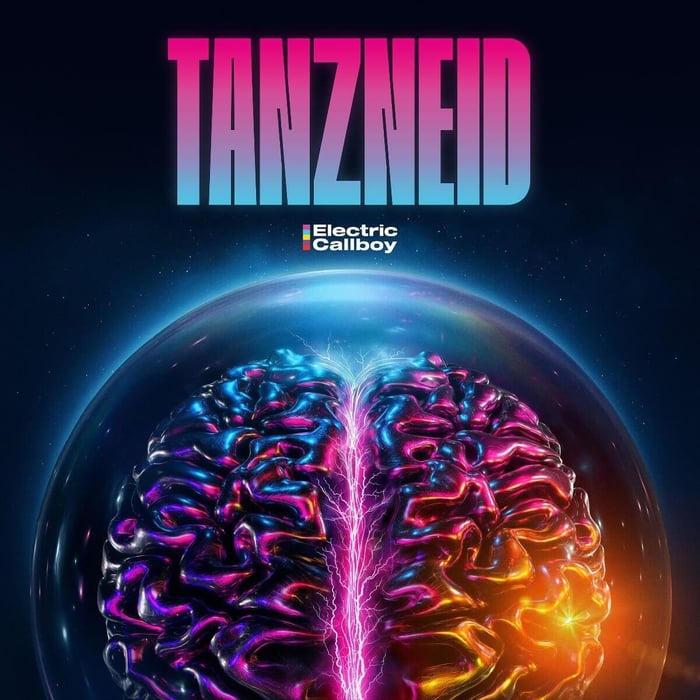
Artwork
Conclusion
Tanzneid Electric Callboy is packed with individual gems, but it doesn’t lock into a unified statement. It’s a beautifully chaotic mess: some tracks are sour and heavy, some are shiny and ridiculous, some are straight-up weird, and a few are so effective they make you forgive the mess entirely. Electric Callboy clearly know their sound inside and out—metal, EDM, retro-pop nostalgia—and they execute each corner with real skill. The problem is the shape of it: calling this a cohesive album feels generous when it plays more like a loud, candy-colored compilation that leaves you grinning… and slightly unsatisfied.
Our verdict: People who treat albums like playlists (and live for pit-to-rave whiplash) will love this. Anyone craving a proper front-to-back journey will get irritated and start reorganizing the tracklist in their head by song four.
FAQ
- Is Tanzneid Electric Callboy more metalcore or more dance?
It depends on the track, which is sort of the point—and also the problem. “Heartclub” hits hardest; “RATATATA” aims for the festival bounce. - Are there too many previously released songs?
If you’ve followed the singles, yes, it can feel like you’re re-watching trailers. If you haven’t, it’ll feel like nonstop highlights. - What’s the weirdest moment on the album?
“The Way You Are” pulling a full boyband slow-dance fakeout before collapsing into screaming darkness. - Does the album have a clear theme or storyline?
Not really. The through-line is “Electric Callboy being Electric Callboy,” which is satisfying until you want something more intentional. - Do the remixes matter?
If you love the electronic side, they’re a bonus dessert. If you wanted a tight album, they’ll feel like the kitchen kept sending out extra fries.
If you’re the type who bonds with an album’s aesthetic as much as the sound, a cover poster hits the same itch—feel free to browse prints at our store: https://www.architeg-prints.com
 | DISCOUNTGET 30% OFF*Use code on your next order:
|
* This post may contain affiliate links, meaning we earn a commission if you make a purchase through these links, at no additional cost to you.