Exodus Goliath Review: The Old Guys Still Sound Like a Knife Fight


 See more Architeg Prints stories on Google.
Exodus Goliath Review: The Old Guys Still Sound Like a Knife Fight
Exodus Goliath is cynical thrash that refuses to “age gracefully”—fast, nasty, weirdly inventive, and proud to make you stare at the ugly stuff.
This isn’t a “comeback” record. It’s a threat.
Some bands get older and start sanding down the corners. Exodus Goliath does the opposite: it sharpens everything until it feels unsafe to hold. I put this album on expecting veteran competence—tight riffs, familiar rage, the usual—and instead got something meaner than that. Not louder for the sake of being louder. Just… colder. Like the music’s looking right at you, daring you to flinch first.
Exodus have never been easy listening—and they’ve gotten worse on purpose
Exodus have never exactly been the band you play to “set the mood.” But over the last couple decades, their heaviness hasn’t just been about weight—it’s been about bleakness. The subject matter they reach for isn’t vague evil-movie imagery. It’s the real-world kind: historical atrocities, medical disasters, institutional abuse, school shootings, and the sort of true-crime nightmare fuel that makes you regret having a brain.
And that’s the first big statement this record makes: the band isn’t trying to entertain you out of darkness—they’re trying to trap you in it. You can disagree and call it theatrical, sure. But when these songs lock in, they don’t feel like costumes. They feel like somebody insisting you look at the raw footage.
Rob Dukes being back changes the album’s entire posture
A lot of that suffocating mood has always been about the voice, and Rob Dukes is a specific kind of hostile presence. Even with how beloved Zetro Sousa is, Dukes has a different stink on him—nastier, more physical, less “character,” more “guy who might bite through a padlock.”
He spits words like they’re weapons he’s been saving. And yeah, the image is unavoidable: tattooed brute energy, the kind of delivery that sounds like it’s trying to start a riot in a hallway. After being gone a long time, he’s back on the mic here, and Exodus Goliath becomes his first album with them since 2010. That alone tells you the band isn’t aiming for nostalgia. They’re aiming for impact.
Right away I wasn’t totally sure how I’d feel about it—Dukes can be so blunt he borders on cartoonish—but the longer I sat with the record, the more that ugliness started to feel like the point rather than a side effect.
The album moves like a monster: fast, catchy, and proudly cynical
Here’s the thing that surprised me: this album is vicious, but it’s also catchy in that dangerous way—hooks that don’t feel friendly, just efficient. It hits with that whiplash thrash snap, the kind that makes your neck react before your opinion does.
The cynicism isn’t decorative either. These songs have the stance of people with zero interest in comforting you. Exodus Goliath feels built by a band that’s fine with making you stare at the worst parts of humanity without blinking.
- “The Changing Me” slides in with hooks that almost pass for melodic, like a thin strip of clean bandage over a wound. But it’s still mostly churn and grime—violence-and-death energy with its boots on.
- “Promise You This” comes in on a rhythm that, for a second, feels weirdly jovial—close enough to that classic bouncy thrash pulse that you might mistake it for a good-time track. But it isn’t a party. It’s an unhinged ride that uses bounce as a taunt.
- “3111” as an opener is basically Exodus condensing cartel-murder horror into something tight and propulsive. It’s “engaging” in the way a car crash is engaging: you don’t want it, but you can’t look away.
If someone told me the band’s intent here was to make atrocity sing-along-able, I wouldn’t even argue. That’s kind of what thrash does at its sharpest—turns panic into riffs you can shout with strangers.
It’s heavier than you expect… but the weird part is how inventive it gets
For something this blunt, Exodus Goliath has more imagination than I expected. Historically, Exodus haven’t exactly been the kings of the slow track. When they slow down, it can feel like they’re waiting to speed up again.
So I put on the title track ready to tolerate it—and I had to revise that first impression fast.
“Goliath” (the song) actually works. It’s lethargic and swaggering, dragging itself forward like it’s too angry to hurry. It folds in sludge/stoner-ish weight, and instead of feeling like “Exodus doing something different,” it feels like a grimy room you’re stuck standing in. The atmosphere is uncomfortable on purpose. It doesn’t float. It looms.
That’s an arguable claim, of course—someone will hear it as the band playing dress-up outside their lane. I hear it as them finally making “slow” feel like a threat instead of a break.
Then there’s “Violence Works,” which toys with riffs that are so chunky and rhythmic I half expected old-school rap cadences to show up. Not because it becomes a crossover track, but because the guitar patterns flirt with that talky, percussive swagger. It’s a strange move, and it’s exactly the sort of detail that keeps the record from being a one-color bruiser.
And “Summon Of The God Unknown”—nearly eight minutes—goes for an ambitious, multi-personality structure. It’s the band letting the song mutate instead of just sprinting to the finish line. A lesser thrash band would pad that length with repetition. Here, it actually feels like an argument unfolding.
Don’t get it twisted: this is still a thrash album, not a reinvention project
Even with those experiments, Exodus Goliath doesn’t pretend it’s abandoning thrash. If anything, it’s thrash with extra scars. The “new” stuff mostly shows up as flourishes—little character tics across the tracklist—rather than some big stylistic pivot.
That’s also where one mild criticism sneaks in for me: sometimes the album toys with new textures and then snaps back to familiar habits so quickly it feels like it doesn’t fully trust its own detours. Like the band opens an interesting door, glances inside, and then goes, “Anyway—back to the beating.”
Still, the intent stays clear. These are career metalheads making metal with no apology and no watering-down for maturity points.
The closer swings a fist and dares you to call it subtle
By the time “The Dirtiest Of The Dozen” hits, Exodus basically stop winking and start shoving. It’s a pit-starter with a semi-autobiographical bite, and it wouldn’t have felt out of place back on Dukes’ first run with the band—specifically that early-era ferocity that turned everything into a brawl.
This is where the album gets so ill-tempered it almost edges into ridiculousness. Almost. But that’s also part of Exodus’ appeal: they’re not trying to be tasteful, and they’re not trying to be included in anyone’s polite list of “important” bands. They’re shamelessly metal, and the record’s fun in the way blunt catharsis is fun—like screaming into wind and liking the echo.
You can debate legacy politics forever—who “should” be ranked where—but listening to Exodus Goliath, that argument feels irrelevant. The point is the present tense: the band still sounds like it enjoys being a problem.
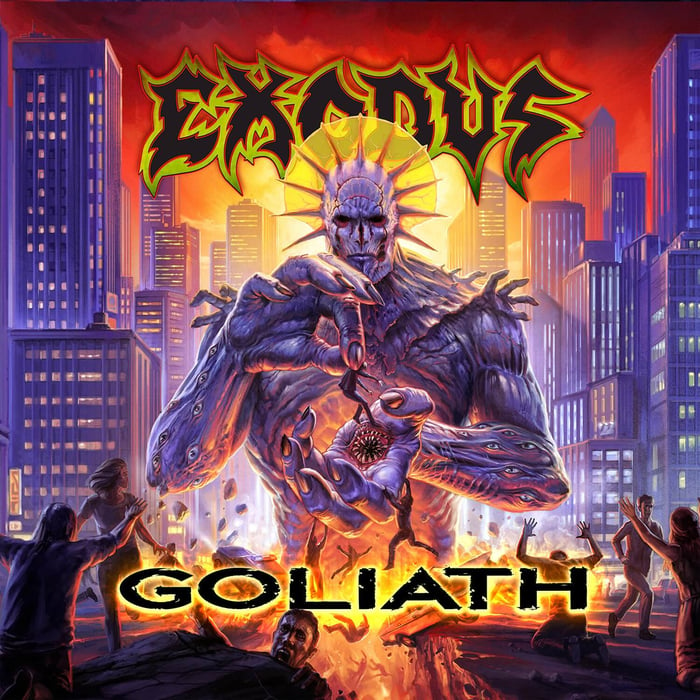
Album art
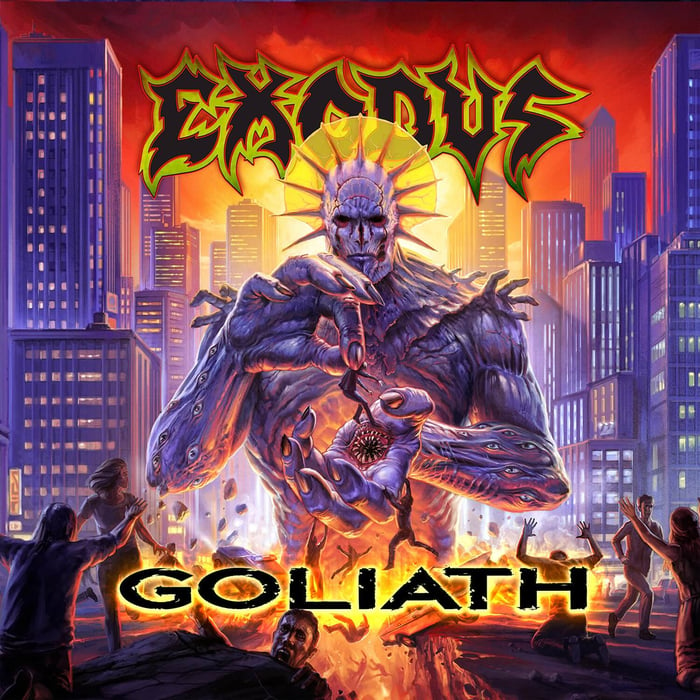
Release details (because, yes, you’ll ask)
Goliath is set for release on March 20th via Napalm Records.
Conclusion
Exodus Goliath doesn’t mellow, doesn’t reflect politely, and doesn’t pretend brutality is a phase you grow out of. It takes speed and cynicism, adds just enough weird sideways muscle (that title track, those rhythmic experiments, that long-form epic), and then doubles down on being unpleasant in the most cathartic way possible.
Our verdict: This will hit hard for listeners who want thrash that still sounds like it could get banned from a nice neighborhood—people who like hooks, but prefer them attached to barbed wire. If you want “mature” metal that processes feelings gently, you’re going to hate this and complain that it’s too angry. Correct. That’s the point.
FAQ
- What’s the core vibe of Exodus Goliath?
Fast, cynical thrash that treats human horror like the main theme, not a garnish. - Does Rob Dukes returning matter, or is it just fan-service?
It matters. The vocal posture is nastier and more physical, and the album leans into that hostility. - Is the title track actually slow, and does it work?
It’s slower, swaggering, and surprisingly effective—more sludge-tinged atmosphere than typical Exodus pacing. - Does the album experiment, or is it straight thrash?
It stays thrash, but it adds character flourishes: odd rhythmic riff choices and a longer, multi-section track that actually evolves. - Will this appeal to people who don’t like dark lyrical themes?
Probably not. The record doesn’t “lighten up,” and it doesn’t want to.
If you’re the kind of person who treats album art like part of the music, you can grab a favorite album cover poster for your wall over at our store: https://www.architeg-prints.com — it fits the whole “loud object in a quiet room” philosophy.
 | DISCOUNTGET 30% OFF*Use code on your next order:
|
* This post may contain affiliate links, meaning we earn a commission if you make a purchase through these links, at no additional cost to you.