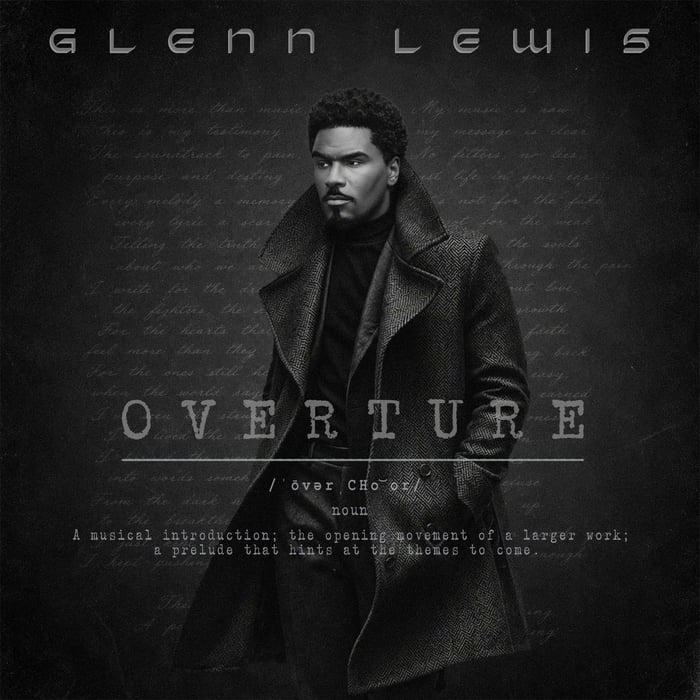
Glenn Lewis Overture Album Review: Love With a Terms Sheet (Sorry)


 See more Architeg Prints stories on Google.
Glenn Lewis Overture Album Review: Love With a Terms Sheet (Sorry)
Glenn Lewis’ Overture album returns to soul music with side-eyes, hard questions, and characters who treat romance like a contract negotiation.
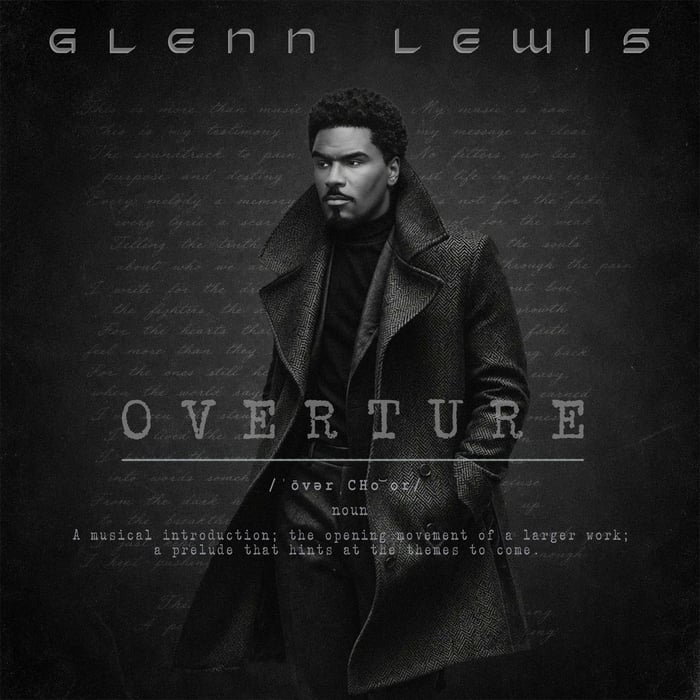
This isn’t a comeback album. It’s an audit.
Most “return” records show up waving a flag, trying to prove the artist still has it. Overture doesn’t do that. It shows up with a calculator and starts asking what love costs, who’s paying, and why everyone keeps signing the same deal again.
Glenn Lewis—Toronto soul singer, gone quiet for years—comes back sounding less interested in celebrating romance than interrogating it. And honestly, that’s the whole point: the album isn’t trying to make you swoon. It’s trying to make you stop mid-swoon and go, “Wait… is this a scam?”
The opening move: love as a negotiation, not a feeling
The album plants its flag early with “Love Ain’t Free,” and it’s not subtle about the premise. A toast to new beginnings gets answered with a businesslike challenge:
“She said love ain’t free/What you gon’ do for me? Let me see.”
That’s the energy—romance as a counteroffer.
Glenn responds like someone who already has his talking points ready. He’s not trying to “grow together.” He’s making sure nobody’s sneaking hidden fees into the relationship:
- “Got them own funds, ain’t tryna raise someone else’s son”
- aiming for “Matching expensive taste, crypto to pesos”
It sounds like two people flirting by comparing balance sheets. And over an interpolation of Patrice Rushen’s “Where There Is Love?”, that tension lands even harder—because the music hints at warmth while the lyrics keep the room cold. I think Glenn does that on purpose: the groove says “classic soul comfort,” while the words act like comfort is exactly what he doesn’t trust.
“What Does Love Mean” turns the hook into a trap
If “Love Ain’t Free” is the negotiation, “What Does Love Mean” is the spiral afterward when you realize the contract didn’t explain the actual product.
The chorus is basically the title—“What does love mean to you?”—and Glenn sounds like he’s asking because he genuinely can’t pin it down. Mid-track, he starts backing away from the whole idea like he’s been burned by vocabulary itself:
“Vows only something said/It’s really all in your head/Love’s only ‘til the next one”
And he delivers that last line flat. Not dramatic. Not wounded. Just… concluded. That choice matters. A lot of singers would squeeze tears out of it. Glenn makes it feel like a casual observation you hate agreeing with.
This is where I revised my first impression of the album. At first, I thought it was going to be a slick, grown-and-sexy return—nice suits, nice chords, safe sentiments. But the longer this track sat with me, the more it sounded like he came back specifically to not give anyone easy reassurance.
“Ruthless” is a heist movie with a lonely ending
Then the record starts populating itself with characters, and “Ruthless” is the sharpest one. Ruth loves “Designer things, them finer things,” and she has a system for getting them: men as pawns, identities as costumes, intimacy as entry-level access.
The details come quick, like scene cuts:
- “Your passwords and pins without you knowing her real name”
- “Intel and dossiers all on her next victim”
- winter in Paris and Geneva, summers working
- “Black her favorite color, legs long like a funeral/Tailor-cut and fit, heels nightmare beautiful”
That portrait is so vivid it’s almost unfair. Glenn makes her glamorous and predatory at the same time, like the song wants you impressed and uneasy in one breath. The track moves constantly—acquisition, movement, pursuit—until it suddenly stops feeling like progress at all.
Because once Ruth has everything, she’s alone off the coast of Belize wondering if love is even possible for her. And Glenn doesn’t hand her redemption. He just shows you the hole under the shine:
“To protect herself, she hid behind the pain and the hate/But all she ever wanted was someone to make her feel safe.”
That’s the punch. Not forgiveness—recognition. The refrain keeps circling: “Maybe this time that love would find her/Maybe she’ll open up/Maybe she’ll learn to trust someone,” and it goes on and on while nothing changes. That repetition is the point. Hope becomes another loop, not an exit.
A reasonable listener could argue the song romanticizes her. I don’t hear romance. I hear a character study that refuses to clean up its own mess.
“Jaded” writes from her POV—and doesn’t let her off the hook
“Jaded” is colder, and arguably harsher because it’s written from the woman’s point of view in second person, like Glenn is forcing you to inhabit the choices instead of judging from a safe distance.
She sleeps with a man she plans to leave, dresses up, fabricates phone calls and errands, kisses him goodbye, and locks the door behind her before she even knows he’s out of the building. The chorus doesn’t pretend there’s a mystery here:
“You know that feelings fade and people lie, so why try?/Already know the outcome/This shit got you jaded.”
And then she meets someone on vacation, lets it feel like fate, finds out he’s from her neighborhood, and still bails—later spotting him in a supermarket aisle back home and escaping before he can look up.
“Ain’t this all the makings of what they say fate’s s’posed to be?”
she thinks… and walks away anyway.
That contradiction is the whole song: wanting connection, fearing the invoice it comes with.
“Past Tense” is the friend who stops being polite
After that, “Past Tense” shifts perspective again—now Glenn is the friend in a woman’s ear, the one who’s watched the slow-motion collapse long enough to stop sugarcoating it.
“At this point, you playing yourself/Now it’s on you.”
There’s something almost brutal about how plain that is. Not cruel, just done. Like the song understands that “support” can turn into enabling if you keep calling the same wound a love story.
You can disagree with his approach—some people need softness, not bluntness—but the track nails a very specific social moment: when your friend’s relationship becomes a recurring public incident.
“Waiting” asks for almost nothing, which is the embarrassment
“Waiting” is where Glenn turns the camera back toward himself—and he makes a choice a lot of singers avoid: he asks for the bare minimum and lets that be humiliating.
He put everything into a relationship, got told that “being easy was boring,” and now the other person has moved on far enough that “Your girl been texting me.” The plea is small, almost pathetic in the most human way:
“Won’t you say something, anything?/Instead of me waiting, waiting, waiting.”
Near the end he snaps into a different conclusion: “Truth is you ain’t stopped to free the man in me.” That line is doing a lot. It’s him reclaiming dignity, but it’s also him rewriting the story in real time—because waiting too long makes anyone want to believe the problem was the other person’s failure to recognize their value.
I’m not totally sure which side the song wants me on. That uncertainty actually helps it; it feels like a thought still forming.
“Say You Will” acts confident, then admits it’s terrified
“Say You Will” flips the dynamic: Glenn pressures someone into committing. They want to “Just stay friends.” He’s already decided: “I gotta have you.”
And for a minute, it sounds like he’s going to bulldoze the whole situation with certainty. Then the bridge caves in:
“What if we drift?/What if we don’t make it and we grow apart?”
He has no answer. He’s only still begging for a yes.
That’s one of Overture’s recurring tricks: it lets a character pose as powerful until the song reveals the fear underneath. If you think that’s manipulative, fair. If you think it’s honest, also fair. The album lives in that uncomfortable overlap.
“Father to Son” tries to end a cycle without turning it into a villain speech
“Father to Son” is the most direct biography on the record: Glenn’s father was a “Rolling Stone, he was sure as they come,” mostly absent, leaving him to “Learn life and all on my own.” Now Glenn has a kid, and he’s trying to reverse the curse:
“Change the damage that’s done with love from father to son.”
What surprised me is how little venom he has. He refuses the easy storyline where the absent father is a monster. “No, I don’t blame you,” he sings, calling him “Just a product of a world that said it hated you.” Then the bridge passes the burden upward: “Only God could once I put it all in His hands.”
That’s a specific kind of maturity—maybe too tidy for some listeners, but it reads like someone choosing peace because the alternative would eat the rest of his life.
“Where Life Begins” is uplifting… and kind of thin
“Where Life Begins” follows that spiritual turn, landing on a simpler message: “What seems like the end is where life begins, sometimes.”
And here’s where the album briefly loses me. The sentiment sits next to “Father to Son” like a birthday card—nice, supportive, but not digging deep enough to earn its space. Maybe that’s intentional, a breather after heavier narratives. Or maybe it’s just one of those tracks that exists because albums feel like they need a “light” moment.
Either way, it’s the rare moment where Overture sounds like it’s settling.
When the writing floats, the voice anchors it
Across the record, Glenn’s writing can be almost airy—quick sketches, slippery motives—while his voice keeps trying to ground it. He doesn’t chase big money notes. Instead he plays with phrasing and placement like he’s turning the words over in his mouth to see which side cuts.
“Impressions” (already familiar to plenty of R&B heads) is the lightest track on the LP: synth, drums, trumpet, and Glenn choosing not to grandstand over the groove. He sticks in the pocket, chasing clarity from someone who won’t give it:
“Don’t leave me guessin’/Lookin’ in all/The wrong direction.”
“G.Y.A.M.L. (My Love)” goes richer in texture, with Seige Monstracity handling instrumentation on three songs. The tone gets less guarded fast. He drops the cool with “Crazy seeing ya,” and by the hook he’s done circling:
“Loving for me you like medicine,” then, “I’m giving you all my love,” no disclaimers.
Then “So Many Stars” strips it down even further. It leans heavily on the vocal—Glenn relaxed, laying the top line against an even groove, stretching carefully without drowning the song in ad-libs. It begins after a blink of an instrumental from Joe Jackson that almost resets your ears, and then it’s just him, right there.
The arguable claim: the quieter songs are where this album wins. The more it tries to be overtly sensual, the more it slides toward generic.
Seduction songs that keep accidentally confessing
“Dance for Me” is almost entirely a plea: “Dance for me, girl/When you do nothing else exists.” Second verse turns into assessment—“Legs in them heels like a thoroughbred walk mean”—which is such a specific line it either lands as vivid or lands as a little goofy. For me, it landed in between: memorable, but not exactly poetry.
“Say What You Want” starts like it might actually consider the woman as a person: “They say you ain’t the same one/Since the day I first met ya” and “Do anybody see her?” But it ends up where these songs often end up:
“Our bodies left doing the talking.”
That’s the album in miniature: it reaches for emotional truth, then defaults to physical language when it gets scared. Glenn’s voice sells lines that, on paper, are kind of dead. That’s a skill. It’s also a tell—sometimes the performance is doing more work than the writing.
“Last Goodbye” lands the thesis without turning preachy
By the time “Last Goodbye” arrives, the album has spent track after track measuring love’s value, doubting it, renegotiating it, walking away from it, crawling back toward it.
“Tomorrow will be here before you know it,”
“And what is new will soon to rust and turn to dust.”
Then comes the most resonant idea on the record: nobody is ever truly known by another. He delivers it like a quiet credo:
“Honesty from tears and facing our fears… That no one truly knows us before the last goodbye.”
It’s the closest the skeptic gets to faith. Not faith in romance—faith in the fact that we’re all partially unknowable, and pretending otherwise is how we hurt each other.
He never gives you a neat number, a final appraisal. He just holds that pre-show glimmer—the hope that maybe, before the lights go out, someone will see you clearly enough to matter.
Conclusion
Overture doesn’t come back to win you over. It comes back to poke the soft parts of love until they admit what they are: bargaining, fear, desire, habit, longing, and—once in a while—something like grace.
Our verdict: People who like soul music that argues with itself will actually love this—especially if you enjoy songs where the “romance” keeps tripping over insecurity and honesty. If you want clean devotionals, easy choruses, and love stories that don’t mention emotional overhead, this album will feel like being handed paperwork on date night.
FAQ
- Is the Overture album more about love or heartbreak?
It’s about the business of love—the negotiations, the self-protection, and the moment you realize heartbreak is sometimes just a bad contract you kept renewing. - Which songs hit the hardest emotionally?
“Jaded” and “Ruthless” feel the most like short films, and “What Does Love Mean” is the one that keeps echoing after it ends. - Does Glenn Lewis sound different after the hiatus?
He sounds controlled. The power comes from phrasing and restraint, not big vocal fireworks. - Is there a “sexy” side to the album?
Yes—“Dance for Me” and “Say What You Want”—but even those tracks can’t stop the album from confessing its doubts. - What’s the main idea the album leaves you with?
That intimacy is real, but complete certainty about another person is mostly a comforting myth.
If this album got you staring at the cover like it’s part of the story, you can always shop a favorite album cover poster at our store—tastefully loud walls are still allowed: https://www.architeg-prints.com
 | DISCOUNTGET 30% OFF*Use code on your next order:
|
* This post may contain affiliate links, meaning we earn a commission if you make a purchase through these links, at no additional cost to you.