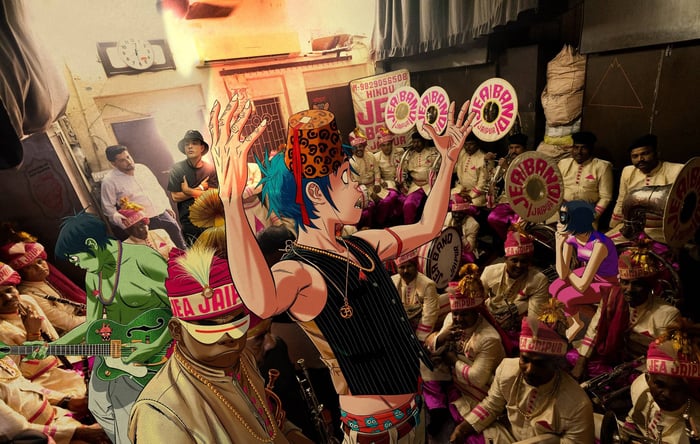
Gorillaz The Mountain Review: Death, Rebirth, and a Huge Cartoon Ego Trip


 See more Architeg Prints stories on Google.
Gorillaz The Mountain Review: Death, Rebirth, and a Huge Cartoon Ego Trip
Gorillaz The Mountain is grief dressed as world-building pop: gorgeous, crowded, occasionally smug, and weirdly comforting when it finally stops performing.
A goodbye record that refuses to sit still
You can tell within minutes that Gorillaz The Mountain isn’t trying to “cope” quietly. It’s trying to build a place where loss can be carried around without stopping the party. That’s the move: make grief portable, make it rhythmic, make it multilingual, make it somebody else’s problem for three and a half minutes at a time.
The line that nails the album’s emotional center hits in ‘Orange County’: “
You know the hardest thing is to say goodbye to someone you love.” Damon Albarn doesn’t sing it like a dramatic reveal; he sighs it like he’s been walking around with it for months and is tired of pretending it’s fine. And for a band that’s always loved the spectacle, the bluntness feels almost suspicious—like the cartoon mask slipped by accident.
I think the album is partly about learning how to say goodbye without turning it into a personality. I’m not totally sure it succeeds every time, but that uncertainty is kind of the point: the record doesn’t sound “resolved.” It sounds like it’s still pacing.
“You know the hardest thing is to say goodbye to someone you love.” — Damon Albarn
The “mystical” pivot (and the quiet flex inside it)
Here’s what’s really happening: Gorillaz are dialing down the chase for international pop stardom—at least in the obvious way—and aiming for something like “mystical music making.” Not mystical as in candles and slogans. Mystical as in: we’re going to treat the whole album like a map, not a playlist.
And yeah, bangers still show up. They just arrive wearing different clothes. The album keeps sliding between bright hooks and global textures like it’s testing whether movement itself can substitute for closure. A reasonable person could argue this is just high-budget tourism in audio form. But the stronger moments feel less like sampling postcards and more like building a room you can actually sit in.
The blunt theme is death. The sneakier theme is starting over without making it inspirational.
A widescreen opener that sets the rules
The title track ‘The Mountain’ opens with Indian soundscapes that feel properly widescreen—like the horizon got pushed back. It doesn’t just “set a mood.” It sets a scale. This is one of those openings that tells you the album will be a full-bodied world, not a handful of singles arguing in a folder.
From there, ‘The Moon Cave’ flicks the switch into funk, like the record is reminding you: yes, we’re grieving, but we’re also alive, and the drums would like credit for that.
Then ‘The Happy Dictator’ (with Sparks involved) takes a playful jab at tyrants and despots who try to posture as eternal. The joke lands because the song doesn’t sound furious—it sounds amused, which is arguably more insulting. It’s the album saying: you’re not immortal, you’re just loud.
That’s a running contradiction here: the record wants spiritual depth, but it also wants to smirk. Sometimes the smirk saves it. Sometimes it makes the emotion feel like it’s being framed for display.
When the guest spots stop being “features” and start being characters
One of the album’s best tricks is how it treats collaborators less like trophies and more like voices in the same strange town. ‘The God Of Lying’ is the clearest example: Joe Talbot from IDLES drops into woozy hip-hop that nods to ‘Clint Eastwood’, except it’s not doing the same early-2000s zombie swagger. It’s jittery and self-interrogating.
Talbot’s lines—“
Are you happy with your housing? Are you climbing up the walls? Are you deafened by the headlines, or does your head not hear at all?”—sound like somebody trying to locate their own value in a room full of noise. The arguable part: Talbot fits Gorillaz better when he’s doubting than when he’s roaring. Here, the doubt is the hook.
And it’s placed smartly: right when the album could’ve drifted into pure aesthetic travel, it drags you back into modern anxiety. It’s a spiritual record that keeps checking its phone.
The middle stretch: where the album either blooms or blurs
This is the part where Gorillaz The Mountain starts feeling like a tapestry—colorful, flowing, constantly changing texture. Sometimes it’s gorgeous. Sometimes it’s almost too good at flowing, to the point where you lose your grip on individual moments.
- ‘The Empty Dream Machine’ moves with a steady soul-rap sway, like it’s trying to keep your breathing even.
- ‘The Plastic Guru’ is a dreamy bop that feels deceptively light—like the album is practicing happiness in a mirror.
- ‘Damascus’ goes full Bollywood rap rager, loud enough to kick the existential dread back under the couch.
- ‘The Sad God’ waltzes heavenward, and it’s hard not to hear that as a deliberate choice: grief made elegant, not brutal.
On my first listen, I honestly thought the constant pivoting was the album showing off—like it wanted credit for range more than it wanted to land an emotion. But on second listen, the jumpiness started to feel like the point: grief doesn’t stay in one genre. One minute you’re numb, next minute you’re laughing at something you shouldn’t, then you’re back to staring at the ceiling.
Still, one mild criticism: the album occasionally mistakes scope for depth. A big world is not automatically a meaningful one, and there are moments where the record’s “world tour” energy threatens to turn into background splendor.
Five languages, one big intent: make the world feel crowded on purpose
The album uses five languages—Arabic, English, Hindi, Spanish, and Yoruba—and it’s not just a flex. It makes the record feel populated, like grief isn’t a private diary but a shared weather system.
The collaborator rollcall is stacked in a way Gorillaz fans will recognize, but it’s deployed with unusual purpose. Johnny Marr’s flowery fretwork appears woven throughout rather than popping in for applause. Other guests pass through the record’s streets too—Omar Souleyman, Asha Puthli, Gruff Rhys, Yasiin Bey, Paul Simonon from The Clash, Trueno, and more—like a moving crowd, not a red-carpet line.
Here’s my arguable take: the album is at its strongest when you stop thinking of these as “features” and start hearing them as evidence that the narrator can’t handle being alone with his thoughts. The more voices, the less silence. And silence is where the dead are loudest.
Guests from beyond the grave (and the album’s real thesis)
This is where Gorillaz The Mountain stops being just ambitious and becomes genuinely affecting—because it invites people who aren’t here anymore to still speak.
Tony Allen appears on ‘The Hardest Thing’, repeating the mantra “
Oya E dide erori,” translated here as “
we are ready, let’s go.” It doesn’t sound like a catchy slogan; it sounds like a ritual, a steadying instruction. The album isn’t begging death for answers. It’s telling the spirit: keep moving.
Mark E. Smith shows up on ‘Delirium’, dragging his surreal menace across a ravey horrorshow, warning a “
shrunken china chief head dealer” that they’re “
coming home a sinner.” It’s grotesque and funny and sharp—like the dead guy walked in, insulted everyone, and accidentally told the truth.
Then there’s Proof (D12) on ‘The Manifesto’, with vocals recorded 25 years ago, landing a line that suddenly feels like a prophecy with teeth: “
No one can convince the invincible to be sensible.” That sentence doesn’t just sit inside the song—it throws a shadow across the album’s whole idea of control. You can’t negotiate your way out of mortality, and the record keeps proving it.
The “deceased choir” continues on ‘Voices From Elsewhere’: Dennis Hopper, Bobby Womack, and Dave Jolicoeur from De La Soul. Their presence isn’t used as a cheap ghost trick. It underlines the album’s most honest claim: absence can be a presence. Art keeps people talking after they can’t talk anymore, and that’s both beautiful and unsettling—like getting a voicemail from a number that shouldn’t work.
‘Orange County’ is the quiet centerpiece, not the loud statement
For all the globe-spanning sound, the emotional bullseye still feels like ‘Orange County’—the bittersweet tearjerker that shares DNA with ‘On Melancholy Hill’ without trying to remake it.
The song’s power comes from how it refuses to be grand. Albarn doesn’t dress the goodbye up in metaphors until it’s unrecognizable. He just admits the hardest thing is the simplest one: letting someone go while still loving them. Later, he frames it with that startlingly plain line:
“I’m not your enemy, your atoms gone, you stand alone, and everything you gave to someone you love – that’s the hardest thing.”
That’s the album in one breath: not a horror story, not a victory lap, but a stubborn insistence that what you gave still counts, even if the person is gone.
And if you want the blunt interpretation? The Mountain isn’t really trying to comfort you. It’s trying to make you functional.
Details
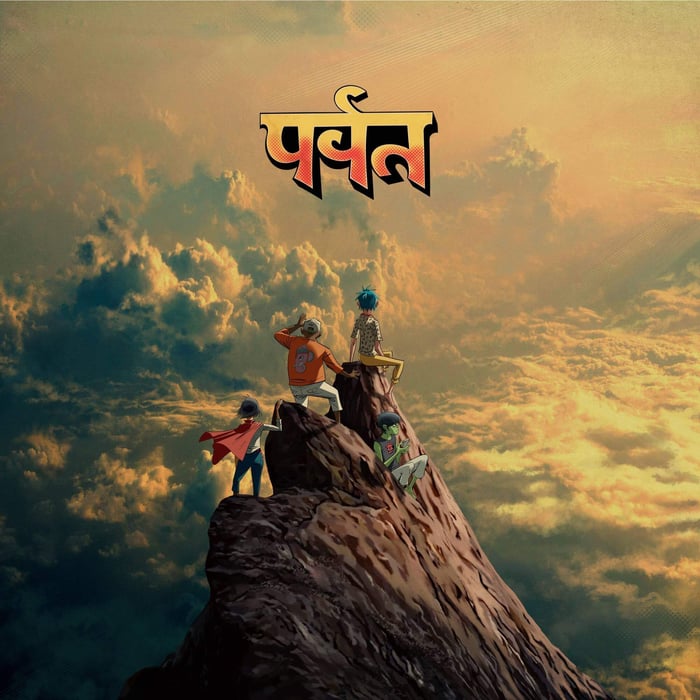
- Record label: Kong
- Release date: February 27, 2026
FAQ
- Is Gorillaz The Mountain more about grief or escapism?
It’s grief using escapism as a vehicle. The traveling, the genre-shifts, the guest voices—they feel like ways to keep moving so the sadness doesn’t harden. - What’s the emotional centerpiece of Gorillaz The Mountain?
‘Orange County.’ It’s the moment the album stops world-building and just says the quiet part out loud. - Do all the collaborations feel necessary?
Not all of them feel equally vital, but the constant company is part of the point: the record sounds like someone refusing to sit alone. - Why include voices from artists who’ve passed away?
Because the album is insisting that absence has weight. Those voices aren’t decoration—they’re proof the past keeps speaking. - Is The Mountain closer to pop Gorillaz or concept-album Gorillaz?
Concept-album Gorillaz, with pop instincts popping up when it needs oxygen.
If this record stuck with you visually as much as sonically, a good album-cover poster is basically the neatest way to keep the “world” on your wall without replaying the goodbye every day. You can browse options at our store: https://www.architeg-prints.com/
 | DISCOUNTGET 30% OFF*Use code on your next order:
|
* This post may contain affiliate links, meaning we earn a commission if you make a purchase through these links, at no additional cost to you.