Swet Deth Review: Crooked Fingers Returns Like a Friendly Ghost With Teeth


 See more Architeg Prints stories on Google.
Swet Deth Review: Crooked Fingers Returns Like a Friendly Ghost With Teeth
Swet Deth isn’t a comeback lap—it’s Crooked Fingers treating death like a room you still have to live in, with guests who sound like witnesses.
A comeback that refuses to act grateful
If you came here expecting a polite “we’re back!” record, Swet Deth will disappoint you in the best way. This doesn’t sound like an artist begging for relevance after a long silence. It sounds like someone who’s been gone long enough to stop caring about the correct tone of voice—and who came back with sharper language, not softer feelings.
The headline fact is simple: this is the first Crooked Fingers album in 15 years. But the more revealing fact is what the record chooses to organize itself around: death, sure, but also the weird sweetness that can cling to it. Not “sweet” like Hallmark-card comfort. Sweet like you’ve lived long enough to know grief doesn’t always show up wearing grief’s uniform.
And yeah, I’ll admit it: on my first pass, I braced for an album that would lean on morbidity like a prop. I expected dramatic candlelight. Instead, what I got was something more sly—songs that keep pointing at the end of things, while quietly insisting the middle still matters.
Death isn’t the point—what comes before it is
Here’s what Swet Deth seems to be doing, under the lyrical talk of death: it’s not obsessed with dying. It’s obsessed with what death does to the living timeline—how it rearranges your habits, your humor, your ability to stand inside a quiet room without filling it with noise.
The record’s “sweetness” is the tell. The writing keeps a wry little grin tucked in its back pocket, like it’s seen “many kinds of death” and refuses to pretend each one is identical. That’s a hard-earned attitude—one that doesn’t romanticize loss, but also doesn’t flatten it into a single shade of black.
There’s an arguable choice baked into that: the album risks sounding almost too comfortable around the subject. Some listeners will hear that as emotional maturity. Others will call it detachment. I’m not even completely sure where I land—some moments feel like gallows humor, other moments feel like plain acceptance, and the line between those two can blur fast when the songs don’t announce which is which.
Crooked Fingers has always been slippery—and this record weaponizes that
Crooked Fingers has never behaved like a fixed band. No two albums supposedly sound alike, and lineups change in studio and on tour. Listening to Swet Deth, that “slippery concept” doesn’t feel like trivia—it feels like the method.
Because the record doesn’t present one stable cast of characters. It moves like a project that shapeshifts depending on what a song demands. And that’s the key: the songs themselves seem to call for specific textures and voices, including parts that apparently required instruments the main writer doesn’t play, or vocals that sit outside his natural register.
So instead of forcing everything through one throat and one toolkit, the album expands outward—more guests than he’s used on any other release in this catalog. That decision matters. It makes Swet Deth feel less like a solitary diary and more like a room full of people swapping stories after the fact. Not a party. More like a wake where the conversation keeps drifting into laughter, then back into silence.
The arguable part: sometimes an album with this many voices can feel like it’s dodging commitment—like it’s afraid to stand alone. I don’t think that’s what’s happening here, but I did catch myself wondering, briefly, whether the guest list was going to become the headline. It doesn’t. Still, the temptation is there.
The guest vocals aren’t decoration—they’re plot
The most obvious “expansion” on Swet Deth is the guest roster, and the album is smart enough to use those voices like characters, not cameos.
Here’s who shows up in specific places:
- Sharon Van Etten appears on “Haunted”
- Matt Berninger (of The National) appears on “From All Ways”
- Mac McCaughan (of Superchunk) appears on “Cold Waves”
And before the bigger-profile names, the record starts closer to home—family, friends, frequent collaborators. That ordering tells you something about intent: this isn’t a flex first, community second. It’s community first, then the wider circle.
A few more specific roles land with real purpose:
- Jon Rauhouse plays pedal steel
- Bachmann’s wife, Liz Durrett, contributes vocals
- Members of the touring band—Skylar Gudasz and Avery Leigh Draut (of Night Palace)—also contribute vocals
What surprised me is how the guests don’t dilute the album’s identity—they sharpen it. The record’s identity becomes the act of choosing the right voice for the right bruise. That’s not the same as “variety.” It’s more like casting.
If you want to disagree with me, here’s the obvious counterpoint: a “historically slippery concept” can be a convenient way to avoid the hard work of a single, unified sound. But I don’t hear avoidance. I hear a kind of grown-up permission: the songs get what they need, even if that means admitting the original voice isn’t always the best tool.
The groove is the trick: the songs move even when the subject doesn’t
One of the record’s slyest moves is rhythmic. There’s a freedom to the collection, and a groove that almost contradicts what the songs are circling.
If Swet Deth were only “an album about death,” that groove would feel wrong—like dancing at the wrong time. But the groove makes sense because death isn’t framed as the album’s final point. The real subject is what happens before the end: anxiety, agony, and the daily negotiation with both.
That’s a brave choice, and it’s also slightly risky. A groove can make heavy topics easier to swallow, and sometimes “easier” is not what listeners want. I can imagine someone calling parts of this record too smooth for its themes, like the music is politely escorting you past the worst of the pain.
Personally, I think the groove is the album refusing to perform suffering. It’s saying: life keeps moving, even when your brain doesn’t want to.
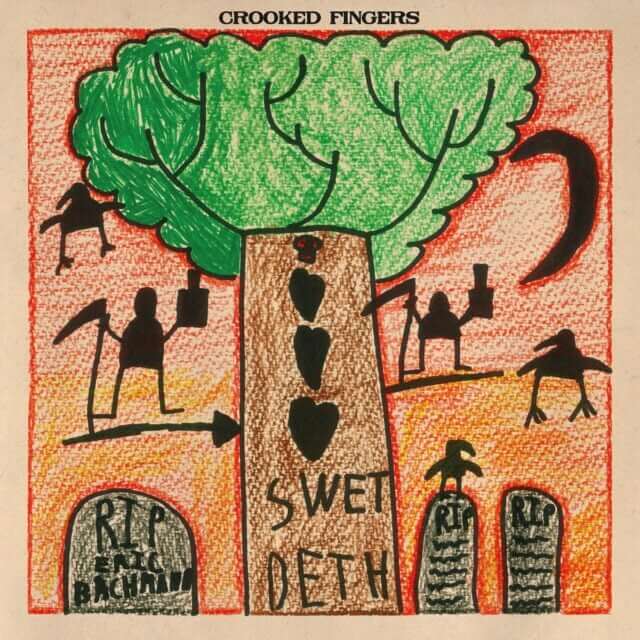
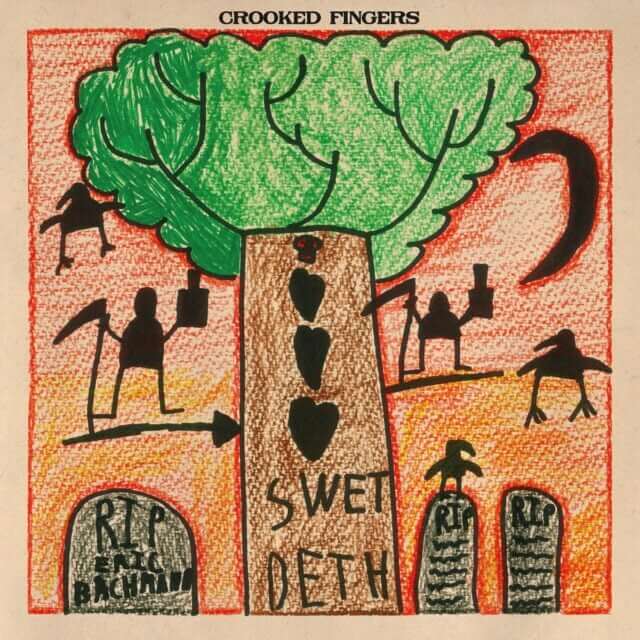
The cover image isn’t subtle—and the album knows it
The album practically hands you its symbol: like a tree sprouting from a graveyard, Swet Deth pushes color into a landscape that “should” be only bleak. The image is morbid and lush at the same time—proof of life planted right in the shadow of its opposite.
That kind of symbolism can be corny if the music doesn’t earn it. Here, the music mostly earns it. Mostly.
Here’s my small hang-up: the concept is so clean it almost feels too neat on paper—death/sweetness, graveyard/color, ending/growth. In lesser hands, that becomes a motivational poster with better lighting. But when the songs lean into that wry sensibility—when they feel like they’re written by someone who’s watched life continue after multiple kinds of loss—the neatness stops feeling like branding and starts feeling like clarity.
And then there’s the detail on the cover that nails the whole attitude to the wall: one tombstone reads “RIP Eric Bachmann.” That’s not just morbidity. That’s self-mythology being punctured in real time. It’s the artist letting the “dead” version of himself exist so the living one can make the record.
The last line it implies is the one that lingers: as Crooked Fingers, he’s never felt more alive. It’s a bold claim for such a death-haunted album, which is exactly why it works.
What Swet Deth is really arguing (whether it admits it or not)
By the end, Swet Deth feels like it’s making a stubborn argument: the only honest way to write about death is to write about the life that refuses to stop happening around it.
The guests reinforce that. The groove reinforces that. Even the cover reinforces that. The album treats death as a fact, not a vibe. And that’s why the “sweet” part doesn’t feel like denial—it feels like someone learning how to keep company with the inevitable without letting it own the room.
I kept waiting for the record to collapse into pure gloom, the way “serious” albums sometimes do when they think seriousness equals slowness and grey tones. It doesn’t do that. It moves. It recruits voices. It makes room for a little crooked humor. And on second listen, that movement started to feel like the entire point, not just an aesthetic choice.
Swet Deth doesn’t try to beat death. It just refuses to let death be the only narrator.
Our verdict: This will land hard for listeners who like songwriter records that stare at the grave and still bother to show up with a melody—and who don’t mind a rotating cast making it feel communal. If you want a tight “band” identity, or you need your dark albums to sound punishingly bleak to feel authentic, Swet Deth might feel suspiciously alive (which, yes, is the point).
FAQ
- What is the core theme of Swet Deth?
Death is present, but the songs keep tilting toward what people do before the end—how they keep moving through anxiety, grief, and whatever comes after loss. - Is Swet Deth really a Crooked Fingers “band” album?
It doesn’t act like a fixed lineup record. It treats Crooked Fingers like a flexible project, pulling in voices and instruments as each song requires. - Which guest musicians appear on the album?
Sharon Van Etten (“Haunted”), Matt Berninger (“From All Ways”), and Mac McCaughan (“Cold Waves”), plus pedal steel from Jon Rauhouse and vocals from Liz Durrett, Skylar Gudasz, and Avery Leigh Draut. - Does the album sound depressing?
Not in a one-note way. There’s a groove and looseness that keeps it from becoming a purely mournful listen, though the subject matter doesn’t pretend everything’s fine. - What’s with the “RIP Eric Bachmann” tombstone detail?
It reads like a deliberate wink at reinvention—burying an old self-image so the current version can make something vivid instead of merely grim.
If this album’s graveyard-color contrast hit you, a good album-cover poster isn’t a bad way to keep that mood on your wall—tastefully, not like a shrine. You can browse prints at https://www.architeg-prints.com/.
 | DISCOUNTGET 30% OFF*Use code on your next order:
|
* This post may contain affiliate links, meaning we earn a commission if you make a purchase through these links, at no additional cost to you.