Hey Colossus’ Heaven Was Wild: DIY Therapy With a Few Unironed Creases


 See more Architeg Prints stories on Google.
Hey Colossus’ Heaven Was Wild: DIY Therapy With a Few Unironed Creases
Hey Colossus’ Heaven Was Wild is a record that embraces imperfection and rawness, capturing the urgency and honesty of a band committed to their art and autonomy in a fractured music industry.
Walk in expecting polish, and it’ll laugh at you
Some records try to impress you. Heaven Was Wild mostly tries to survive you—and I mean that as a compliment. It’s the sound of a band treating “album cycle” like a nuisance and “making the thing” like the only real point.
And yeah, it announces that attitude immediately: this is one of those releases that wants the room sound, the edges, the human wobble. Not “lo-fi cosplay,” but that practical, lived-in mess where the seams are part of the design.
They basically rehearsed it in public, then hit record
Here’s what sticks out: the album was played live across four sold-out London dates in three days—north, south, east, west—right before recording. That’s not a cute anecdote; you can hear the logic in it. They weren’t demoing in isolation, they were stress-testing the material in front of people, then tweaking between gigs like mechanics leaning into an engine bay while it’s still hot.
Then it was straight into a room in Bruton, Somerset with JT Soar’s mobile studio brought down from Nottingham. Five days. Done. “Warts and all.” That timeline matters because it explains the vibe: Heaven Was Wild doesn’t feel fussed over. It feels committed.
Arguable take: a lot of bands claim they want “rawness,” but most of them mean “rawness with safety rails.” This one sounds like it actually accepted the risk.
The ‘imperfections’ aren’t flaws—they’re the point
They openly frame it as having “some imperfections” and “some un-ironed creases,” and I don’t think that’s PR spin. This record doesn’t just tolerate those creases; it relies on them to make the music feel immediate instead of museum-lit.
I’ll admit, my first impression was that the roughness might be covering for a lack of ideas—like, “okay, so we’re doing the whole warts-and-all thing, fine.” But on second listen, the roughness starts reading as confidence: they’re not hiding; they’re refusing to sand the corners because the corners are where the character lives.
Mild criticism, though: there were moments I kept waiting for one section to lock in a little harder, to hit with a cleaner impact. Sometimes the looseness feels intentional; sometimes it feels like the band dared itself not to do a second take and then… didn’t.
Album No. 15: the flex isn’t the number, it’s the refusal
This is Hey Colossus album No. 15, and they even joke it’s record number “30 or 40 or something equally ridiculous.” That line lands because it’s not a victory lap. It’s more like a shrug from someone who’s been doing the thing so long that counting turns silly.
They’re heading toward a quarter century of existence, and they mention there are “deep thoughts” to be had about that—then immediately refuse to do that kind of reflection “here.” That’s not avoidance; it’s a choice. Heaven Was Wild doesn’t sound like a band writing a memoir. It sounds like a band using noise, riffs, rhythm, and friction as a way to keep moving.
Arguable take: longevity usually makes bands polite. This one sounds like it’s using longevity to get less polite.
This record treats music like therapy—because it is
They say outright there’s therapy in music—listening and playing—and that this one “felt like therapy” and that it was needed. I can’t pretend I know the specifics behind that need. But the album carries that “I have to get this out of my body” energy, the kind where the performances don’t exist to entertain first—they exist to discharge something.
What surprised me is how unromantic that idea is here. It’s not a grand statement about healing. It’s more like: this was necessary, so we did it, and if it’s a little scuffed, good.
Arguable take: calling music “therapy” usually turns it soft. Here it turns it stubborn.

The reference list is a decoy—and they know it
They name-check a ridiculous spread of reference points they discussed:
- The Associates
- Jonathan Fire*Eater
- Red Medicine by Fugazi
- The Ruts
- Wire
- Stereolab
- Evergreen (the Louisville one)
- A Thousand Leaves by Sonic Youth
- Wipers
- Lungfish
- Danzig
- The Rolling Stones (positive and negative)
- Tango In The Night (apparently always discussed)
Then they undercut the whole exercise with: “Does it sound like any of those things? Of course not.”
That’s the most honest part. The list isn’t there so you can play “spot the influence.” It’s there to show how the band thinks: pull from post-punk angles, hardcore tension, art-rock drift, classic-rock swagger (and its bad habits), and even glossy pop arguments like Tango In The Night—then come out the other side sounding like Hey Colossus, not a tribute act.
Arguable take: the reference list is less about sound and more about permission—permission to borrow attitudes, not tones.
The guest vocals are less ‘features’ and more interruptions
They brought Claire from Objections / Nape Neck to sing on one song, and Angi Fletcher plus James Finlay of Nottingham’s Fists to sing on another.
When a band this deep into its catalog invites voices in, it can go two ways: celebrity cameo energy, or a genuine shake-up. This feels like the second. The guests don’t sound like garnish; they sound like the band wanting to break its own patterns mid-album.
I’m not 100% sure whether the record is trying to create “characters” through these voices or just inject fresh texture, but either way the effect is the same: the guest moments make the album feel less like a closed system and more like a messy room where people keep walking in and changing the conversation.
Arguable take: the guest spots are where the album admits it doesn’t fully trust its own momentum—and that doubt makes it better.
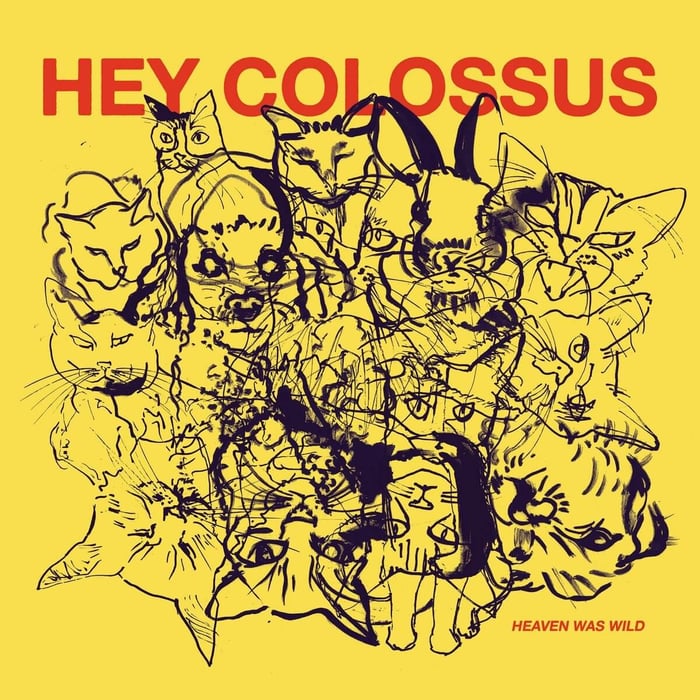
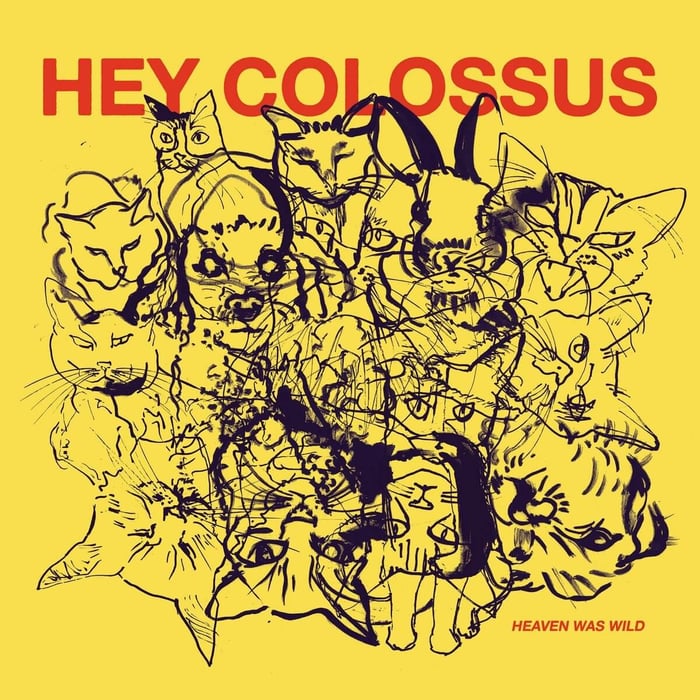
The artwork concept is oddly tender, and it changes the listen
Angi did the sleeve too, and the concept is disarmingly specific: all their pets—alive or dead—together, “reporting back” that “Heaven was wild!” They “had the best time.” No humans allowed. “We don’t deserve it.”
That’s not just cute. It reframes the album title. It turns “Heaven Was Wild” into something like a message from the other side that isn’t religious or epic—it’s basically animals going, “Relax. It rules here.” And then, because it’s Hey Colossus, they twist the knife with the obvious implication: humans would probably ruin it.
“All our pets, alive or dead, together and reporting back to us that ‘Heaven was wild!’ … No humans allowed, obviously. We don’t deserve it.” — Hey Colossus
Arguable take: that single idea makes the album feel less nihilistic than it might otherwise; it’s heavy, but it’s not joyless.
Wrong Speed Records: control as a survival tactic, not a brand
They’re blunt about the business end: by 2026 they run their own label, release their own records, and release music by people they love. They call it “absolutely the time to be in control,” to platform others “fighting the same fight.” Then the real kicker: “The music industry is in pieces,” and Wrong Speed Records / Hey Colossus are “not part of the music industry.”
That last line isn’t rebellious cosplay. It reads like someone who looked at the usual pipelines—gatekeepers, metrics, whatever—and decided it all sounded exhausting. This record doesn’t feel “independent” in the trendy sense. It feels independent in the workmanlike sense: if you want it done right, you build the machine yourself.
Arguable take: the album’s most radical move isn’t a sound choice—it’s the refusal to ask permission.
So what is Heaven Was Wild actually doing?
It’s doing the unfashionable thing: choosing speed, honesty, and control over elegance. The live run-up, the five-day recording window, the proud admission of imperfections, the guest voices used like disruptions, the pet-afterlife sleeve concept, the label self-sufficiency—it all points to the same intent.
Heaven Was Wild is a band saying: we’re still here, we’re still making decisions quickly, and we’d rather be slightly unkempt than politely inert.
And if that sounds romantic, it isn’t always. There are moments where the “we’ll keep it warts-and-all” ethos edges close to “we’ll let it slide.” I can’t fully tell where that line is on every listen. But the album’s bigger bet—that mess can be more truthful than polish—mostly pays off.
Arguable take: this record doesn’t want your approval; it wants your attention, and there’s a difference.
Conclusion
Heaven Was Wild plays like a fast, necessary document: tested in public, captured quickly, and left with its creases intact on purpose. The DIY control streak doesn’t feel like a slogan—it feels like the only way this band can keep the blood moving.
Our verdict: People who like their rock music a little scuffed, stubborn, and self-owned will actually like Heaven Was Wild—especially if you respect a band that treats “imperfection” like a creative tool. If you need glossy production, tidy arcs, and the comfort of everything landing exactly on the grid, this album will feel like someone left fingerprints on your screen and walked away.
FAQ
- Is Heaven Was Wild really a “warts and all” recording, or just marketed that way?
It sounds like the real thing: rushed in a good way, committed to first-capture energy, and not interested in sanding down every edge. - How did the pre-recording London shows shape the album?
Playing the new record across four sold-out dates and tweaking between gigs makes the album feel field-tested rather than lab-built. - Who are the guest vocalists on the album?
Claire (Objections / Nape Neck) appears on one song, and Angi Fletcher plus James Finlay (Fists) appear on another. - What’s the deal with the album artwork?
Angi Fletcher created the sleeve showing the band’s pets—alive or dead—together, reporting that “Heaven was wild,” with the pointed note that no humans are allowed. - Why does the label angle matter for this record?
Hey Colossus running Wrong Speed Records reads like a practical survival move—control the releases, support their circle, ignore the crumbling industry machine.
If the sleeve concept lodged in your brain like it did in mine, a poster of your favorite album cover is a pretty decent way to keep that feeling on the wall instead of in a tab you’ll never reopen. You can browse prints at https://www.architeg-prints.com.
 | DISCOUNTGET 30% OFF*Use code on your next order:
|
* This post may contain affiliate links, meaning we earn a commission if you make a purchase through these links, at no additional cost to you.