Iron & Wine Hen’s Teeth Review: Folk Twins, One in a Red Fever Dream


 See more Architeg Prints stories on Google.
Iron & Wine Hen’s Teeth Review: Folk Twins, One in a Red Fever Dream
Iron & Wine Hen’s Teeth feels like Light Verse’s weirder sibling—same DNA, different weather, and it keeps pulling love songs into the dirt.
Come for the cozy voice, stay for the unsettling grin
I hit play expecting Iron & Wine to do the usual gentle lantern-light thing. Instead, Hen’s Teeth shows up like that same lantern, except it’s swinging from a hook in a humid room and throwing shadows where you didn’t ask for them.
And yeah, it’s still Sam Beam—soft edges, careful phrasing—but the record keeps insisting on something more physical. More plant-smell. More teeth.
Same sessions, different personalities—and you can hear the split
Here’s what’s obvious almost immediately: Hen’s Teeth and Light Verse are cut from the same stretch of momentum. They were recorded in the same run of sessions, with the same band, at Waystation in Laurel Canyon, after a long dry spell. That matters, because you can hear what happens when an artist stops hoarding songs and starts letting a room full of musicians finish the thought.
Beam even says it outright—when he’s writing and the band can actually meet him there, they shove him into places he wouldn’t invent alone. He’s chasing spontaneity now. Less proving, more playing. Less “right answer,” more “let’s see what happens if we push on this.”
I buy that, mostly because the record moves like it was made quickly. The performances have that “caught on tape” snap—songs landing in a few takes, sometimes two or three tracked in a day. You can practically hear everyone deciding, in real time, not to overthink it.
That pace is a creative decision, and it’s also a gamble. Sometimes it makes a song feel alive. Sometimes it makes it feel like they didn’t double back to sand a rough edge. I’ll take the trade most days.
Light Verse was airy; Hen’s Teeth is damp and red
This is where the “siblings” idea stops being marketing talk and starts being sound. Light Verse—named after that playful kind of poetry—wore its looseness like a grin: wordplay, humor, a little nonsense, silhouettes falling or floating through a cyanotype sky. Even when it got serious, it stayed bright enough to keep breathing.
It also carried song titles that basically wave you forward like a friend trying to cheer you up without being corny: You Never Know, All in Good Time (with Fiona Apple, and yes, it’s gorgeous), Cutting It Close, Taken by Surprise. It felt like shaking the dust off the pandemic years without making a big speech about it.
Hen’s Teeth, though? Earthier. Darker. More tactile. It’s not trying to float. It’s trying to root.
Even the titles tell you it’s a different habitat: Roses, Robin’s Egg, Dates And Dead People, Singing Saw. Those aren’t abstract feelings; those are objects you can hold, eat, or get cut by.
And the lyrics don’t just “explore intimacy.” They practically stage a body horror version of romance—lovers so entwined they start swapping molecules. On Roses, Beam sings:
“Run into the one you love forever / Laugh into each other’s empty mouth,”
Which is… sweet, if you don’t picture it too clearly. And if you do picture it clearly, it’s still sweet—just sweet in a slightly haunted way.
On Paper And Stone, he goes even further back into that idea of two people collapsing into one:
“But for the time we fell in two / You’d be me and I’d be you / One crust of bread could fit in our mouths / You’d breathe in and I’d let it out.”
Then In Your Ocean turns the romantic impulse into something almost self-erasing:
“Praying for dry ground / Though I only want to drown / When I find myself swimming in your ocean.”
If you’re looking for “healthy boundaries,” this album politely shuts the door in your face.
The cover tells you the truth before the first track does
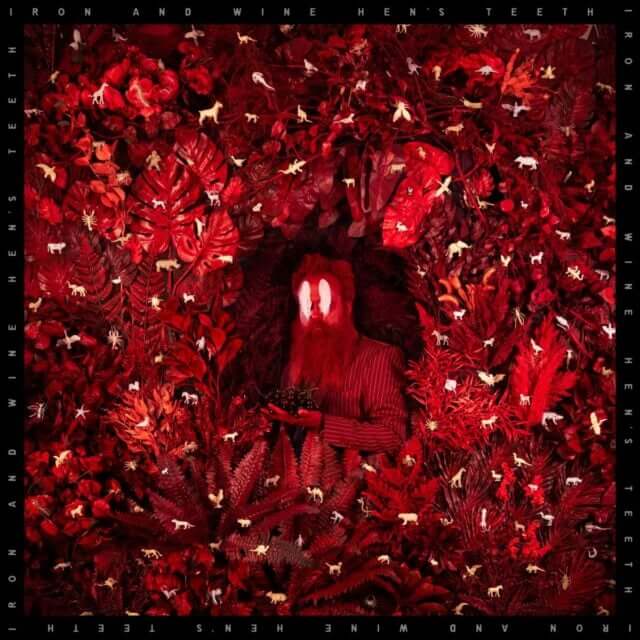
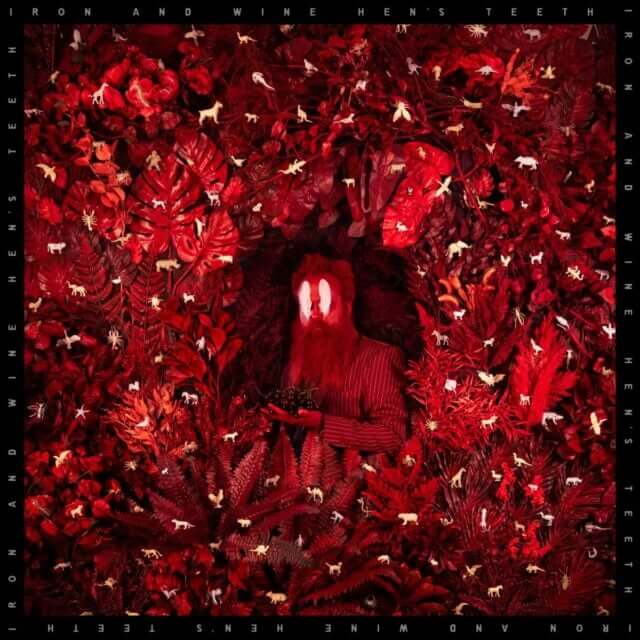
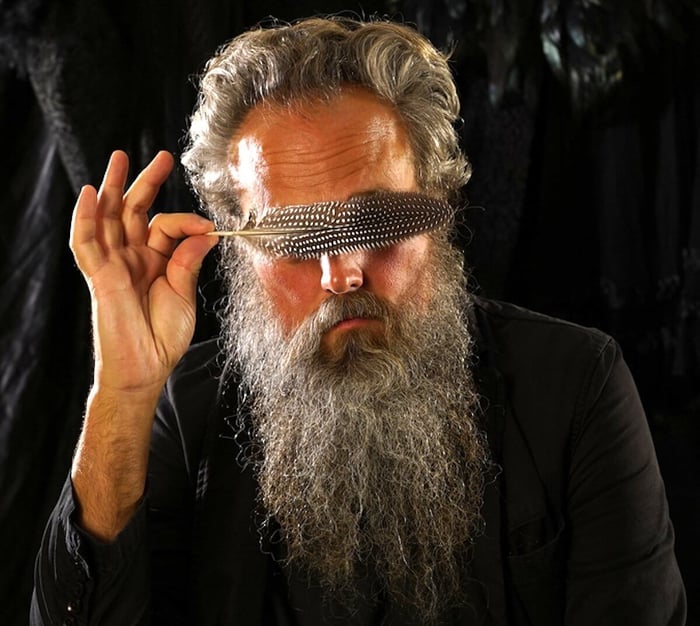
The Hen’s Teeth cover portrait is basically the album’s mission statement, just painted with sweat. Beam’s surrounded by thick ferns and tropical growth, dressed in a pinstripe jacket, holding a massive cluster of grapes, his beard spilling down his chest. He looks like a harvest god who learned table manners, or a gentleman outlaw hiding in a jungle cave—both readings work.
The best part is the white feathers covering his eyes. It doesn’t read as blindness. It reads like his “vision” literally escaped his face and turned into something airborne. The whole scene is washed in humid, spooky red, hovering somewhere between Leonora Carrington’s surreal unease and the iconic intensity of Frida Kahlo.
And compared to Light Verse’s cool blue-white palette, the contrast is almost rude. Like: you thought we were doing breeze and sky? No. We’re doing heat and sap.
The real experiment is genre—Beam’s playing dress-up, but it’s not cosplay
Beam frames the experiments on Hen’s Teeth as more about genre than form, and that’s exactly how it lands. The songwriting doesn’t suddenly become unrecognizable; the clothing changes.
He’s been leaning on Van Morrison’s Astral Weeks as a north star—the idea of jazz musicians playing folk music and making it bloom in ways folk players don’t usually chase. That’s a specific kind of looseness: not “messy,” more like “let the room breathe and see what spills out.”
He points to Singing Saw as something Dock Boggs and Simon & Garfunkel could’ve done together, and… I didn’t believe that sentence until I heard the track’s posture. It has that old-world directness, but it’s dressed with a kind of careful harmony-minded prettiness.
He also calls Roses and In Your Ocean straightforward folk-rock—except they build to apocalyptic endings. That’s not just drama for drama’s sake; it feels like a structural choice: take something familiar, then keep adding weight until it buckles.
And then there’s the Tropicalia pull—Dates And Dead People and Defiance, Ohio drawing from that bright, angled, rhythm-forward world. Beam’s take is that it’s not that different from jazz, and that all these forms have been in rock forever. Which is true, but also: he’s using that history as permission to smuggle new colors into an Iron & Wine record without calling it a reinvention.
I’m not totally sure every genre-switch hits with equal force—there were moments I kept waiting for one groove to get weirder than it actually did—but the intent is audible. This album wants the comfort of folk and the unpredictability of players who don’t treat folk like fragile glass.
The band is the point, and the cast is stacked
The personnel list isn’t trivia here—it’s the engine. On Hen’s Teeth, you’ve got:
- David Garza on guitar
- Sebastian Steinberg on bass
- Tyler Chester on keyboards
- Drums split between Griffin Goldsmith, Beth Goodfellow, and Kyle Crane
- Paul Cartwright on violin, mandolin, other strings—and handling the string arrangements for both records
That rotating drum situation is especially telling. It’s like Beam didn’t want one “signature” rhythmic personality pinning the whole album down. Different tracks breathe differently, and the percussion choices quietly steer the emotion: some cuts feel like they’re walking; some feel like they’re swaying; some feel like they’re bracing.
And the strings aren’t there to “add lushness.” They’re there to add nerve endings.
Duets as drama: the record keeps turning into conversations
Beam admits he’s obsessed with duets, and you can hear why: duets turn a song into a scene. Even if the lyric is simple, two voices automatically create tension—agreement, disagreement, longing, distance, whatever.
He traces that obsession back to Love Letter To Fire with Jesca Hoop, and from there the logic is straightforward: duets are inherently dramatic, and they’re fun. So he finished certain songs with I’m With Her in mind, and the trio shows up on the ebullient lead single Robin’s Egg, then again on the tender, mournful Wait Up.
This is where I’ll admit I initially expected the guest vocals to be decorative—pretty harmonies, tasteful support. On second listen, that assumption felt lazy. The way the voices sit in the songs changes the emotional temperature. It doesn’t just widen the sound; it makes the narrator less alone, which makes the obsessive, merging-love theme feel less like a private spell and more like a shared decision.
And if that sounds like I’m romanticizing it—maybe I am. But that’s the trick of a good duet: it convinces you that two people are choosing the same illusion at the same time.
Here’s the clearest statement of Beam’s mindset, and it’s one of the few artist quotes that actually matches what my ears hear:
“When I’ve been on a writing kick, and the band can meet me where I’m at, they push me into something I hadn’t imagined… There are no right or wrong answers.” — Sam Beam
The family detail isn’t a footnote—it changes the emotional framing
The most quietly affecting choice on Hen’s Teeth is bringing in Arden Beam—Beam’s daughter—for harmonies and backing vocals on Roses, Singing Saw, Defiance, Ohio, and Grace Notes.
Her voice adds a personal closeness you can’t fake. Not in a gimmicky “look who’s on the tracklist” way—more like a subtle shift in gravity. These songs are already preoccupied with intimacy, merging, and the boundaries between selves. Then you hear a family voice inside that world, and suddenly the record’s obsession with connection feels less like fantasy and more like life experience leaking into the art.
Arden was born two months before Beam’s debut The Creek Drank The Cradle (2002) came out; she’s 23 now, a musician herself, and the first of his children to appear on an Iron & Wine record. That timeline matters because it turns “collaboration” into something bigger than a studio preference. It’s legacy showing up in the backing vocals, casual as breathing.
Beam calls it exciting—more of a family affair—and says he likes making Iron & Wine records, but he likes collaboration even more: friends bringing musical and emotional force to a simple set of chords, everyone offering their most vulnerable, expressive self. He describes it as the weirdest, best job ever.
I mostly agree with the “best job” part. The “weirdest” part is hearing how comfortable he is letting the songs be communal now. Old Iron & Wine sometimes felt like a person whispering in a room by himself. Hen’s Teeth keeps opening the door and letting people in.
What Hen’s Teeth is really doing: making romance feel like weather
The big move on Hen’s Teeth isn’t “going darker” just to sound mature. It’s turning love into a physical environment—something you can drown in, sweat through, get tangled in. The album keeps treating intimacy like it’s not an emotion but a habitat, which is why the plant-life imagery and the tactile titles don’t feel incidental.
Do I think every experiment lands perfectly? Not quite. There are moments where the record hints at an “apocalyptic ending” and I wanted it to go one step further—either blow up or get truly strange—rather than stopping at “intense enough.” But I’d still rather hear Beam risk that edge than retreat to tasteful ambiguity.
And the funniest contradiction is this: the lyrics keep talking about merging into someone else, yet the album’s whole creative process is about Beam separating his control and sharing authorship. It’s like the theme is obsession, but the practice is trust.
Conclusion
Iron & Wine Hen’s Teeth sounds like a musician choosing immediacy over perfection, then using that looseness to drag folk into warmer, darker corners. It’s not trying to reinvent Iron & Wine; it’s trying to make the project feel less like a diary and more like a room full of people chasing the same flicker of luck.
Our verdict: People who actually like Hen’s Teeth are the ones who want Iron & Wine to feel earthly, collaborative, and a little unsettling—folk-rock that sweats and blooms. People who won’t like it are the “keep it soft, keep it pretty, keep it safely distant” crowd. If you need your love songs to respect personal space, this album is going to stand way too close.
FAQ
- What is the core vibe of Iron & Wine Hen’s Teeth compared to Light Verse?
It feels earthier and darker, with more tactile imagery and bigger endings, even though both records come from the same sessions. - Where was Hen’s Teeth recorded?
At Waystation studio in Laurel Canyon, during the same sessions that produced Light Verse. - Who plays on Hen’s Teeth?
David Garza (guitar), Sebastian Steinberg (bass), Tyler Chester (keyboards), drummers Griffin Goldsmith, Beth Goodfellow, and Kyle Crane, plus Paul Cartwright on strings and string arrangements. - Which guests appear on the album?
The trio I’m With Her appears on Robin’s Egg and Wait Up. Arden Beam contributes harmonies/backing vocals on several tracks. - Is Hen’s Teeth more about form experimentation or genre experimentation?
Genre—pulling from folk-rock, jazz-like looseness, and Tropicalia flavors rather than radically changing song structures.
If this record’s red-jungle mood stuck with you, a favorite album cover poster isn’t a bad way to keep that atmosphere on the wall—quietly judging your living room. You can browse options at https://www.architeg-prints.com.
 | DISCOUNTGET 30% OFF*Use code on your next order:
|
* This post may contain affiliate links, meaning we earn a commission if you make a purchase through these links, at no additional cost to you.