Holly Grove Review: Jadasea Drowns His Voice on Purpose (It Works)


 See more Architeg Prints stories on Google.
Holly Grove Review: Jadasea Drowns His Voice on Purpose (It Works)
Holly Grove sounds like Jadasea hiding inside the mix on purpose—bass-first, bruised writing, and a few moments that almost feel like escape.
A record that doesn’t want your attention—so it steals it anyway
If you’re expecting Holly Grove to “come through clean,” don’t. This album shows up like someone talking to you from the next room with the sink running—annoying at first, and then weirdly intimate once your ears adjust.
And yeah, that’s the point. Holly Grove doesn’t try to be bigger than life. It tries to be smaller than the beat. Arguably, it’s one of the boldest choices an underground rapper can make right now: not dominating the track, but letting the track swallow him and calling that honesty.
The “sunk voice” thing isn’t a quirk here—it’s the whole thesis
Moving through Holly Grove, I kept thinking about that specific strain of underground rap that lives in the overlap of South London and New York bedroom recording logic: voices mixed under the beat instead of sitting proudly on top. Not muffled by accident—muffled like a decision. Short loops, deliberately unflashy drums, and production that would rather hypnotize you for a minute than entertain you for three.
Jadasea has lived in this terrain long enough that he’s stopped decorating it. He just leans into the most extreme version of it: his voice is pushed so deep into the mix it’s practically a rumor. The mix “eats him alive,” and it feels intentional—like he’s proving he can still be legible while being half-buried.
A reasonable listener could argue this is self-sabotage. I get that. But I hear it as control: he’s making you work for the meaning because the meaning is work.
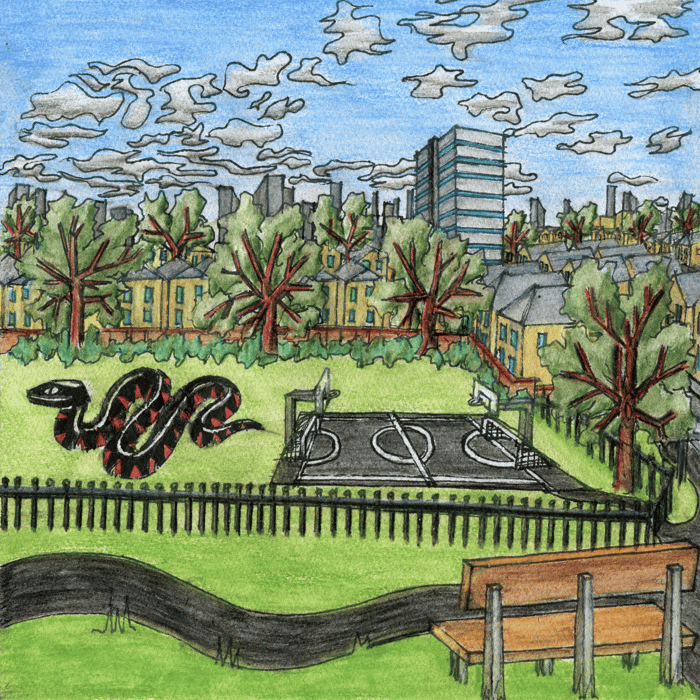
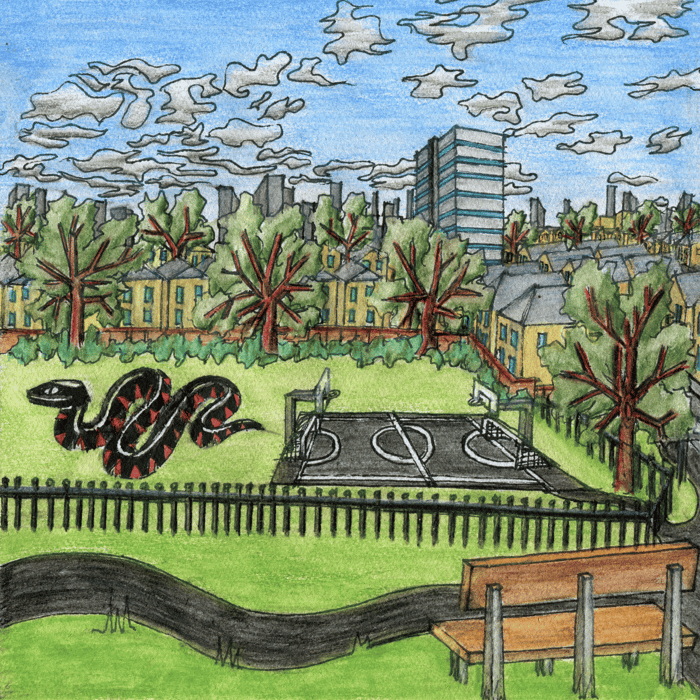
And the one thing that stays clean—almost stubbornly clean—is location. Peckham, SE15, those streets. Everything else is fog, but that territory keeps snapping into focus like a streetlight cutting through drizzle.
The beats: low-end as architecture, not decoration
The production is obsessed with bass and sub-bass—not in a “club” way, more like bass as gravity. The top end gets smeared and elusive, like the highs were wrapped in cloth. When the beats get heavy, they don’t open up; they compress. They push the weight forward until it feels like the room has no extra oxygen left—just Jadasea and whoever’s in there with him.
Most of the beats come from Harrison, and the choices feel consistent: not “full arrangements,” more like pressure systems.
Here’s how a few moments hit:
- “Cobra” is the clearest example of the method. Simple, pronounced, anchored by low-end like a foundation beam. The drums are the most physical thing in the track—everything else feels secondary, kept in that humid, underground murk. Arguably, it’s the album’s purest mission statement: the beat doesn’t support him, it contains him.
- “Don’t panic” flips the feeling. It’s basically a wash of low-end with barely any mid-range push and almost no high-end brightness. Contemplative, inward, sealed shut. Everything folds inward, but nothing reaches outward—like a thought loop you can’t stop replaying.
- “Mind Game” has the strangest mix decision on the record: the low frequencies swallow everything, then suddenly thin near the end. The track contracts like someone tightening a drawstring. It feels like being pressed into a tunnel—claustrophobic in a way that’s more psychological than sonic.
- By “The Wire,” the low-end is so thick the beat sounds like it’s being forced through a narrow slit. And through that constriction, Jadasea’s vocal still cuts—quietly, but with edges.
I’ll admit, my first impression was that the mix was just going to frustrate me. On second listen, I realized the frustration is part of the listening posture the album demands: lean in, stop expecting “clarity,” accept that the blur is the message.
The writing shows up in bruised bursts, not tidy quotables
Jadasea’s meaning doesn’t present itself nicely. You don’t get clean little aphorisms floating on top of the beat. You get fragments you have to pull out of clutter—and even once you catch them, they land like bruises, not speeches.
On “SE15,” he outlines the perimeter fast: images sliding by, street math, defense mechanisms stiffening mid-sentence. Lines rush over before they can settle. There’s ambition in there—schemes, money, the climb—but it doesn’t sound like a motivational speech. It sounds like someone reciting the plan while scanning the room.
“Gambit” keeps that same edgy posture: night already set in, decisions already made, dice already thrown. The “pack of work” feels like something he needs off his chest before the city fully wakes up. Arguably, the tension works better than if he spelled everything out—because in this world, spelling things out is the luxury.
Weed and lean aren’t party favors here—they’re maintenance
A lot of records casually mention substances like they’re confetti. Holly Grove does the opposite: weed and lean show up constantly, and they never sound fun. They sound like coping mechanisms with bad customer service.
- “Spliff n Yak” turns smoke into upkeep. It’s not indulgence; it’s management. The vibe is one body in a room, talking to himself in the mirror, using the routine to avoid dealing with anyone.
- “Strainz” drags the title into the lungs. It’s paper in jeans until there’s no more, grind and smoke mashed into one exhausted exhale. If someone told me this track was designed to sound tired, I’d believe them.
- “Remorse” gives the numbing an explicit reason: loneliness that “was a lot.” The image that sticks is getting high in the kitchen with the stove on the pot—domestic, hazy, slightly dangerous in that normal way. The hook stays battered, stuck in that place where talking never connects and remorse doesn’t burn off no matter what you light.
If there’s a critique to make, it’s that the bleakness can start to feel like the default setting rather than an escalation. Not boring—just so committed to the same emotional temperature that you start craving a sharper turn.
“Esc” offers a breath—then reminds you it’s not a real exit
Then there’s “Esc,” and for a moment the beat actually lets fresh air in. It’s clearer, swifter, and it moves with more momentum than the tracks around it. The surface feels less clogged. Jung (in the mix here) doesn’t collapse under it; he juggles it.
But the “escape” is basically a sign on a door that still won’t open. Jadasea reaches past himself and finds nothing. That clean beat becomes the only evidence that an exit exists at all—which is kind of cruel, honestly, but effective. Arguably, it’s the album’s most manipulative moment, and I mean that as a compliment.
Features that don’t “shine”—they haunt
The guest voices on Holly Grove don’t arrive to dazzle you. They arrive like additional thoughts in the same dim room.
Anysia Kym shows up on “Intrinsic” with a chorus that sits inside the same gloom rather than floating above it. It’s not a glossy feature; it’s a second voice in a similar low register, bluntly accepting less. Next to Jadasea’s flakiness, her tone feels like someone being tired of pretending.
MIKE on “Collateral” fits so naturally it barely reads as a guest spot. Same sour inwardness, same quiet ache—asking why the people you’re “supposed” to have keep leaving first, and why the hurt just keeps its job forever. The beat already sounds built for that kind of question.
Then John Glacier hits differently on “Lemon Cherry.” This is the album’s longest and most yammering track, and structurally it’s the most unfocused—like it refuses to choose a straight line. At first I thought, okay, this could’ve been tightened. But once her chorus rises through the mush—envy on the dancefloor, people hating and adoring her at the same time—the extra minutes suddenly make sense. She doesn’t drown in the mix; she climbs out of it. Arguably, she’s the only one here who treats the fog like something to stand on.
On “Entrance,” duendita opens from a more solitary, more bleeding place than the surrounding tracks. There’s an aching specificity: being well past the “young and reckless” stage, sober at a party, reluctant to leave, wishing someone’s eyes would just close. When Jadasea calls her a surmiser, it lands like he’s admitting she reads the situation too accurately. And the image of a candle by the door becomes a tiny, sad symbol of escape—one morsel of light on a trail that keeps sloping downward.
Near the end, grief stops circling and finally moves
Late in the album, something shifts. The grief has been pacing in place for most of Holly Grove, but near the end it stops looping and actually goes somewhere.
On “Intent,” the pulse solidifies. Jadasea’s voice is pushed a little more forward than usual—still not “front and center,” but closer, like he stepped nearer to the microphone without fully committing to being seen.
The writing changes texture too: less numbness, more courage. Time spent in a hearse. Strain on his shoulder. Eyes full of tears. And then the decision—heartfelt, not theatrical—to continue anyway. Money or no money. Surplus or no surplus. Devils or no devils.
I’m not totally sure whether that’s hope, exactly. It might just be stamina. But stamina is a kind of hope when you’ve been living in the low-end this long.
Where Holly Grove actually lands
By the end, Holly Grove feels less like a playlist of moods and more like a deliberate trapdoor: you fall into the mix, you adapt to the darkness, and eventually you start hearing the emotional detail hiding under the bass.
And if you don’t adapt? The album won’t meet you halfway. Arguably, that’s the whole flex.
Holly Grove has standout moments that keep pulling me back—especially “Cobra,” “Mind Game,” and “Lemon Cherry.” Not because they’re “catchy,” but because they’re the clearest examples of what this record is trying to prove: you can blur the surface and still hit the nerve.
Conclusion
Holly Grove isn’t trying to sound big. It’s trying to sound true inside a cramped room, with the bass doing the talking and the voice fighting to be heard anyway—and somehow, that ends up louder than a clean mix ever would.
Our verdict: People who like their rap low-lit, bass-heavy, and emotionally blunt will live in Holly Grove. If you need crisp vocals, bright hooks, or any proof the artist wants to be “accessible,” you’ll tap out fast—and honestly, the album won’t miss you.
FAQ
- What is the core sound of Holly Grove?
It’s underground rap with vocals deliberately sunk into bass-forward production, favoring murk and pressure over sparkle. - Is Holly Grove a lyrics-first album?
Yes, but not in a tidy way—meaning comes in fragments you have to pull from the mix, not quotables served on a plate. - Which tracks best represent the album’s approach?
“Cobra” for the low-end architecture, “Mind Game” for the strangest mix movement, and “Lemon Cherry” for the feature that changes the room. - Do the guest features stand out?
They stand out by not trying to shine—Anysia Kym and MIKE blend into the gloom, while John Glacier cuts through it. - Is Holly Grove easy to get into on first listen?
Not really. It can feel frustrating at first, but the record makes more sense once you accept the blur as intentional.
If the album’s atmosphere got under your skin, it might belong on your wall too—worth browsing a favorite album cover poster at our store: https://www.architeg-prints.com
 | DISCOUNTGET 30% OFF*Use code on your next order:
|
* This post may contain affiliate links, meaning we earn a commission if you make a purchase through these links, at no additional cost to you.