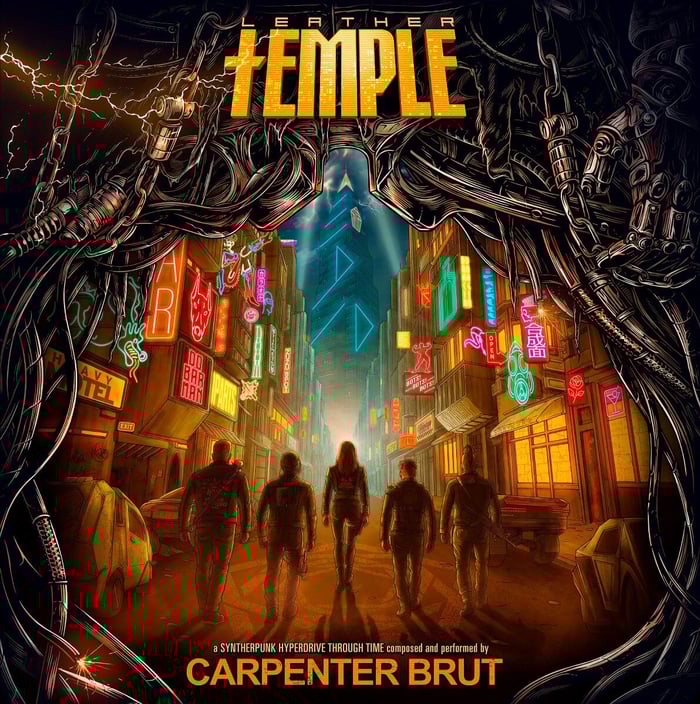
Leather Temple Review: Carpenter Brut’s Neon Cathedral Is Too Loud to Pray In


 See more Architeg Prints stories on Google.
Leather Temple Review: Carpenter Brut’s Neon Cathedral Is Too Loud to Pray In
Leather Temple turns synthwave into a chrome-plated sermon—thrilling, a little repetitive, and weirdly hopeful when it shouldn’t be.
A neon-lit warning label before you press play
If you put on Leather Temple expecting polite retro vibes, you’re going to get steamrolled. This album doesn’t “set a mood” so much as it shoves you into a rain-slick sci-fi street and dares you to find the exit.
And yeah, it’s clearly trying to be huge on purpose—Carpenter Brut isn’t writing songs here, he’s building a glowing, over-engineered monument and inviting you to stand too close.
Leather Temple isn’t an album title—it’s a mission statement
The first thing that hits is how much this record wants to be architectural. Not “good tracks in a row,” but actual rooms, corridors, and big heavy doors. The synths aren’t decoration; they’re the walls. The guitars aren’t there to “add edge”; they’re there to make sure you feel the floor shake.
I’m not even convinced the goal is variety. The goal seems to be immersion—a synth-soaked soundtrack that would fit right into a neon sci-fi film, the kind where everything is wet, everything is lit from below, and everyone’s hiding something. That approach is a flex, and also a trap: when you commit this hard to one world, repetition stops being a flaw and starts being the risk you knowingly took.
The opener kicks the doors down: “Ouverture (Deus Ex Machina)”
Here’s the dramatic entrance: “Ouverture (Deus Ex Machina)” opens with a grand, theatrical flourish that feels almost Phantom Of The Opera-adjacent—big, looming, and slightly smug about it. It’s announcing itself. Not asking permission.
What I like is how it immediately frames Leather Temple as cinema, not playlist fodder. What I’m less sure about—at least on first pass—is whether it’s setting up a story or just setting up a lighting rig. The difference matters, and the album plays with that line a lot.
Still, as an opener, it works because it tells you the rules: bombast is normal here, sinister undertones are the baseline, and subtlety will not be making a guest appearance.
“Major Threat” and the rain-slick city it insists you picture
The transition into “Major Threat” is where the album starts moving instead of posing. It builds slowly, letting the synths wash over you in layers, like the soundtrack is assembling itself in real time. The beat has that driving momentum that basically forces a scene into your head—some futuristic, steam-punk-ish sprawl drenched in neon.
And then the guitars arrive and the whole thing becomes a bombardment: synth and metal fused into one oversized machine. A reasonable listener could argue this is too much, too on-the-nose, too “soundtrack for a movie that doesn’t exist.” I get that. But I think that’s exactly the point: Carpenter Brut is committing to the illusion so hard that resisting it feels like arguing with weather.
The title track “Leather Temple” knows exactly how cool it is
“Leather Temple” (the track) doubles down on the futuristic aesthetic it’s been building—think Bladerunner 2049 moodiness, but with less existential silence and more “the speakers might crack.”
What surprised me is how well it switches between sheer bombast and a more controlled low-key stretch without losing tension. There’s a moment where the bass line gets space to breathe—smooth, confident, and honestly kind of smug in the best way—right in the middle of all that noise. That’s not an accident. That’s the album showing it can hold back… it just rarely wants to.
If you think this kind of music is all surface, this is one of the moments that argues back. Not with subtle emotion, but with pure control of pacing.
“She Rules The Ruins” is where the record starts grinning
After the title track’s heavy strut, “She Rules The Ruins” keeps the pace up but does it with a theatrical setup—like the curtains rise again and you already know something ridiculous is about to happen.
It evolves into this tinkering synth passage that feels like a fuse burning down… and then it goes full throttle into a heavy metal + euro-synthwave collision that’s basically designed to make you move. Even when it drops into a calmer section, it never relaxes. It sits there with its finger hovering over the detonator, and that tension is half the fun.
Hot take: the “low key” moments on this album work best when they feel like threats, not rests. This track understands that.
“Start Your Engines” wants to be fun, even if it’s a little thin
Then “Start Your Engines” comes in with cascading synths and a driving riff that—let’s not pretend otherwise—carries a whiff of Eurovision energy. Big melody, big shine, big wink.
I expected that comparison to annoy me more than it did. On second listen, I actually respected the choice: it’s a deliberately lighter shot of sugar in the middle of all the steel-and-neon seriousness. Still, this is where the album shows its first real soft spot. The track is enjoyable, but it’s missing that extra umph the earlier songs had. It wants to floor it, but the engine doesn’t quite catch the way the title implies.
That said, the fact that I’m calling this the weak link so far is basically proof the record has been setting a pretty high bar for its own nonsense.
“Neon Requiem” runs out of steam… but the sax is hard to argue with
“Neon Requiem” lives in a similar neighborhood: fun tone, stylish surface, but it doesn’t stretch as far as you want it to. It’s one of the moments where the album’s dedication to its aesthetic starts to expose the seams—like you can hear the template underneath the paint.
And yet: that saxophone. It threads through the track with this slick, undeniably sexy presence, like someone put a cigarette in the mouth of the whole mix. I’m not sure if the song earns that level of cool, but I also don’t care while it’s playing. It’s an indulgence that distracts you from the fact the track is, structurally, a little quick to burn out.
If you think “style over substance” is automatically a criticism, you’ll roll your eyes here. I think Leather Temple is intentionally betting that style is the substance.
“Iron Sanctuary” brings the cinematic hammer down
When the album snaps back into form, it does it hard. “Iron Sanctuary” is another cavalcade of synths—huge ones—stacked with intense horn sounds that make everything feel widescreen and expensive.
At times, it honestly feels like the love child of Vangelis and Hans Zimmer, not because it’s copying them note-for-note, but because it’s chasing that same “bigger than your living room” feeling. The cinematic scope here has no chill, and that’s why it works: the track refuses to be background music.
A reasonable person could say it’s overblown. I’d argue the overblown part is the entire pleasure. This is music that wants to be too much.
The back half: when the mask slips and repetition shows up
Here’s where I have to be a little blunt: the back end starts showing a repetitive streak that earlier tracks mostly dodge through sheer force of personality.
“The Misfits/The Rebels” and “Speed Or Perish” can be weirdly hard to distinguish at times because they walk similar beats and structural moves to what came earlier. It’s not that they’re bad—far from it. The riffs still hit, and there are a few djenty moments that bring out that involuntary stank face (you know the one). But the sense of surprise starts fading, like the album is so committed to its world that it keeps driving around the same block.
I kept waiting for a left turn—a strange tempo shift, a sudden minimal section, anything that changes the shape of the experience. Instead, the record doubles down. That’s either admirable stubbornness or a creative blind spot, depending on your tolerance for this particular brand of neon thunder.
“The End Complete” refuses to end like a typical finale
Then “The End Complete” arrives and—unexpectedly—it doesn’t go for the final boss fight. After so much sensory assault, it plays things softer, almost like the album is exhaling.
The mood turns hopeful in a way that feels almost suspicious at first, like the rain finally stops in this dystopian city and you can imagine sunlight hitting the street for the first time. But it doesn’t fully trust that brightness. There are sinister undertones that don’t sit right, like something uncanny is still moving behind the scenes.
This is one of those endings that “defies expectations” mostly because the album trained you to expect constant impact. It doesn’t feel like a hard stop. It feels like the camera pulling back, leaving room for another sequel if Carpenter Brut ever wants to open the doors again.
How Leather Temple actually wants you to listen
By the time it’s over, Leather Temple feels less like a collection of tracks and more like a physical environment you spent time inside. Even the songs that aren’t as strong don’t derail the experience—they just don’t hit the same adrenaline sweet spot.
If you’re going to do it right, this is headphone-in-a-dark-room music. Loud. The kind of loud where you start noticing how the low end interacts with your pulse. Or crank it on a stereo if your neighbors are forgiving (or equally infected with this neon plague).
And yeah, the thought of this material live sounds like a genuinely great idea—especially with the memory of Bloodstock hanging out there as proof this project belongs on a stage that can handle its size.
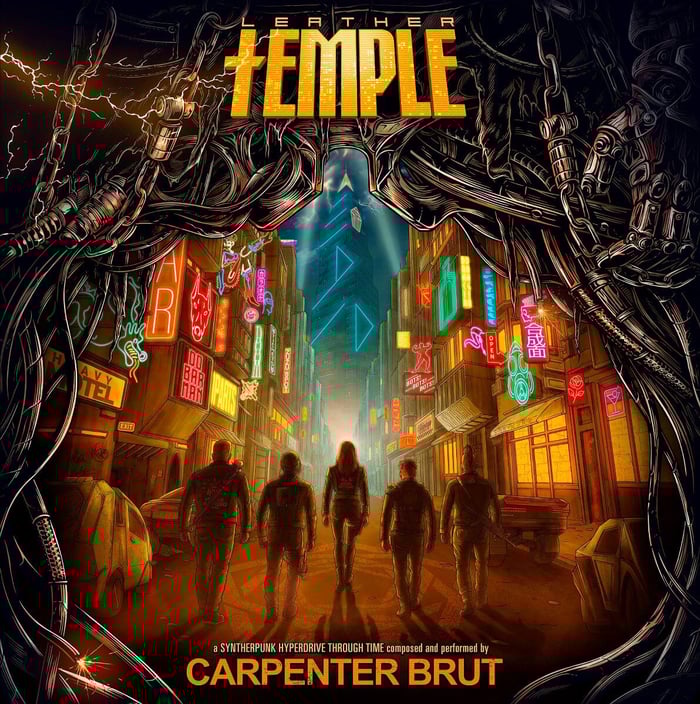
Release note (because it matters for context)
Leather Temple is out now via No Quarter Prod/Virgin Records—which tracks, because this album doesn’t sound like it was meant to live quietly on a hard drive. It sounds built for scale.
Conclusion
Leather Temple is Carpenter Brut building a neon cathedral and blasting the doors off the hinges—sometimes thrilling, sometimes samey, and still oddly magnetic even when it’s looping familiar moves.
Our verdict: People who like synthwave with metal teeth—and who enjoy feeling mildly bullied by production—will love this. If you want subtle songwriting, organic band interplay, or anything resembling restraint, you’ll get annoyed fast and start yelling “does every song need to be this shiny?” at your speakers.
FAQ
- Is Leather Temple more synthwave or more metal?
It’s synthwave architecture with metal reinforcements—big riffs and heavy textures, but the synths are the primary building material. - What’s the best track to start with if I’m new to Carpenter Brut?
“Ouverture (Deus Ex Machina)” tells you the whole deal immediately: theatrical, sinister, cinematic, and proudly overdone. - Does the album get repetitive?
Yes, especially toward the back half—some tracks share similar pacing and beats—but the riffs and sound design keep it enjoyable if you’re already onboard. - Are there any lighter or more playful moments?
“Start Your Engines” leans into a glossy, almost Eurovision-like fun, even if it doesn’t hit as hard as the earlier tracks. - Does the ending feel final?
Not really. “The End Complete” softens the landing and leaves the door cracked open, like the story could easily continue.
If this album’s neon paranoia got under your skin, a good album-cover poster is basically the only appropriate wall decor. You can browse options at our store: https://www.architeg-prints.com
 | DISCOUNTGET 30% OFF*Use code on your next order:
|
* This post may contain affiliate links, meaning we earn a commission if you make a purchase through these links, at no additional cost to you.