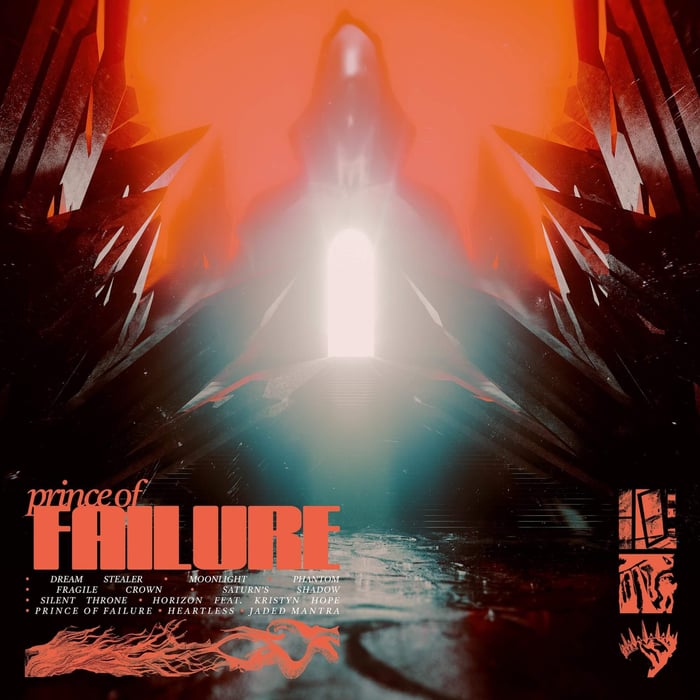
Prince of Failure Album Review: Trauma Prog in a Fancy Metal Suit


 See more Architeg Prints stories on Google.
Prince of Failure Album Review: Trauma Prog in a Fancy Metal Suit
Prince of Failure transforms isolation and self-doubt into a cathartic journey of heavy, emotional music that is both dramatic and honest.
A record that’s “therapy,” but with the lights turned up
People love calling music “therapy,” like it’s some gentle cup of tea. This album isn’t tea. It’s more like someone turning their internal monologue into a character, then making that character sing at you until you either relate or tap out.
Prince of Failure is Dan Tompkins (yes, the voice you’ll recognize from Tesseract) basically deciding that the clean, controlled version of himself isn’t enough to hold what he’s trying to say. So he builds a whole persona—PRINCE OF FAILURE—and lets that mask do the talking. And crucially, he doesn’t do it alone: Paul Ortiz (Chimp Spanner’s brain) is right there shaping the music like it’s a carefully engineered pressure valve.
Here’s what I think the album is actually doing: it’s not “telling a story” because stories are fun. It’s telling a story because distance is the only way to look at long-term isolation, masking neurodivergence, and the trauma that comes from living that double-life without flinching. The character isn’t cosplay—it’s a coping mechanism with a budget.
I’m not totally sure the concept always lands cleanly on first listen… but I also don’t think it’s trying to. It wants you slightly disoriented, like you’ve walked into the middle of somebody else’s internal argument.
The concept isn’t subtle—because it can’t afford to be
This self-titled record runs 12 tracks, and the whole thing moves like a controlled descent and a negotiated return. It’s basically a “from darkness to brightness” arc—except it doesn’t pretend the brightness is permanent. That’s the trick: even the hopeful moments sound like they’ve been earned with bruises.
A reasonable listener could argue the concept is doing too much—personification, chapters, lore, the whole dramatic framing. But to me, that’s the point. When you’ve spent years masking, understatement starts to feel like lying. This record chooses theatrical clarity over tasteful ambiguity.
“The Glass Veil” starts the story by barely existing
The opening track, “The Glass Veil,” doesn’t kick the door in. It creeps. It fades in like something you weren’t meant to overhear: slow, soft, and half-formed, with percussion that feels distant, like it’s happening in another room. There’s an echo of voice—more presence than performance.
If you came here for immediate prog-metal fireworks, this is where you might roll your eyes. I almost did. On my first pass I thought, okay, atmospheric intro, we get it. But later it clicked: the track is the sound of a person re-materializing. It’s not “setting a mood.” It’s illustrating that the narrator is not fully assembled yet.
And that choice matters because the whole album is about identity feeling constructed, not natural.
“Dream Stealer” sells you the fantasy—and then stabs you with the chorus
From that haze, “Dream Stealer” arrives as the first real chapter, and it’s where the album shows its hand: melody isn’t decoration here, it’s the weapon.
The vocal harmonies move with that almost storybook sweep—like something out of a fantasy novel where the hero is secretly the villain and everyone’s pretending not to notice. Each verse builds an electric atmosphere, and the chorus doesn’t just “hit”—it pulls, hard. It’s one of those choruses that makes you feel like you’re remembering a pain you didn’t know you filed away.
An arguable take: the verses are doing careful worldbuilding, but the chorus is the actual point—the part where the mask cracks and you hear the person underneath. If someone told me the chorus saves the song, I wouldn’t fight them.
And as the first full-length statement on the record, it sets an expectation: this is going to be emotional, yes, but it’s also going to be structured. Nothing is accidental. Even the drama feels engineered.
“Saturn’s Shadow” is where the album stops being pretty and starts being useful
Around the middle, “Saturn’s Shadow” is the one that doesn’t just sound heavy—it feels heavy in the specific way self-hatred feels heavy: repetitive, intimate, and weirdly logical.
The vocals don’t hold back, and the arrangements lean into a metal-laced intensity that feels like it’s chasing the lyrics rather than supporting them. It’s one of those tracks where you don’t just listen once. You listen, then you rewind because you realize the words are doing something cruelly precise.
The song frames the mind as an adversarial presence—almost a separate entity—describing a relationship where the self and the mind are “disconnected.” Then it drops the question that lands like a needle:
“Do you think you’re giving in to me too soon?” — Dan Tompkins (as Prince of Failure)
And it answers itself with that cold, inevitable follow-up: “It’s easy to see, you’re giving in to me.” That’s the bleakness here: not suffering as chaos, but suffering as a persuasion.
An arguable statement I’ll stand by: this is the album’s lyrical center of gravity. Everything before it is buildup; everything after it is fallout.
The mind as a roommate you can’t evict
What “Saturn’s Shadow” captures—maybe too accurately—is how mental illness and neurodivergence can make your own head feel like a second personality living inches away from you, commenting on your life like it’s a sport.
The track plays that relationship as a kind of communication: moments of clear, level exchange, then sudden episodes of noise and chaos that you can’t shut down—only survive. That’s not a metaphor that needs embellishment. It’s already nasty enough.
Now, here’s where I hesitate a bit: the song is specific enough to feel personal, but vague enough to be universal, and that balancing act is hard. I can imagine someone hearing it as “too broad” or “too conceptual.” But to me, that universality is the validation. It’s the album saying: you’re not uniquely broken; you’re just living with a brain that fights dirty.
And yes, I think that’s why it’ll hit metal fans especially hard—because heavy music has always been a place where ugly feelings get to be spoken out loud without apology.
“Jaded Mantra” closes the book… and refuses a neat moral
By the time “Jaded Mantra” lands at the end, it’s not just a closer—it’s a climax and a resolution that still refuses to clean up the mess. The track feels like the story sealing itself shut, but you can hear the fingerprints on the cover.
The narrator describes themselves as:
“A tainted mind searching for an open door” — Dan Tompkins (as Prince of Failure)
And that line tells you the whole deal: the final chapter is about relief, escape, an end to the lonely dark. But the record doesn’t pretend liberation is simple. There’s acceptance in the ending that feels… regrettable. Like the character gets a moment of clarity, but not a miracle.
The last line—“I’m the prince of failure”—doesn’t read like defeat to me. It reads like identification. And that’s a sharp choice: instead of conquering the title, the narrator claims it. If that sounds like giving up, you might hate this ending. If it sounds like finally naming the thing that’s been haunting you, you’ll probably feel your chest loosen a little.
Mild criticism, though: I do think the final statement risks being too tidy as a tagline—so perfect it almost feels designed for the project name first and the emotional reality second. It still works, but you can see the stitching if you squint.
Why this project exists (and why it’s not just a side quest)
What surprised me is how much Prince of Failure doesn’t feel like a casual detour. This isn’t Tompkins dabbling outside his main band’s sound for fun. It feels like he had material that didn’t belong in that world—too raw, too narrative, too inward—and he needed a separate container for it.
And Ortiz, instead of repeating the comfort zone of Chimp Spanner’s usual identity, seems to enjoy the new problem: how do you make music that can carry theatrical emotion without tipping into melodrama?
The album’s real thesis, as I hear it, is this: exploring the machinery of your mind doesn’t just expose pain—it also unlocks creative routes you didn’t have access to when you were busy pretending you were fine.
Even if you don’t buy the concept, the intent is obvious. This record wants to be a vessel for the stuff that doesn’t fit into polite conversation.
Artwork
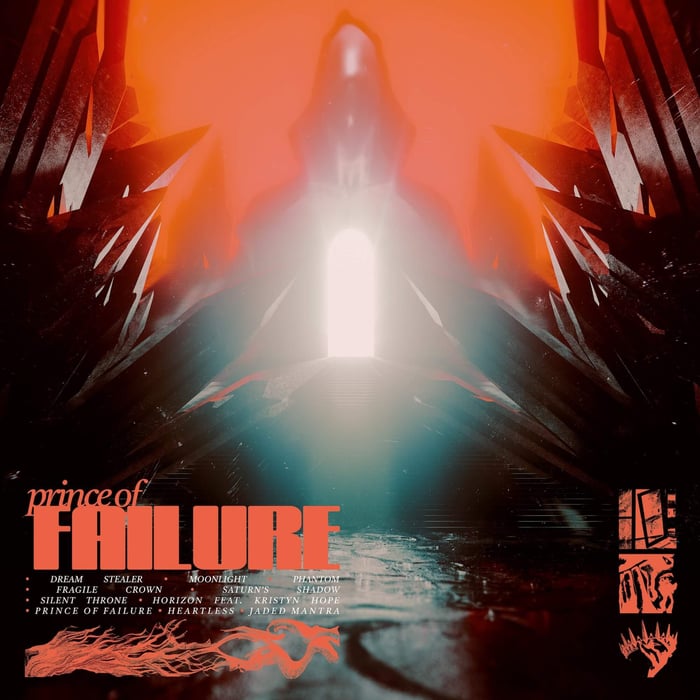
Release note
Prince of Failure is out now via Kscope.
I’d personally peg the listening experience around an 8/10 level of effectiveness for what it’s trying to do—not because it’s perfect, but because it commits. It doesn’t flinch. And commitment is rare.
Conclusion
The real move on Prince of Failure is turning private damage into a character-driven narrative so it can be stared at directly. It’s catharsis with stage lighting: dramatic, controlled, and honest enough to sting.
Our verdict: If you like emotionally loaded prog/metal where the vocals sound like they’re confessing in real time, you’ll actually like this album. If you demand “fun” from your heavy music—or you break out in hives when an album uses a concept and means it—this will feel like being trapped in someone’s dream journal (the expensive edition).
FAQ
- Is Prince of Failure a band or a concept project?
It plays like a concept project with a named character at the center, built to personify the struggles being explored. - Who are the main artists behind Prince of Failure?
Dan Tompkins (vocals) and Paul Ortiz (music/production backbone) drive the record as a duo. - What’s the album’s story arc?
It runs as a 12-track journey from internal darkness toward a kind of light—without pretending the darkness is “solved.” - Which tracks best represent the album’s emotional core?
“Saturn’s Shadow” feels like the lyrical gut-punch, while “Jaded Mantra” delivers the closing resolution and final self-labeling. - Is this similar to Tesseract or Chimp Spanner?
You can hear the pedigree, but the intent is different: it’s more character-driven, more openly emotional, and less interested in staying tasteful.
If this whole “gorgeous suffering with a logo” vibe spoke to you, you can always put it on the wall too—shop your favorite album cover poster at our store: https://www.architeg-prints.com
 | DISCOUNTGET 30% OFF*Use code on your next order:
|
* This post may contain affiliate links, meaning we earn a commission if you make a purchase through these links, at no additional cost to you.