Santa Rosa Album Review: Fat Ray & Raphy’s Basement Gospel (Kinda)


 See more Architeg Prints stories on Google.
Santa Rosa Album Review: Fat Ray & Raphy’s Basement Gospel (Kinda)
Santa Rosa turns Detroit grit into tight, loop-heavy confessionals—where flexing and self-loathing share the same breath, and that’s the point.
This album starts by yelling at itself
Some records introduce the “world.” Santa Rosa introduces the mirror—and immediately starts talking reckless to it. The whole thing feels like a guy pacing in a cramped room, arguing with his past, then winning the argument by sheer volume.
And yeah, that’s a compliment. Because Fat Ray isn’t using confession as a branding exercise. He’s using it like a weapon: point it inward, fire, reload, then act surprised he’s still standing.
Bruiser Brigade energy: a label that moves like a crew
There’s a specific kind of hunger that comes from rappers who aren’t waiting to be “picked.” This album sits in that lane. You can hear the ecosystem around it: Detroit heads who sound like they’ve been active, sharpening their craft in public, not hiding behind mystique.
Raphy’s presence is the glue. The production doesn’t chase trends or “modernize” anyone. It just gives each voice the right kind of space to land. That choice matters—because Santa Rosa isn’t trying to be a big statement album. It’s trying to be effective, like a well-worn tool that still cuts.
Fat Ray raps like he’s keeping receipts on himself
The first real scene that sticks is “Rap City in the Basement,” because it doesn’t ease you in—it shoves you downstairs and makes you look around. Ray’s waking up to a loaded gun, hearing his mom upstairs, and snapping at himself for being broke, overweight, and stuck. It’s not poetic about it. It’s nasty. It’s immediate. It’s also weirdly motivating, like watching somebody bully themselves into leveling up.
What hits harder is how quickly he flips the tone mid-verse. One second he’s disgusted with his reflection, the next he’s crowning himself “Ray Hova” like the insult phase was just a warm-up. A lot of rappers can do self-deprecation. Fewer can make it feel like part of the same engine as the bragging. Ray does. The flexing doesn’t cancel the shame—it rides on top of it.
That’s basically the Santa Rosa formula:
- self-attack
- self-mythology
- street detail with no neat lesson attached
- repeat until it sounds like therapy you can’t bill insurance for
And if you want moralizing, you’re in the wrong place.
“Good Sense” and “K-Dot Pool” aren’t trying to be inspirational
“Good Sense” is the kind of track where Ray admits he told his ex to go be great, then immediately confesses he still hasn’t lost weight. That should sound like a throwaway detail. Here it lands like a bruise you keep poking. Then—because he can’t leave it alone—he swerves back into threat-talk, rolling up “like a doctor” with a ridiculous amount of ammo. It’s not a contradiction to him. It’s the same mood: control what you can, even if it’s only your ability to escalate.
“K-Dot Pool” is even more telling because it stretches into one long verse that keeps changing posture. Ray barks like a general, then turns around and talks to younger kids like he’s tired of watching them speedrun the same mistakes. He’s asking why they’re selling pills, why they’re hanging around people who can’t wait to snitch, why they’re chained to the dumbest outcomes. And the key part: he doesn’t pretend he’s outside the cycle. He talks like someone who knows exactly how the machine works because he helped keep it running.
I think that’s why the album doesn’t preach. Preaching would let him off the hook.
“Change Us” is where the album goes cold—and it works
When “Change Us” hits, the temperature drops. Fat Ray’s verse is unusually exposed: asking forgiveness for what he’s done, admitting he feels hollow, describing grief like it physically changes the planet. That’s not “vulnerable rap” in the sanitized sense. It’s more like: the tough guy mask slipped, and he didn’t bother fixing it before the next line.
Then billy woods steps in and bends the whole track into something stranger—images of sliding cars and black ice, rigor mortis nearby but lagging behind. The line about nothing growing in winter, except it still does, lands like a quiet correction to Ray’s emotional panic. It’s colder, more abstract, but it doesn’t feel like a different song. Raphy keeps the beat open enough that both approaches can coexist without the track snapping in half.
That’s a production flex, honestly: the beat doesn’t “feature” the guests. It hosts them.
Raphy’s beats aren’t flashy—they’re disciplined
Raphy builds these tracks out of tight chopped loops—soul and funk fragments clipped to the bone—then lets the drums and bass do the heavy lifting. The samples knock without begging for attention. It’s not maximalist. It’s not minimalism-as-a-gimmick either. It’s just… functional in the best way.
If anything, the album’s biggest tell is how little it needs to dress itself up. Most of these beats could survive with nothing but:
- a loop you can’t stop nodding to
- drums that swing instead of stomping
- a bass pocket that makes the rapper sound bigger
- a vocal phrase flipped like a nervous tick
And because the frame is compact—almost aggressively so—there’s no time for filler bridges or cinematic outros. The album moves like it’s late for something.
“Fast Freddy” proves Fat Ray can take a heavyweight punch
“Fast Freddy” is the moment where the album stops being purely “Ray’s world” and becomes a stress test. Black Thought shows up and does what he does: skips the foreplay and starts swinging. He even jokes about skipping the preface and editor’s notes—then proceeds to rap like the notes would’ve been a second verse.
Here’s the thing I didn’t expect: Fat Ray holds up. Fully. The energy doesn’t dip when the guest arrives, which is usually where a track accidentally turns into a résumé comparison. Ray matches the pace, lands his couplets, keeps the momentum. The beat has that early-2000s underground feel—like it could’ve slid onto a Rawkus-era tracklist—and that choice is deliberate. It’s a backdrop that demands actual rapping, not just “vibes.”
On first impression, I thought the song might turn into a guest-spot showcase where Ray politely steps aside. On second listen, it’s the opposite: the feature almost functions like a stamp saying, “Yes, he belongs in this ring.”
“High Score” brings battle-rap breath and local history
“High Score” comes in with Marv Won, and you can hear the battle-rap wiring in how he moves—quick pivots, punchlines that don’t wait around for you to catch up, the kind of delivery that sounds like it grew up in open-mic rooms where hesitation gets you eaten.
There’s a funny specificity to some of the lines—like the Kevin Federline-to-Britney jab—and then the very “let me be clear” moment where he emphasizes his paperwork is clean and he’s never been with Diddy. It’s a reminder that Santa Rosa isn’t floating in metaphor land. These guys are rapping like real-life allegations are a weather system you plan your day around.
The title track “Santa Rosa” is smooth on purpose
“Santa Rosa” (the song) leans into a certain classic smoothness—Fat Ray even calls out that Soul II Soul feeling—and it’s one of the album’s sly moves. Because Ray doesn’t turn smooth beats into soft moments. He uses them to make the threats sound expensive.
He’s talking round-table masterminds, weapon upgrades that make muskets sound like toys, and the feeling of finishing first after the rap game tried to jump him. It’s not just boasting. It’s the sound of a guy insisting the struggle didn’t just make him tougher—it made him smarter, and he wants credit for that.
Whether you buy the mythology or not, the conviction sells it.
Street economics, told without a lecture
“Big Worm” has a simple message: don’t cross your plug. Ray calls himself Sugar Ray, counts plays until the bag is gone, and takes shots for thirty like Steph Curry. It’s straightforward, almost casual, which is exactly why it lands. He’s not trying to dress it up as a cautionary tale. He’s stating policy.
“Lockdown” keeps that same no-moral tone: fiends keep buying even when prices drop, and the rapper “murders beats” so his people can eat. Again: no cleanup, no PR version. Just the cycle described at eye level.
And “Plates” might be the bluntest. Ray’s demanding his cut across cities like it’s a billing department, bringing up pawning a Jacob watch when things got tight, then wrapping it all in a hook that’s basically an invoice with drums.
This is where I’ll admit a small gripe: a couple of hooks hit so blunt they flirt with being plain. Not bad—just almost too functional, like the song is clocking in and clocking out. The upside is that the verses keep saving them.
The penultimate track argues against the industry like it’s a nuisance
Near the end, Fat Ray asks why he’d beg a label to “buy” him—especially when Big Daddy Kane is still able to rap. And he means it in the most pointed way: as in, why would a grown MC with decades in him act like permission is the prize?
He runs a rhyme scheme around the idea that he can’t let them “Spotify” him, can’t let them crucify him, can’t let them samurai him—stacking the pattern until it feels like he’s building a wall out of internal rhymes. Meanwhile, Monica Blaire floats around with a Motown-leaning interpolation about a heart made of steel, which gives the whole thing this stubborn resilience. Like: yes, I’m bruised, and no, you can’t own the bruise.
Between tracks, the spoken bits talk about breaking negative cycles and not accepting mistreatment. It’s self-help language, but it doesn’t feel corny because the album never pretends the habits are easy to drop. It’s more like the artist is talking to himself again—just calmer this time.
“Scudded” closes the loop by refusing to sanitize the struggle
Then “Scudded” kicks in and the vibe shifts into motion: a kid in old-school Marni running through the city, ten bricks on consignment, trying to time his way out of a messed-up environment. It’s frantic without being chaotic. You can feel the stakes, not through dramatic strings or sad piano, but through the plainness of the details.
The album closes with someone basically saying: the struggle sounds violent and gangsta because it is, and they’re trying to get out of it. That ending matters because it doesn’t ask for sympathy—it asks for the mic. Same difference, in their world.
And the wild part is, after all the self-anger and threats and grief, the closing sentiment doesn’t feel like a twist. It feels like the only honest way to end.
Where I land on it (and what I’m still unsure about)
I’m still not totally sure whether Fat Ray is actually optimistic across this record, or just good at performing optimism as a survival technique. Sometimes the confidence sounds like a breakthrough; other times it sounds like he’s talking himself into making it to tomorrow. The album never clarifies, and maybe that’s the honesty.
What I am sure about is this: Santa Rosa is compact on purpose, and it uses that tight runtime like pressure. No wandering. No luxury. Just bars, loops, and the constant sense that the next decision matters.
And if you’re keeping score of standout moments, the ones that kept pulling me back were “Fast Freddy,” “Santa Rosa,” and “Change Us”—because that run shows the album’s full trick: technical rapping, slick confidence, and real emptiness, all living in the same house.
Conclusion
Santa Rosa isn’t trying to clean up its own story. It’s trying to tell it efficiently—like a man reading his own case file out loud, then underlining the parts he refuses to be judged for. The self-roasts, the steel-hearted hooks, the guest verses that actually add weight: it all points to an album that wants control more than it wants forgiveness.
Our verdict: People who like hard loops, grown-man bars, and rappers who can admit they’re a problem without begging you to clap will actually love this album. If you need your rap “relatable” in a gentle, hashtag-friendly way—or you think drug talk should come with a moral bow—this is going to feel like someone yelling reality through your living room wall.
FAQ
- Is Santa Rosa more about rapping or mood?
Rapping. The mood comes from the details and the loops, but the bars are the main event. - Do the guest features take over the album?
No. The features hit hard, especially on “Change Us” and “Fast Freddy,” but Fat Ray never feels like the side character. - What’s the main sound of the production?
Tight chopped soul/funk loops with drums and bass doing the heavy lifting—disciplined, not decorative. - Is it a “concept album” with a storyline?
Not in a neat plot sense. It’s more like recurring scenes: reflection, survival math, grief, and the refusal to be managed. - Which tracks should I start with?
“Rap City in the Basement” for the thesis, “Fast Freddy” for the skill check, and “Change Us” for the coldest emotional pivot.
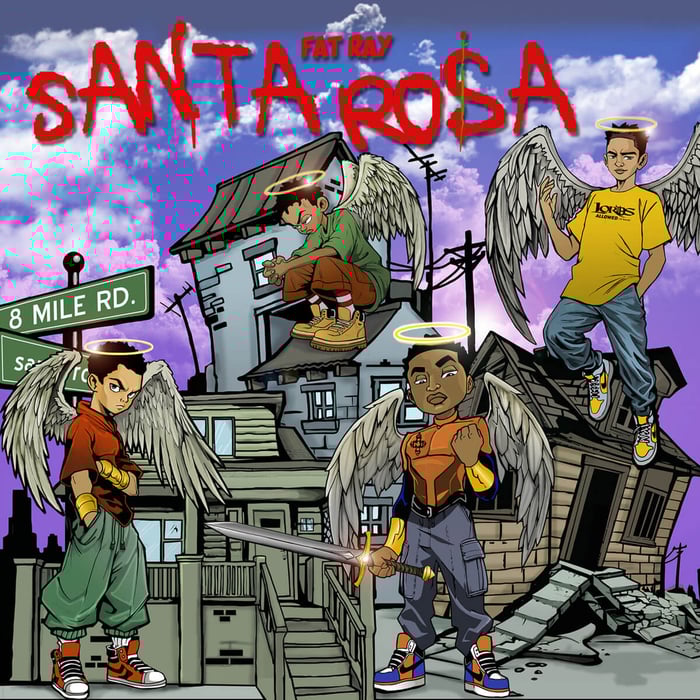
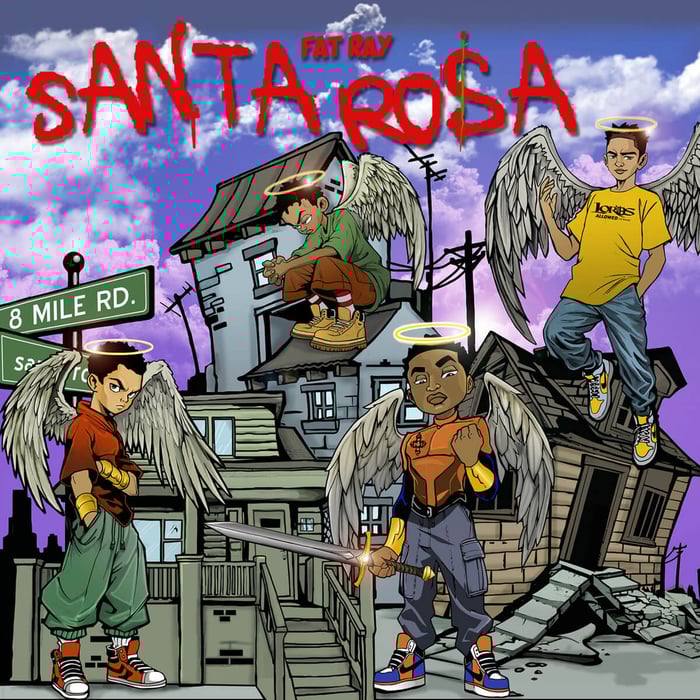
If you’re the type who judges an album by whether the cover looks like it could argue with you, you might want to frame that energy—shop your favorite album cover poster at our store: https://www.architeg-prints.com
 | DISCOUNTGET 30% OFF*Use code on your next order:
|
* This post may contain affiliate links, meaning we earn a commission if you make a purchase through these links, at no additional cost to you.