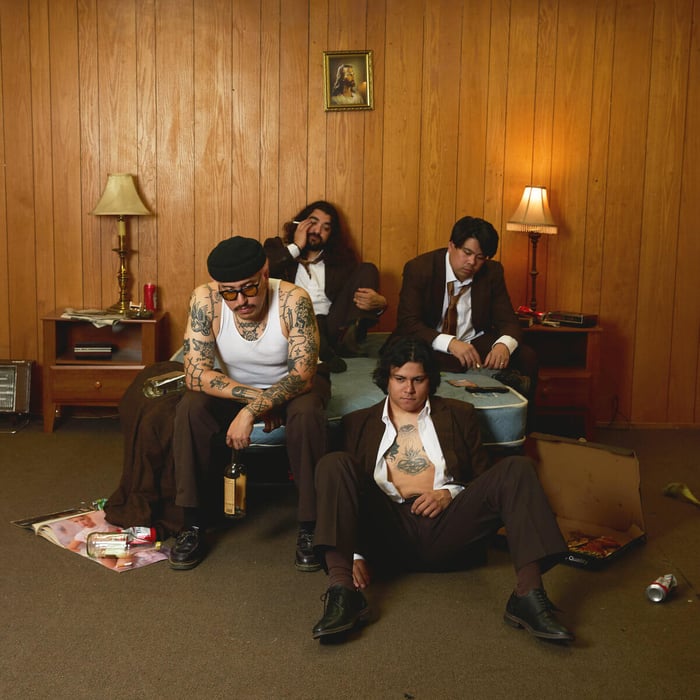
What’s Left Now Review: Death Lens Punches You Awake (Politely)


 See more Architeg Prints stories on Google.
What’s Left Now Review: Death Lens Punches You Awake (Politely)
What’s Left Now is Death Lens turning tour-burnout into sharp punk therapy—hooky, jittery, and just messy enough to feel like real life.
Death Lens doesn’t ease you in. What’s Left Now feels like the band walking back into the room, kicking the chair over, and saying, “Okay—now listen.” And yeah, that aggression reads as confidence, but it also reads like necessity. This album sounds like a group that’s had to keep moving even while pieces of the machine were falling off.
In the two years since their last record, they lived the glamorous version of punk life—nine months of touring, momentum, more faces in the crowd—and the less glamorous version too: stress, friction, and two members leaving. The interesting part isn’t the adversity itself (bands fall apart all the time). It’s how What’s Left Now treats that chaos like fuel instead of tragedy. They come back as a quartet again, clearly determined to “cut the bullshit,” and you can hear that decision all over the record: fewer soft landings, fewer polite fades, more moments that feel like somebody yanked the cord out of the wall.
That said, I’m not totally sure the album is “honest” in the diary-confessional way people usually mean. It’s honest in the we’re not stopping to explain ourselves way—which is its own kind of truth.
“Monolith” isn’t an intro—it's a shove
The first thing you hear on “Monolith” is unfocused, distorted TV audio—like you’re flipping channels in a motel room at 2 a.m. and everything is slightly cursed. Then the band drops into high-energy garage rock with big, anthemic harmonies that don’t pretend to be subtle. The chorus practically plants a flag by repeating “do you feel it?” until you either give in or decide you hate fun.
Vocally, the delivery lands in that familiar pop-punk neighborhood—there’s a tone and snap that made me think of Josh Franceschi the first time through. But Death Lens isn’t copying; they’re weaponizing that kind of clarity inside something more scuffed-up and impulsive. It’s a strong opening impression.
And I’ll admit: at first, I thought the TV-noise intro was going to be one of those “look how gritty we are” gestures that ages badly. On second listen, it clicked as a mission statement. The album isn’t about polish. It’s about interruption.
“Power” makes speed sound like a personality trait
That momentum doesn’t dip when “Power” hits. It’s loud, fast, and built like a spring-loaded toy: pop-rock bounce strapped to punk wiring. The pacing is the point—no scenic route, no throat-clearing. It’s the kind of track that makes it nearly impossible not to nod along, even if you’re trying to act too cool for it.
Here’s the arguable take: “Power” is catchy enough that it almost disguises how aggressive it is. If you’re listening casually, you might miss how hard it’s pushing because the hook keeps grinning at you.
The one place I’ll nitpick? The song’s “go go go” approach is so committed that it risks flattening the dynamics. It works, but it also sets a challenge for the rest of What’s Left Now: can the album keep moving without feeling like one long sprint?
A feature that slows the blood down without killing the pulse
The record’s energy stays high even when it gets more serious. That’s not a generic compliment—it’s a specific trick Death Lens pulls: they slow the tempo, but they keep the body-language of fast music. You still find yourself moving, even when the chords get heavier.
“Waiting To Know” (featuring Militarie Gun) is the cleanest example. It shifts into a slower tempo and threads alternative rock textures with a little emo melody slipped in like an extra ingredient you didn’t order—but you’re glad it’s there. The feature doesn’t feel like a marketing bolt-on; it feels like a second voice in the same argument.
And the weird thing is: even at a slower pace, it still bops. Not in a party way. More like a tense, foot-tapping way—like your nervous system is keeping time for you.
“Am I A Drug To You?” is the mood swing that actually earns its spot
Right after that, “Am I A Drug To You?” leans into a darker mood, and it does it with a specific palette: alternative rock blended with electronic touches, then tied off with acoustic guitar strumming. That acoustic element matters—it’s the human hand on the steering wheel while everything else flickers and buzzes around it.
This track feels powerful in a different way than the loud ones. It’s not trying to rally you; it’s trying to corner you. The narrative can be read a bunch of ways depending on what you bring to it—addiction, dependency, emotional manipulation, plain old obsession. I kept changing my mind about what it “meant,” which is usually how I know a song is doing more than posing.
If I have any uncertainty here, it’s this: I can’t tell whether the electronic/alternative blend is a one-off experiment or a direction they want to chase. The song sells it, but part of me kept waiting for the album to commit even harder to that texture—then it swerves back to punk muscle again.
The album’s highlights aren’t accidents—they’re pressure points
There are a lot of standout moments on What’s Left Now, and it’s honestly hard to compress them without turning into a tracklist recitation. But a few songs feel like they’re built to leave bruises.
“Saints In The Panic Room” comes in with these heavy, tin-like drumbeats that immediately darken the room. The percussion doesn’t just keep time—it clangs like a warning. The whole track carries frustration in its posture, and it reads like the lyrics are circling the reality of living in a broken home. Not in a poetic-distance way either. More like: this is what it felt like, and it still lives in my shoulders.
Arguable statement, but I’ll say it anyway: this is where Death Lens sounds most “adult,” not because it’s calmer, but because it doesn’t flinch. It doesn’t need to scream louder to sound more serious—it just chooses heavier sounds and lets them sit there.
The closing run turns the record into a communal middle finger
The final three tracks—“Last Call,” “Pulling Teeth,” and “Debt Collector”—close the album like a door slam you can’t take back. The punk energy comes back in full, packed with those anthemic “hey, hey, hey” moments that are basically designed for a crowd to shout back.
This stretch gives the record its “release valve.” If earlier songs feel like tension and coping mechanisms, these last tracks feel like reaction. Not reflection—reaction. The urge here is simple and kind of timeless: flip the bird to the world, then keep walking.
My mild criticism: the “hey, hey, hey” chant energy is undeniably effective, but it’s also the easiest weapon in the punk toolbox. Death Lens uses it well, yet a small part of me wanted at least one of these closers to swerve—something stranger, or uglier, or more surprising. The album mostly plays its final hand face-up.
So what is this album actually doing?
Here’s what I think What’s Left Now is really up to: it’s not trying to document hardship as a storyline. It’s trying to rebuild momentum after the kind of touring grind that turns your life into a repeating hallway. The band sounds like they’ve decided that if things are going to be unstable anyway—lineup changes, road stress, whatever—then the music should lean into that instability and make it feel intentional.
And crucially, it’s fun. Not in a shallow way. More like a functional way: the kind of record you put on when you need your spine straightened back out.
It’s a solid, genuinely enjoyable listen—something that works as a pick-me-up without pretending you’re not also carrying baggage.
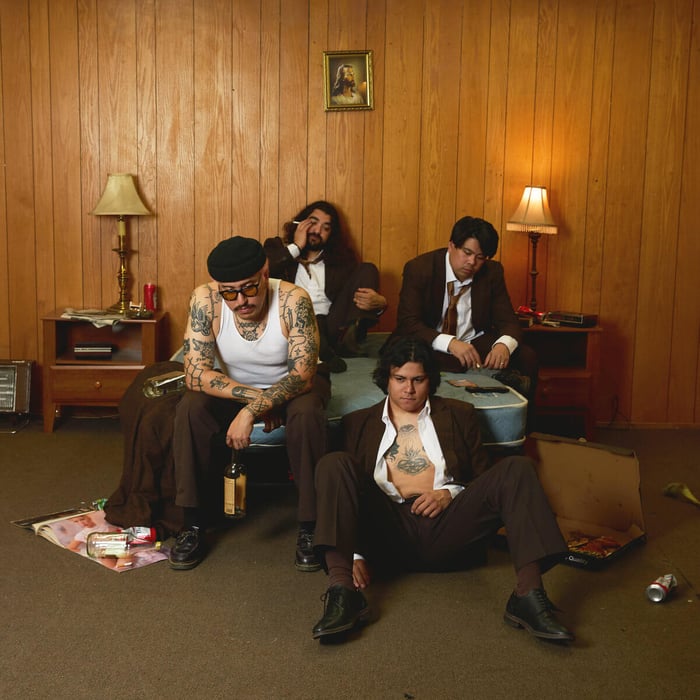
Artwork check
Release note
What’s Left Now? is out now via Epitaph Records.
You can also follow Death Lens on Facebook.
Conclusion
What’s Left Now doesn’t ask for your attention—it takes it, shakes it, and hands it back slightly dented. Death Lens turns burnout into propulsion, and the best moments feel like they’re happening too fast for self-pity to catch up.
Our verdict: People who like punk that’s hooky and slightly scuffed—like it was recorded with adrenaline still in the cables—will actually love this. If you need your albums to be smooth, elegant, and respectfully quiet, you’ll bounce off this hard and then complain that it’s “a bit much,” which is sort of the point.
FAQ
- What’s Left Now is what kind of album?
It lands in punk with big pop-rock hooks and garage bite, with occasional detours into alternative and electronic shading. - Does the album stay high-energy the whole time?
Mostly, yes—but even the slower moments keep your head moving. The tempo dips without the pulse dying. - Which track changes the mood the most?
“Am I A Drug To You?” shifts into moody alternative/electronic textures and uses acoustic guitar to keep it grounded. - Is the feature on “Waiting To Know” worth it?
Yeah. It doesn’t feel stapled on. The slower tempo and emo-leaning melody make it one of the album’s most absorbing moments. - Where does the record hit hardest lyrically or emotionally?
“Saints In The Panic Room” carries a darker frustration, and it reads like it’s grappling with the fallout of a broken home.
If this album’s artwork vibe is stuck in your head, that’s usually a sign you want it on a wall, not just in a playlist. You can pick up an album-cover poster style print at our store: https://www.architeg-prints.com
 | DISCOUNTGET 30% OFF*Use code on your next order:
|
* This post may contain affiliate links, meaning we earn a commission if you make a purchase through these links, at no additional cost to you.