Bruno Mars’ The Romantic Review: Oldies-Soul Swagger, New Problems

 See more Architeg Prints stories on Google.
Bruno Mars’ The Romantic Review: Oldies-Soul Swagger, New Problems
Bruno Mars’ The Romantic sounds like romance in a tailored suit—until the seams split. Here’s what The Romantic is really up to, track by track.
A pretty album that’s quietly plotting something
Bruno Mars doesn’t come back with The Romantic like he’s “returning.” He comes back like he never left the room—he just stopped making eye contact for a while.
And yeah, the long gap between solo albums used to mean the wheels fell off. Here, it reads more like strategy. In the years since 24K Magic, he’s stayed floating above pop’s surface: a Silk Sonic detour with Anderson .Paak, giant collaborations (“Die with a Smile” with Lady Gaga, “APT.” with ROSÉ), absurd streaming numbers, a whole new decade of adulthood. The solo album didn’t arrive because it didn’t need to. He was still winning without it.
But the most meaningful shift isn’t any single hit. It’s the sound he chose to live inside this time—and the person who helped him build it.
The real headline is D’Mile—and the temperature change
Here’s the pivot you feel immediately: The Romantic isn’t neon. It’s amber.
D’Mile (Dernst Emile II) is all over this album in a way that doesn’t feel like “producer did a good job” and more like “producer moved the furniture, changed the lighting, and told Bruno to stop shouting across the room.” The two connect around 2019 through James Fauntleroy, and by the time “Leave the Door Open” existed, the Mars universe had already started warming up—less flash, more glow.
This album’s nine tracks are produced by Mars and D’Mile together, with Philip Lawrence and Brody Brown writing alongside them, and you can hear the group-think: everything is coherent, calibrated, and intentionally un-hyper. The horns don’t jab you in the ribs; they hover. Guitars curl around the groove instead of slicing it. Drums breathe under the vocal like they’re paid hourly and not trying to steal the scene.
And then there’s the horn sound itself—engineered by Gabriel Roth (yes, that Gabriel Roth, the Daptone Records founder tied to those Sharon Jones and Charles Bradley brass sessions). That lineage matters because it explains why the arrangements here feel patient. Nothing is overcrowded. Nothing is desperate to prove it’s “big.”
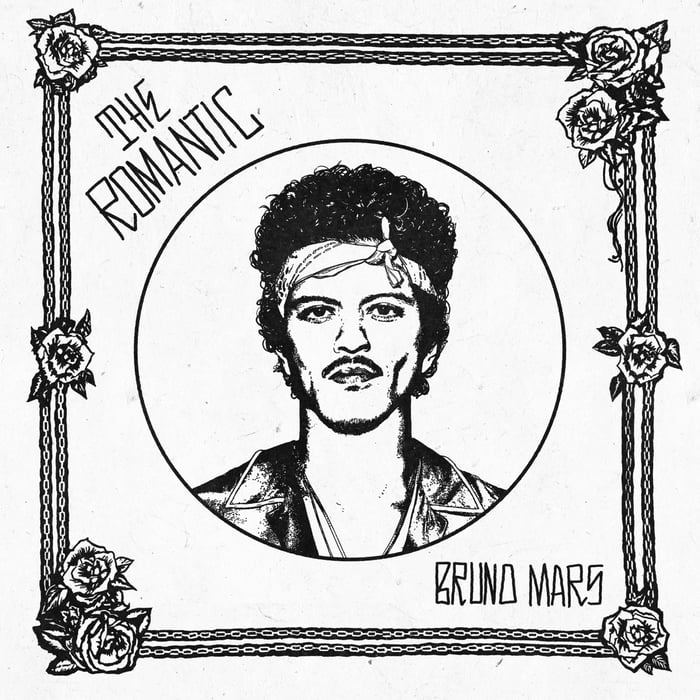
The cover art tells you what the record wants—without asking
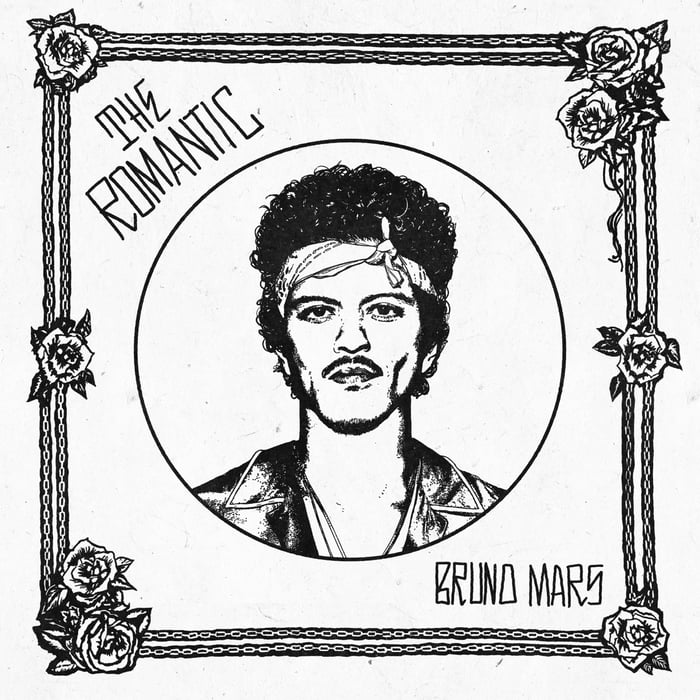
The cover of The Romantic isn’t just aesthetic; it’s a mission statement.
Monochrome portrait. Roses and chains. Lowrider-culture lettering. The word “romantic” embedded in a visual grammar that sits close to the oldies-soul revival lane—Thee Sacred Souls, Thee Sinseers, that whole Daptone-adjacent circuit where sweetness isn’t irony, it’s religion.
Mars isn’t Mexican, obviously. But between his Puerto Rican roots and his years in LA, this doesn’t scan like costume tourism to my ears or eyes. It scans like proximity—like somebody who’s been around these records long enough to stop treating them as props.
If 24K Magic leaned into New Jack Swing, and Silk Sonic aimed at ‘70s Philly soul, The Romantic reaches further back—to doo-wop ballads and sweet soul sides that have lived for decades at quinceañeras, car shows, backyard parties, and inside cars with the windows down and the bass politely up.
Arguable take: this is Mars at his most studied—and for once, the studying pays off more than the showing off.
The first three tracks: desire, but shot from three different distances
The album opens with a mini-suite of wanting-someone energy, except each song picks a different camera lens.
“Risk It All” tries to be epic—and kind of forgets to be personal
“Risk It All” is Mars going full sweeping romantic: he’ll swim seas, sacrifice everything, climb any mountain. It’s a grand-gesture opener meant to set the tone, with a Latin tinge that signals where the palette is headed.
But it’s also… weirdly generic. Big promises with no address attached. No actual person in the room—just the idea of a woman-shaped destination. I kept waiting for a detail, some identifying scratch on the surface, and it never comes. The song works as mood-setting, but it’s also the first hint that The Romantic might prefer postcard love to real-life love.
Arguable take: “Risk It All” is intentionally vague because the album doesn’t want consequences yet.
“Cha Cha Cha” drops into chaos, and that’s when Bruno sounds alive
Then “Cha Cha Cha” drops thirty thousand feet into a club scene where Mars is clearly having fun being ridiculous. He’s singing his face off about “lemon pepper steppers,” there’s a party at the bakery, “hooligans” outside—just cartoonish nightlife detail stacked like a Jenga tower.
And it works because the song knows what it is. It’s not pretending to be profound. The one moment that made me sit up is when it briefly floats away from the dancefloor into that line about going to the moon later, hoping your wings get to fly. For a second, the track peeks past the party and you see the softer machinery behind it.
Arguable take: the goofiness is a disguise—Mars uses comedy the way other singers use reverb.
“I Just Might” turns flirtation into a tryout (and it’s smarter than it sounds)
“I Just Might” arrives like a lead single should: disco-pop, funk-bright, instantly legible. It’s also built on a conditional, which is the key detail. He’s not pledging love; he’s offering a maybe—if she dances as good as she looks, he might make her his baby.
That line—“But what good is beauty if your booty can’t find the beat?”—is classic Bruno: funny, blunt, a little shallow, and somehow charming anyway. Later, he turns the whole thing into a casting call, basically telling her to put spirit and heart into it, and if he likes what he sees, she’s coming home.
“Put some spirit in it, put your heart into it / That’s all I need.” —Bruno Mars
Seduction as audition. And I don’t think that’s accidental. Mars has always been comfortable being the guy who says the fun thing instead of the true thing. These first three songs are him running that mode at full wattage—clean suit, bright grin, no vulnerability allowed.
Arguable take: the “conditional romance” here is the album admitting it’s scared of sincerity.
“God Was Showing Off” is gorgeous… and a little unsettling
The album gets stranger—better, too—when “God Was Showing Off” comes on.
Mars tells her she’s so beautiful that God basically flexed while making her. He calls her an “earth angel,” tells her not to hide her wings. It’s flattery pitched at biblical scale, and the production plays it straight—no wink, no satire, just warm soul glow like an old 45 spinning somewhere respectful.
Then the lyric pushes further: he starts talking like God has favorites, like she’s “blessed with just a little more.” In the outro he’s betting she can walk on water and turn that water into wine.
Here’s where I hesitated: I couldn’t tell if the worship is aimed at her, or if it’s really Mars admiring his own ability to worship. That’s the unnerving part—the song is so committed you start wondering who the devotion is for.
Arguable take: this is the album’s most inventive writing because it’s the first time Mars’ charm risks sounding obsessive.
When he loses composure, the album finally hits blood
The record levels up when Mars stops sounding certain.
“Why You Wanna Fight?” is where the performance cracks
“Why You Wanna Fight?” is baby-making music on the surface, sure, but it’s also the first time he sounds like he doesn’t fully control the narrative. He admits he was wrong. He says he’ll call her mom, plead with her friends—actual messy human behavior, finally. There’s a line where he insists she might hate him now but he never stopped loving her, and it lands because it sounds like a man trying to keep his pride from driving the car.
Arguable take: this is the first song where Bruno stops being a concept and starts being a person.
“On My Soul” goes full pledge—and Curtis Mayfield’s ghost nods
“On My Soul” pulls him back into vows, but in a way that feels rooted instead of theatrical. It’s two minutes and fifty-four seconds of smooth commitment—he wants to give her his name, he’s traveled the world and she’s right here, and he drops that clean little line about not needing a rocket ship to find your own shooting star.
The most telling sentence on the album might be the simplest: he’s trying to live the dream, but he needs her on his team. That’s not poetry; it’s admission. The dream doesn’t work alone.
Arguable take: this is Mars quietly confessing that fame is useless without somebody normal to come home to.
“Something Serious” aims for domesticity—beautiful, safe, and a bit frustrating
“Something Serious” follows with even less drama: real love, pretty babies, the whole future-in-soft-focus pitch. It’s the path from desperation to commitment to domesticity, drawn in clean lines.
But here’s the mild problem: even when he’s “unguarded,” the writing stays in postcard territory—lovely, brief, unsigned. He never says what the fight was about. He never tells you what he did wrong. He promises he’ll love her like she’s never been loved before, but he never shows you what that looks like on a random Tuesday morning.
At first I thought the vagueness was classy—like he’s protecting privacy. On second listen, it started feeling more like self-protection: keep it general, keep it painless, keep it so nobody can argue with it.
Arguable take: The Romantic mistakes safety for depth in its middle stretch.
“Nothing Left” finally asks for something back
Then “Nothing Left” cracks the whole thing open.
This is Mars admitting the magic isn’t automatic anymore. He used to light up when he called to say “I love you,” but now the words don’t hit the same. He’s alone in the home they built. The fire doesn’t burn like it used to. He can’t find the spark in her eyes.
After eight songs of him praising women, promising sacrifice, doing the whole romantic gymnast routine—this is the first time he asks for reciprocity and genuinely doesn’t know if he’ll get it. It’s not louder. It’s not flashier. It’s just emotionally riskier.
Arguable take: “Nothing Left” is the only moment where the album stops selling love and starts experiencing it.
“Dance with Me” ends the album mid-question (and that’s the point)
The closer, “Dance with Me,” picks up directly from that uncertainty. He asks her to dance with him one more time, hoping the music resets the relationship—hoping when the song ends, they’ll fall in love again. He asks for pride to be put aside, right next to his.
“Put your pride aside, right here next to mine.”
What’s brutal is how the track feels like it’s playing out in real time: backing vocals folding over each other while he insists he doesn’t want to dance with anyone else… and the song keeps going… and she still hasn’t answered.
Arguable take: the album ends on purpose without closure because Mars knows romance is often a monologue.
So what is The Romantic actually doing?
As a fourth solo outing, The Romantic is short, sleek, and made by people who know exactly how to build this kind of record. That know-how pays off more often than it doesn’t.
The Mars/D’Mile blend—warm analog brass, close-mic vocals, clean rhythm sections—rarely stumbles. Mars’ voice is still one of pop’s most reliable instruments; he can sell hallelujah-scale devotion or a “lemon pepper steppers” flex without changing his pulse. And the production gives even the more lyrically generic early tracks a reason to exist: the arrangements themselves carry meaning.
Still, the album’s signature is also its limitation: it stays beautiful and it stays safe—until the last two songs decide to tell the truth.
Arguable take: this record doesn’t climax with a big hook; it climaxes with a man realizing charm didn’t fix anything.
Conclusion
The Romantic isn’t Bruno Mars trying on oldies-soul like a costume. It’s him moving into a warmer, more patient sound—and then letting the mask slip at the end. The best moments aren’t the biggest gestures; they’re the ones where he stops performing romance and starts bargaining with it.
Our verdict: People who like vintage-soul glow, clean songwriting, and Bruno acting like a grown-up heartthrob will eat this up. People who need messy specifics, sharp storytelling, or lyrical risk throughout—not just at the end—will get bored halfway and only wake up for “Nothing Left.” If you want chaos, this album irons its shirt before leaving the house.
FAQ
- Is The Romantic more like 24K Magic or Silk Sonic?
It leans warmer and older than 24K Magic’s neon bounce, and it feels less showy than Silk Sonic—more doo-wop/sweet-soul mood than big retro spectacle. - Does D’Mile’s production really change Bruno’s sound?
Yes. The whole record runs on glow instead of punch—horns sit back, drums breathe, and Bruno’s voice gets room rather than competition. - What’s the album’s strongest stretch?
The closing run—especially “Nothing Left” into “Dance with Me”—because it finally lets uncertainty into the room. - What’s the biggest drawback?
The middle leans on pretty, universal promises. It sounds great, but sometimes it dodges the specifics that would make the romance feel lived-in. - Which songs feel most essential?
“Why You Wanna Fight?,” “Nothing Left,” and “Dance with Me” are where the album stops flirting and starts revealing consequences.
If you’re the type who treats album art like part of the spell, you can always shop a favorite album cover poster at our store—same wall, better lighting: https://www.architeg-prints.com
 | DISCOUNTGET 30% OFF*Use code on your next order:
|
* This post may contain affiliate links, meaning we earn a commission if you make a purchase through these links, at no additional cost to you.