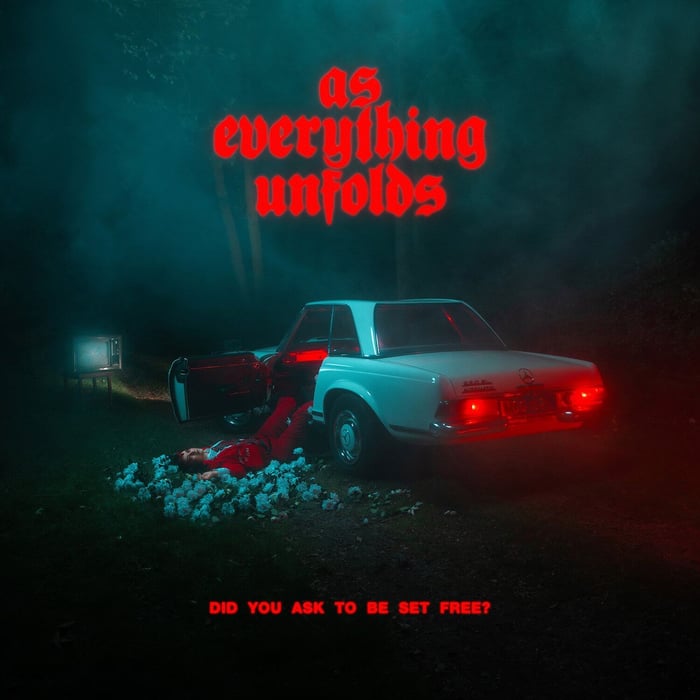
Did You Ask to Be Set Free Album Review: Grief, Hooks, and a Big Swing


 See more Architeg Prints stories on Google.
Did You Ask to Be Set Free Album Review: Grief, Hooks, and a Big Swing
Did You Ask is As Everything Unfolds turning tragedy into pop-leaning catharsis—sometimes messy, often magnetic, and way more intentional than it first sounds.
A record that doesn’t “process” grief— it weaponizes it
Some albums gently guide you through pain. Did You Ask To Be Set Free? doesn’t guide anything. It kicks the door in, starts singing, and dares you to keep up.
AS EVERYTHING UNFOLDS (a quartet out of High Wycombe, Buckinghamshire) sound like a band that’s stopped asking permission—especially compared to the metalcore-leaning shape of their first two records. Five years after their debut Within Each Lies The Other, this third LP Did You Ask To Be Set Free? lands like a deliberate left turn: less about fitting a scene, more about building a world that can actually hold what happened to them. And yes, it’s experimental. But the bigger truth is simpler: it’s heartbreak dressed up as catchy choruses and hard edges.
The grief is the engine, not the backstory
Here’s what’s really driving the album: it’s written from inside the band’s mental state after the death of former bandmate Jamie Gowers, who died mid-tour almost two years ago. You can hear the aftershock in how the songs move—like they’re trying to outrun something that keeps appearing in the rearview mirror.
Charlie Rolfe sings like she’s choosing confrontation on purpose. The record doesn’t feel like “sad songs,” it feels like an argument with reality. And instead of narrating pain in a straightforward diary way, she takes a sideways approach—creating a fictional character to cling to in day-to-day life, pulling inspiration from video games, movies, and albums she cares about. That detail matters because you can hear it: these songs behave like scenes. They don’t just confess; they perform survival.
I’m not totally sure the concept always stays coherent from track to track—but the emotional logic is consistent: when real life becomes unlivable, you build a proxy self and let that take the hits.
That writing spark? It sounds like permission to make it ugly
A specific catalyst hangs over this album: Rolfe reading Rick Rubin’s The Creative Act, which seems to have flipped the “okay, write again” switch.
And the band didn’t rush the writing. They spent two years shaping Did You Ask To Be Set Free?, then recorded it on a tight three-week schedule in February 2025. That combo—long writing, short recording—explains why the songs feel carefully designed but still a little feral around the edges. Like: “we know exactly what this is,” but also, “we can’t stay in this room too long.”
The album’s intent feels blunt: take the hardest material they’ll ever touch and force it into something that can outlast them.
“Denial” opens the album like a confrontation, not a warm-up
Coming off that context, “Denial” isn’t just an opener—it’s a thesis statement with its hands around your collar. The song frames emotional destructiveness in a way that’s almost scarier because it’s not cartoon-villain rage. It’s recognition. Rolfe’s voice carries urgency that reads like she’s trying to sympathize with someone while still holding them accountable—a hard balance that most bands dodge by picking one emotion and blasting it at you.
There’s a specific kind of pain in lines like:
- “And I know the darkness you’re running from / It’s all on the inside”
- “Can you feel the impact you’re having on? / Us all in your selfish spite.”
That’s not poetic ambiguity. That’s the sound of somebody staying in the conversation even when they shouldn’t have to.
Arguable take: “Denial” is less about the other person and more about the singer refusing to let chaos be “mysterious.” Naming it is the whole point.
“Gasoline” is the album’s shiny trap—and it works
Then “Gasoline” shows up and basically grins at you. This is the gritty pinnacle of the record’s accessibility: a fiery, almost chart-ready chorus hook that sticks whether you want it to or not. The hook doesn’t feel like compromise; it feels like a tactic. Like the band is saying, “You’re going to carry this with you, so we might as well load it with meaning.”
I’ll admit it: on first listen, I thought “Gasoline” might be the obvious single moment that cheapens the emotional premise. On second listen, I changed my mind—it’s not cheap, it’s strategic. The catchiness is the sugar that helps the medicine actually get inside you.
Arguable take: “Gasoline” isn’t the band going mainstream; it’s the band using pop discipline to make grief unavoidable.
“Find Another Way” flips the pacing—and risks sincerity
By the time “Find Another Way” arrives, the record makes a noticeable directional shift. The tempo eases off, and it leans into something closer to a power ballad. It’s still recognizably the evolved version of this band, but it’s also them letting the air out of the room on purpose.
This is where I briefly wasn’t sure if the album would lose momentum—slower tracks on heavy-adjacent records can feel like contractual obligations. But “Find Another Way” earns its space by sounding emotionally expensive. It doesn’t beg for tears; it just stands there and lets the feeling hit.
Arguable take: the slower pacing here is more daring than the heavy parts, because it gives you fewer distractions.
“Cut The Lies” is short, bouncy catharsis (and maybe too perfect)
Then “Cut The Lies” detonates in 2 minutes and 43 seconds—tight, bouncy, exhilarating. It’s the kind of track that tries to turn catharsis into movement, like shaking water off your hands.
There’s also a very specific electronic-adjacent bounce to it that recalls deadmau5’s “Professional Griefers” in spirit—less in literal sound-alike terms, more in that kinetic “this should be huge in a room” feel. It’s easy to picture it live, because the song is basically built like a trigger for crowd energy.
A mild criticism: it’s so cleanly constructed that part of me wanted one moment of ugliness—one scraped knee, one imperfect vocal crack—just to keep it human. Still, the precision is the point.
Arguable take: “Cut The Lies” is the album’s most effective therapy session, because it refuses to wallow.
“Set In Flow” brings the heavy back… with synth gloss
“Set In Flow” is a killer track, and it’s where the album’s hybrid identity starts flexing hardest: heavier post-hardcore weight mixed with ’80s-inspired, synth-led production. That decision could’ve been corny. Instead it lands like a purposeful contradiction—like the band is saying the future can still be haunted, but it can also be bright.
Arguable take: the synth isn’t nostalgia; it’s denial dressed as neon, and that’s why it fits.
“What You Wanted” is the only feature—and it doesn’t feel like a stunt
“What You Wanted” brings in the album’s only guest: Dani Winter-Bates of Bury Tomorrow. His screams are instantly recognizable and add extra vigor, but the key detail is that the feature doesn’t hijack the record. It slots in like it was always supposed to be there.
A lot of features scream “marketing.” This one feels more like adding another voice to the argument—another angle of pressure.
Arguable take: Winter-Bates doesn’t “elevate” the track; he reinforces the album’s central tension by making it louder.
“Idols” doubles down—and the vocals get meaner on purpose
“Idols” hits like “Set In Flow” mark two—equally impactful, but with a different vocal arc. The melody carries fast-paced pop-punk energy, yet Rolfe’s vocals keep getting heavier as it goes, gaining gusto like she’s getting fed up mid-song.
That escalation reads as intentional character work: the track starts like a sprint and ends like a shove.
Arguable take: “Idols” is the album admitting it’s angry at the idea of role models in the first place.
“Edge Of Forever” surprised me—and I’m still deciding if that’s good
“Edge Of Forever” throws a curveball: the leading instrumental melody gives off And So I Watch You From Afar energy. I didn’t expect that kind of mathy, forward-driving instrumental personality to show up here, and it’s a surprisingly effective jolt.
I’m slightly uncertain whether it fully belongs in the album’s emotional sequence—part of me hears it as an interlude that wandered in from a different brain. But the surprise is also refreshing, like the record briefly zooms out and remembers it can be a band album, not only a catharsis document.
Arguable take: the instrumental feel here is the album’s most “alive” moment—because it stops explaining itself.
“Setting Sun” closes the record like a radio-friendly bruise
The closer “Setting Sun” is a radio-friendly ballad, and it brings Did You Ask To Be Set Free? to a clean, exemplary finish. Not a grand explosion—more like the quiet after you’ve said the hardest thing out loud and now you have to live with it.
If the earlier tracks are confrontation, “Setting Sun” is acceptance with its teeth still clenched.
Arguable take: ending on something approachable isn’t a sellout move—it’s the band insisting the pain belongs in public, not hidden in a niche.
So what is Did You Ask actually doing?
By the end, the album has made its case: it wants to be infectious and tear-jerking at the same time, with gnarling riffs, strong musicianship, and pop-minded writing that refuses to act ashamed of itself. It’s the sound of a band refusing to be treated like an “up-and-coming” footnote. This isn’t a starter band record; it’s a declaration that they intend to lead, not follow.
If you’re forcing me to quantify it, I land around a 9/10 in terms of how effectively it accomplishes what it’s clearly trying to do—turn real loss into something with longevity, not just something that bleeds once and disappears.
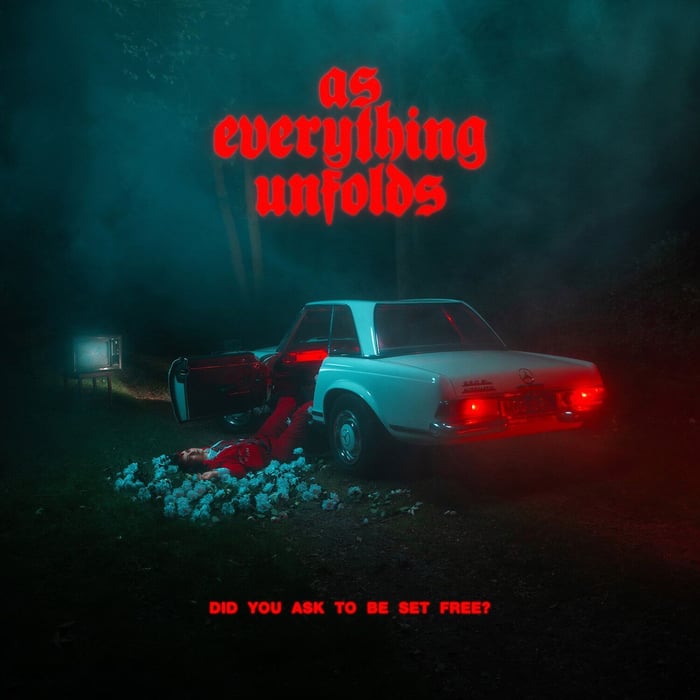
A final practical note: Did You Ask To Be Set Free? is out now via Century Media Records. If you want to keep tabs on the band, they’re on Facebook (As Everything Unfolds): https://www.facebook.com/AsEverythingUnfolds
Conclusion
Did You Ask To Be Set Free? doesn’t sound like a band “moving on.” It sounds like a band building a new machine to carry something heavy—sometimes with synth gloss, sometimes with a throat-full-of-sand scream, and sometimes with a pop hook that refuses to leave your bloodstream.
Our verdict: People who like their catharsis catchy—the ones who want big choruses without pretending everything’s fine—will actually love this album. People who demand pure metalcore orthodoxy, or who flinch at pop instincts showing up in heavy spaces, will not… and they’ll probably call it “too accessible” while humming “Gasoline” by accident.
FAQ
- Is “Did You Ask” still metalcore?
Not really in the strict sense. It shifts away from the metalcore shape of the earlier records and mixes heavier post-hardcore moments with pop and synth-driven choices. - What’s the album’s emotional core about?
It centers on Charlie Rolfe’s mental state and the band’s grief following the death of former bandmate Jamie Gowers mid-tour almost two years ago. - What’s the most instantly catchy track?
“Gasoline.” The chorus is basically designed to haunt you. - Does the guest feature feel out of place?
No. Dani Winter-Bates (Bury Tomorrow) appears on “What You Wanted,” and it fits the album’s tone instead of turning into a cameo circus. - Is this album better on headphones or speakers?
Headphones for catching the synth-led production details; speakers if you want “Cut The Lies” to feel like it’s already in a live room.
If this album’s visuals lodged in your head the way the hooks do, you can always grab a favorite album cover poster for your wall at our store: https://www.architeg-prints.com/ — it’s a nice way to let the obsession look intentional.
 | DISCOUNTGET 30% OFF*Use code on your next order:
|
* This post may contain affiliate links, meaning we earn a commission if you make a purchase through these links, at no additional cost to you.