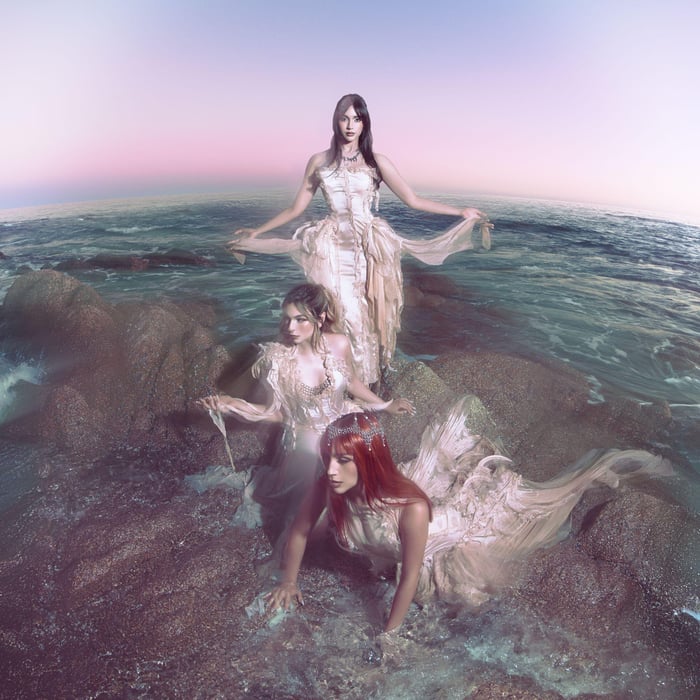
Everything’s Falling Review: The Warning Turns Panic Into a Party Trick


 See more Architeg Prints stories on Google.
Everything’s Falling Review: The Warning Turns Panic Into a Party Trick
Everything’s Falling feels like The Warning staring down failure—then turning it into forward motion, riffs first, feelings second (but still bleeding through).
This album doesn’t “cope”—it charges
There’s something almost backwards about Everything’s Falling. It’s clearly obsessed with fragility—like it keeps poking at worst-case scenarios just to see if they flinch—but the music refuses to sit in the rubble and journal about it. The songs don’t mope. They move. Anxiety gets converted into momentum, and vulnerability doesn’t show up as softness so much as a sharpened edge.
That’s an arguable choice, by the way. Plenty of bands write “everything is collapsing” records that actually sound collapsed. The Warning don’t do that here. They make catastrophe feel like fuel, which is either cathartic or suspiciously functional, depending on your tolerance for rock bands that refuse to drown.
Five albums in, they’re not reinventing anything—good
By the time you hit album five, the big temptation is the dramatic reinvention: the left turn, the “new era,” the symbolic haircut. The Warning—Dany, Ale, and Pau Villarreal—don’t bother with that kind of theater. What they do instead is more annoying (and more impressive): they sound like a band that knows exactly what space they’ve earned and isn’t asking permission to take up more of it.
You can hear the long climb behind this. From XXI Century Blood (2017) through Keep Me Fed (2024), they’ve been tightening their grip on modern rock without sanding off their bite. They’ve also done the classic proof-of-life tour résumé—sharing stages with Guns N’ Roses, Foo Fighters, Halestorm, and Muse, and most recently heading out with Yungblud—but the important part is what that experience does to the feel of this record: they sound secure. Not cocky. Secure.
And yes, I’m aware “secure” can read like “safe.” I don’t think it is. I think it’s them finally realizing they don’t need to audition anymore.
The first track sets the rules: dread is allowed, paralysis isn’t
The album opens with “Ritual,” and it’s the kind of opener that basically tells you, “Don’t worry, we brought structure.” It starts with an industrial-rock intro that builds tension like a machine warming up, then snaps into a familiar The Warning guitar groove—muscular, direct, and unembarrassed about being a rock riff.
The emotional premise is anxiety and the anticipation of disaster, but the delivery isn’t fragile. It’s braced. Like they’re saying: fine, the world’s ending—let’s at least keep time properly.
They get “adventurous” without doing that annoying genre-tour thing
The confidence across Everything’s Falling makes room for texture. Not the try-hard kind where a band tosses in synths to prove they’ve heard of the future. More like: the palette gets wider, but the foundation stays intact.
I caught echoes of Keep Me Fed in the sleekness and pacing, and little nods to the bite and shape of ERROR (2022) in the heavier moments. The arguable part: I don’t think this record is trying to prove range. I think it’s doing the opposite—it’s showing how much they don’t need to prove anymore.
If anything, Everything’s Falling sounds like a band getting comfortable with their ceiling. And raising it anyway.
“Perfect Daughter” and the title track: vocals as a weapon, not a garnish
“Perfect Daughter” doesn’t waste time. The vocals are upfront almost immediately, full force, no coy build. The rhythm section locks into a melody that’s catchy without sounding sugary, and the production is clean—impeccable, even.
That said, here’s a small gripe: I’ve heard Dany live, and I’m not convinced the album mix always captures the full physical punch of her voice. It’s not weak on record—far from it—but live she hits like a weather event. Here, the edges are occasionally smoothed. Some listeners will love that polish. I kept wanting a little more air moving.
Still, “Perfect Daughter” works because it frames that vocal power as something internal and unrestrained, not performative.
And the title track, “Everything’s Falling,” earns its spotlight. The vocals are the main event—rasp, color, and grit all allowed to show up like they belong there. The build has that feeling of a held breath finally getting released, the kind that makes your shoulders drop even if you didn’t realize you were tensing.
I thought on first listen that this track might be too clean to hit hard. On second listen, the restraint started feeling like the point—like they’re choosing control because the lyric is already spiraling.
Tempo shift time: “Why Do You Like It When I Cry?” is rude in the best way
When “Why Do You Like It When I Cry?” shows up, the record changes its posture. It’s an earworm, driven by lead guitar, and Pau hits the drums with that jackhammer certainty that dares you to stand still. It’s the kind of groove that makes you feel guilty for sitting down.
One of The Warning’s biggest strengths is their bridge-writing, and they prove it again here: the low end starts rumbling like it’s coming up through the floor, turning into a breakdown-style section. Then Pau’s screams slice through at exactly the right moment—sharp enough to reset your attention without wrecking the song’s shape.
Arguable take: the bridge is the real hook, not the chorus. The track is basically built to bully you into replaying it.
“Bloodsport” hands the spotlight to Ale—and it’s a smart handoff
If the previous track is led by guitar, “Bloodsport” shifts the grin over to Ale. It’s bass-driven in a way that doesn’t feel like “look, we turned the bass up,” but more like the bass is steering the attitude. There’s a cheeky, fun energy baked into it that feels destined to land with fans who like their rock a little less serious and a little more swaggering.
Some people will call that “lighter.” I think it’s a relief valve. If you’re going to write an album circling fragility and catastrophic possibilities, you need moments that laugh at the panic instead of feeding it.
The darker run: distortion as a second skin
“Bite My Tongue” leans into modern rock undertones, and the distortion sits on the vocals and guitars like a second skin—close, clinging, deliberate. It’s not just “heavy”; it’s coated.
Then “Kill Or Be Killed” pushes further into aggression, like it’s clearing the runway for “Ego”—one of the previously released singles and one of the album’s most distinct choices. “Ego” comes in with a metal-edged bite and is sung in Spanish, and that melodic cadence gives it a particular character: anger and defiance, sharpened into something that feels focused rather than chaotic.
I’ll admit I hesitated the first time it arrived—partly because switching languages inside a heavy track can sometimes feel like a “special feature.” But it doesn’t play as a gimmick here. It plays as identity.
“Break” and “Bruises” prove they know when to stop swinging
After that stretch, “Break” shifts the lighting. It trades aggression for atmosphere and lands as a restrained rock ballad without turning into a power-ballad cliché. The standout moment is how the melodic section brings guitar, bass, and drums together—tight, unified, and not over-performed. It feels like they’re holding back on purpose, which is a kind of confidence not every hard-rock band has.
Then “Bruises” does a funny thing: it saves the heaviest punch for the breakdown, and the rhythm—unexpectedly led by drums—gives it a danceable pulse. Not “club” danceable. More like: you start moving before you realize you’re moving.
Arguable take: “Bruises” is heavier because it’s rhythmic, not because it’s loud.
“Waste Your Time on Me”: the chorus hits like a door flying open
“Waste Your Time on Me” starts with pinching guitars over a restless drum-and-bass pattern. It feels itchy, like it can’t wait to get to the point. Then it bursts into an explosive chorus that finally lets the tension cash out.
This is where the album’s pacing gets sneaky. Song by song, it pulls more “joy” into focus, almost without you noticing. Not joy as in sunshine—joy as in motion, fight, the satisfaction of a band hitting together.
“Kerosene” closes the record by refusing to be noble about it
By the time “Kerosene” arrives, the album has earned the right to be a little reckless. It’s fun, hectic rock with a hook that’s designed to stick whether you approve or not:
“you rip my hair, my style, my jeans” — The Warning
That line is a playful jab, and the song matches it with reckless energy. It’s also a statement: they don’t need to prove anything anymore, so they can let themselves enjoy their own storytelling. No grand moral. No forced dignity. Just a band sprinting to the finish because sprinting feels good.
Arguable take: “Kerosene” is the album’s real thesis, not the title track—because it shows what they do with the fear once they’ve looked it in the eye.
The “constructed” part is real—and it doesn’t cage them
You can feel the intention throughout Everything’s Falling: the aesthetic feels curated, the themes are consistent, and the track flow doesn’t wander. It’s built. Carefully.
But what makes it satisfying is that the construction doesn’t feel restrictive. The songs still breathe. They still take risks inside the structure—getting heavy, pulling back into vulnerability, then snapping into something playful before the mood can fossilize.
If the album has a core move, it’s this: it keeps choosing to push back. Fragility and anger are all over it, but the record doesn’t romanticize collapse. It argues with it. Loudly.
Everything may be falling, but The Warning sound stronger than ever—annoyingly so, if you were hoping they’d finally flinch.

Release details (because you’ll ask anyway)
Everything’s Falling is set for release on August 28 via Lava/Republic Records.
They also maintain an official presence on Facebook (search: The Warning Rock Band).
And yeah—if you want the blunt number I land on after sitting with it: I’m around a 9/10. Not because it’s perfect, but because it’s doing what it’s trying to do with very little wasted motion.
Conclusion
Everything’s Falling doesn’t wallow in the idea of failure—it uses it like a kick drum. The Warning take dread, tension, and ego-wounds and turn them into songs that move like they’ve got somewhere to be, even when the lyrics are staring into the void.
Our verdict: People who like modern rock that hits hard and knows when to smirk will love this album. If you need your “emotional” records to sound miserable and collapsing in real time, you’ll probably roll your eyes and call it too polished—then catch yourself humming “Kerosene” anyway.
FAQ
- Is Everything’s Falling heavier than The Warning’s previous albums?
It’s heavier in bursts—especially around “Kill Or Be Killed,” “Ego,” and the “Bruises” breakdown—but it also makes room for restraint (“Break”) and punchy hooks. - What’s the best entry point track if I’ve never listened to them?
“Ritual” is a clean statement of intent: tension up front, riffs locked in, and a chorus that doesn’t waste time. - Does the album have any standout vocal moments?
“Perfect Daughter” throws the vocals front and center immediately, and “Everything’s Falling” lets the rasp and texture come through beautifully. - Which song feels most likely to become a fan favorite live?
“Bloodsport” has that bass-led, cheeky energy that crowds tend to adopt fast, and “Why Do You Like It When I Cry?” basically dares people not to move. - Is “Kerosene” a serious closer or a fun one?
Fun, hectic, and hooky—more reckless grin than noble finale, which is exactly why it works.
If this record has you craving a physical reminder of that “panic turned into momentum” feeling, it’s not a bad excuse to grab a favorite album cover poster for your wall. We’ve got options over at https://www.architeg-prints.com/ that fit the vibe without turning your room into a merch booth.
 | DISCOUNTGET 30% OFF*Use code on your next order:
|
* This post may contain affiliate links, meaning we earn a commission if you make a purchase through these links, at no additional cost to you.