Marrow Deep Album Review: Mastodon Survives Grief, Adds Keys, Gets Weird


 See more Architeg Prints stories on Google.
Marrow Deep Album Review: Mastodon Survives Grief, Adds Keys, Gets Weird
Marrow Deep is Mastodon refusing to be a memorial band—grief is in the wiring, but the riffs still bite, and the new keys change the whole mood.
Come for the riffs, stay for the uncomfortable honesty
It’s getting hard to hear Mastodon without hearing the weight around them. Not because the music demands pity—because the band keeps letting real-life damage seep into the chords like oil into concrete. Marrow Deep doesn’t try to “move on” in any tidy, inspirational way. It stares at the mess, acknowledges it, and then keeps playing anyway.
And yeah, there’s a fresh layer of loss hanging over this record after the not-so-amicable split and untimely death of guitarist Brend Hinds. What surprised me is that Brann Dailor, Troy Sanders, and Bill Kelliher don’t sound like they’re collapsing under it. They sound like they made a decision: we’re not freezing in amber. They pull in Nick Johnston (guitar) and João Nogueira (keyboards), and instead of “new lineup panic,” you get a band that’s aggressively choosing forward motion.
That’s an arguable read, sure. Maybe they’re just doing what bands do. But listening to the way these songs refuse to sit still, it feels like intent—not accident.
“Barbaians Blood” opens like they’re trying to scare you back into paying attention
You don’t get a gentle on-ramp. “Barbaians Blood” comes sprinting out of the gate—frantic, foaming, and restless in that very specific Mastodon way where the chaos is choreographed, like a bar fight with blocking marks.
It’s also your first real introduction to the new members, and honestly, I didn’t expect the keys to land as naturally as they do. On my first listen I braced for that awkward “guest instrument pasted on top” feeling. But the keyboards slide into the spectrum without turning the band into prog cosplay. The sound stays muscular; it just gets more dimensional around the edges.
If you’re looking for proof Mastodon still knows how to jolt the nervous system, this opener does the job.
The album keeps looking backward, but it’s not nostalgia—it’s unfinished business
From here, Marrow Deep starts doing that thing where it pushes ahead while constantly glancing over its shoulder. “Snakes For Dinner,” “Your Ghost Again,” and “In The Ruins” are basically soaked in loss and longing, but they don’t wallow. They swing between anger and sadness, then tumble into whatever the new version of the band is supposed to be.
What hits is how together it sounds. The playing feels locked in—old members and new ones. That’s a bold claim considering the circumstances, but I kept hearing a group that’s playing like it has something to prove, not a band politely finishing contractual obligations.
And if you came here expecting grief as a theme, you’ll get it—but you’ll also get the sound of a band using that grief as fuel, which is a more dangerous and interesting choice.
“In The Ruins” quietly messes with the Mastodon template
“In The Ruins” is where I first thought,
oh, they’re actually changing the recipe, not just swapping a guitarist.You still can’t miss Brann Dailor’s drumming—his style is basically a watermark—but the track dilutes the usual Mastodon density into something closer to psychedelic post-rock. It’s not “soft,” exactly. It’s more like the fight drained out of the anger and left behind emotional exhaustion.
The chorus still goes frenetic, but it doesn’t feel like rage. It feels like spiraling.
And Nick Johnston is a real factor here. His guitar tone carries a more contemporary edge that both compliments and clashes with Bill Kelliher’s classic feel. It’s an unusual pairing—and that’s why it works. You can hear a broader musical vocabulary forming at the borders of those big, bluesy-psychedelic motifs Mastodon has always leaned on.
I’ll admit: I’m not 100% sure whether this is a permanent evolution or the sound of a band mid-transition. But even as a transitional moment, it’s compelling.
Don’t worry, the monstrous riffs didn’t get “matured” out of existence
If you’re nervous that keyboards equal “less heavy,” relax. Mastodon didn’t suddenly decide to become tasteful background music. There are still monstrous riffs and plenty of blistering solos, and “Golden Spires” is a clear reminder that the band can keep things beefy when it wants to.
That said, the more interesting story is that they’re willing to venture into stranger arrangements without sounding like they’re apologizing for it. Some of these choices feel like the band is deliberately testing what a Mastodon song can hold without breaking.
And yes, not every turn is equally satisfying. There were moments where I caught myself thinking, okay, you’re flirting with a vibe longer than you need to. That’s my mild gripe: a couple passages lean so hard into atmosphere that the momentum blurs a bit. But even then, it’s a band problem I’d rather have than “playing it safe forever.”
João Nogueira’s keyboards don’t decorate—they rewrite the room
The biggest shift on Marrow Deep isn’t a new guitarist. It’s João Nogueira on keys, because that changes the emotional lighting of the whole record. It’s the difference between harsh daylight and a neon sign buzzing outside a motel window at 2 a.m.
“Snakes For Dinner” already hinted at this in the singles run—one of those tracks that makes people turn their heads like,
wait, what is Mastodon doing?But across the album, the small alterations add up. The band sounds rejuvenated, not in a corny “comeback” way, but in a “we have new tools, so we’re writing differently” way.
And then there’s “Moth And Bone.” The opening moments barely register as Mastodon at all. Laid-back. Gentle synths. Lush delayed guitars. It’s almost calm—almost. Like they’re letting you exhale just to see what you do with the oxygen.
Who expects Mastodon to sound relaxed without sounding bored? That’s the trick. The calm feels intentional, not lazy.
When the big chops return, it’s not a reset—it’s a new perspective
Of course the heavy muscles show back up. They always do. But now it feels like they’re being used differently—less like a default setting, more like a choice.
“They’re Coming For You” has that sharp, off-kilter progressive edge I hadn’t realized I missed from them. It’s a little lopsided, in a good way—like the song is walking on rocks instead of pavement. And the direction feels oddly nostalgic: classic ’70s riff instincts mixed with the weird textures of early ’80s metal/hard rock.
The arguable part: it sounds like Mastodon stopped drawing only from “the Mastodon sound” and started digging back into what actually inspires them as players. That’s why the riffs feel less autopilot.
You can hear flashes that recall Rush during “Your Ghost Again.” And “The Vanishing” opens with a sludgy, fuzzy Electric Wizard-style intro that’s so thick you can practically see it. I kept waiting for it to collapse under its own weight, but it doesn’t—it blooms into what might be the lushest blend of Mastodon’s new vision.
Not a totally new beast. Just transformed. And, frankly, sounding like it found a mountainous vigor I haven’t felt from them in maybe a decade.
The back half gets reckless—in the best way
By the time “A Vampire’s Demeanor” hits, the album’s done pretending to be polite. That track is bonkers—scary, fun, and just unstable enough to feel like a cousin of the trippy madness from Once More ’Round the Sun.
And then the closer, “The Three Fates,” goes even further left. It’s one of the most experimental tracks they’ve attempted, and it feels like the band giving itself permission to be confusing on purpose. Some listeners will call that indulgent. I get it. But I’d argue it’s the sound of Mastodon refusing to be reduced to a trauma narrative or a “classic lineup” discussion.
If you’re an older fan who drifted away, this record has a shot at pulling you back—not because it panders, but because it’s got pure energy that earlier albums sometimes seemed to set aside in favor of predictable pacing. And if you’re new to Mastodon because of all the unfortunate attention around the group, Marrow Deep is a pretty wild entry point: it shows a progressive metal band that’s prolific and technically sharp, but still willing to smear paint on the walls.
So what is Mastodon now? “Pinned down” isn’t the point
Marrow Deep makes it obvious you can’t really pin down what Mastodon is anymore. Sure, there’s a recognizable core sound—certain rhythmic instincts, certain guitar shapes, that signature sense of controlled panic. But they’ve pushed past the mildly predictable vibe that hovered around the last few records.
The sorrow that hung over Hushed and Grim still lingers here, but Marrow Deep isn’t just a lament. It feels like acknowledgment—respectful, yes, but also stubborn. It’s the sound of a band choosing to keep building, even when the foundation got cracked.
And of course there’s a sense of honoring Hinds in here. It would be ridiculous to think there wouldn’t be. But the more interesting move is that the band doesn’t turn honoring into reenacting. They don’t try to “restore” the past. They try to expand the present.
The big claim I’ll stand by: Mastodon has always been bigger than the sum of its parts—and Marrow Deep proves it by refusing to shrink into a tribute act for its own history.
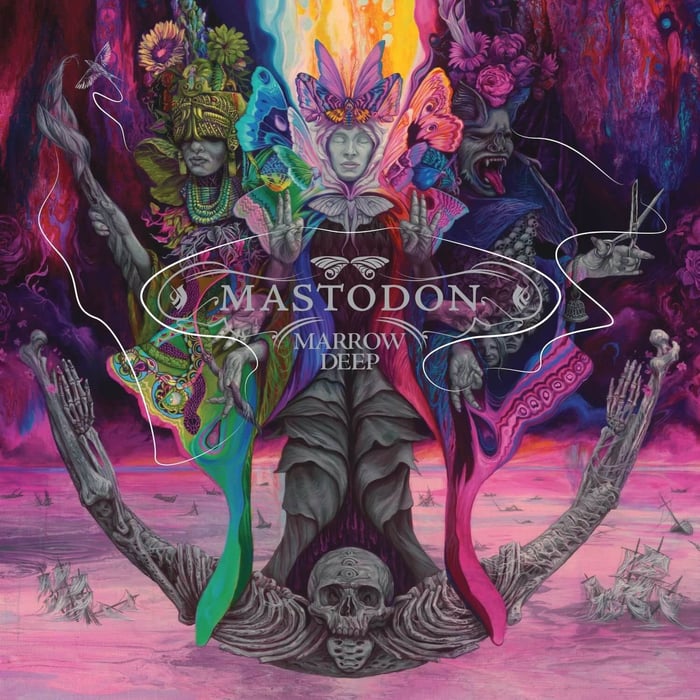
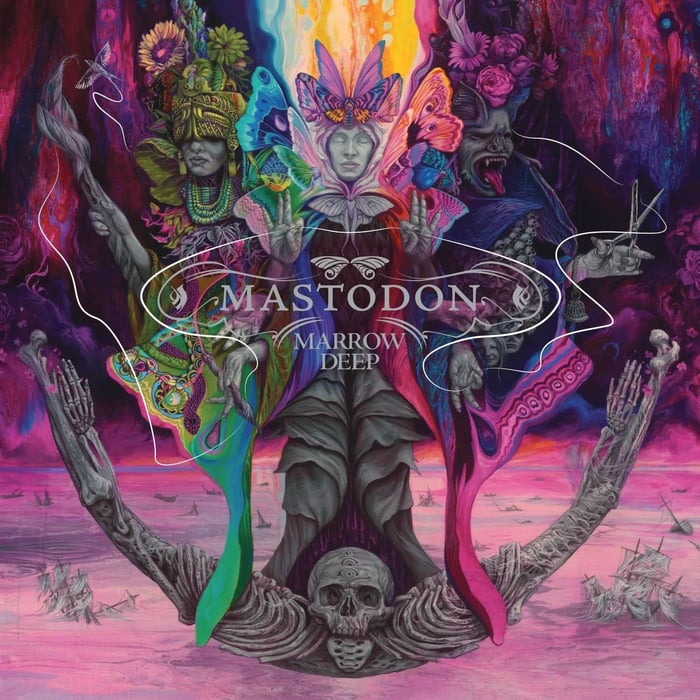
Artwork
Release info
Marrow Deep is out on August 28 via Loma Vista Recordings.
If you want the official social rabbit hole: https://www.facebook.com/Mastodon
I land at a 9/10 for how effectively this album pulls off its real mission: survive the story around it without being consumed by it.
Conclusion
Marrow Deep sounds like Mastodon refusing to let grief become their genre. It’s heavy, sure—but the real weight is in the choices: letting keyboards rewire the mood, letting new guitar chemistry clash on purpose, and letting exhaustion show without polishing it into something inspirational.
Our verdict: People who like their progressive metal messy, emotional, and slightly feral will actually love Marrow Deep—especially longtime listeners who wanted the band to take a risk again. People who only want the “classic” Mastodon silhouette, perfectly preserved and politely repeated, are going to hear these new textures and react like someone rearranged their furniture.
FAQ
- Is Marrow Deep still “heavy” Mastodon?
Yes—tracks like “Golden Spires” keep the riffs monstrous, even when other songs drift into calmer or stranger spaces. - Do the keyboards change the band’s identity?
They change the feel more than the identity. The keys don’t sit on top; they alter the atmosphere and pacing. - What track best shows the new direction?
“In The Ruins” is the clearest pivot: familiar drumming, but a more psychedelic post-rock lean and a drained, exhausted emotional tone. - Will older fans who fell off reconnect with this?
Probably, if what they missed was urgency and unpredictability. If they only want the old blueprint, they might resist it. - Is this album mainly about loss?
Loss is everywhere—“Snakes For Dinner,” “Your Ghost Again,” and “In The Ruins” especially—but the record doesn’t just mourn. It pushes forward in a way that feels deliberate.
If you’re the type who bonds with album art as much as riffs, consider grabbing a favorite album cover poster for your wall at https://www.architeg-prints.com. It fits the whole “live with the music” thing without you having to explain it to anyone.
 | DISCOUNTGET 30% OFF*Use code on your next order:
|
* This post may contain affiliate links, meaning we earn a commission if you make a purchase through these links, at no additional cost to you.