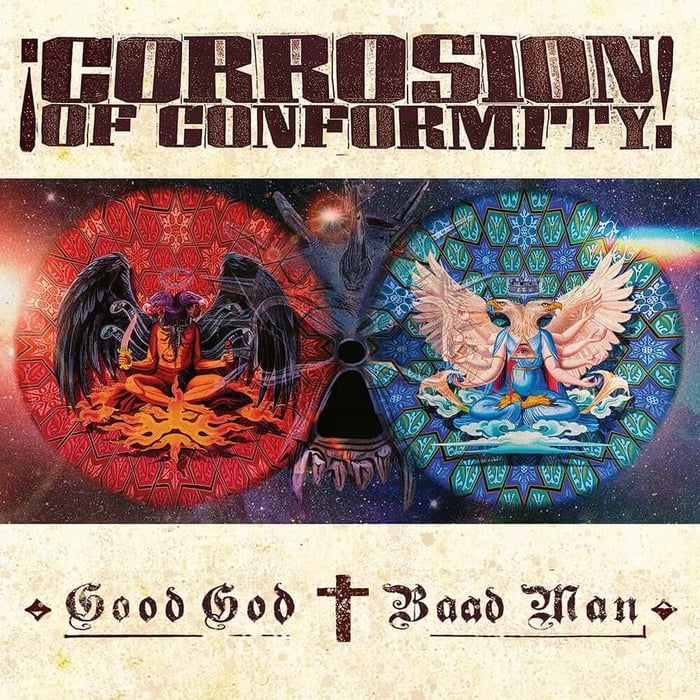
Good God/Baad Man Review: COC’s “Double Album” That Cheats Time


 See more Architeg Prints stories on Google.
Good God/Baad Man Review: COC’s “Double Album” That Cheats Time
Good God/Baad Man is Corrosion of Conformity splitting into two moods—holy haze and bar-fight funk—without padding the runtime or pretending it’s subtle.
The Setup: This Band Doesn’t Do Calm, Even When It Tries
Corrosion of Conformity has always felt like a band built out of collisions—personal, musical, and otherwise. You can hear it in how they lurch from swagger to doom to psych fog like they’re changing lanes without signaling. After decades of lineup churn and real-life loss—including the death of founding drummer Reed Mullin in 2020, and the later exit of longtime bassist Mike Dean—this could’ve easily been the point where the story turns into a long, sad fade-out.
Instead, Good God/Baad Man shows the opposite instinct: when things get unstable, they don’t simplify. They multiply. A double album is a mildly unhinged move in 2026, and that’s kind of the point—this band still wants to take up space.
How It Was Built: A Riff Partnership Dragging the Whole Thing Forward
This record sounds like it was primarily pulled into shape by Pepper Keenan and Woody Weatherman—the kind of writing duo that doesn’t “collaborate” so much as argue in riffs until the best one wins. The playing has that familiar COC confidence: not flashy, not apologetic, just locked into what the groove is supposed to do to your spine.
They bring in a serious rhythm engine here too: Bobby Landgraf and Stanton Moore. You can feel the difference in the way the drums land—more immediate, more placed in the mix, like somebody decided the kick drum should hit you in the chest instead of merely existing.
And yeah, the whole thing being tracked at Barry Gibb’s mansion/studio is the sort of detail that sounds fake even when it’s true. But it tracks: this album carries itself like it was recorded in a place where you can get away with ridiculous decisions.
Video: The Album Shows Its Teeth Early
The Double-Album Trick: It’s Long, But It Doesn’t Act Long
In the current attention economy, a double album can feel like homework. I went in expecting bloat—because that’s what most “two sides of the band” projects become: one good record and one dumping ground.
But Good God/Baad Man stays just over an hour, and that changes everything. It’s not a sprawling endurance test; it’s more like two distinct rooms in the same house. You walk through one door, the lights are low and the air smells like incense. You walk through the other, the floor’s sticky and somebody’s laughing too loud.
And that split is real. Good God leans spiritual—wide, searching, slightly cosmic. Baad Man is the physical half—raw, horny, funny in a dangerous way. If you don’t buy that concept, fine, but you can hear them committing to it in the pacing and the tone choices.
Good God Side: Psychedelic Questions, Stoner-Metal Certainty
The opener, “Good God? / Final Dawn,” sets the Good God mood immediately: sprawling, psychedelic, and heavy in that “slowly rotating machinery” way. The guitars are smeared with effects, and the lyrics sound like they’re staring straight at the ceiling fan at 3 a.m. and trying to figure out whether God is in the room or just the echo.
It’s also the first moment where the album tells you what it’s actually doing: it’s not chasing novelty, it’s chasing scale. This side wants to feel like a long hallway. It’s existential without being delicate—more “questioning” than “confessional.”
And yes, the Sabbath worship is everywhere—COC has never hidden that—but it gets almost cheeky on “You Or Me.” That main riff is so close to “Wheels of Confusion” that it stops being influence and starts being a raised eyebrow. Pepper’s vocals even drift into Ozzy-ish territory enough that I caught myself thinking, is he doing a bit? I’m not completely sure. It might be intentional homage, or it might just be the natural result of living inside these riffs for decades. Either way, it works because they don’t treat it like a museum piece—they treat it like a living, stomping thing.
When They Get Mad: “Gimme Some Moore” Is Not Subtle—and That’s the Point
“Gimme Some Moore” is the most pissed off they’ve sounded in a while. It’s basically a bar-room brawl turned into a groove: leather, chains, spikes, and the kind of swagger that makes you check your own posture.
It’s also one of those tracks where the band sounds like they’re grinning while throwing the punch. The backing “yeah yeah yeahs” from Al Jourgensen add that extra smear of grime, like somebody dragged the mic stand through an alley before the take.
If I’m nitpicking, the aggression is so on-the-nose that it flirts with cartoonish—but that’s also why it’s satisfying. Not everything needs to be literary. Sometimes you want the riff to be the plot.
The Instrumental Pivot: A Desert Mirage in “Bedouin’s Hand”
Then the album does something smart: it breathes.
“Bedouin’s Hand” is an instrumental interlude driven by Eastern-leaning melodies and tumbling percussion. It paints a specific scene—dust, sun, wide-open space—without trying to over-explain itself. It’s a palate cleanser, sure, but it’s also a tone-setter: Good God isn’t only about heaviness; it’s about travel.
That interlude slides neatly into “Run For Your Life,” the closer for the Good God half. This is where the Zeppelin-esque DNA shows up: a languid escape tale with a sense of movement, like the song is walking rather than sprinting. The lead playing from Pepper and Woody is the real luxury here—melodic, patient, and confident enough to leave air around the notes.
Production Choices: Direct Drums, Sneaky Flavor
The production feels like it was engineered for punch. Warren Riker’s background outside metal shows up in the directness—especially the drums, which hit with a clarity that doesn’t sand off the grit.
But it’s not sterile. There are samples and little sonic add-ons scattered through the record, and they never feel like “modernization.” They feel like someone seasoning the stew. You can argue some of those bells and whistles are unnecessary, and maybe they are, but the album’s whole attitude is excess-with-purpose, so I’ll allow it.
Baad Man Side: A Funky Threat With a Dirty Smile
Then Baad Man opens, and the vibe shifts like a switchblade clicking.
The title track comes in with a sample of Jamaican dancehall artist Ninjaman calling himself a “reeeeaaal bad man,” and then—bang—an irresistibly funky groove takes over. This is the sound of a band deciding that heaviness isn’t only doom and sludge. Sometimes heaviness is just the rhythm section strutting like it owns the block.
On first listen, I thought this side might be the “looser” half—fun, but less substantial. On second listen, I had to eat that thought. The looseness is the structure. It’s controlled chaos, and the band sounds revitalized, like they’re playing for the sheer joy of making the room move.
The Real Highlight: “Asleep On The Killing Floor” Hits Like a Dare
“Asleep On The Killing Floor” is where Baad Man shows its teeth properly. Frenetic pacing, bubbling bass lines, snarling attitude—it’s everything you want from a Corrosion of Conformity track when you want them to sound hungry.
This is also the point where the album’s “two sides” concept stops being conceptual and becomes practical: Good God floats; Baad Man swings. And swing, frankly, is harder to fake.
A Detour Into the Seedy Part of Town
From there, the record takes a deliberate walk into grime with “Handcuff County” and “Swallowing The Anchor.” These songs aren’t trying to be nice about anything. They’re not even trying to be cool—they’re trying to be sleazy in a way that’s almost theatrical.
On “Handcuff County,” Pepper channels Billy Gibbons in both guitar tone and vocal posture—bluesy shuffle, braggadocious lyrics, that ZZ Top-style grin that shows too many teeth.
“Swallowing The Anchor” stays in that lane and makes its intentions painfully clear right away with the opening line:
“She had the t*ts of a witch and the soul of liar. She was a neighborhood trick girl, she’ll set your soul on fire.”
That line is either going to make you laugh, wince, or roll your eyes. Personally, I did a little of all three. It’s an example of the album’s biggest gamble: sometimes the band’s carnal side reads as knowingly trashy, and sometimes it just reads as trashy. The difference depends on your tolerance for blues-rock filth.
The Come-Down: “Brickman” as a Campfire Drug Ballad
After the party comes the crash, and “Brickman” plays that role as an acoustic drug-ballad. It sounds like it was written late at night, somewhere remote—campfire energy, desert air, the kind of tune you play when the jokes have stopped and the consequences are starting to arrive.
I’ll admit this is the moment that briefly lost me. Not because it’s bad, but because the album has been so physical and full-bodied that going quiet risks feeling like a dip in momentum. But it earns its place by setting up the ending. It’s the exhale before the final push.
The Final Statement: “Forever Amplified” Refuses to Be Small
The closer, “Forever Amplified,” is a tribute to fallen members of the band, and it’s built like a monument. A dramatic intro, then a pile-driving riff that doesn’t let up for five minutes. Everyone locks into the pocket like they’re trying to keep the lights on through sheer force of will.
For the last refrains, gospel singer Anjelika “Jelly” Joseph joins in, and her voice changes the temperature of the whole ending. It’s one of those moments where the hair on your neck actually reacts—because the album has been dealing in grit and swagger, and suddenly there’s this huge, human lift of soul on top of it. It doesn’t sentimentalize the record; it sharpens it.
The Aftertaste: A Band That Might Vanish Again, So They Over-Delivered
Given COC’s history, it wouldn’t shock me if it takes years before there’s another record. Good God/Baad Man seems aware of that, and it plays like a band making sure the cupboard stays full for a while. There’s enough here—twists, detours, big riffs, dumb-fun moments, and a genuinely moving closer—to keep the fans fed without making newcomers feel like they need a map.
And the funniest part? For a “double album,” it’s weirdly disciplined.
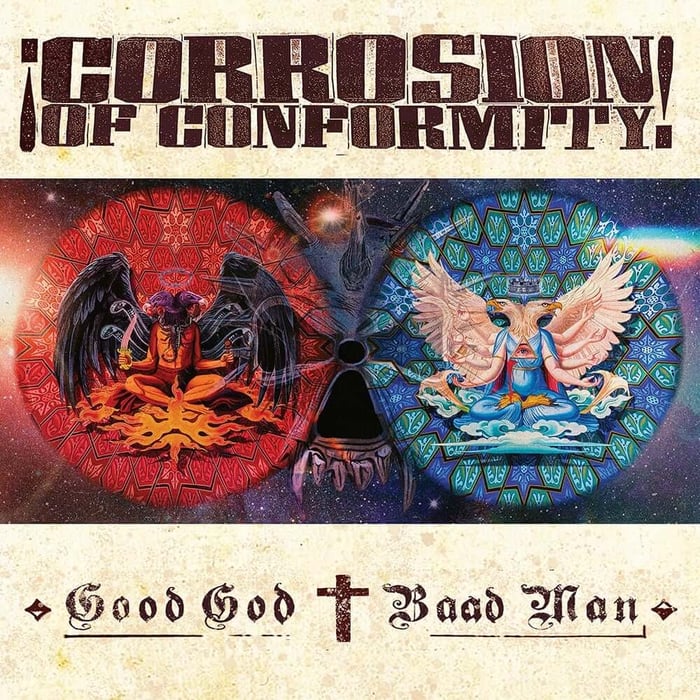
Good God / Baad Man is out now via Nuclear Blast.
Corrosion of Conformity have an official Facebook page if you want the straightforward, non-mystical updates.
Conclusion
Good God/Baad Man isn’t trying to reinvent Corrosion of Conformity—it’s trying to prove they can still split themselves in half and come back stronger, louder, and weirder than the math suggests.
Our verdict: People who like their sludge with groove, their doom with swagger, and their “serious” music willing to get a little filthy will actually love Good God/Baad Man. If you demand subtle lyrics, restraint, or a band that acts its age, this record is going to feel like a leather jacket left in the sun—still wearable, but absolutely not polite.
FAQ
- Is Good God/Baad Man really manageable in one sitting?
Yeah. It runs a bit over an hour, so it feels more like a long album with two moods than an endless double. - What’s the difference between Good God and Baad Man?
Good God leans more spiritual and psychedelic; Baad Man is rawer, funkier, and more carnal in attitude. - Which track best represents the “pissed off” side of the album?
“Gimme Some Moore” comes in swinging—pure bar-fight energy with extra grit in the backing vocals. - Where does the Sabbath influence show up most obviously?
“You Or Me” wears it loud, especially in the main riff and the Ozzy-leaning vocal vibe. - What’s the closing track trying to do emotionally?
“Forever Amplified” turns into a tribute—big riff, bigger feeling—especially once Anjelika “Jelly” Joseph comes in near the end.
If this album put a particular image in your head—desert campfires, sticky club floors, or that cover staring at you—printing your favorite album art as a poster isn’t a bad way to keep the mood around. If you want, you can shop prints at our store: https://www.architeg-prints.com/
 | DISCOUNTGET 30% OFF*Use code on your next order:
|
* This post may contain affiliate links, meaning we earn a commission if you make a purchase through these links, at no additional cost to you.